
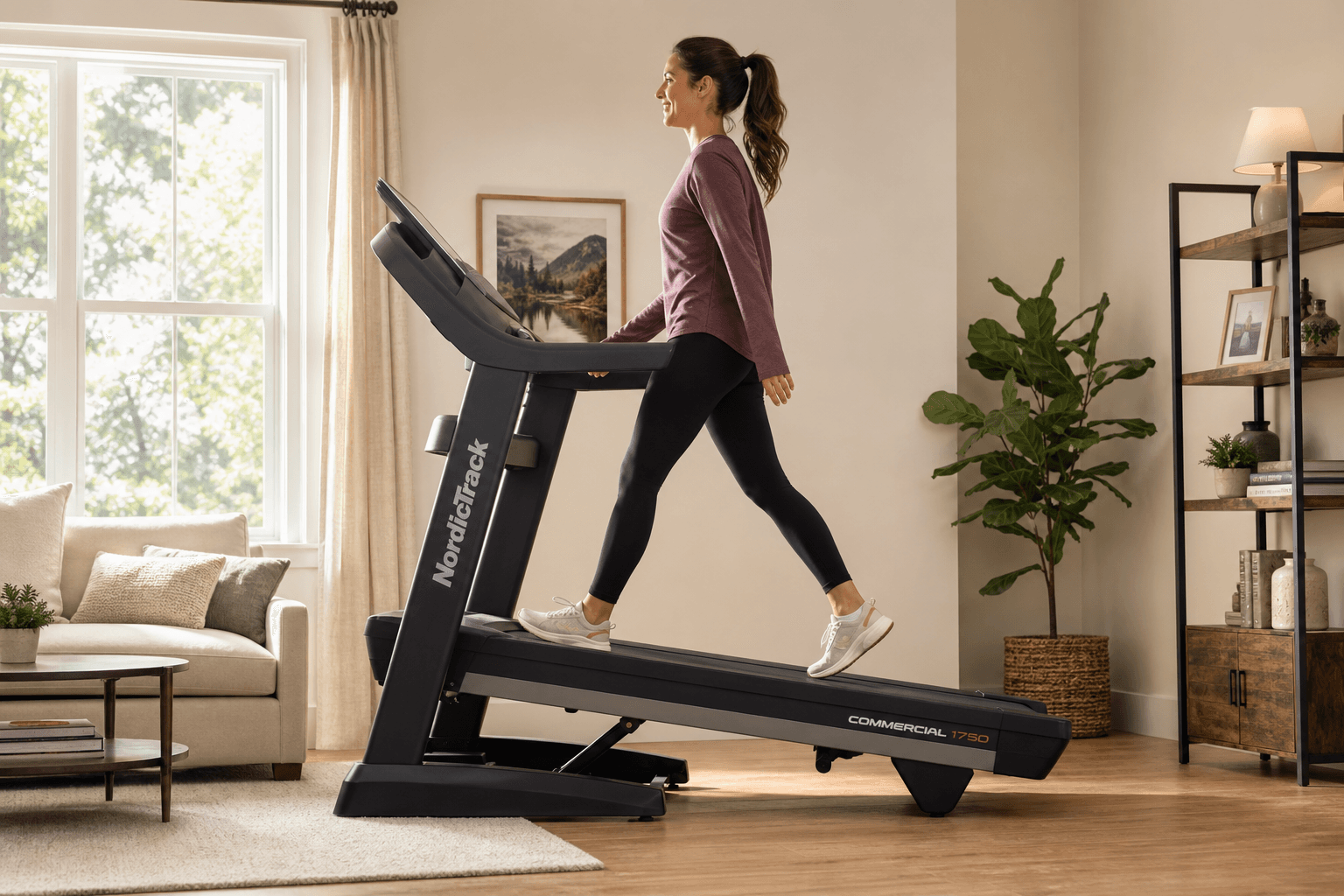
The Walking Pad Boom and Its Hidden Risks
Walking pads — those slim, under-desk treadmills that promise walking while you work — have exploded in popularity. Their appeal is obvious: prices between $200 and $400, a footprint small enough to slide under a couch, and the promise of sneaking in steps during a Zoom call. For budget-conscious shoppers and apartment dwellers, they look like the perfect entry point into home walking.
But there is a problem the marketing does not show you. Independent lab testing by Consumer Reports in 2026 uncovered serious safety and durability failures in walking pads — belt tears during short-duration tests, safety mechanisms that create fall risks, and widespread evidence of fake reviews inflating product ratings. The same testing found that full-size entry-level treadmills, like the Horizon T101 at $649, routinely pass far more rigorous evaluations without these failures.
This article lays out exactly what the lab data shows, compares the real costs over five years, and helps you decide which machine belongs in your home — based on evidence, not marketing claims.
What Consumer Reports Found: Lab-Tested Failures in Walking Pads
Consumer Reports put several under-desk treadmills through a standardized durability test using a robot that walked on each machine for 12 hours. The results were alarming enough that the organization concluded most under-desk treadmills are "probably not worth the risk." Here is what the testing revealed:
- Belt failure in 12 hours: The belt on one walking pad tore completely during the 12-hour robot test. Consumer Reports notes this is a durability event "rarely seen" in their standard 25-hour tests on full-size treadmills. A machine that fails in half the time of a full-size treadmill's test is not built for daily use.
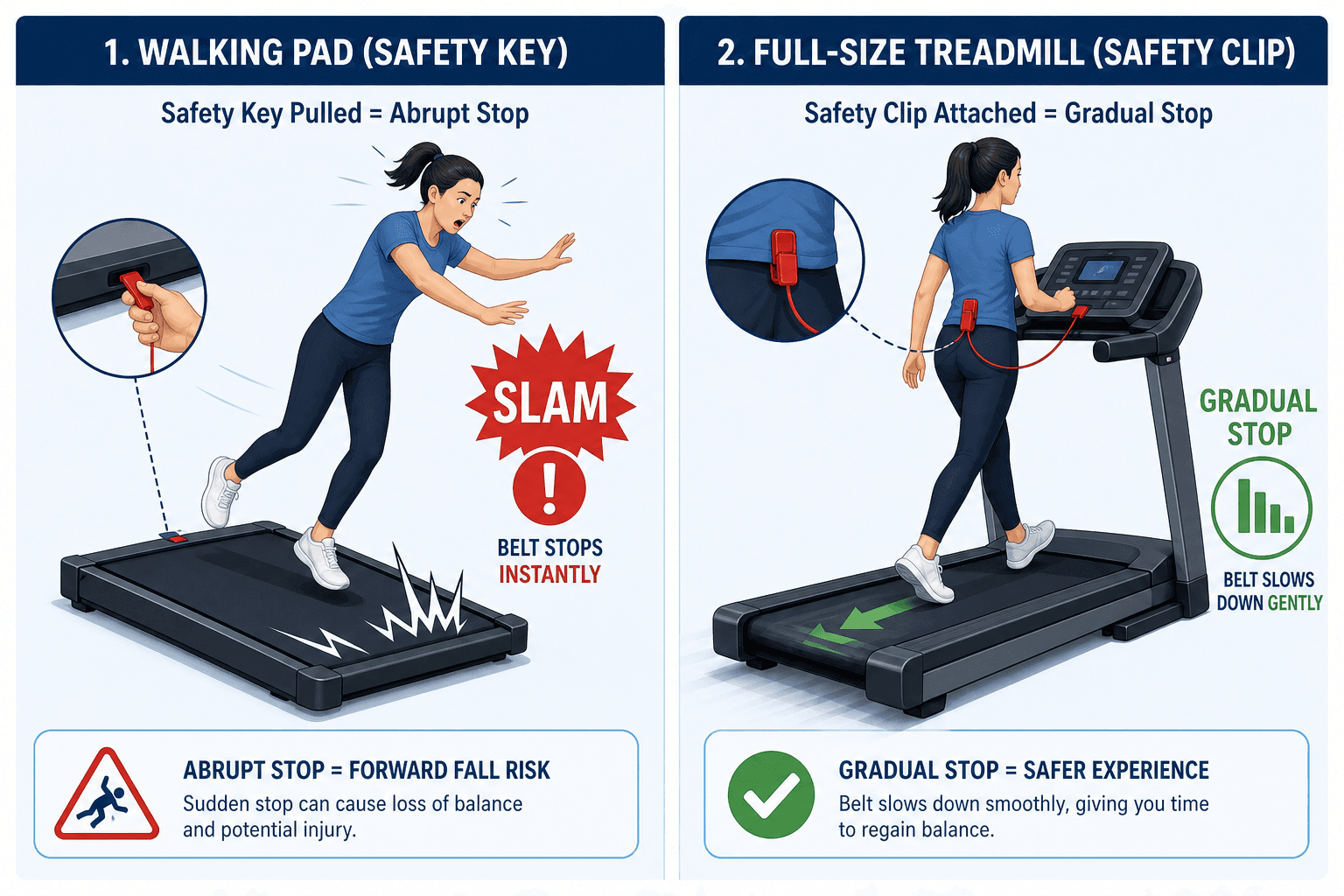
- Safety key creates a fall risk: Pulling the safety key on most walking pads caused the belt to "slam to a sudden stop, creating a fall risk." On a full-size treadmill, the safety clip triggers a gradual deceleration — you slow down naturally before stopping. On a walking pad, the belt locks up instantly, which can send a walker stumbling forward.
- Inaccurate advertised speeds: One tested product claimed a minimum speed of 0.5 mph but actually ran at 1.1 mph. For someone who wants a very slow walking pace for desk work, that difference matters — and it signals poor quality control.
- Fake review epidemic: Fakespot, a service that analyzes review authenticity, estimated that Amazon altered or removed more than 9,000 reviews for a single walking pad product tested by Consumer Reports. This suggests the high ratings you see online may not reflect real-world experiences.
- Re-listed after injury reports: Consumer Reports documented that an Amazon listing for a walking pad was removed after a user reported a head injury caused by the machine suddenly stopping — but the same treadmill later reappeared under a different listing.
Walking Pad Pros: What They Do Well
To be fair, walking pads are not without legitimate advantages. For a narrow set of use cases, they solve real problems:
- Price: Most walking pads cost between $200 and $400, which is significantly less than even the most affordable full-size treadmills.
- Compact storage: Many models are thin enough to slide under a bed or stand against a wall in a closet. If you have zero dedicated floor space, a walking pad can disappear when not in use.
- Under-desk usability: The primary selling point — you can walk while working at a standing desk. A full-size treadmill is too tall and bulky for this setup.
These advantages are real, but they come with trade-offs that the next section makes clear.
Walking Pad Cons: Where the Risks Outweigh the Savings
The drawbacks of walking pads go beyond the lab failures. Even if you get a unit that does not tear its belt or slam to a stop, the design limitations make it a poor choice for anyone who plans to walk regularly:
- Low weight capacity: Consumer Reports found that many tested models had a maximum weight capacity of just 220 lbs. Industry experts note that walking pads often have weak motors that "stutter" under heavier loads. If you weigh over 220 lbs — or plan to share the machine with someone who does — a walking pad is not a viable option.
- No incline: This is the single biggest performance limitation. Walking on a flat surface burns roughly 50% fewer calories than walking at a 10% incline, according to expert testing. Most walking pads have no incline adjustment at all. You are leaving half the potential calorie burn on the table.
- Flimsy handrails: The handrails on walking pads are typically short and lightweight — they are not designed to support your weight if you lose balance. On a full-size treadmill, the handlebars are sturdy enough to provide real stability.
- Short warranties: Most walking pads come with 90-day to 1-year warranties on parts and labor. A full-size treadmill from a reputable brand typically includes 2–5 years on parts and a lifetime warranty on the frame and motor.
- Safety key sudden-stop mechanism: As Consumer Reports documented, the safety key on most walking pads causes an abrupt stop rather than a gradual slowdown. This is not a minor inconvenience — it is a genuine fall hazard, especially if you are walking at a faster pace or carrying something.
Full-Size Treadmill Pros for Walkers: Why the Investment Pays Off
An entry-level full-size treadmill like the Horizon T101 addresses every failure point found in walking pads. Here is how the features specifically benefit walkers:
- Incline capability: The Horizon T101 offers 0–10% incline. Walking at a 10% incline burns roughly 50% more calories than walking flat, according to expert data. You get more results from the same time investment.
- Higher weight capacity: The T101 supports up to 300 lbs. The Sole F63, another strong entry-level option at $1,199, supports up to 325 lbs. Both comfortably accommodate users who exceed the 220 lb limit common on walking pads.
- Gradual safety stop: Full-size treadmills use a safety clip that slows the belt gradually when pulled. You decelerate naturally rather than being thrown forward by a sudden stop. This is a fundamental safety advantage.
- Wider, longer belt: The Horizon T101 has a 20" x 55" walking surface. A walking pad typically offers a belt that is 16–17" wide and 40–45" long. The extra space makes walking feel natural and comfortable — you are not constantly adjusting your stride to stay on the belt.
- Lifetime warranty: The Horizon T101 includes a lifetime warranty on the frame and motor. If the motor fails in year 8, it is covered. A walking pad that fails after 18 months is a total loss.
For walkers who are concerned about space, many full-size treadmills fold. The Horizon T101 has a folding design that reduces its footprint when not in use. Our Folding Treadmill Buyer's Decision Framework explains the different folding mechanisms and their trade-offs for apartment living.
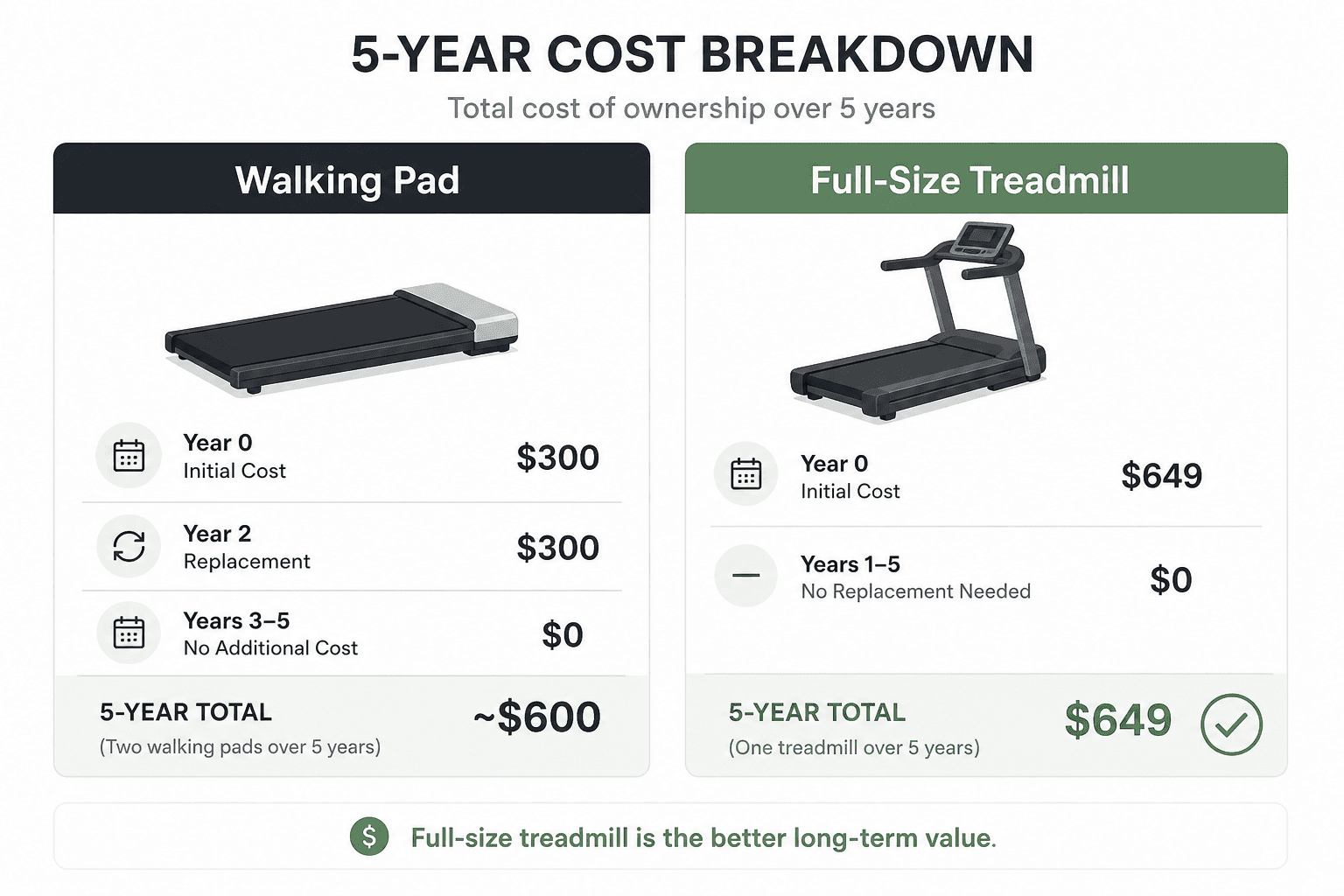
Cost Comparison: $649 Horizon T101 vs. $300 Walking Pad Over 5 Years
The upfront price difference is stark — a $300 walking pad costs less than half of a $649 full-size treadmill. But the total cost of ownership over five years tells a different story.
| Cost Factor | Walking Pad ($300) | Horizon T101 ($649) |
|---|---|---|
| Initial purchase | $300 | $649 |
| Expected lifespan | 1–2 years (belt/motor failure) | 10+ years (lifetime frame/motor warranty) |
| Replacement cost (years 1–5) | $300–$600 (1–2 replacements) | $0 |
| Total cost over 5 years | $600–$900 | $649 |
| Cost per year (5-year average) | $120–$180 | $130 |
The math flips when you factor in durability. Consumer Reports' finding that a walking pad belt tore in 12 hours — a test full-size treadmills routinely pass for 25+ hours — suggests that many walking pads will not survive daily use for more than 12–18 months. If you replace a $300 walking pad twice in five years, you have spent $900 — more than the Horizon T101, which is still running under its lifetime warranty.
For a deeper breakdown of long-term costs, including electricity, maintenance, and resale value, see our Walking Pad vs. Full-Size Treadmill: A 3-Year Durability and Total Cost of Ownership Comparison.
Verdict: Who Should Buy Which?
The evidence from Consumer Reports lab testing, expert durability data, and cost analysis points to a clear conclusion for most walkers: a full-size entry-level treadmill is the safer, more durable, and more cost-effective choice.
Buy a full-size treadmill (like the Horizon T101) if:
- You plan to walk daily or several times per week.
- You weigh over 220 lbs or want a machine that can accommodate multiple household members.
- You want incline capability to maximize calorie burn and build lower-body strength.
- Safety is a priority — you want a gradual stop mechanism, sturdy handrails, and a stable platform.
- You want a machine that will last 10+ years with a warranty that backs it up.
Consider a walking pad only if:
- You absolutely need under-desk walking capability for use during work hours.
- You weigh under 220 lbs and will use the machine lightly (20–30 minutes, a few times per week).
- You accept the safety trade-offs — the sudden-stop mechanism, the short warranty, and the risk of belt or motor failure.
- You are comfortable with the possibility of replacing the unit within 1–2 years.
If you decide a full-size treadmill is right for you, our Best Home Treadmill for Walking: A Buyer's Guide for Walkers (Not Runners) covers the top models, including the Horizon T101 and Sole F63, with detailed specs and recommendations for different budgets and spaces.
Decision Matrix: Walking Pad vs. Full-Size Treadmill at a Glance
Use this quick-reference table to compare the key decision factors side by side:
| Factor | Walking Pad | Full-Size Treadmill (Horizon T101) |
|---|---|---|
| Price | $200–$400 | $649 |
| Weight capacity | Often 220 lbs | 300 lbs |
| Incline | None (flat only) | 0–10% |
| Safety key behavior | Sudden stop (fall risk) | Gradual deceleration |
| Warranty (frame/motor) | 90 days – 1 year | Lifetime |
| Durability (lab test) | Belt tore in 12 hours (CR test) | Passes 25-hour test routinely |
| Calorie burn (vs. flat) | Baseline | Up to 50% more at 10% incline |
| Best use case | Light, occasional under-desk walking | Daily walking fitness for all levels |
For readers who are still weighing their options, our How to Choose a Treadmill for Home Use: A Decision Framework for Walkers, Joggers, and Runners provides a broader framework that considers your long-term fitness goals, not just the immediate purchase decision.
Comments
Join the discussion with an anonymous comment.