
Why Walking on a Treadmill Is Different from Running
If you have spent any time shopping for a home treadmill, you have likely noticed a pattern: nearly every buying guide is written with runners in mind. The recommendations emphasize 3.5+ CHP motors, 60-inch decks, and top speeds of 12 MPH — specs that matter when you are pounding the belt at an 8-minute-mile pace but are overkill for walking.
Walkers occupy a different performance envelope. Your foot strike is gentler, your stride is shorter, and your peak speed rarely exceeds 4.5 MPH. That means you can safely use a shorter deck, a less powerful motor, and a machine that costs hundreds of dollars less — provided you prioritize the one spec that runners often take for granted: incline.
This guide reframes the buying criteria for walkers. Instead of asking "Is this treadmill fast enough for running?" we ask "Does this treadmill give me the deck length, motor power, and incline range I need for an effective walking workout?" The answers are different — and they will save you money, floor space, and frustration.
The Three Key Buying Criteria for Walkers
When you strip away the runner-centric noise, three specs determine whether a treadmill is a good fit for walking: deck length, motor power, and incline range. Here is how each one changes when walking is your primary activity.
Deck Length: 55 Inches Is Enough for Most Walkers
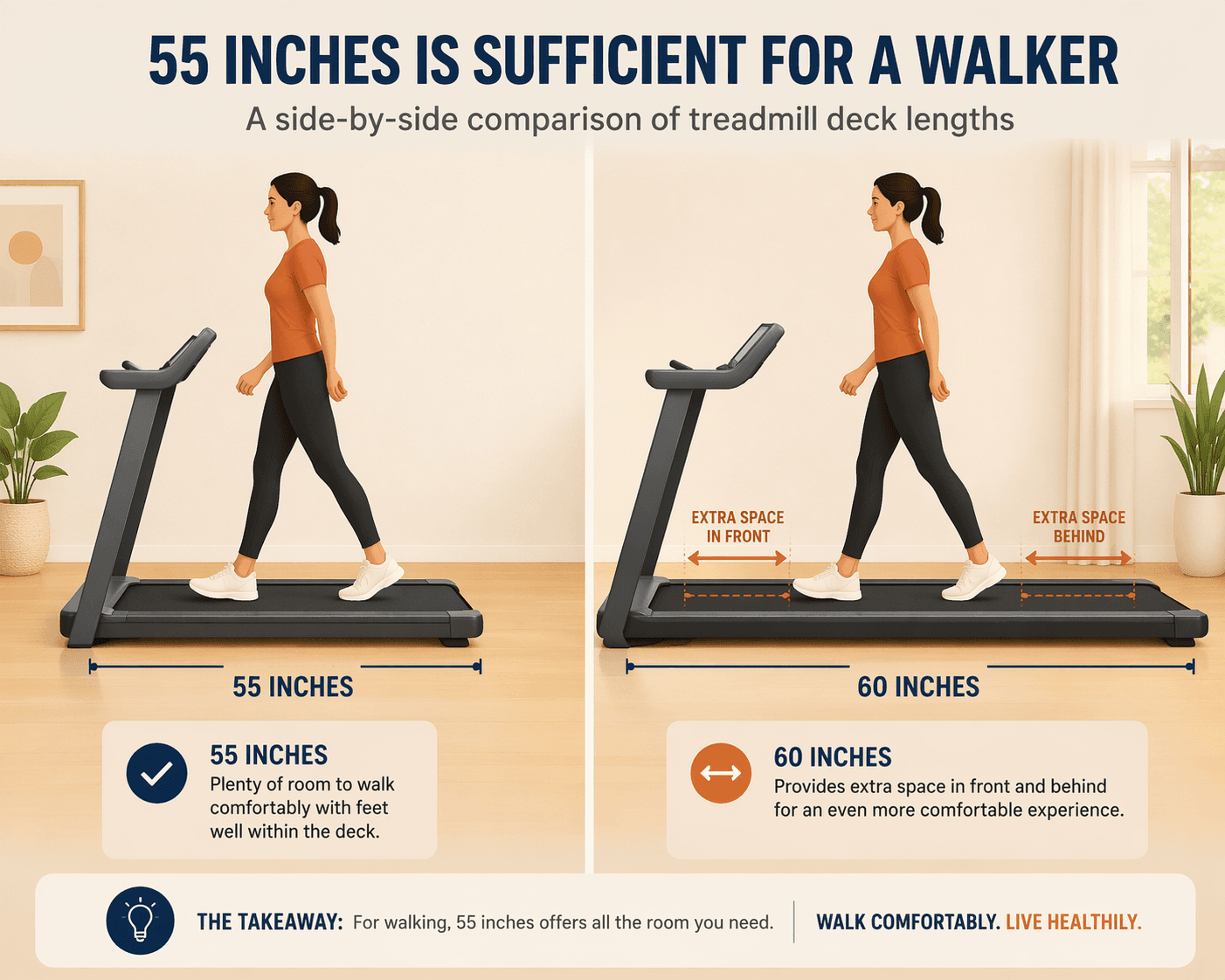
Runner-focused guides insist on a 60-inch deck. The logic is sound for running: a longer stride needs more belt to avoid stepping on the rear roller. But walkers take shorter strides. A 55-inch deck is sufficient for walkers up to about 6 feet tall, and even a 50-inch deck can work for shorter individuals or those who walk at a moderate pace.
The practical implication is significant. Treadmills with 55-inch decks are generally less expensive, lighter, and more compact than their 60-inch counterparts. They also fold more easily and fit into smaller rooms. If you are under 6 feet and plan to walk — not run — a 55-inch deck is not a compromise; it is the appropriate spec.
Motor Power: 2.5–3.0 CHP Is the Sweet Spot
Continuous horsepower (CHP) ratings are the most misunderstood spec in treadmill marketing. A 2.5 CHP motor is perfectly adequate for walking and light jogging. It maintains consistent belt speed at walking paces without straining, and it generates less noise and heat than a larger motor running at partial capacity.
The jump to 3.0 CHP provides a comfortable margin for heavier users (over 250 lbs) or for those who occasionally want to jog. Anything above 3.0 CHP is unnecessary for walking and adds cost without benefit. The Horizon T101, for example, uses a 2.5 CHP motor and is explicitly tested as sufficient for walking at its 10 MPH top speed — a speed you will never reach if you are walking.
Incline: The Most Important Feature for Walkers
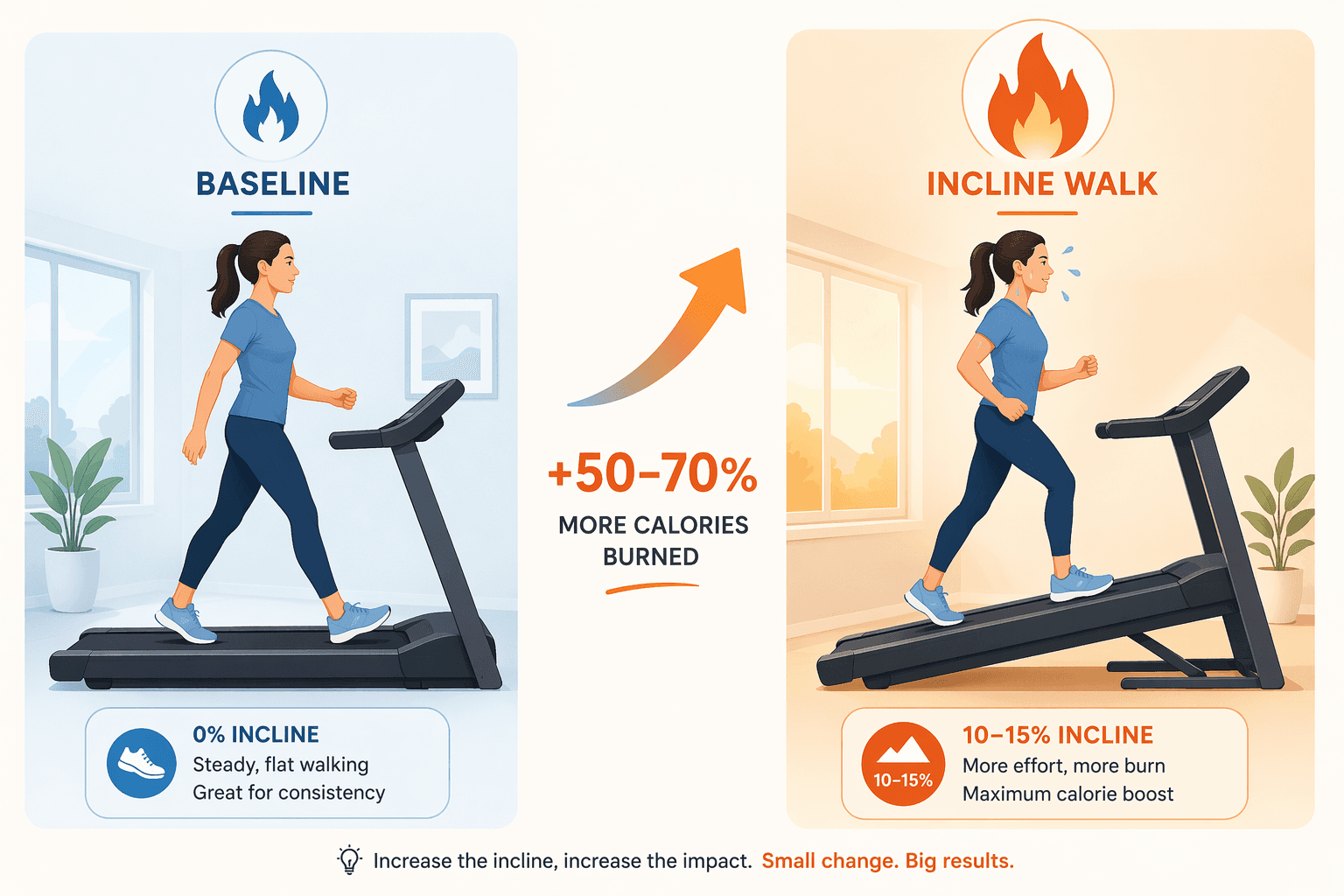
This is the spec that separates a good walking treadmill from a great one. Walking on a flat surface is low-intensity exercise. Walking at a 10–15% incline transforms the workout, elevating heart rate and engaging the glutes, hamstrings, and calves far more than flat walking ever could.
Research supports this. A study published in the April 2021 edition of Sports found that altering incline by even 7% has a significant effect on heart rate and cardio output. Another study in PLOS One (Padulo et al., 2013) showed that running on a 7% incline increased heart rate by 15% compared to flat running — a gap that is even more pronounced at walking speeds, where the relative effort increase is larger.
For walkers, a 10–15% incline range is the single most impactful feature. It allows you to burn 50–70% more calories than walking flat, closing the calorie gap with running without the joint impact. If you are choosing between a treadmill with a 10% max incline and one with 15%, spend the extra money on the steeper model.
Walking Pad vs. Full-Size Treadmill: Which Is Right for You?
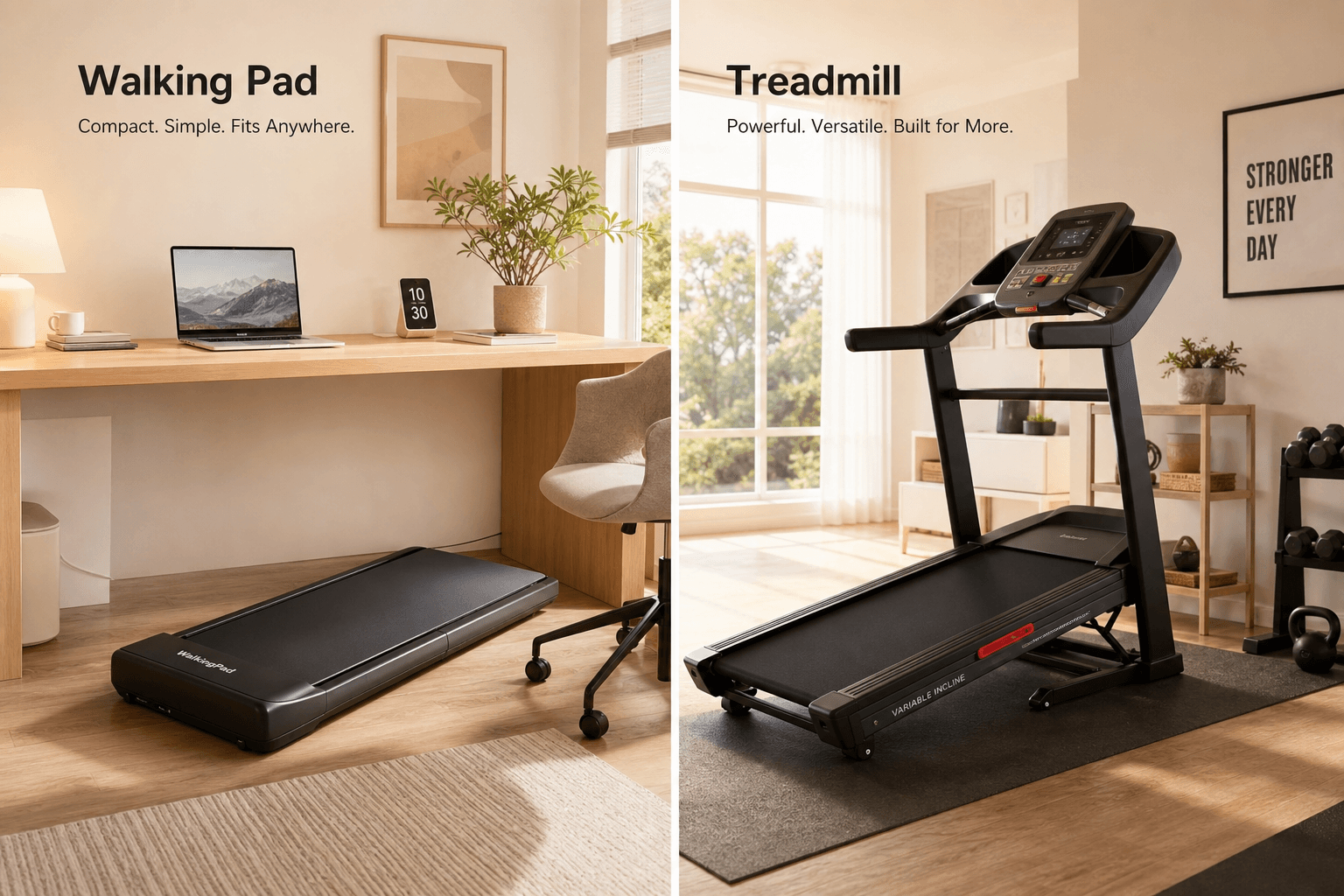
The rise of walking pads has created a genuine fork in the buying decision. A walking pad is a slim, often foldable treadmill designed exclusively for walking — no handrails, no console, no incline (or a fixed low incline), and a top speed around 3–4 MPH. A full-size treadmill offers handrails, a console with programming, adjustable incline, and speeds up to 12 MPH.
Each form factor suits a different walking style. The table below maps the tradeoffs across the dimensions that matter most to walkers.
| Dimension | Walking Pad | Full-Size Treadmill |
|---|---|---|
| Floor footprint | Very small (fits under a desk, leans against a wall) | Large (typically 70–80 inches long, 30+ inches wide) |
| Top speed | 3–4 MPH (walking only) | 8–12 MPH (walking plus future jogging option) |
| Incline range | None or fixed 5% max | 0–15% adjustable (critical for intensity) |
| Stability at walking pace | Adequate for slow walking; can feel narrow at faster paces | Solid and stable at all walking speeds |
| Handrails | None (balance全靠 user core stability) | Full handrails for safety and balance support |
| Typical price | $300–$600 | $600–$1,800 |
| Best for | Step accumulation during work hours, light walking | Intentional walking workouts, incline training, long sessions |
If your goal is to accumulate steps while working from home and you do not need incline, a walking pad like the WellFit TM037 is a space-efficient, cost-effective choice. If your goal is to build cardiovascular fitness through intentional walking workouts — especially incline walking — a full-size treadmill with adjustable incline is the better investment.
Best for Walkers on a Budget: Horizon T101
The Horizon T101 consistently appears on "best budget" lists, but it earns its place here for a specific reason: its specs align almost perfectly with what walkers need, and it avoids the upcharge for runner-oriented features you will not use.
- Motor: 2.5 CHP — sufficient for walking and occasional light jogging
- Deck: 20" x 55" — long enough for walkers under 6 feet
- Incline: 0–10% — good range for intensity progression
- Top speed: 10 MPH — far more than you need, but the motor handles walking speeds effortlessly
- Weight capacity: 300 lbs
- Warranty: Lifetime frame and motor — exceptional for a sub-$700 treadmill
- Price: ~$649
The T101's 55-inch deck is the key differentiator. Runner-focused reviews sometimes mark this as a limitation, but for walkers it is a feature: it reduces the machine's overall length, making it easier to fit into a bedroom or living room corner. The 10% incline is enough to produce meaningful intensity increases, and the lifetime warranty means you are covered for the long haul.
Assembly is straightforward — tested at around 15 minutes — and the machine folds for storage. If you are a walker on a budget, this is the best value on the market.
Best Walking Pad: WellFit TM037
The WellFit TM037 is the walking pad that comes closest to bridging the gap between pure step-accumulation devices and actual walking workouts. It offers a 5% incline — rare in the walking pad category — and a 3.0 CHP motor that is unusually powerful for its class.
- Motor: 3.0 CHP — more than enough for walking; runs quietly
- Deck: 16" x 43.3" — narrow and short; suitable for slow-to-moderate walking only
- Incline: 0–5% — limited but present; better than the fixed-flat walking pads
- Top speed: 6.2 MPH — fast enough for brisk walking
- Machine weight: 45 lbs — genuinely portable; can be moved room to room
- Weight capacity: 320 lbs
- Price: ~$400
The tradeoffs are real. The 43.3-inch deck is short — you will need to stay centered and avoid overstriding. The 5% incline is better than nothing but far below the 10–15% range that unlocks serious cardio benefits. And like all walking pads, there are no handrails, so balance is entirely on your core.
The TM037 is best for walkers who want a portable, under-desk option for step accumulation during the workday, with the option to add a slight incline for a bit more intensity. If your primary goal is dedicated walking workouts with real incline, skip the walking pad category entirely and go with a full-size treadmill.
Best Full-Size Walking Treadmill with Incline: Sole F63
If you are serious about walking as a primary form of exercise, the Sole F63 is the treadmill to beat. It delivers the three things walkers need most — a long enough deck, a reliable motor, and a steep incline — in a package backed by one of the best warranties in the industry.
- Motor: 3.0 CHP — smooth, quiet, and durable for daily walking sessions
- Deck: 20" x 60" — the full 60 inches provides generous stride clearance for walkers of any height
- Incline: 0–15% — the steepest incline in this price range; ideal for high-intensity walking
- Cushioning: Cushion Flex Whisper Deck — reduces joint impact by up to 40% compared to asphalt, tested at approximately 70 dB noise level
- Weight capacity: 325 lbs
- Warranty: Lifetime frame and motor, 3-year deck, 1-year labor
- Price: ~$1,199
The 15% incline is the headline feature for walkers. At a 15% grade, a 3 MPH walking pace produces a cardiovascular demand comparable to light jogging on flat ground, but with far less joint stress. The Cushion Flex Whisper Deck makes long sessions comfortable, and the lifetime warranty means you are buying a machine built to last.
The F63 does not have a touchscreen or streaming integration — it is a straightforward, durable machine focused on the mechanics of walking. If you want a treadmill that will still be running reliably a decade from now, this is the pick.
Best Splurge for Walkers Who Want Streaming: NordicTrack T Series 10
Some walkers want more than a belt and a motor — they want guided workouts, scenic routes, and entertainment to make long walking sessions feel shorter. The NordicTrack T Series 10 delivers that experience with a 10-inch touchscreen and iFit integration, while still offering walking-appropriate specs.
- Motor: 3.0 CHP — reliable for daily walking and occasional jogging
- Deck: 20" x 60" — full-length belt for comfortable stride clearance
- Incline: 0–12% — slightly less than the Sole F63 but still excellent for walking intensity
- Screen: 10-inch touchscreen with iFit — streaming classes, scenic walks, and automatic incline adjustment
- Price range: $999–$1,799 (varies by sales and bundle)
The iFit subscription is the catch. The treadmill's interactive features — auto-adjusting incline, guided walking programs, scenic routes — require an ongoing iFit membership. Without it, the T Series 10 functions as a manual treadmill with a basic console. Factor the subscription cost into your total ownership calculation.
For walkers who struggle with motivation or want the structure of guided programming, the T Series 10 is worth the premium. The 12% incline is sufficient for high-intensity walking, and the 60-inch deck provides room to stretch your stride. Just be prepared for the ongoing subscription cost.
Comparison Table: Top Picks for Walkers
| Model | Price | Motor | Deck | Incline | Warranty | Best For |
|---|---|---|---|---|---|---|
| Horizon T101 | ~$649 | 2.5 CHP | 20" x 55" | 0–10% | Lifetime frame/motor | Budget-conscious walkers under 6 feet |
| WellFit TM037 | ~$400 | 3.0 CHP | 16" x 43.3" | 0–5% | 1 year | Step accumulation, WFH walking, portability |
| Sole F63 | ~$1,199 | 3.0 CHP | 20" x 60" | 0–15% | Lifetime frame/motor | Serious walkers who prioritize incline and durability |
| NordicTrack T Series 10 | $999–$1,799 | 3.0 CHP | 20" x 60" | 0–12% | 10-year frame, 2-year parts | Walkers who want streaming and guided programming |
Frequently Asked Questions
Is a 55-inch deck long enough for walking?
Yes, for walkers under about 6 feet tall. A 55-inch deck provides adequate stride clearance at walking speeds. The Horizon T101's 55-inch deck, for example, is explicitly tested as sufficient for casual runners under 6 feet — walkers have even more margin. If you are over 6 feet or have a long stride, step up to a 60-inch deck like the Sole F63.
Do I need a 3.0 CHP motor for walking?
Not necessarily. A 2.5 CHP motor is sufficient for walking and light jogging. The Horizon T101 uses a 2.5 CHP motor and handles walking paces without strain. A 3.0 CHP motor provides extra margin for heavier users (over 250 lbs) or for those who want the option to jog occasionally. Anything above 3.0 CHP is unnecessary for walking.
How important is incline for walking?
Incline is the single most important feature for walkers. Walking at a 10–15% incline can burn 50–70% more calories than walking flat, and it engages the glutes, hamstrings, and calves far more effectively. A study in Sports (April 2021) confirmed that even a 7% incline has a significant effect on heart rate and cardio output. If you are choosing between two treadmills, prioritize the one with the steeper incline.
Can I use a walking pad for incline walking?
Most walking pads have no incline adjustment. The WellFit TM037 offers a 5% incline, which is better than flat but still far below the 10–15% range that produces meaningful cardio benefits. If incline training is a priority, choose a full-size treadmill with at least 10% incline adjustment.
Is a walking pad safe for daily use?
Walking pads are generally safe for slow-paced walking, but they lack handrails, which means balance is entirely on your core stability. Consumer Reports has flagged safety concerns with some under-desk treadmills, recommending consumers be very wary of these products. If you have balance concerns or plan to walk at faster paces, a full-size treadmill with handrails is the safer choice.
Comments
Join the discussion with an anonymous comment.