
The Walking Pad vs. Treadmill Confusion: Why Buying the Wrong One Costs You Twice
At first glance, a walking pad and a full-size treadmill look like they solve the same problem: you want to walk or run indoors. But that surface-level similarity hides a fundamental split in use cases. A walking pad is a specialized tool for low-speed walking under a desk. A full-size treadmill is a versatile cardio machine built for jogging, running, incline training, and interval work. Choosing the wrong one doesn't just mean you have the wrong equipment — it means you've wasted floor space and, in many cases, hundreds of dollars on a machine that will need replacing sooner than you expect.
Most buying guides compare these two categories on specs alone — motor power, speed range, deck size — and stop there. They miss the dimension that matters most over time: durability and total cost of ownership. A walking pad's lower upfront price looks attractive, but its motor is often not built for sustained daily use. Consumer Reports has flagged poor build quality and safety issues on many walking pads, advising caution. Meanwhile, a mid-range treadmill with a lifetime frame and motor warranty can outlast three walking pads, making it the cheaper option in the long run for anyone who uses their machine regularly.
Walking Pad vs. Full-Size Treadmill: Side-by-Side Spec Comparison
Before we dig into the details, here is a clean, scannable comparison of the key specs that separate these two categories. Use this table as a quick reference as you read through the deep dives below.
| Specification | Walking Pad (Typical Range) | Full-Size Treadmill (Typical Range) |
|---|---|---|
| Motor Power | 0.75 – 1.5 HP (often DC) | 2.5 – 4.0 CHP (DC or AC) |
| Top Speed | 3.75 – 7.6 MPH (walking mode ~3.8 MPH) | 10 – 12 MPH |
| Incline Range | None (flat deck only) | 0 – 15% (some up to 40%) |
| Running Deck Length | 40 – 47 inches | 55 – 60 inches |
| Running Deck Width | 15 – 17 inches | 20 – 22 inches |
| Weight Capacity | 220 lbs | 300 – 400 lbs |
| Footprint (L x W) | ~50" x 20" (varies by model) | ~77" x 35" (industry standard) |
| Folding / Storage | Folds flat; stores under bed or in closet | Folding deck; upright storage; needs ~17 sq ft |
| Assembly Required | None (unfold and use) | 60 – 90 minutes |
| Price Range | $300 – $600 | $700 – $4,000+ |
| Warranty (Frame/Motor) | 90 days – 1 year (often limited) | Lifetime frame/motor (mid-range and above) |
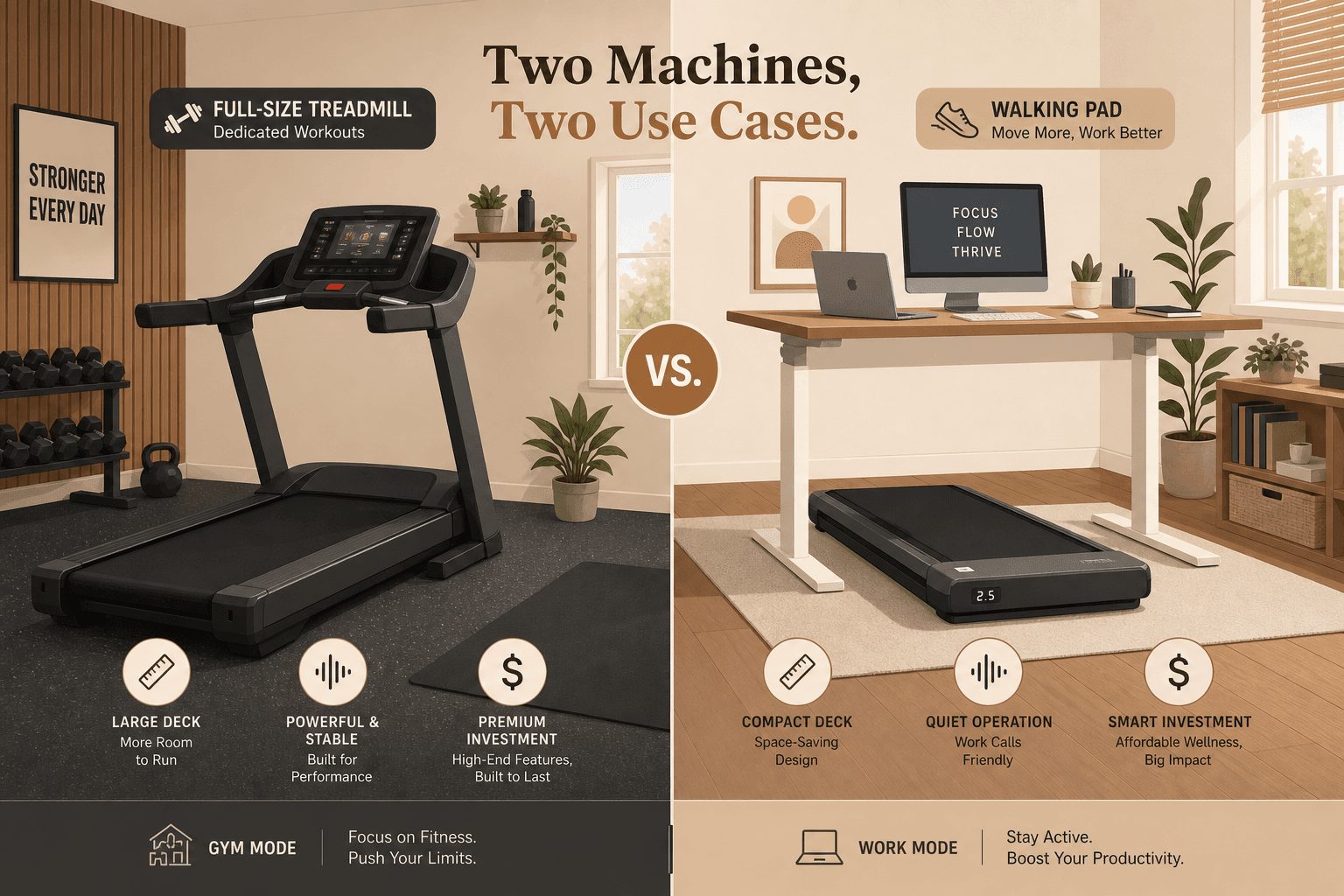
Walking Pad Deep Dive: What You Get (and What You Give Up)
A walking pad is essentially a motorized walking surface stripped down to its essentials: a narrow, short deck, a low-power motor, and no console to speak of. Models like the WalkingPad C2 (rated 3.1/5 by Garage Gym Reviews) have a 47-inch by 15.7-inch deck, a top speed of 3.7 MPH, and a 220-pound weight capacity. The UREVO 2-in-1, priced around $290, offers a 42.5-inch deck and a walking-mode top speed of 3.8 MPH. These machines are designed for one thing: walking at a moderate pace, typically while standing at a desk.
The Upsides
- Ultra-compact storage: Most walking pads fold flat and slide under a bed, a couch, or into a closet. The UREVO 2-in-1 is just 5.1 inches tall with the handrail down and weighs 57 pounds.
- No assembly: Open the box, unfold, and start walking. There is no hardware, no wiring, and no 90-minute build session.
- Low noise: The small DC motor and lack of a heavy belt system make walking pads quieter than full-size treadmills — a real advantage in apartments or shared walls.
- Under-desk usability: Many walking pads are low enough to slide under a standing desk, allowing you to walk while you work.
The Trade-Offs
- No running or jogging: With a top speed of 3.75–3.8 MPH in walking mode, you cannot break into a jog. Even the higher-speed mode on some 2-in-1 models (up to 7.6 MPH) is unsafe for running on a 40-inch deck.
- No incline: Walking pads have a flat deck. You cannot simulate hills, which limits calorie burn and muscle engagement compared to an incline treadmill.
- Short, narrow deck: A 40–47 inch deck is too short for a natural walking stride for anyone over about 5'8", and the 15–17 inch width feels cramped compared to a standard 20-inch treadmill deck.
- Low weight capacity: The 220-pound limit excludes a significant portion of the adult population. Adding 0.5 CHP for users over 200 lbs is standard advice for treadmills, but walking pad motors are already underpowered.
- Limited warranty: Many walking pads carry only a 90-day warranty on parts and labor. Consumer Reports warns that cheap treadmills under $500 often have 90-day warranties and may break within months.
For readers who need help choosing a compact treadmill based on specific storage constraints (under-desk, vertical fold, or fold-flat), our Small Treadmill Storage Type Guide covers the options in detail.
Full-Size Treadmill Deep Dive: The Versatile Workhorse
A full-size treadmill is built for the full spectrum of cardio training: walking, jogging, running, interval sprints, and incline work. The category spans from budget-friendly models like the Horizon T101 (under $1,000, with a 55-inch deck, 10 MPH top speed, and 10% incline) to premium machines like the NordicTrack Commercial 1750 ($2,500, with a 4.25 CHP motor, 60-inch deck, and -3% to 12% incline). The Bowflex T6, often on sale for $999, offers a 60-inch deck, 12 MPH top speed, and 15% incline — specs that rival machines costing twice as much.
The Upsides
- Running capability: With top speeds of 10–12 MPH and decks of 55–60 inches, full-size treadmills accommodate runners up to about 6'4" (per Consumer Reports). The 60-inch deck is the standard for comfortable running.
- Incline training: Most models offer 10–15% incline; some incline trainers go up to 40%. This allows you to simulate hills, increase intensity without speed, and target different muscle groups.
- Higher weight capacity: Typical limits range from 300 to 400 lbs, making these machines accessible to a much wider range of users.
- Superior durability: Mid-range and above treadmills come with lifetime frame and motor warranties. TreadmillReviews notes that a well-maintained motor can last 7–12 years. The Horizon T101, for example, carries a lifetime frame and motor warranty at under $1,000.
- Safety features: Handrails, emergency stop clips, and wider decks provide stability and safety that walking pads lack.
The Trade-Offs
- Large footprint: An industry-standard treadmill measures about 77 inches long by 35 inches wide — roughly the size of a two-seater sofa. You need a dedicated space of about 17 square feet, plus clearance on each side.
- Assembly required: Most full-size treadmills require 60–90 minutes of assembly. This is a significant barrier for people who want to unbox and start using the machine immediately.
- Higher upfront cost: A quality treadmill starts around $700 and climbs quickly. The under-$500 category, as Consumer Reports notes, often has 90-day warranties and wobbly frames.
- Potential subscription costs: Connected treadmills from NordicTrack, Peloton, and others require ongoing subscriptions ($39/mo for iFIT Pro, $44/mo for Peloton All-Access) to access their full content libraries. These costs add significantly to the 3-year total.
- Noise: The larger motor, belt, and deck generate more noise than a walking pad. This can be an issue in apartments with thin floors.
If you are trying to match a treadmill to your specific running style — whether you are a marathoner, a HIIT sprinter, or a casual jogger — our Best Home Treadmill for Your Running Style guide breaks down the CHP, deck length, and cushioning requirements for each type.
The 3-Year Durability and Total Cost of Ownership Analysis
This is the core differentiator of this comparison. The upfront price tag tells only part of the story. When you factor in how long each machine lasts, the cost gap between a walking pad and a full-size treadmill narrows dramatically — and in some cases, reverses.
Walking pads are not built for sustained daily use. Their small DC motors, typically rated at 1.0 HP or less, are designed for intermittent walking sessions — not for an hour of daily use, day after day. Consumer Reports warns that cheap treadmills under $500 (which includes most walking pads) often have 90-day warranties and may break within months. Based on the available data on build quality and motor specifications, a walking pad used daily for 30–60 minutes is likely to experience motor failure or structural issues within 12–18 months. At that point, the machine is often not worth repairing (the cost of a replacement motor can approach the price of a new unit), so the buyer faces a replacement purchase.
A full-size treadmill, by contrast, is built to a different standard. A mid-range model like the Horizon T101 ($999) comes with a lifetime frame and motor warranty. The NordicTrack Commercial 1750 ($2,500) has a 4.25 CHP motor and a 60-inch deck. TreadmillReviews estimates that a well-maintained treadmill motor should last 7–12 years. Even a budget-friendly full-size treadmill at $700–$1,000 is expected to outlast three or four walking pads.
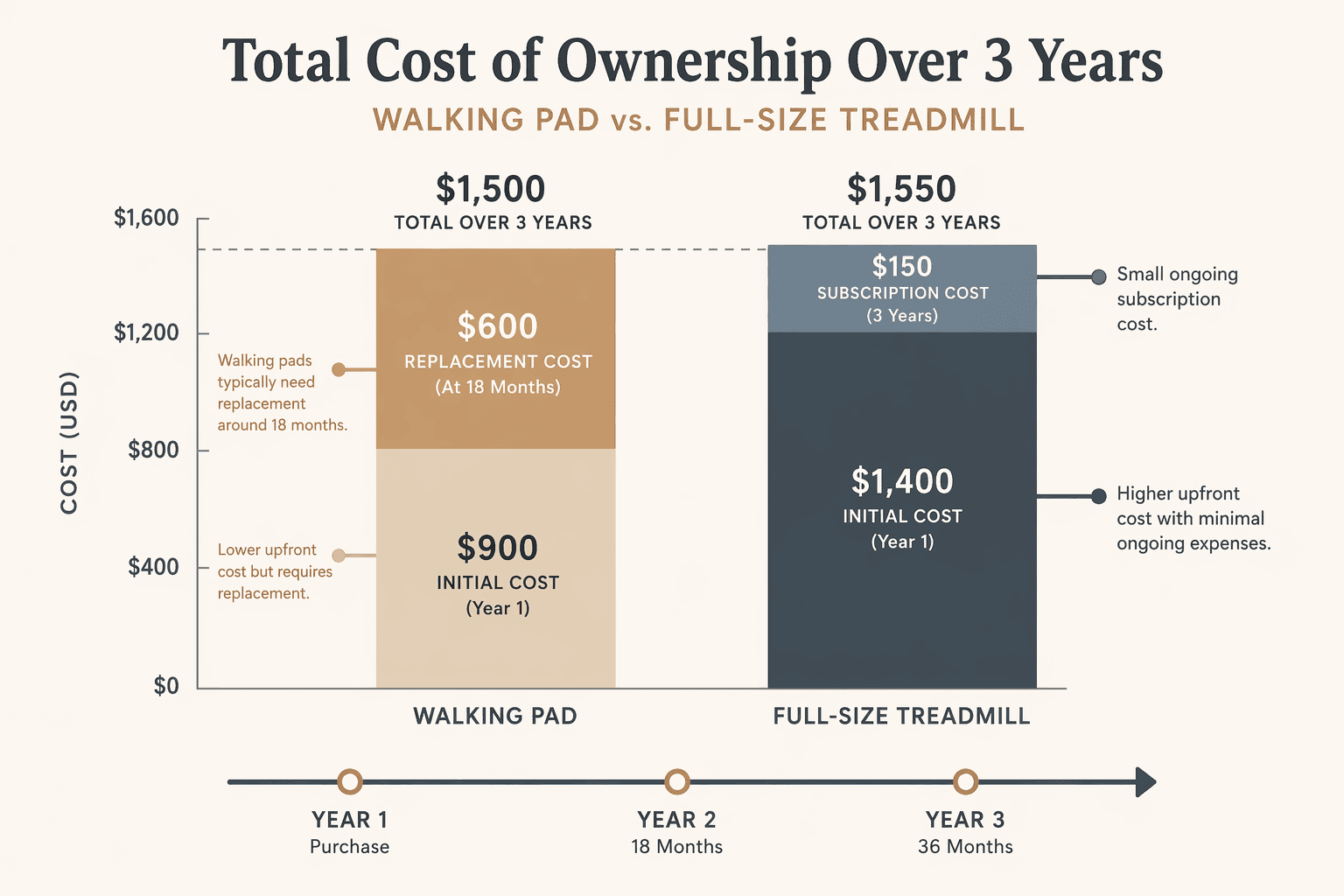
| Scenario | Walking Pad (e.g., $400 model) | Full-Size Treadmill (e.g., $999 Horizon T101) |
|---|---|---|
| Year 1 | $400 (initial purchase) | $999 (initial purchase) |
| Year 1.5 | $400 (replacement unit) | $0 (still under warranty) |
| Year 3 | $800 total (two units) | $999 total (one unit, still running) |
| 3-Year Total | $800 – $1,200 (if a third unit is needed) | $999 – $1,000+ (no replacement needed) |
| With Subscription (3 yrs) | N/A (no subscription needed) | $999 + $1,404 (iFIT Pro at $39/mo) = $2,403 |
Subscription costs add another layer to the TCO calculation for connected treadmills. A NordicTrack 1750 at $2,500 plus three years of iFIT Pro at $39/month totals roughly $3,904. That is a significant number, but it is also a choice — you can buy a subscription-free treadmill like the Horizon T101 and avoid that cost entirely. For a detailed breakdown of subscription versus subscription-free treadmill costs, see our Subscription-Free vs. Connected Treadmills comparison.
Decision Matrix: Who Should Buy Which Machine?
The right choice depends on your specific constraints — space, budget, fitness goals, and usage frequency. Use the table below to match your profile to the recommended machine type.
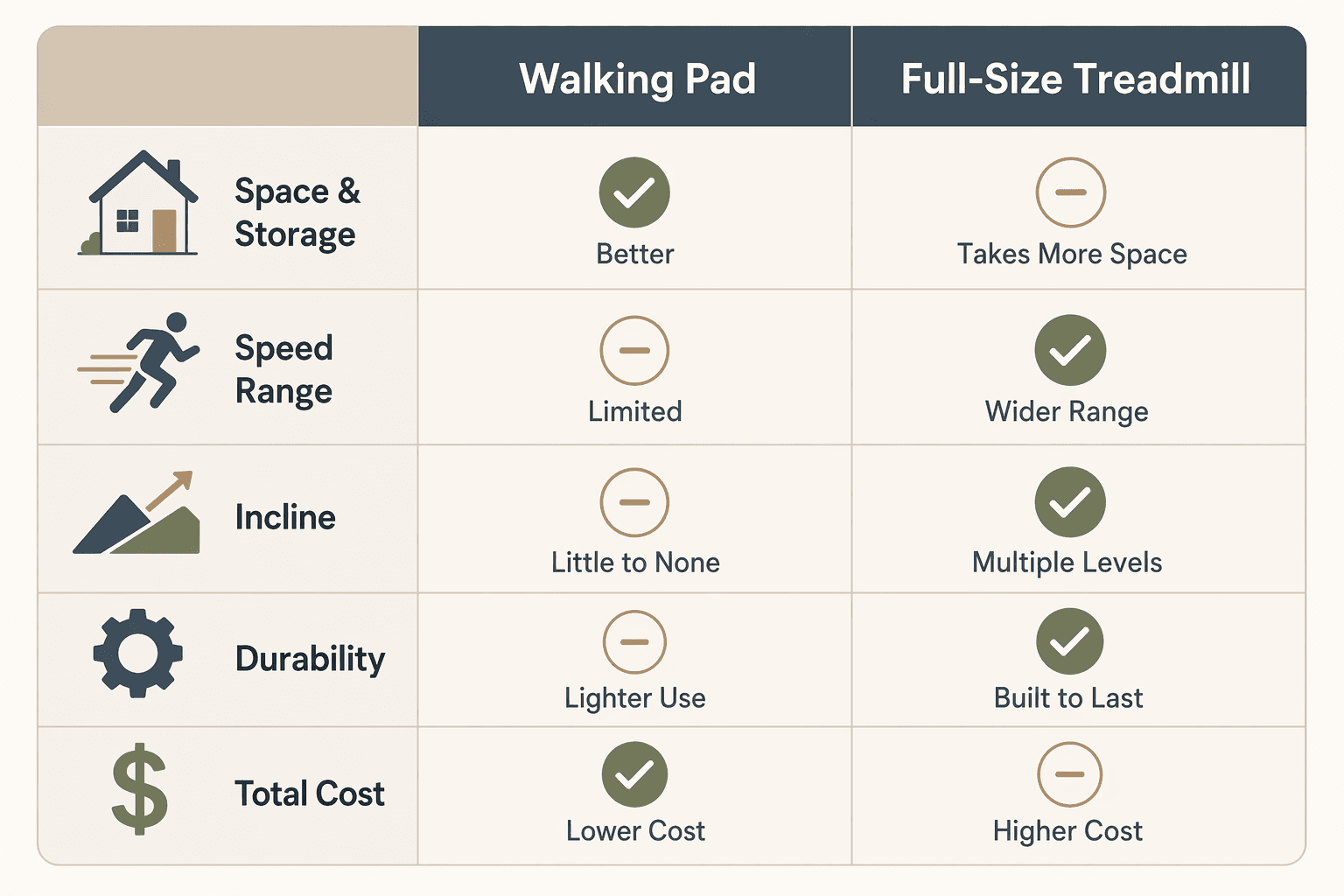
| Reader Profile | Recommended Machine | Key Reason | Example Models |
|---|---|---|---|
| Apartment dweller with very limited floor space | Walking pad | Folds flat, stores under bed, no assembly, low noise | WalkingPad C2, UREVO 2-in-1 |
| Remote worker who walks while working | Walking pad | Low profile fits under standing desk; quiet motor | UREVO 2-in-1, Goplus 2-in-1 |
| Casual walker (2–3 times per week) | Walking pad or budget treadmill | Walking pad is cheaper upfront; treadmill offers more longevity | WalkingPad C2 or Horizon T101 |
| Daily walker (30+ min, 5–7 days/week) | Full-size treadmill | Walking pad motor likely fails within 18 months; treadmill lasts 7–12 years | Horizon T101, Bowflex T6 |
| Jogger or runner | Full-size treadmill | Walking pads max out at 3.75 MPH and have decks too short for running | NordicTrack 1750, Bowflex T6 |
| Budget-conscious buyer (under $500) | Walking pad (with caveats) | Only option under $500; accept that it may need replacement in 12–18 months | UREVO 2-in-1, Goplus 2-in-1 |
| Budget-conscious buyer ($700–$1,000) | Full-size treadmill | Lifetime frame/motor warranty; better durability; running capability | Horizon T101, Bowflex T6 (on sale) |
| Incline training or HIIT enthusiast | Full-size treadmill | Walking pads have no incline; treadmills offer 10–40% incline | NordicTrack 1750, Bowflex T6 |
Key Limitations to Watch For Before You Buy
Both categories have pitfalls that are easy to miss when you are focused on price and specs. Here are the critical limitations to check before you commit.
Walking Pad Limitations
- Deck too short for running: At 40–47 inches, the deck is roughly 10–15 inches shorter than a standard treadmill. Your stride will hit the front or rear roller at any speed above a brisk walk.
- No incline: You cannot simulate hills, which limits training variety and calorie burn.
- Low weight capacity: The 220-pound limit excludes many users. Check the capacity against your weight plus any clothing or gear.
- Motor failure risk: The small motor is not rated for sustained daily use. Consumer Reports warns of poor build quality and safety issues in this category.
- Limited warranty: 90-day warranties are common. Compare this to the lifetime frame/motor warranty on a $999 treadmill.
Full-Size Treadmill Limitations
- Heavy and bulky: Most treadmills weigh 200–300 lbs. Moving one upstairs or into a tight space requires planning and often a second person.
- Assembly time: Plan for 60–90 minutes of assembly. Some retailers offer in-home assembly for an additional fee.
- Large footprint: At roughly 77" x 35", you need a dedicated space. Even folding models require about 17 square feet when in use.
- Subscription lock-in: Connected treadmills may require a $39–$44/month subscription for full functionality. Verify whether the features you want require a paid plan.
- Noise in apartments: The motor, belt, and foot strikes generate more noise than a walking pad. Cushioned decks help, but the sound may still carry through floors.
Our Testing Insights and Final Recommendations
Garage Gym Reviews has tested over 50 treadmills and walking pads, providing a credible body of data on performance, durability, and value. Their testing consistently shows that full-size treadmills in the $700–$1,500 range offer dramatically better durability and versatility than walking pads at any price. The Horizon T101 (3.8/5 rating) and Bowflex T6 (4.6/5 rating) are standout examples of what you get at the $1,000 price point: lifetime frame/motor warranties, 10–12 MPH top speeds, 10–15% incline, and decks long enough for running.
Walking pads, by contrast, score lower across the board. The WalkingPad C2 earned a 3.1/5 rating from GGR, with the short deck and low weight capacity cited as primary drawbacks. Consumer Reports' testing reinforces this picture, warning of safety problems and poor build quality in the under-desk treadmill category.
Final Recommendations by Reader Profile
- Buy a walking pad if: You are a casual walker (2–3 times per week), you have extremely limited storage space (under a bed or in a closet), you need an under-desk walking solution for work, and you accept that the machine may need replacement within 18 months.
- Buy a full-size treadmill if: You walk daily, you jog or run at any frequency, you want incline training, you weigh over 220 lbs, or you want a machine that will last 7–12 years with proper maintenance.
- Consider a compact treadmill as a middle ground if: You need a smaller footprint than a full-size treadmill but want running capability and better durability than a walking pad. Models like the Echelon Stride-6 ($1,699) fold completely flat to 10 inches high while offering a 60-inch deck and 12.4 MPH top speed.
For first-time buyers who are still unsure which category fits their space, budget, and goals, our First-Time Home Gym Buyer's Decision Framework walks through the process step by step. And if you have already decided on a treadmill but need help comparing specific models, our Small Treadmill Buying Guide covers the seven critical specs to check before you buy.
Comments
Join the discussion with an anonymous comment.