
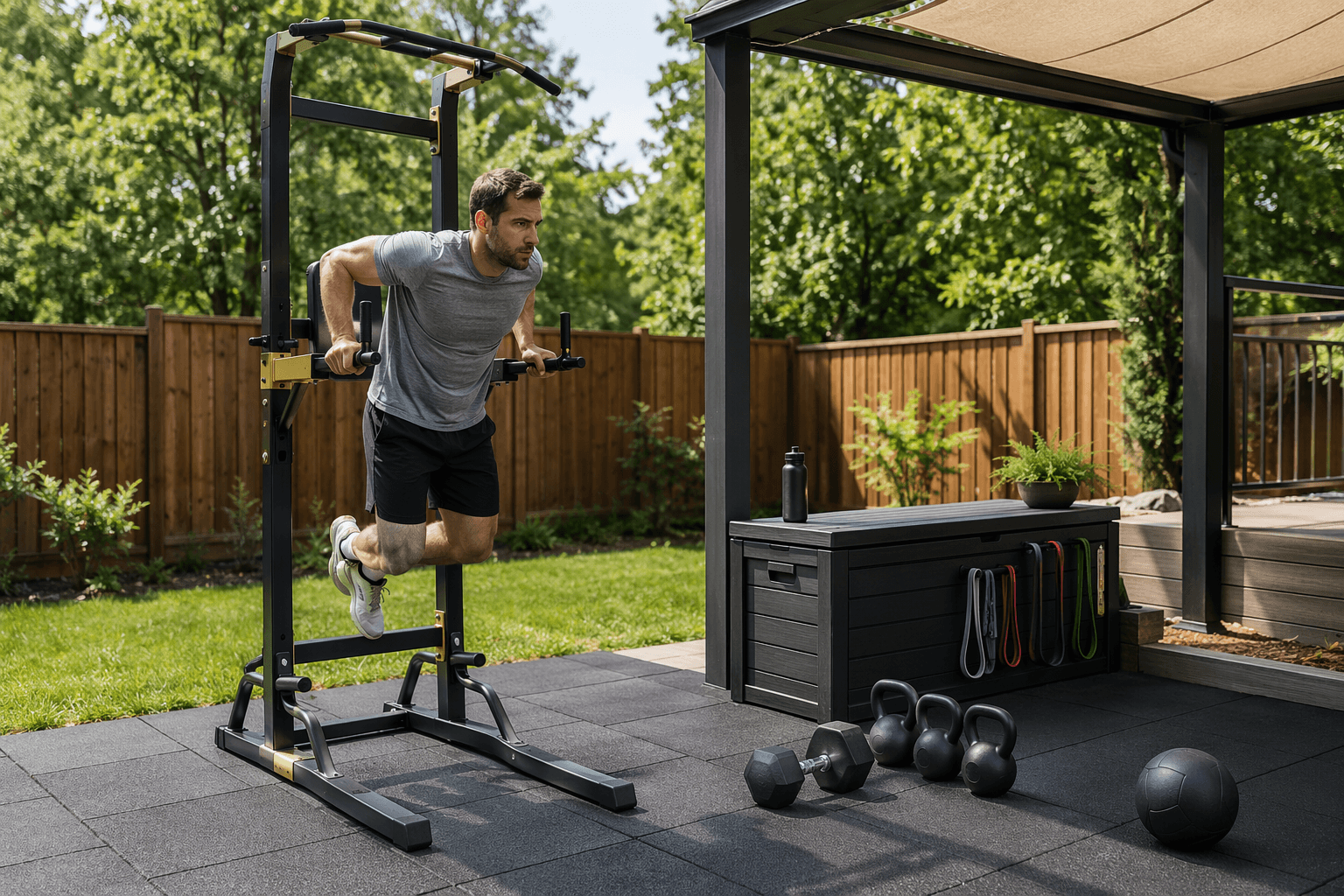
Moving your bodyweight training outdoors sounds straightforward: buy a pull-up bar, bolt it down, and start working. But the moment you start browsing, the options split into three distinct categories that serve very different training styles. A power tower is the default choice for good reason — it is compact, affordable, and does the basics well. But dedicated calisthenics stations and weatherproofed training rigs have evolved significantly in the last few years, and each category solves problems the others leave open.
The core question is not which product is best — it is which category matches how you actually train and where you plan to put it. A power tower that works perfectly for pull-up volume will frustrate you if your goal is muscle-up progressions. A full calisthenics station with 16 square feet of footprint will not fit on a balcony. A portable rig that folds away is ideal for a renter but may lack the stability for heavy ring work.
This comparison breaks down the three categories — power towers, calisthenics stations, and weatherproofed rigs — by training style, space requirements, weather durability, and upgrade path, so you can match the setup to your goals and outdoor conditions rather than the other way around.
The Three Categories: Power Towers, Calisthenics Stations, and Weatherproof Rigs
Before comparing performance, it helps to define what each category actually includes. The lines blur at the edges — some calisthenics stations include dip bars that look like a power tower's — but the design priorities differ in ways that matter for your training.
Power Towers
A power tower is a freestanding or wall-mounted frame with a pull-up bar and dip station as its core features. Most also include push-up handles and a leg-raise station. The design prioritizes pull-up and dip volume — sets, reps, and density work — over dynamic movement clearance. Typical price range is $120 to $469.
Representative models from current 2026 reviews include:
- Stamina Outdoor Power Tower Pro ($469) — 11-gauge steel, 144 lbs, 330 lb capacity, UV-protected powder coating, bolt-down option, 3-year frame warranty.
- Sportsroyals Power Tower ($289) — 440 lb capacity, adjustable height 70.1" to 92.7", steel construction.
- Weider Power Tower ($179) — 300 lb capacity, 57" x 41" footprint, requires sandbags for stability.
- OneTwoFit Wall-Mounted Power Tower ($120) — 440 lb capacity, 23.5 lbs, requires concrete or brick wall.
- Fit! Home Gym ($399) — 300 lb capacity, folds to under 2' x 4' for storage.
Calisthenics Stations
Calisthenics stations are designed for dynamic bodyweight skills — kipping pull-ups, muscle-ups, front levers, and toes-to-bar. They offer greater height, wider grip zones, and more structural stability than a typical power tower. Most are wall-mounted, post-mounted, or freestanding with a larger footprint. Price range is roughly $250 to $800+.
Key models in this category:
- Gornation Outdoor Pull Up Station (~$800) — all-in-one with pull-up bar, barbell hooks, and dip station, ~16 sq ft footprint, 550 lb capacity, weather-resistant coating.
- Pullup & Dip system (~$350) — wall/post/tree mount, removable and portable base unit, supports 20+ exercises including pull-ups, dips, rows, and leg raises, V-shaped dip handles.
- Khanh Trinh Portable Bar ($250) — alloy steel, corrosion-resistant, height-adjustable 46" to 102", 440+ lb capacity, compatible with rings and punching bags.
Weatherproof Training Rigs
Weatherproof rigs are essentially outdoor-rated power racks or modular cage systems designed for barbell training, pull-ups, and ring work. Brands like SwingSesh, MoveStrong, and Rogue's outdoor line fall here. These are the most expensive and space-intensive option, but they support the widest range of exercises — squats, bench press, pull-ups, dips, and ring work — in a single structure. Pricing typically starts above $1,000 and can exceed $3,000 for a full setup with accessories.
Because these rigs are designed for permanent outdoor installation, they use heavier-gauge steel, hot-dip galvanized or stainless steel construction, and require a concrete or deck foundation. They are the least portable option and the most resistant to weather.
| Category | Price Range | Typical Footprint | Best For | Key Limitation |
|---|---|---|---|---|
| Power Tower | $120 – $469 | 3–5 sq ft base | Pull-up/dip volume, leg raises | Limited height for dynamic skills |
| Calisthenics Station | $250 – $800+ | 16+ sq ft | Muscle-ups, kipping, front levers | Higher cost, larger footprint |
| Weatherproof Rig | $1,000 – $3,000+ | 20+ sq ft | Barbell training + bodyweight hybrid | High cost, permanent installation |
Training Style Comparison: Which Setup Matches Your Workout?
The most common mistake in this category is buying a power tower for calisthenics skill work or buying a calisthenics station for basic pull-up volume. The table below maps each category to specific training styles so you can match the equipment to your actual workout, not the other way around.
| Training Style | Power Tower | Calisthenics Station | Weatherproof Rig |
|---|---|---|---|
| Pull-up / chin-up volume | Excellent — purpose-built for high-rep sets | Good — may be overkill for volume work | Good — requires pull-up bar attachment |
| Dip volume | Excellent — integrated dip station | Good — integrated or add-on dip bars | Good — requires dip attachment |
| Muscle-up progressions | Poor — insufficient height clearance | Excellent — designed for kipping clearance | Good — tall enough with proper setup |
| Toes-to-bar / leg raises | Limited — low bar height | Excellent — high bar clearance | Good — tall enough with proper setup |
| Ring work (muscle-ups, dips) | Poor — no mounting point, low height | Excellent — ring-compatible height | Excellent — ring-compatible height |
| Barbell training (squat, bench) | Not supported | Limited — some have barbell hooks | Excellent — purpose-built for barbells |
| Portability / seasonal use | Moderate — some models fold | Low — most are permanent mount | Very low — permanent installation |
If your primary goal is building pull-up and dip volume — say, working toward 20 consecutive pull-ups or adding weighted dips — a power tower is the most cost-effective and space-efficient choice. The Sportsroyals at $289 or the Weider at $179 will serve you well for years.
If you are training for muscle-ups, front levers, or other dynamic calisthenics skills, the height limitation of a power tower becomes a real problem. You need enough clearance above the bar for kipping and enough space below for toes-to-bar. A calisthenics station like the Gornation or Pullup & Dip system provides that clearance. The Khanh Trinh portable bar, at $250 and adjustable up to 102 inches, is a budget-friendly entry point for skill work.
If your training blends bodyweight work with barbell lifts — squats, bench press, deadlifts — a weatherproof rig is the only category that supports both without compromise. These are essentially outdoor power racks with pull-up bars and dip attachments, and they require a corresponding investment in space and budget.
Space and Height Requirements: Footprint, Clearance, and Installation
Outdoor space is rarely unlimited, and the footprint of your equipment determines whether it fits your yard, patio, or balcony at all. But footprint is only half the equation — height clearance for overhead movements is equally important and often overlooked.
| Dimension | Power Tower | Calisthenics Station | Weatherproof Rig |
|---|---|---|---|
| Floor footprint | 3–5 sq ft (base) | 16+ sq ft | 20+ sq ft |
| Minimum ceiling height needed | 8 ft (pull-ups) | 9–10 ft (muscle-ups) | 8–9 ft (barbell overhead) |
| Typical bar height | 70" – 84" | 84" – 102" | 80" – 96" |
| Installation type | Freestanding or wall-mount | Wall/post-mount or freestanding | Bolt-down concrete or deck |
| Portability | Some models fold or move | Low — most are permanent | Very low — permanent |
For renters or anyone who cannot drill into concrete, the portable options matter most. The Khanh Trinh portable bar ($250, 46"–102" adjustable height) is designed to be assembled and disassembled without tools, and its manufacturer claims wobble is reduced by 90% compared to basic freestanding stands. It works with rings and punching bags, making it the most versatile portable option in the under-$300 range.
Wall-mounted options like the OneTwoFit Power Tower ($120, 440 lb capacity) are the most space-efficient choice for covered patios or balconies, but they require a solid concrete or brick wall. If you only have drywall, you will need to install plywood backing first — a factor many buyers discover only after the equipment arrives.
For permanent backyard installations, most setups operate in 100 to 200 square feet total, according to outdoor gym planning guides. That includes space for the equipment itself plus room to move around it. A calisthenics station at 16 square feet needs at least 8 feet of clearance in front and behind for dynamic movements. A weatherproof rig at 20+ square feet needs similar clearance for barbell loading and racking.
Flooring is worth planning alongside the equipment purchase. Rubber gym tiles or outdoor turf protect the equipment base from ground moisture and provide a stable, non-slip surface for training. The Rubber vs. Foam Gym Flooring comparison explains the material differences relevant to outdoor setups.
Weather Durability: Powder-Coated vs. Galvanized vs. Stainless Steel
The single biggest variable in how long your outdoor equipment lasts is not the brand or the price — it is the coating and material quality. A $179 power tower left uncovered in a backyard can show rust within one season, while a $469 unit with proper UV-protected powder coating can last five years or more with minimal maintenance.
Three material types dominate the outdoor equipment market, and each suits different climates and usage patterns.
| Material / Coating | Best Climate | Durability | Cost Impact | Maintenance |
|---|---|---|---|---|
| Powder-coated steel | Dry, temperate climates | Good — 5+ years with coating integrity | Standard (included in most models) | Monthly inspection, touch-up chips immediately |
| Hot-dip galvanized steel | Coastal, humid, rainy climates | Excellent — 10–20 years | Premium ($100–$300+ upcharge) | Minimal — inspect welds annually |
| Stainless steel | Coastal, salty air, any climate | Excellent — 'set it and forget it' | Highest (premium models only) | Nearly zero on shaft; wipe occasionally |
The importance of coating quality scales with your local climate. Salt air within 50 miles of a coastline corrodes metal up to 10 times faster than inland air, according to outdoor equipment maintenance sources. If you live near the coast, powder-coated steel will require vigilant maintenance — monthly cleaning, immediate touch-up of any chipped coating, and covering the equipment when not in use. Hot-dip galvanized or stainless steel is the better long-term investment in coastal areas.
For covered setups — under a pergola, carport, or roof overhang — powder-coated steel performs well because it is shielded from direct rain and UV exposure. A covered roof setup is nearly as protected as a garage gym, according to maintenance guides. For open-yard installations with full sun and rain exposure, upgrade to galvanized or stainless if your budget allows.
Commercial-grade outdoor equipment, which uses heavy-gauge steel with thick powder coating or galvanization, is rated for 10 to 20 years with regular maintenance. Residential equipment typically uses lighter materials and thinner coatings, which is why the price gap between a $179 tower and a $469 tower often reflects real differences in steel thickness and coating quality — not just brand markup.
Upgrade Path: Starting Small vs. Buying a Complete Station
There are two valid approaches to building an outdoor bodyweight setup, and the right one depends on your budget certainty and how sure you are about your long-term training goals.
Start Small and Build Up
This path begins with a single piece of equipment — typically a portable pull-up bar or a wall-mounted power tower — and adds components over time as your training evolves. The advantage is lower upfront cost and the flexibility to change direction if your goals shift.
- Start with a portable freestanding bar like the Khanh Trinh ($250) or a wall-mounted power tower like the OneTwoFit ($120).
- Add gymnastics rings ($30–$60) for ring push-ups, rows, and muscle-up progressions.
- Add a dip belt and weight plates for weighted pull-ups and dips.
- If you outgrow the portable bar, sell it and invest in a permanent calisthenics station or weatherproof rig.
This approach works well for renters, people with uncertain long-term space, or anyone who wants to confirm they will actually use outdoor equipment before committing several hundred dollars.
Buy a Complete Station Upfront
If you know your training goals and have a permanent outdoor space, buying a complete station upfront saves money over time and avoids the hassle of piecemeal upgrades. A Gornation Outdoor Station (~$800) or a Pullup & Dip system (~$350) covers pull-ups, dips, rows, and leg raises in a single purchase. A weatherproof rig at $1,000+ adds barbell capability.
The trade-off is commitment. A complete station is harder to move, harder to sell, and harder to modify if your training focus changes. But for someone who knows they want a permanent outdoor gym and has the space, buying once at a higher quality level is usually the better financial decision.
Whichever path you choose, the Complete Weatherproofing and Maintenance Guide covers the ongoing care routine that keeps outdoor equipment functional for years — monthly cleaning, coating inspection, and proper storage practices.
Decision Framework: Which Reader Profile Are You?
The following profiles map the most common reader situations to the equipment category that fits best. Find your situation and use the recommendation as a starting point, not a final verdict — your specific space, climate, and budget may shift the balance.
- Bodyweight skill seeker — You train for muscle-ups, front levers, and ring work. You need height clearance (9+ feet) and a wide grip zone. Recommendation: Gornation Outdoor Station (~$800) or Pullup & Dip system (~$350). If budget is tight, the Khanh Trinh portable bar ($250) at max height works for most skills.
- Strength-focused — Your training centers on barbell lifts with bodyweight accessories. You need a power rack, bench, and pull-up bar in one structure. Recommendation: Weatherproof rig from SwingSesh, MoveStrong, or Rogue ($1,000+). Budget for a concrete pad or deck reinforcement.
- Space-constrained — You have a balcony, small patio, or covered porch. Every square foot counts. Recommendation: Wall-mounted power tower (OneTwoFit $120) or wall-mounted calisthenics bar (Gornation wall bar). Requires a solid concrete or brick wall.
- Budget-focused — You want to start outdoor training for under $300 and may move in the next few years. Recommendation: Portable freestanding bar (Khanh Trinh $250) or entry-level power tower (Weider $179). Store indoors when not in use to extend lifespan.
Real-World User Feedback: What Outdoor Home Gym Owners Wish They Knew
Online fitness communities — particularly r/homegym, r/bodyweightfitness, and r/calisthenics — surface recurring themes from people who have already built outdoor setups. While individual experiences vary, several patterns appear consistently enough to be worth noting before you buy.
The most frequently cited regret is underestimating coating quality. Multiple users report that a budget power tower left uncovered through one rainy season developed rust on the pull-up bar and base joints. The consensus recommendation is to either buy a unit with galvanized or stainless steel components, or commit to storing the equipment under a cover or indoors when not in use.
Height is the second most common regret. Users who bought a power tower for calisthenics skill work quickly discovered that the bar height (typically 70 to 84 inches) is insufficient for kipping pull-ups, muscle-ups, or toes-to-bar. Several reported selling their power tower within six months and upgrading to a taller calisthenics station.
Portability is the third theme, especially among renters. Users who bought a permanent bolt-down station and then moved reported significant difficulty disassembling and transporting the equipment. Those who started with a portable freestanding bar or a wall-mounted unit with removable brackets had an easier transition.
If you want to see a broader range of outdoor equipment options beyond the three categories covered here, the Best Outdoor Exercise Equipment for Backyard Gyms roundup covers eight top picks tested for weather resistance and value.
Comments
Join the discussion with an anonymous comment.