
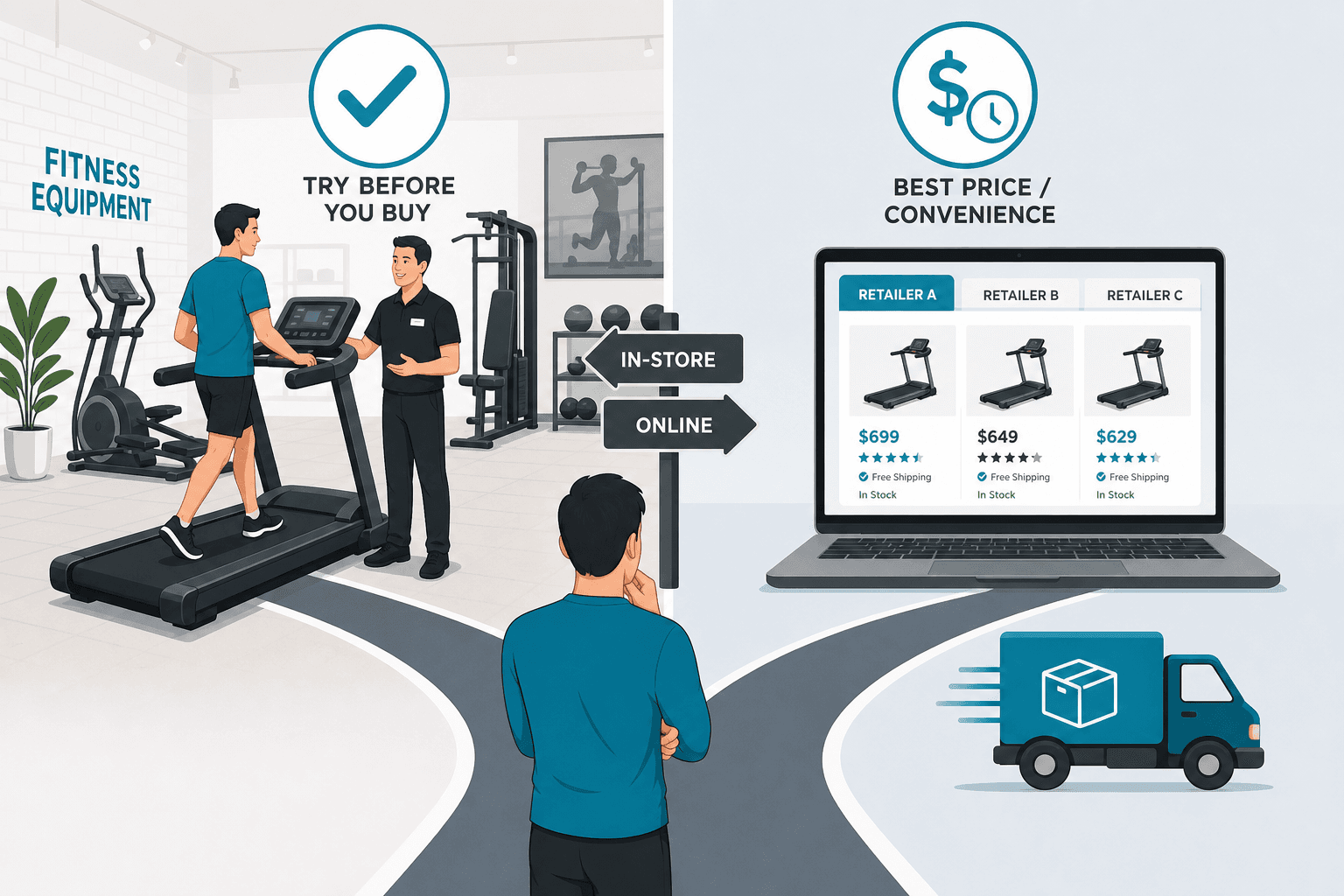
Why the Online vs. In-Store Decision Matters for High-Consideration Equipment Purchases
A home gym purchase is rarely an impulse buy. The average investment for a meaningful setup — a quality treadmill, a power rack with a barbell and plates, or a smart gym system — lands in the $1,500 to $3,500 range. That is a high-consideration purchase by any standard, and the channel you choose to make it can affect everything from the price you pay to whether the equipment still works two years from now.
The stakes are not just financial. A poorly chosen purchase channel can leave you with equipment that does not fit your space, a warranty that does not cover the part that broke, or a return policy that charges you 20% to send a treadmill back. On the other hand, the right channel can save you hundreds of dollars, connect you with expert advice, and ensure you get a machine that actually matches your training needs.
This guide does not rank retailers or declare one channel the winner. Instead, it provides a structured framework to match your specific buyer profile — your experience level, the equipment category you are buying, your tolerance for risk, and your need for pre-purchase testing — to the channel that fits. By the end, you will have a clear decision path and a set of criteria for evaluating any store, whether it has a physical address or exists only as a URL.
When a Physical Fitness Equipment Store Is the Right Choice
Brick-and-mortar fitness equipment stores offer something no website can: the ability to touch, sit on, and use a machine before you commit several thousand dollars to it. For certain types of equipment and certain buyer profiles, that tactile experience is not a luxury — it is a necessity.
Testing Comfort and Fit for Cardio Machines
Treadmills, exercise bikes, ellipticals, and rowers are intensely personal purchases. Stride length, handlebar position, seat comfort, and belt feel vary dramatically between models. A treadmill that feels smooth during a five-minute test walk in a showroom may reveal a jarring deck flex during a 30-minute run at home. The Fitness Outlet notes that budget treadmills under $500 are "almost universally built to standards not designed for consistent daily use," which makes the in-person assessment of build quality even more critical. If you plan to use a cardio machine more than three times a week, testing it in person is the single best way to avoid a costly mismatch.
Assessing Real-World Build Quality
Spec sheets can make a $400 treadmill look nearly identical to a $2,000 one. In a showroom, the differences become obvious: the wobble in the frame, the noise from the motor, the cheap plastic housing on the console. Fitness Gallery operates seven showroom locations and emphasizes that "you get what you pay for," warning that low-cost equipment from big-box retailers often carries warranties that "don't last and don't cover much." Seeing and touching the equipment in person lets you judge whether the frame is welded or bolted, whether the upholstery will hold up, and whether the controls feel intuitive.
Getting Expert Guidance for Complex Purchases
If you are buying a power rack, a cable machine, or a multi-station gym, the configuration options, space requirements, and assembly complexity can be overwhelming. A knowledgeable salesperson at a specialty fitness store can walk you through the trade-offs between a half-rack and a full rack, explain the difference between plate-loaded and selectorized weight stacks, and help you measure your ceiling height against the machine's uprights. Ocean Fitness Equipment recommends asking about fitness goals, space, and budget before any purchase — a conversation that is far more productive in person than over a chat window.
Securing Local Warranty and Post-Purchase Support
When a treadmill motor fails or a cable snaps, having a local store that handles warranty claims and service calls is a tangible advantage. Many physical retailers offer professional delivery and white-glove setup — The Fitness Outlet provides this service across its four showroom locations — and can dispatch a technician if something goes wrong. That local relationship is worth something when you are staring at a non-functional machine and the online retailer's customer service line is routing you through an automated system.
When Buying Fitness Equipment Online Makes More Sense
Online shopping opens up a universe of options that no single showroom can match. For buyers who know exactly what they want, who are comfortable with self-installation, or who are working with a tight budget, the internet is often the smarter choice.
Price Comparison Across Multiple Retailers
Online shopping makes it trivial to compare prices across dozens of retailers in minutes. The same model of treadmill or power rack can vary by hundreds of dollars between sellers, and online-only retailers often have lower overhead that translates into lower prices. FitSW's review of 11 online retailers highlights that refurbished equipment from specialists like Fitness Superstore can offer 40-70% off MSRP, with a free one-year warranty and the option to extend coverage up to five years. For a buyer willing to accept cosmetic imperfections on a functional machine, those savings are substantial.
Access to Niche and Specialty Brands
Physical showrooms carry what sells. If you are looking for a specialty brand — a specific type of plyo box, a specialty barbell, a niche cable attachment — your local store likely does not stock it. Online retailers like Rogue Fitness (American-made, premium pricing) and Titan Fitness (which offers a scratch-and-dent program for certified, slightly used equipment) give you access to products that a showroom would never dedicate floor space to.
Refurbished and Used Deals
The used and refurbished market is where online shopping truly shines. Gym Pros has been A-rated by the Better Business Bureau since 2003 and runs a well-regarded refurbished program. Pro Gym Supply has served clients on all continents for 20 years. These specialists inspect, repair, and warranty equipment that would otherwise end up in a landfill, and they sell it at a fraction of retail. For barbells, plates, racks, and benches — equipment where cosmetic condition is secondary to structural integrity — buying used from a reputable online refurbisher is often the smartest financial move.
Accessories and Smaller Items
For items like resistance bands, yoga mats, foam rollers, kettlebells, and dumbbells, the shipping is simple, the fit is not an issue, and the price competition online is fierce. There is little reason to visit a physical store for these purchases unless you need them immediately.
Decision Matrix: Matching Your Buyer Profile to the Right Channel
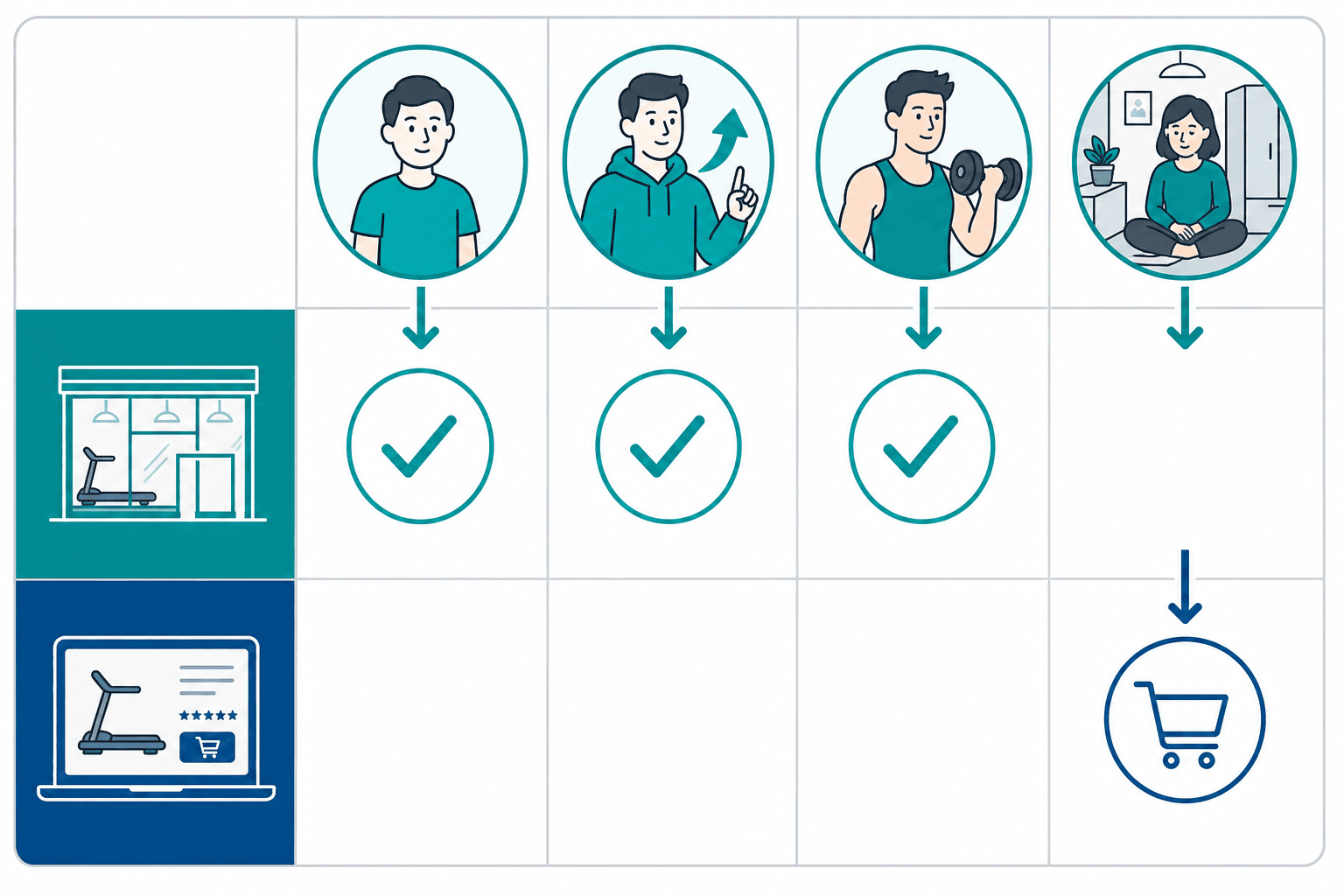
The following matrix maps common buyer profiles to the recommended purchase channel. Use it to self-identify and get a clear starting point.
| Buyer Profile | Recommended Channel | Key Considerations |
|---|---|---|
| First-time home gym builder | In-store | Needs hands-on testing, expert guidance on space and setup, and local warranty support. The risk of buying the wrong equipment sight-unseen is highest for this group. |
| Upgrade buyer (replacing existing equipment) | Hybrid or online | Already knows what they like and dislike. Can test the specific model in-store, then buy online if the price is significantly lower. Warranty portability is the main risk. |
| Serious athlete or powerlifter | Online (specialty retailers) | Needs specific barbells, racks, and plates that local stores rarely stock. Refurbished and specialty online retailers offer the best selection and value. |
| Small-space dweller (apartment, condo) | In-store | Must verify footprint, ceiling height clearance, and noise level in person. Online spec sheets often omit critical dimensions like folded depth or vibration transfer. |
| Budget-conscious buyer (under $500 total) | Online (refurbished/used) | New equipment under $500 is often poor quality. Refurbished commercial-grade equipment from online specialists offers far better value at the same price point. |
| Buyer of accessories and small items | Online | Shipping is simple, fit is not an issue, and price competition is fierce. No meaningful advantage to buying in-store. |
If you are still uncertain about what equipment to buy after deciding on a channel, our Home Gym Equipment Decision Framework can help you match your budget, space, and training goals to the right equipment category.
What to Look for in a Physical Fitness Equipment Store
Not all physical stores are created equal. A big-box retailer with a single treadmill on the floor is a very different experience from a dedicated fitness equipment showroom. Use the following criteria to evaluate any store you visit.
- Staff knowledge and willingness to answer questions. Ocean Fitness Equipment recommends that a good salesperson should ask about your fitness goals, available space, and budget before showing you any equipment. If the first question is "What's your budget?" without any context, that is a red flag.
- Showroom access. A legitimate fitness equipment store should let you use the machines. Fitness Gallery urges buyers to "try before you buy" and operates seven showroom locations specifically for that purpose. If a store has a "no touch" policy on its display models, walk out.
- Delivery and assembly services. Large equipment requires professional delivery and assembly. Ask whether the store offers white-glove setup, what it costs, and whether it includes removal of packaging materials.
- Financing options. Many specialty fitness stores offer financing. Fitness Gallery notes that financing is available, and The Fitness Outlet confirms that HSA/FSA funds may be applicable for some equipment purchases. Ask about both options.
- Post-purchase support. What happens if a part breaks six months after purchase? Does the store handle warranty claims directly, or do you have to contact the manufacturer? A store that stands behind what it sells is worth a premium.
What to Look for in an Online Fitness Equipment Retailer
Online retailers range from highly reputable specialists to fly-by-night operations with AI-generated product pages. The following checklist will help you separate the trustworthy from the risky.
- Warranty clarity and length. Ocean Fitness Equipment advises paying attention to warranty terms that cover "the frame, motor, electronics, and parts" separately. A lifetime frame warranty is common on quality equipment; a one-year parts-only warranty is a warning sign. Gymdesk warns that "consumer warranties often void the moment the machine lives in a facility," so if you are buying for a home gym, confirm the warranty explicitly covers residential use.
- Return policy and restocking fees. Some online retailers charge 15-25% restocking fees on returned equipment, plus the cost of return shipping. Read the policy before you click "buy." If the policy is vague or hidden, consider that a red flag.
- Shipping costs and delivery timelines. Large equipment ships via freight, not parcel. Ask whether the price includes curbside delivery or white-glove service, and how long delivery typically takes. Some online retailers quote 2-3 weeks but deliver in 6-8.
- Customer review verification. Gray Matter Lifting advises avoiding companies with "AI generated photos, incorrect spec sheets." Look for reviews on third-party sites (not just the retailer's own website) and be skeptical of products with dozens of five-star reviews but no detailed descriptions of real-world use.
The Hybrid Approach: Test In-Store, Buy Online — and When It Backfires
The hybrid approach — test a machine in a physical showroom, then buy it online for a lower price — is a common strategy among savvy shoppers. Brazyn Life explicitly recommends this: "test in-store, research online." In theory, it gives you the best of both worlds — the tactile experience of a showroom and the pricing of an online retailer.
In practice, the hybrid approach carries several risks that buyers often overlook.
- Warranty complications. Some manufacturers require that equipment be purchased from an authorized dealer for the warranty to be valid. If you buy from an unauthorized online seller, you may end up with a machine that the manufacturer refuses to service.
- Different units. The treadmill you tested in the showroom may be a 2025 model with a specific deck and motor, while the online retailer ships you a 2026 model with different components. Spec sheets can change mid-year without notice.
- Ethical considerations. You used a salesperson's time, expertise, and the store's floor space to make your decision, then took the revenue elsewhere. Small specialty stores survive on margins that do not accommodate showrooming at scale. If you value having local stores available for future purchases, consider whether the online savings justify the impact.
Red Flags for Both Channels
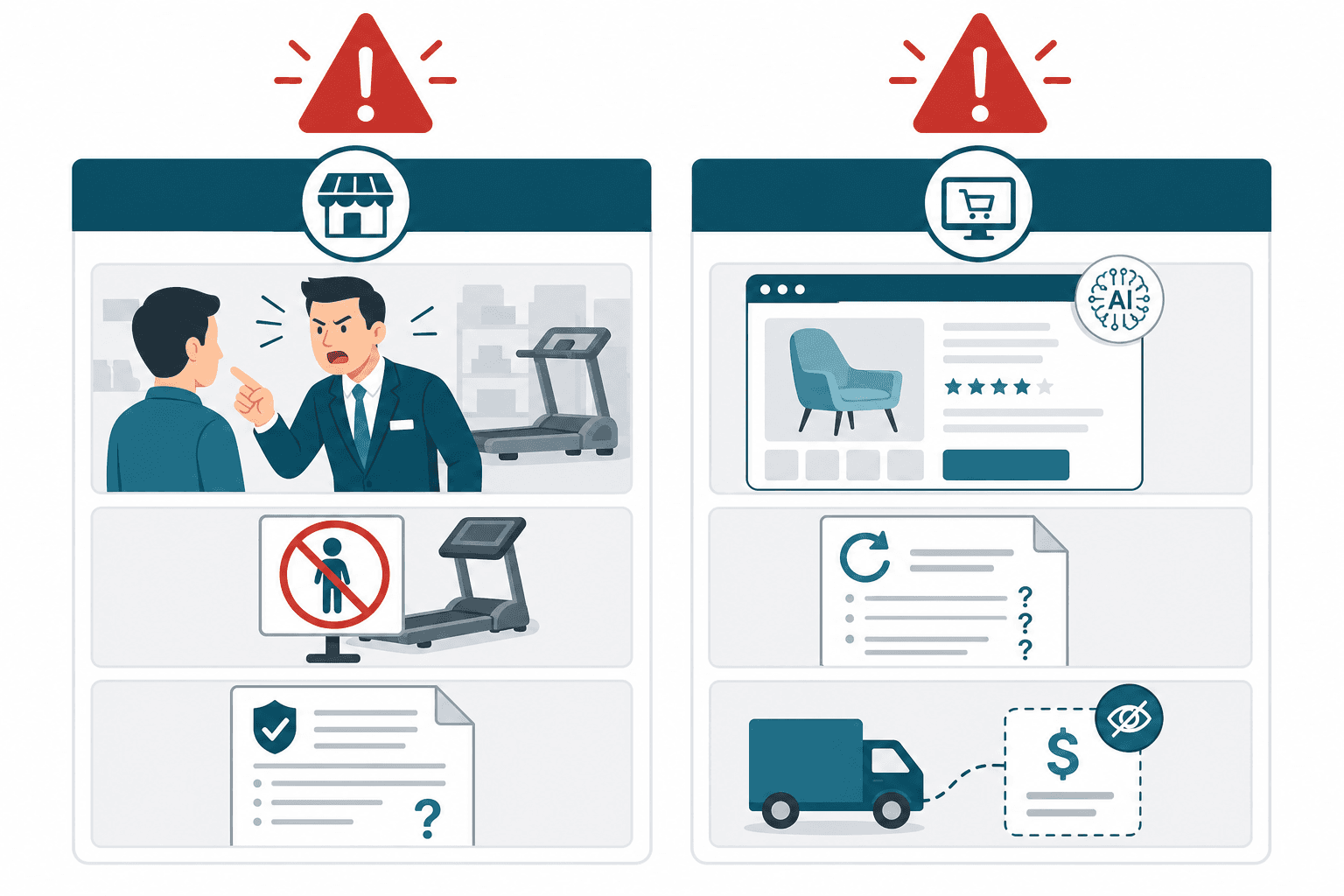
Whether you shop online or in-store, certain warning signs should make you pause. The following table summarizes the most common red flags for each channel.
| Red Flag | In-Store | Online |
|---|---|---|
| Pushy sales tactics | Salesperson pressures you to buy today, dismisses your questions, or refuses to let you test equipment. | Limited-time countdown timers on product pages, aggressive pop-ups offering discounts if you buy now. |
| Vague warranty information | Store cannot clearly explain what the warranty covers or how to file a claim. | Warranty terms are buried in fine print or not mentioned on the product page at all. |
| No-touch showroom | Equipment is roped off or has a "do not sit" sign. You cannot test the machine. | N/A (but AI-generated product photos with incorrect specs are the online equivalent.) |
| High restocking fees | Store charges 15-25% to return a machine, even if it was never used. | Return policy is hidden or states that the customer pays return shipping on freight items. |
| No customer service phone number | N/A (you are in the store.) | The only contact option is a contact form or email. No phone number is listed anywhere on the site. |
| Unrealistic pricing | Price is significantly below market average with no clear explanation (closeout, floor model, etc.) | Price is too good to be true. The site may be a scam or selling counterfeit goods. |
Brazyn Life also warns about pushy sales tactics and vague warranty information in physical stores. Gray Matter Lifting adds that online shoppers should be wary of "AI generated photos, incorrect spec sheets" — a growing problem as low-quality sellers use AI to create product pages that look legitimate but contain fabricated specifications.
Your Next Step: From Purchase Channel to Equipment Selection
By now, you should have a clear sense of which purchase channel fits your buyer profile. Here is a simple decision flow to confirm your path:
- Are you a first-time buyer, buying a cardio machine for frequent use, or unsure about fit and feel? → Start with in-store shopping. Visit a specialty fitness equipment store with a showroom, test the machines, and ask questions.
- Are you an experienced buyer who knows exactly what you want, or are you on a tight budget? → Start with online shopping. Compare prices across multiple retailers, check refurbished options, and verify warranty terms before purchasing.
- Do you want to test in-store but buy online? → Proceed with caution. Verify that the online retailer is an authorized dealer, confirm the warranty is valid, and only pursue this route if the savings are substantial (20% or more).
- Are you buying accessories or small items? → Buy online. The selection is wider, the prices are lower, and there is no meaningful advantage to buying in-store.
Once you have decided on your purchase channel, the next step is choosing the right equipment. Our Best Home Exercise Equipment: A Constraint-Based Buying Guide for 2026 provides structured comparisons, tiered recommendations, and total cost of ownership notes to help you make an informed purchase. For a deeper look at the long-term financial picture, read our 5-Year Total Cost of Ownership Guide to understand how warranty, maintenance, and subscription costs affect the true price of your equipment.
Comments
Join the discussion with an anonymous comment.