
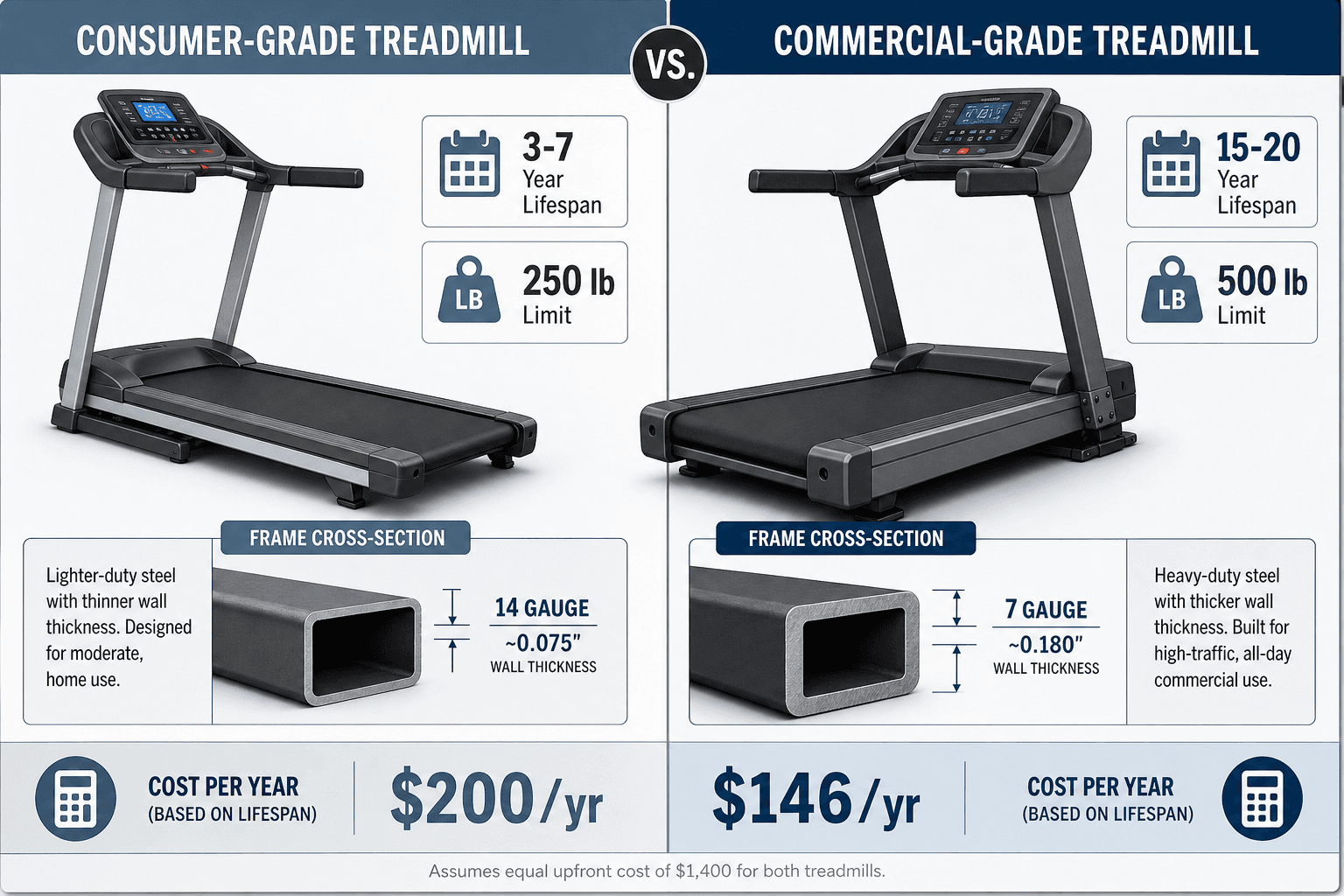
Should You Buy Commercial-Grade Equipment for Your Home Gym?
If you train four to six days per week, have a dedicated workout space, and are tired of replacing consumer-grade gear every few years, the question eventually surfaces: should I buy commercial equipment for my home gym? The answer is not a simple yes or no, but the data points in a clear direction for serious home gym owners.
Commercial-grade equipment costs more upfront — often two to five times more than a comparable consumer model. But the engineering behind that price tag — thicker steel frames, continuous-duty motors, higher weight capacities, and components designed for 10+ hours of daily use — means the equipment lasts three to four times longer. When you run the numbers on a cost-per-year basis, commercial equipment can be roughly 37% more economical over its usable life.
This article is not a general cost-benefit analysis or a three-tier decision framework. Those angles are already covered elsewhere on this site. Instead, this is a deep dive into the engineering specifications that separate commercial from consumer equipment — frame gauge, motor duty cycle, certifications, and weight capacity — paired with a detailed total cost of ownership model and a practical guide to the remanufactured buying pathway. If you want to understand why commercial equipment costs what it costs and whether that investment makes sense for your specific home setup, this is the place to start.
Before diving into specs, it helps to understand how different equipment types fit your training style. If you are still deciding between a treadmill, a rower, or a cable machine, the home gym equipment types explained guide can help you match equipment categories to your goals before you decide on a grade level.
What 'Commercial-Grade' Actually Means: Duty Cycles, Certifications, and Frame Gauge
The term "commercial-grade" gets thrown around loosely in marketing materials, but in the fitness equipment industry it refers to specific, measurable engineering specifications. Understanding these specs is the only reliable way to evaluate whether a piece of equipment is truly built for the long haul.
Frame Gauge: The Structural Foundation
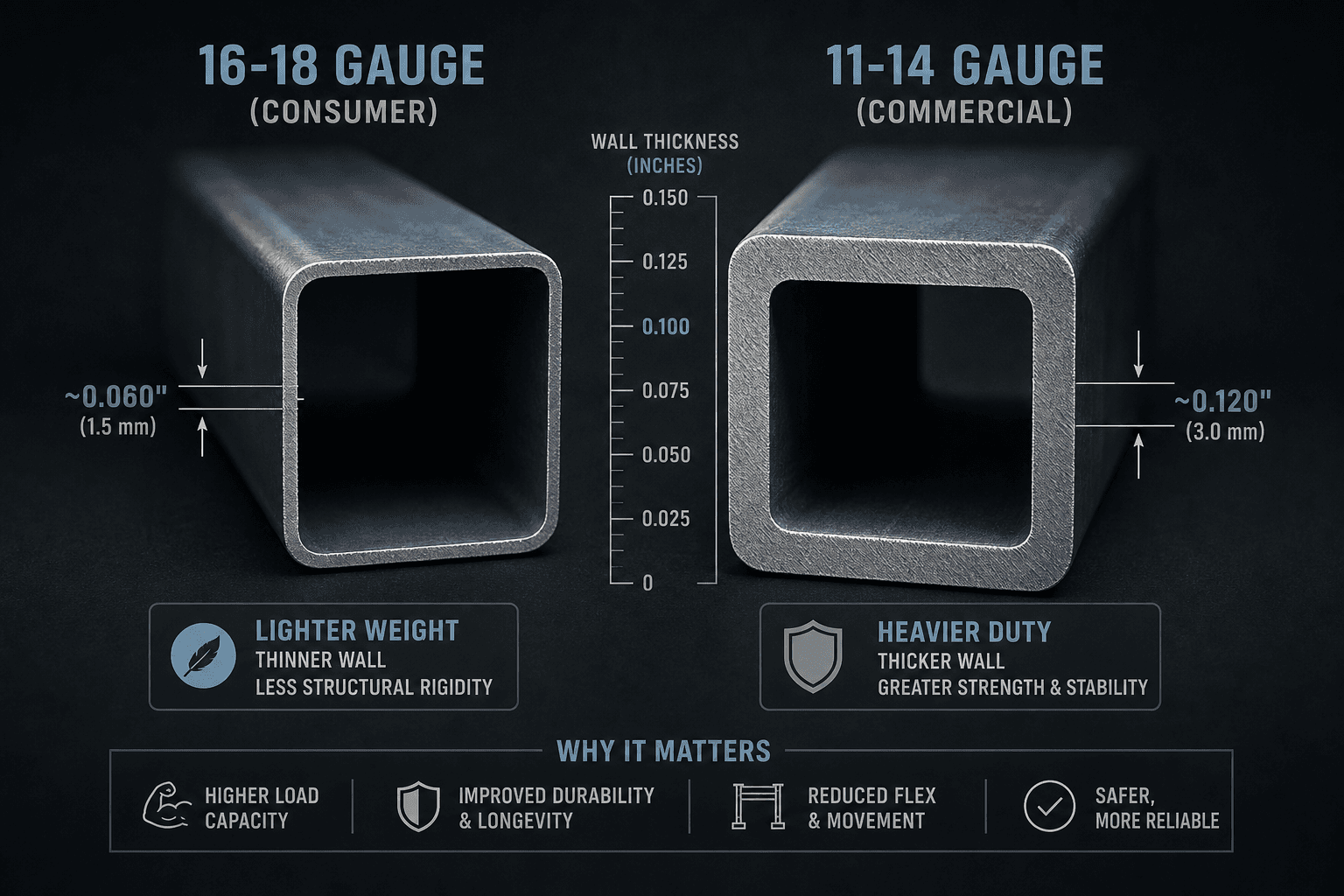
The most fundamental difference between commercial and consumer equipment is the thickness of the steel used in the frame. Commercial equipment is built with 11- to 14-gauge steel, while consumer equipment typically uses 16- to 18-gauge steel. The gauge number is inverse to thickness — lower gauge means thicker steel. An 11-gauge frame is roughly 0.12 inches thick, while an 18-gauge frame is about 0.05 inches thick. That difference more than doubles the amount of steel in the structural load path.

Comments
Join the discussion with an anonymous comment.