
If you have spent any time in a commercial gym, you have likely logged miles on a Matrix treadmill or cycled through intervals on a Matrix bike. The brand is everywhere — hotel fitness centers, corporate wellness rooms, university recreation centers, and franchise gyms. That ubiquity creates a natural question for home buyers: if Matrix equipment is good enough for a gym that runs it 12 hours a day, is it the right choice for a home setup?
This review answers that question by treating Matrix as a complete brand ecosystem, not a single product. We cover the full product line — treadmills, ellipticals, bikes, functional trainers, and adjustable dumbbells — along with the modular console system, warranty terms, pricing, and how Matrix compares head-to-head against Life Fitness, Precor, and Technogym. The goal is to give you a framework for deciding whether Matrix fits your specific priorities: console technology, biomechanics, resale value, serviceability, or total cost of ownership.
This is a comprehensive brand review, distinct from a narrow cost-value analysis. If you are looking for a deep dive on long-term ownership costs or polarized owner-review data, our existing article Is Matrix Exercise Equipment Worth the Price? covers that angle. Here, we take the wider view.
Matrix Brand Overview: Johnson Health Tech's Value-Premium Play
Matrix Fitness is the "mid-premium commercial brand" within Johnson Health Tech, a company founded in 1981 and headquartered in Taipei, Taiwan. Johnson Health Tech is one of the world's largest fitness equipment manufacturers by volume, and it operates multiple brands across different price tiers. Matrix sits in a strategic slot: above the company's value-oriented brands but below the ultra-premium tier occupied by Technogym and Cybex.
FitnessNav's 2026 strategic evaluation rates Matrix as a "Niche" brand with a Stable performance index and an overall score of 5.6 out of 10. The sub-scores tell a more nuanced story: Manufacturing Quality scores 8.5/10, R&D Innovation 7.8/10, and Interface UX 8.2/10. These numbers reflect a brand that builds hardware well and invests in user-facing technology, even if it does not lead the market in biomechanics research or brand prestige.
Matrix's target buyer is the value-conscious commercial facility — a gym that wants premium aesthetics and solid performance without paying top-tier pricing. For home buyers, this positioning translates into equipment that looks and feels like a commercial machine, uses many of the same components (thick decks, large rollers, commercial-grade cushioning), but costs less than a comparable Life Fitness or Technogym model. The trade-off, as we will explore, comes in biomechanics refinement and long-term resale value.
Matrix Product Lines: What's Available for Home Buyers
Matrix's home product line covers the major cardio and strength categories. The table below summarizes each line, key specs, and price ranges based on current Johnson Fitness & Wellness listings (Summer 2026). Prices vary by console choice — more on that in the next section.
| Product Line | Models | Key Specs | Price Range (with console) |
|---|---|---|---|
| Treadmills (non-folding) | T30, T50, T75 | 3.25 HP DC motor (T30/T50), AC motor (T75); 20" x 60" deck; 400 lb capacity; 0-15% incline | $3,299 – $7,399 |
| Treadmills (folding) | TF30, TF50 | 3.25 HP DC motor; 20" x 60" deck; 400 lb capacity; near-90° fold; 346 lb unit weight | $3,499 – $6,699 |
| Ellipticals (front-drive) | E30, E50 | 20" stride (E30), 22" stride (E50); 350 lb capacity; adjustable ramp | $3,599 – $6,299 |
| Ellipticals (rear-drive) | A30, A50 | 20" stride (A30), 22" stride (A50); 400 lb capacity; adjustable ramp | $4,399 – $7,099 |
| Upright Bikes | U30, U50 | Magnetic resistance; 350 lb capacity; adjustable seat and handlebars | $1,399 – $3,799 |
| Recumbent Bikes | R30, R50 | Magnetic resistance; 350 lb capacity; step-through design | $2,599 – $5,899 |
| Indoor Cycle | ICR50 | WattRate power meter; magnetic resistance; 300 lb capacity | $999 |
| Functional Trainer | FTR30 | Dual weight stacks (2 x 200 lb); 14 cable positions; 4:1 ratio | $1,999 – $3,899 |
| Adjustable Dumbbells | DB50, DB80 | 5-50 lb (DB50), 5-80 lb (DB80); 5 lb increments | $749 – $899 |
A few observations on the lineup. First, Matrix does not offer a budget tier — the entry-level T30 treadmill starts at $3,299, which places it firmly in premium territory. Second, the strength offering is limited compared to Life Fitness or Technogym. The FTR30 functional trainer and DB adjustable dumbbells cover the essentials, but there is no Matrix selectorized chest press, lat pulldown, or leg press for home buyers. If you want a full selectorized strength setup, you will need to look at other brands or mix Matrix cardio with a different strength line.
The Matrix Console Ecosystem: XR, XER, XIR, and XUR
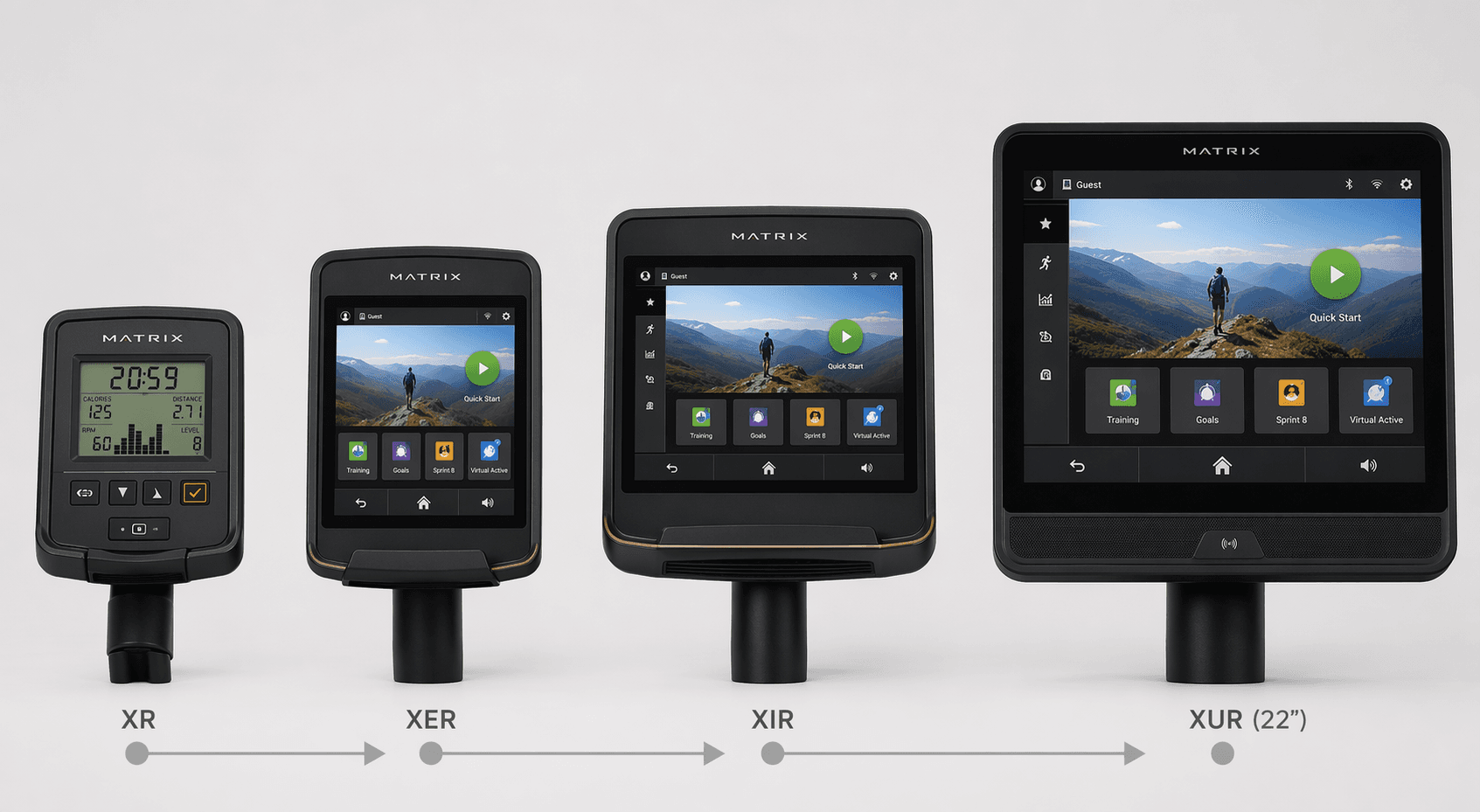
Matrix's console system is one of its strongest differentiators. Rather than locking each model to a single screen size or feature set, Matrix offers four console tiers that can be paired with most cardio machines. You choose the frame and drive system you want, then pick the console that matches your budget and tech preferences.
| Console | Screen | Type | Key Features | Typical Price Premium |
|---|---|---|---|---|
| XR | 8.5" | LCD | Basic display; 10 built-in programs; heart rate grips; Bluetooth FTMS | Base (included) |
| XER | 10" | HD Touch | Touchscreen; Virtual Active; Sprint 8; Bluetooth FTMS; device shelf | +$500 – $800 |
| XIR | 16" | HD Touch | Larger touchscreen; HDMI port for device mirroring; Netflix, YouTube, Spotify apps | +$1,000 – $1,400 |
| XUR | 22" | HD Touch (Flagship) | Largest screen; full streaming app suite; HDMI port; premium audio | +$1,500 – $2,000 |
The XIR and XUR consoles include an HDMI port for device mirroring, which is rare in the home fitness equipment space. This means you can cast your phone or tablet screen to the console display — useful for following a third-party workout app or watching content not available through Matrix's native app suite.
A critical point for subscription-averse buyers: Matrix does not require a mandatory subscription for core console functionality. The Sprint 8 HIIT program, Virtual Active scenic routes, and all manual modes work out of the box with no paid membership. iFIT integration and streaming apps (Netflix, YouTube, Spotify) require separate subscriptions, but these are optional. Bluetooth FTMS support means you can also pair the console with Zwift, Kinomap, or Peloton apps on your own device — no Matrix subscription needed.
Home Warranty and Total Cost of Ownership
Matrix's home warranty is one of the strongest in the premium segment. The coverage applies to all Matrix home cardio machines and the FTR30 functional trainer:
- Lifetime: frame, motor, and cushioning system
- 7 years: parts
- 2 years: labor
To put that in context, here is how Matrix's warranty compares to its primary competitors:
| Brand | Frame | Motor | Parts | Labor |
|---|---|---|---|---|
| Matrix | Lifetime | Lifetime | 7 years | 2 years |
| Life Fitness | Lifetime | Lifetime | 5 years | 1 year (home) |
| Precor | Lifetime | Lifetime | 5 years | 1 year |
| Technogym | Lifetime | Lifetime | 3-5 years | 1-2 years |
Matrix's 7-year parts coverage and 2-year labor are notably longer than the industry standard of 5 years parts and 1 year labor. This matters for total cost of ownership: if a component fails in year 6, you pay for labor but not the part. On a machine that costs $4,000–$7,000, that difference can be significant.
Matrix also designs for serviceability. The gxmmat.us comparison notes that Matrix equipment features easy-access panels, which can reduce out-of-warranty repair costs because a technician spends less time disassembling the machine to reach the failed component. Life Fitness parts, by contrast, are often more expensive out of warranty, and the machines can be more labor-intensive to service.
Where Matrix Excels: Console Tech, Value Pricing, and Serviceability
Matrix's strengths cluster around three areas: console technology, value pricing, and serviceability. Each addresses a specific pain point for home buyers.
Entertainment-First Console Technology
FitnessNav's 2026 evaluation gives Matrix an Interface UX score of 8.2/10, reflecting a console experience that feels more like a tablet than a traditional fitness display. The XIR and XUR consoles run native Netflix, YouTube, and Spotify apps — not just screen mirroring from your phone. The interface is responsive, the screens are bright and high-resolution, and the layout is intuitive. If your primary motivation for upgrading from a basic treadmill is a better entertainment experience, Matrix's consoles are best-in-class at their price point.
Value Pricing: 95% of the Performance at 80% of the Price
The value proposition is straightforward: Matrix uses commercial-grade components — 1-inch thick decks, 60 mm rollers, 2.2 mm belts, and the same cushioning system found in their commercial line — but prices the finished machine below Life Fitness and Technogym. A Matrix T50 with the XIR console runs approximately $5,500–$6,500. A comparable Life Fitness Platinum Club Series treadmill starts around $7,000 and can exceed $9,000 with a touchscreen console. Matrix is not cheap, but it is consistently less expensive than the other premium commercial brands for equivalent specs.
Customer reviews on Matrix's own site reflect this satisfaction. Across 201 total reviews, 83% are 5-star and 16% are 4-star, with fewer than 1% at 3 stars. One A50/XUR elliptical owner states: "There is no comparison between either of those machines and the A50 in terms of build quality or performance." Another TF50 buyer writes: "If you are choosing between Life Fitness brand and Matrix brand, Matrix is far better." These are self-selected reviews on the manufacturer's site, so they skew positive, but the consistency across 201 responses is notable.
Serviceability and Folding Options
Matrix's easy-access panel design is a practical advantage that becomes relevant only when something breaks. Most home buyers never think about serviceability until they need a repair, but the difference between a $200 repair and a $500 repair often comes down to how many hours a technician must spend accessing the component. Matrix's design philosophy reduces that labor time.
The folding TF30 and TF50 treadmills also address a real constraint for home buyers: space. These models fold to a near-90° vertical position, reducing floor footprint when not in use, while maintaining the same 20" x 60" running surface and 400 lb weight capacity as the non-folding T-series. Most folding treadmills in this price range compromise on deck length or motor power; Matrix does not.
Where Matrix Falls Short: Biomechanics, Resale Value, and Commercial Durability
No brand is perfect, and Matrix has three areas where it trails the market leaders. Understanding these trade-offs is essential for making the right purchase decision.
Biomechanics: Life Fitness and Technogym Lead
The gxmmat.us comparison states that Life Fitness "generally holds the edge in biomechanics, especially in selectorized strength and treadmill shock absorption." Matrix uses the Ultimate Deck System — six round, ring-shaped cushions that provide a firmer running surface. Some runners prefer this stiffer feel because it provides a more responsive push-off. Others find it less forgiving than Life Fitness's FlexDeck Shock Absorption System, which is widely considered the gold standard for joint-friendly running.
If you have joint concerns or primarily run for long distances (5+ miles per session), the difference in shock absorption may matter to you. The Matrix deck is not harsh — it uses a 1-inch thick deck and commercial-grade cushioning — but it is firmer than Life Fitness. The best way to evaluate this is to test both brands side by side at a dealer.
Resale Value: Matrix Depreciates Faster
Life Fitness equipment consistently retains higher resale value on the secondary market. This is partly a function of brand recognition — Life Fitness has been the dominant commercial brand for decades — and partly a function of perceived durability. If you plan to sell your equipment in 5–10 years, Life Fitness will likely recoup a higher percentage of its original price than Matrix.
For most home buyers, resale value is a secondary concern. Equipment is a long-term purchase, and the difference in resale value between Matrix and Life Fitness is unlikely to offset the higher upfront cost of Life Fitness. But if you know you will move or upgrade within a few years, it is worth factoring into your decision.
Commercial Durability Reports and the Home Use Distinction
Some durability complaints about Matrix originate from commercial settings where machines run 12+ hours per day. That is a different use case from home ownership. Matrix's commercial equipment is designed for that environment, but even well-built machines will show wear under continuous high-traffic use.
One specific report from the gxmmat.us comparison mentions a "subtle wobble" in the console mast on a Matrix T7xe during sprints. This is a commercial model, and the reviewer notes it during high-intensity running. For home use — where the treadmill might see 30–60 minutes of use per day — this is unlikely to be an issue. The non-folding T-series home treadmills use a reinforced frame that eliminates the "frame-sway" found in folding models, according to the TreadmillReviews.net T50 review.
Matrix vs. Life Fitness vs. Precor vs. Technogym: Comparison Table
The table below summarizes how Matrix stacks up against its primary competitors across the dimensions that matter most to home buyers. Data is drawn from FitnessNav, gxmmat.us, and runreviews.com (2018 baseline comparisons, verified against current pricing).
| Dimension | Matrix | Life Fitness | Precor | Technogym |
|---|---|---|---|---|
| Brand Positioning | Mid-premium commercial; value-premium | Premium commercial; industry standard | Premium commercial; biomechanics focus | Ultra-premium; design and innovation leader |
| Price Range (Treadmill) | $3,299 – $7,399 | $4,000 – $9,000+ | $3,500 – $7,000 | $6,000 – $12,000+ |
| Home Warranty | Lifetime frame/motor/cushioning; 7yr parts; 2yr labor | Lifetime frame/motor; 5yr parts; 1yr labor | Lifetime frame/motor; 5yr parts; 1yr labor | Lifetime frame; 3-5yr parts; 1-2yr labor |
| Console Options | 4 tiers (XR to XUR); modular; no mandatory sub | 2-3 tiers; Discover SE/SI; no mandatory sub | 2-3 tiers; P80; no mandatory sub | 1-2 tiers; Live/Mywellness; subscription optional |
| Subscription Required | No (core features free; streaming apps optional) | No (core features free; streaming apps optional) | No (core features free) | No (core features free; premium content optional) |
| Biomechanics Reputation | Good; firmer deck; solid for most runners | Excellent; FlexDeck gold standard for shock absorption | Excellent; natural stride motion on ellipticals | Excellent; advanced ergonomics research |
| Resale Value | Moderate; depreciates faster than Life Fitness | High; best-in-class resale value | Moderate-high | Moderate-high; brand cachet helps |
| Best For | Buyers wanting commercial aesthetics and tech at lower cost | Buyers prioritizing biomechanics and resale value | Buyers wanting natural elliptical motion and solid build | Buyers wanting design prestige and advanced connected features |
Verdict: Who Should Buy Matrix for Their Home Gym?
Matrix is not the right choice for every home buyer, but it is an excellent choice for a specific profile. Here is a clear breakdown of who should buy Matrix and who should look elsewhere.
Buy Matrix If:
- You want commercial-grade aesthetics and build quality without paying Life Fitness or Technogym pricing. Matrix delivers 95% of the performance at roughly 80% of the cost.
- Console entertainment is a priority. The XIR and XUR touchscreens with native Netflix, YouTube, and Spotify are best-in-class at this price point, and the no-subscription policy means you are not locked into a monthly fee.
- You want the flexibility to upgrade your console later. The modular system means you can buy a lower-tier console now and upgrade to a larger screen without replacing the entire machine.
- Space is a constraint and you need a folding treadmill. The TF30 and TF50 fold to near-90° vertical without compromising on deck size, motor power, or weight capacity.
- You value long warranty coverage and serviceability. The 7-year parts and 2-year labor warranty is among the best in the industry, and the easy-access panel design reduces potential repair costs.
Consider Alternatives (Life Fitness, Precor, Technogym) If:
- Biomechanics and shock absorption are your top priority. Life Fitness's FlexDeck system is the industry standard for joint-friendly running, and Technogym's ergonomics research is unmatched.
- Resale value matters to you. Life Fitness equipment consistently commands higher prices on the secondary market.
- You need a full selectorized strength line. Matrix's home strength offering is limited to the FTR30 functional trainer and adjustable dumbbells. If you want a selectorized chest press, lat pulldown, or leg press, you will need to look at Life Fitness, Precor, or a dedicated strength brand.
- Brand prestige is a factor in your decision. Technogym carries a design cachet that Matrix does not, and some buyers are willing to pay a premium for that.
For a broader framework on choosing the right equipment type for your goals, space, and budget, see our home gym equipment types explained guide. It covers how to match equipment archetypes to your training style and space constraints.
Frequently Asked Questions About Matrix Exercise Equipment
Is Matrix better than Life Fitness?
It depends on your priorities. Matrix offers better value for the price — roughly 95% of the performance at 80% of the cost — and superior console technology with no mandatory subscription. Life Fitness leads in biomechanics (especially treadmill shock absorption) and resale value. For most home buyers, Matrix is the better value; for serious runners or those prioritizing resale, Life Fitness may be worth the premium.
Does Matrix require a subscription?
No. Core functionality — including Sprint 8 HIIT, Virtual Active scenic routes, and all manual modes — works without any subscription. iFIT integration and streaming apps (Netflix, YouTube, Spotify) require separate subscriptions, but these are entirely optional. Bluetooth FTMS support allows pairing with third-party apps like Zwift or Kinomap without a Matrix subscription.
How long do Matrix treadmills last?
With proper maintenance, a Matrix home treadmill should last 10–15 years for typical home use (3–5 hours per week). The lifetime warranty on the frame, motor, and cushioning system covers the core structural components. The 1-inch thick deck, 60 mm rollers, and commercial-grade belt are designed for longevity well beyond what most home users will need.
Is Matrix good for running?
Yes, with a caveat. Matrix treadmills use the Ultimate Deck System, which provides a firmer running surface than Life Fitness's FlexDeck. Some runners prefer this for a more responsive push-off, especially during speed work. If you have joint concerns or primarily run long distances, test the cushioning at a dealer before buying. The T50 and T75 models offer a 20" x 60" running surface, 12.5 mph top speed, and 0-15% incline — suitable for most runners.
What is the warranty on Matrix home equipment?
Matrix offers a lifetime warranty on the frame, motor, and cushioning system; 7 years on parts; and 2 years on labor. This applies to all home cardio machines and the FTR30 functional trainer. Adjustable dumbbells and accessories have different warranty terms — check the specific product page for details.
Where is Matrix made?
Matrix is manufactured by Johnson Health Tech, a global company headquartered in Taipei, Taiwan. Johnson Health Tech operates manufacturing facilities in Taiwan and China. The company also has a significant presence in the United States, with corporate offices and distribution centers in Cottage Grove, Wisconsin, and other locations.

Comments
Join the discussion with an anonymous comment.