
Most buyers pick an exercise bike by screen size and brand. That is why three months later it is a very expensive clothes rack. I have seen this happen to friends — and the problem is not willpower. It is that they bought the wrong bike by looking at the wrong things. The specs that actually determine whether a bike gets ridden past the first month are resistance type, adjustability range, and true footprint. This guide covers the seven specs that matter, so you can buy a bike you will still use in six months.
The used market is flooded with barely ridden machines. The reason is almost never I just don't like cycling. It is that the bike is uncomfortable, noisy, or too big. And those problems trace back to specs the buyer never checked. Brand loyalty and screen size tell you none of that.
Consider the Schwinn IC4 and the Bowflex C6. They are the same bike. Confirmed by a Schwinn spokesperson, reported by Wirecutter and Outdoor Gear Lab. Same frame, same drivetrain, same 100 levels of magnetic resistance. One says Schwinn, the other says Bowflex. Buy whichever is cheaper. The brand does not change the hardware.
Magnetic Resistance Is the Only Quiet Option for Home
Resistance type is the single most important spec for home use, and magnetic wins, full stop. Magnetic uses electromagnets with no physical contact. It is near-silent — Outdoor Gear Lab reports the Peloton Bike+ delivers 100 levels at under 50 dB. That matters in an apartment or shared walls. Friction resistance uses a pad that wears down and gets louder over time (50–70 dB). Air resistance, like the Rogue Echo Bike, hits around 76 dB at highest intensity — think a loud conversation. Magnetic also requires zero maintenance: no pads to replace, no calibration. Even the budget Schwinn IC4 offers 100 levels of magnetic resistance.
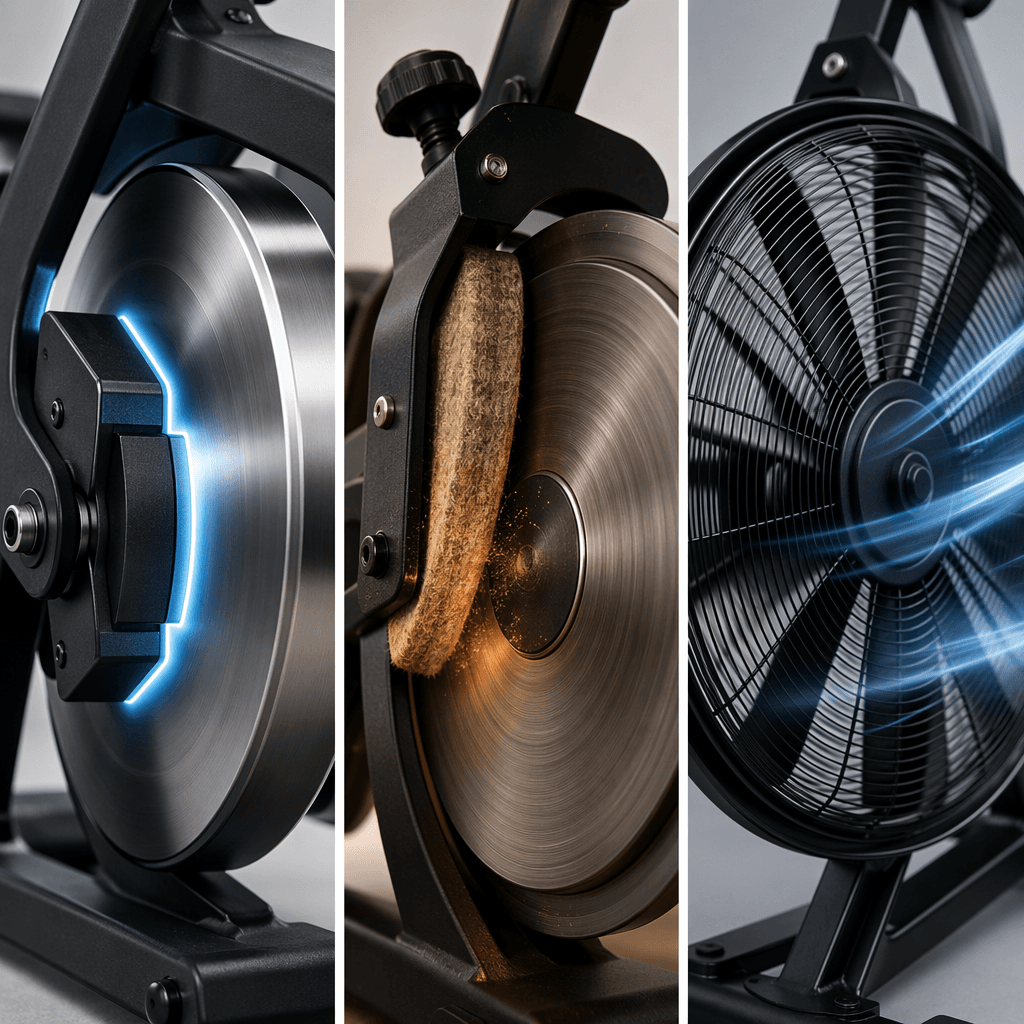
| Resistance Type | Noise | Maintenance | Precision |
|---|---|---|---|
| Magnetic | < 50 dB | None | 100 levels |
| Friction | 50–70 dB | Pad replacement | Continuous (wears) |
| Air | ~76 dB | None | Variable |
Don't Buy a Bike With a Flywheel Under 30 Pounds
Flywheel weight is the second spec most buyers overlook. A light flywheel produces jerky momentum — you pedal, and the bike stutters. Garage Gym Reviews recommends a minimum of 30 pounds for smooth momentum and stability. That is the floor. Bikes under 20 pounds feel cheap and wobbly at intensity. Heavier flywheels, like the 49-pound unit on the Sunny Health and Fitness SF-B1002, provide a more realistic road feel. But weight alone is not everything; bearing quality and frame rigidity also matter. A 35-pound flywheel on a flimsy frame still feels bad. Look for a bike that combines a heavy flywheel with a stable, welds-not-bolts frame.
A note: heavier flywheels mean heavier bikes. That matters if you need to move it often. The tradeoff is worth it for the ride quality.
Your Body Won't Fit a One-Size-Fits-All Bike
You can have the best resistance and heaviest flywheel, but if the bike does not fit your body, you will stop riding. Adjustability is more than seat height. Fore-aft seat position, handlebar height and fore-aft, and Q-factor all matter. Q-factor is the lateral distance between the outside edges of the two crank arms. It is the most overlooked spec in the entire market. According to Outdoor Gear Lab, the range spans from 150 mm on the NordicTrack X24 (roughly road-bike width) to 222 mm on the Schwinn 290 Recumbent. A wider stance can cause hip or knee discomfort, especially for riders with narrow hips or prior knee issues. The Peloton Bike+ sits at 170 mm, the Schwinn IC4 at 190 mm. If you have ever ridden a bike that felt like your legs were splayed out, that is a wide Q-factor. Most buyers never check it, and it is why many bikes feel wrong from the first ride.
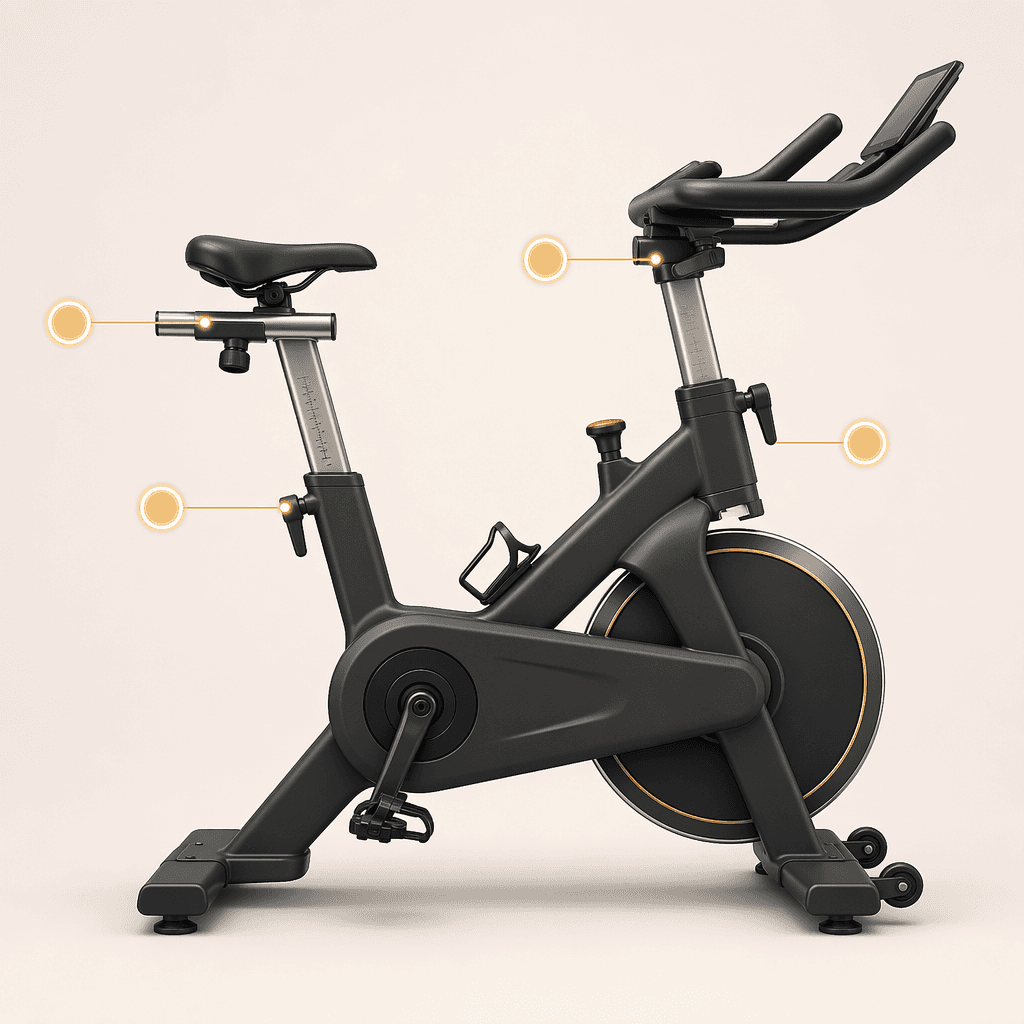
Adjustment quality matters too. Look for infinite (tool-free) adjustment over indexed clicks. Some bikes use pins and holes; others use a sliding rail with a lever. The latter is better. And do not assume a premium brand gets adjustability right. Peloton issued two seat-post recalls: May 2023 (original Bike, 35 reports of broken seat posts) and November 2025 (Bike+ model PL-02, 3 reports, 2 injuries). A big screen does not prevent a seat post from snapping.
Measure Your Corner Before You Buy
Every bike claims to be compact. The reality: footprint varies widely. Outdoor Gear Lab measured the Yosuda Indoor Cycling at 871 square inches, the Schwinn IC4 at 1,036, the NordicTrack X24 at 1,321, and the Schwinn 290 Recumbent at 1,838. To make sense of that, a standard yoga mat is about 2 feet by 6 feet, or 1,728 square inches. So the Yosuda is roughly half a yoga mat, while the recumbent is larger than a full mat. If you have a corner in an apartment, measure it. Do not guess.
| Bike Model | Footprint (sq in) | Comparison to Yoga Mat |
|---|---|---|
| Yosuda Indoor Cycling | 871 | ~0.5x mat |
| Schwinn IC4 | 1036 | ~0.6x mat |
| NordicTrack X24 | 1321 | ~0.76x mat |
| Schwinn 290 Recumbent | 1838 | ~1.06x mat |
Some bikes fold. The Marcy Foldable Upright Exercise Bike collapses from 32 inches in length to 14 inches, which is genuinely space-saving. But folding mechanisms can introduce wobble. Test the stability before buying.
A 10-Year Frame Warranty Means They Trust It
Warranty length is a direct proxy for how much the manufacturer trusts its own product. The industry standard for exercise bikes is about 10 years on the frame and 1 year on parts, according to Garage Gym Reviews. The Schwinn IC4 and NordicTrack X24 both offer 10-year frames, 3-year parts (IC4), and 2-year parts (X24), plus 1-year labor. Those are good. Budget bikes with 1- or 2-year frame warranties are telling you they do not expect the bike to last. If a company will not back the frame for a decade, do not trust it to hold up. Simple.
The Screen Is Not the Feature; Bluetooth FTMS Is
A giant touchscreen looks impressive, but what matters is Bluetooth FTMS (Fitness Machine Service). That is the protocol that allows the bike to communicate with apps like Zwift, Peloton Digital, or TrainerRoad. A bike with Bluetooth FTMS and a basic display can do everything a smart bike can — minus the built-in screen. The Schwinn IC4 has Bluetooth FTMS and works with multiple apps for free. Peloton locks you into a $44/month subscription. NordicTrack iFit costs $39/month. Echelon is $40/month. JRNY is $20/month (or $12 for minimal). If you never plan to use structured classes, a bike without a screen saves you money and clutter.
The real question is not Does it have a screen? but Does it let me use the apps I want without a locked subscription? The Schwinn IC4 and Bowflex C6 are the same bike, and both work with Zwift, Peloton Digital, and others at no extra cost beyond the app fee. That is freedom. A built-in screen that only works with a single expensive subscription is a liability, not a feature.
So which specs matter most for you? If you live in an apartment, prioritize magnetic resistance and a small footprint. If you are tall or heavy, check the weight capacity and adjustability range — aim for 330 lb or more, and make sure the seat goes high enough. If you follow structured classes, confirm Bluetooth FTMS and app compatibility. If you are on a budget, do not skip flywheel weight and warranty. A cheap bike with a light flywheel and a 1-year frame warranty will cost more in the long run.
Ignore the screen size. Ignore the brand. Look at the resistance, the adjustability, the footprint, the warranty. Those are the specs that determine whether your bike becomes a trusted piece of equipment or a very expensive clothes rack.
If you are ready to see specific models ranked by these specs, our best exercise bikes for home by budget, space, and fitness level guide narrows it down. And if you are still deciding between bike types, the decision-matrix guide can help you decide between spin, recumbent, upright, and air bikes.
Comments
Join the discussion with an anonymous comment.