
Best Home Exercise Equipment for Beginners: What to Buy First and What to Add Later (Phased Build Guide)
Most beginner equipment guides are static lists that ignore progression. This phased build guide shows complete beginners exactly what to buy first (under $100), what to add as you progress, and when to upgrade, all within a $1,000 budget – with readiness criteria for each phase.
The Setup That Costs $1,855 and Sits Unused
Here’s the number that stopped me: $1,855. That’s the average price of a home gym setup from Garage Gym Reviews’ 2026 roundups. And here’s the trap — most beginners walk into a store, see a squat rack with a bench and a bar, think “this is what I need,” and swipe the card. Three weeks later the rack is a coat hanger. The habit never formed.
The same review site helped over 82,000 people find budget equipment in 2025 alone — people looking for a cheaper way in after overbuying the first time. If you’re reading this with zero equipment and a budget under $1,000, you are already ahead: you are asking the order question before the price question.
Here’s the short version: buy in phases, tied to what your training actually demands. Readiness criteria — not enthusiasm — should dictate your next purchase.
What a Trainer Actually Starts With
Certified personal trainer Jacob Siwicki says a mat, resistance bands, and dumbbells cover about 90% of effective home training. That’s one trainer’s professional opinion — I treat it as a useful heuristic, not a locked fact. But the math checks out: with those three items you can squat, press, pull, lunge, hinge, and carry. The only missing movements are heavy vertical pulling (pull-ups) and heavy compound lifts, neither of which a beginner needs in the first two months.
Siwicki puts the cost of that starter setup at $470 to $600. That’s a range, not a ceiling. I’ll show you how to start for under $100 and build up only when your training demands it. If you haven’t yet figured out your goals, space, or schedule, the Home Fitness Decision Guide is the better first read. This article assumes you know you want to train and need to know what to buy first.
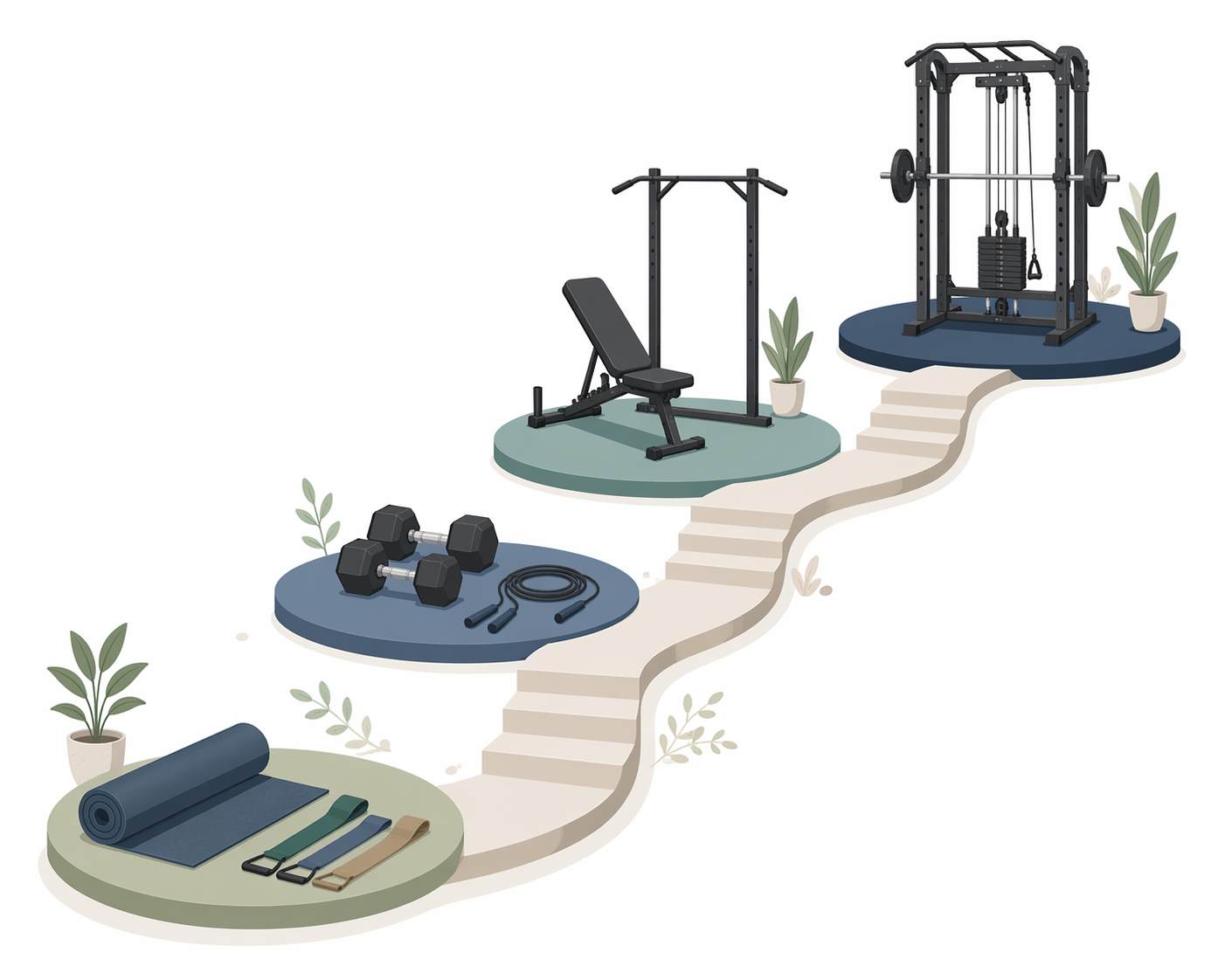
Phase 0: Under $100 — Build the Habit First
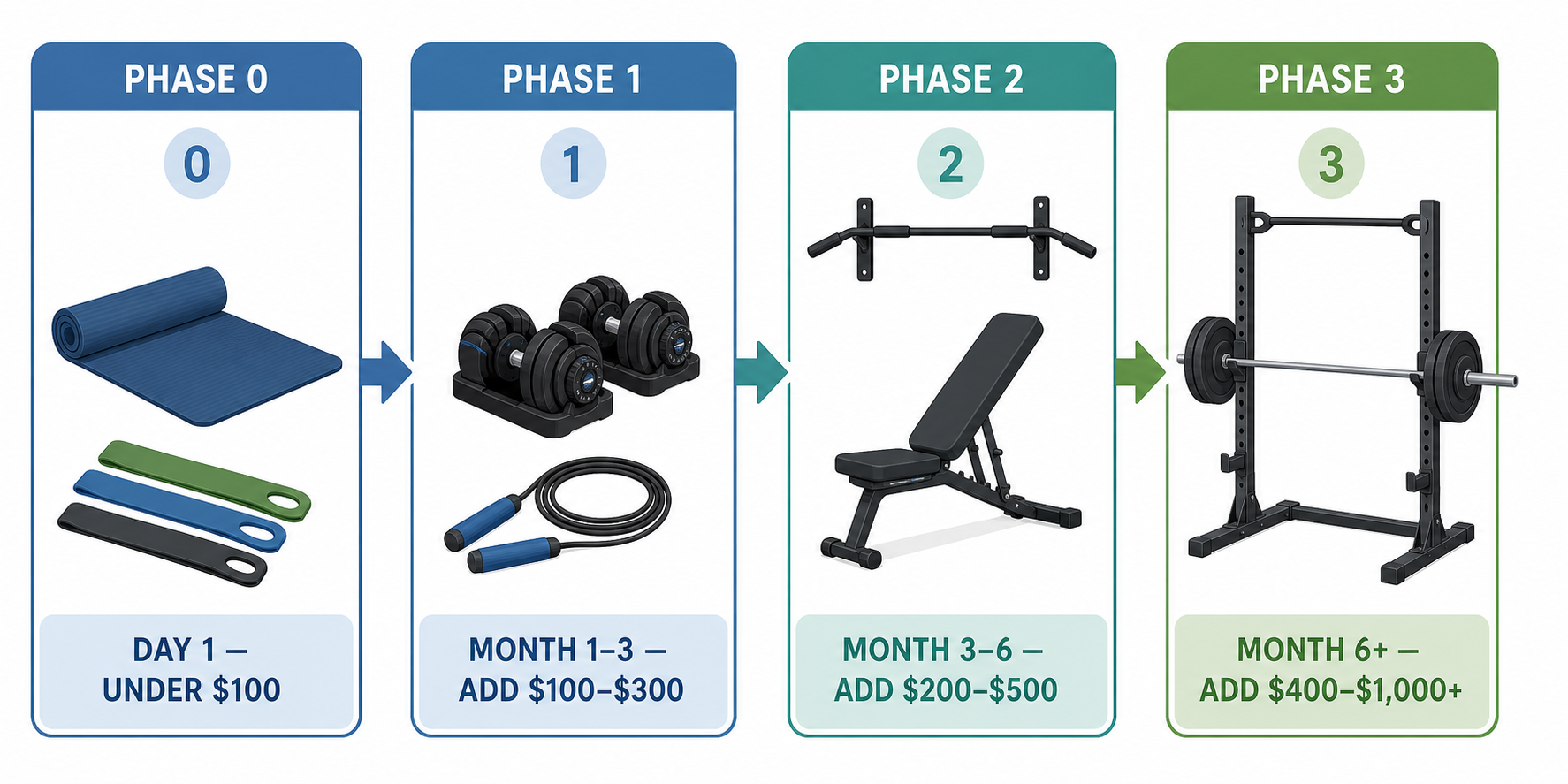
You do not need to be fit to start Phase 0. You need to show up. The readiness criterion is simple: can you complete 3 sets of 12 bodyweight squats with good form without gasping? If not, stay here until you can. That’s the threshold for moving to Phase 1.
What you buy: a mat and a set of resistance bands. That’s it. The Guardian’s test recommends the SPRI Flat Bands at $12.99 and the Lululemon The Mat at $98. That’s $110.99 total — barely over $100. If $98 for a mat feels steep, Siwicki suggests the Manduka PRO at $144 (luxury) or the Vergali Mini Resistance Bands 4-pack at $19.79 (budget-friendly). My take: buy the SPRI bands and a $20–$30 mat from a discount store. Total under $50. Keep the rest in your pocket.
Hidden cost alert: You might need flooring tape or a storage bag. Add maybe $15. Still under $100.
The goal of Phase 0 is habit, not strength. Follow the routines in How to Start Working Out at Home. Once you can do those 3×12 squats without stopping, you’re ready for Phase 1.
Phase 1: Month 1–3 — Add $100–$300 — Introduce Real Resistance
You’ve built the habit. Now you need load. The readiness criterion: you have been doing Phase 0 workouts consistently for at least a month, and bodyweight squats feel easy. That’s the green light to add dumbbells.
Two good entry points: CAP Cast Iron Hex Dumbbells at about $1 per pound — grab a pair of 10s, 15s, and 20s for around $90 total — or Feierdun Adjustable Dumbbells at $109.99 for the space-saver. The CAP dumbbells are a bargain on paper, but shipping can eat into that $1/lb promise. I’ve seen buyers pay $30–$40 to get 50 pounds of iron delivered. That’s a hidden cost most articles don’t name. If you can find them locally, go fixed. Otherwise, the Feierdun adjustables are fine.
Also add a jump rope. The WOD Nation Double Under Speed Jump Rope costs under $20. Great for warm-ups and cardio. Total Phase 1 spend: roughly $110–$130 depending on shipping. Still under $250 cumulative.
If you want a premium option, the REP QuickDraw Adjustable Dumbbells at $335.99 replace up to 12 pairs of fixed dumbbells and take up almost no space. That’s Phase 1 and Phase 2 in one — but also a bigger upfront hit. Either way, you now have real resistance and a cardio tool.
Phase 2: Month 3–6 — Add $200–$500 — Expand Your Exercise Library
You can now complete full-body dumbbell workouts with proper form for two months. That’s the readiness criterion: consistency plus competence. Now it’s time to add a bench and a pull-up bar.
An adjustable bench costs $150–$300 on the open market. A doorframe pull-up bar is $30–$80. These two items unlock dumbbell bench press, rows, step-ups, pull-ups, and hanging leg raises. That’s a serious expansion of your exercise library.
At this point you might also consider flooring if you’re using heavier weights. The Rubber vs. Foam Gym Flooring guide can help you decide. Total cumulative spend after Phase 2: roughly $300–$600, still well under $1,000.
Most beginners can stop here. Phase 3 is for when dumbbells and bodyweight stop challenging you. That may take six months or a year — or never if your goals are maintenance-sized.
Phase 3: Month 6+ — Add $400–$1,000+ — Only When You Need More
The readiness criterion: you’ve been consistently lifting for six months, you can squat 1.5× your bodyweight with dumbbells (or a comparable compound lift), and you feel limited by the weight you own. That’s rare for a beginner. If you meet it, a compact squat rack or an all-in-one cable machine makes sense.
Two options worth your look: the PRx Profile PRO Squat Rack that folds to 12 inches of depth and supports 1,000 lbs — great for small spaces — and the Bells of Steel Cable Tower starting at $434.99. The cable tower is beginner-friendly and compact, but let’s be honest: it’s a luxury, not a necessity. If you’ve made it this far without it, you probably don’t need it. The Best Home Workout Machine for Beginners guide covers the all-in-one machines in more detail. Phase 3 total can push over $1,000, but your cumulative spend stays under $1,000 if you stop at Phase 2.
Red Flags: What Beginners Should Skip Entirely
This is the most important section. Most guides blow it by saying “avoid gimmicks.” Here’s concrete:
- Smith machines. They take up 20–30 sq ft, restrict natural movement, and most beginners would be better off with a squat rack (if they need one at all). Under 200 sq ft of gym space? Don’t even think about it.
- Cheap multipurpose gyms. The $300 all-in-one that promises bench, lat pulldown, and leg press in one frame? It usually does none well.
- Weighted vests for a beginner. You cannot squat 1× bodyweight yet. The vest will sit under your bed.
- Subscription-based smart gyms (Tonal at $59.95/month, Peloton at $49.99/month, iFIT at $39/month). If the habit isn’t established, that’s $40–$60 a month for a clothes hanger. Wait until Phase 2 at least.
The single biggest beginner mistake is not buying the wrong equipment — it’s buying before the habit exists. Skip Phase 0 and you’ll have the gear before you have the routine. That’s how a squat rack becomes a coat hanger.
The 7 Mistakes People Make When Building a Compact Home Gym article covers more traps specific to space-constrained setups.
The Real Cost of Getting It Right
Let’s add it up: Phase 0 ~$100, Phase 1 adds ~$110–$130, Phase 2 adds ~$200–$250. That’s around $410–$480 total. Siwicki’s $470–$600 range was for a complete starter kit; we came in slightly under by being leaner on the mat. Compared to the $1,855 average, you save over $1,300 and end up with exactly the gear you actually use.
The judgment: don’t buy equipment. Buy readiness. Spend on the habit first, gear later. If you only read one paragraph from this article, let it be that. The Home Fitness Decision Guide can help you tie your specific constraints to the right next step.
This result comes from one real apartment under the stated conditions — it is a strong signal, not a guarantee your space will measure identically.
Builds this evidence supports
Cable Machine Alternatives That Save Space and Money
Compare the best cable machine alternatives for home gyms – from resistance bands and pulley systems to suspension trainers and compact digital units – and find the right option for your space and budget.
How to Choose a Compact Home Gym That Works for Your Space, Budget, and Noise Tolerance
This article provides a structured decision framework for apartment dwellers and small-space residents to match their specific floor footprint, noise sensitivity, and budget to the most suitable compact home gym strategy — whether that's an all-in-one machine, modular build, smart digital system, or band/bodyweight setup.
The Garage Gym Reality Check: What Equipment Actually Fits in a Single-Car Garage
Most garage gym guides assume a two-car space. This article uses real dimensions, real equipment footprints, and three layout templates to show what fits—and what doesn't—in a single-car garage (10x20 to 12x20 ft).
Spot something off?
If this result didn't match your own space, let us know — floor-damage and noise claims carry real deposit-risk consequences if we get them wrong.