
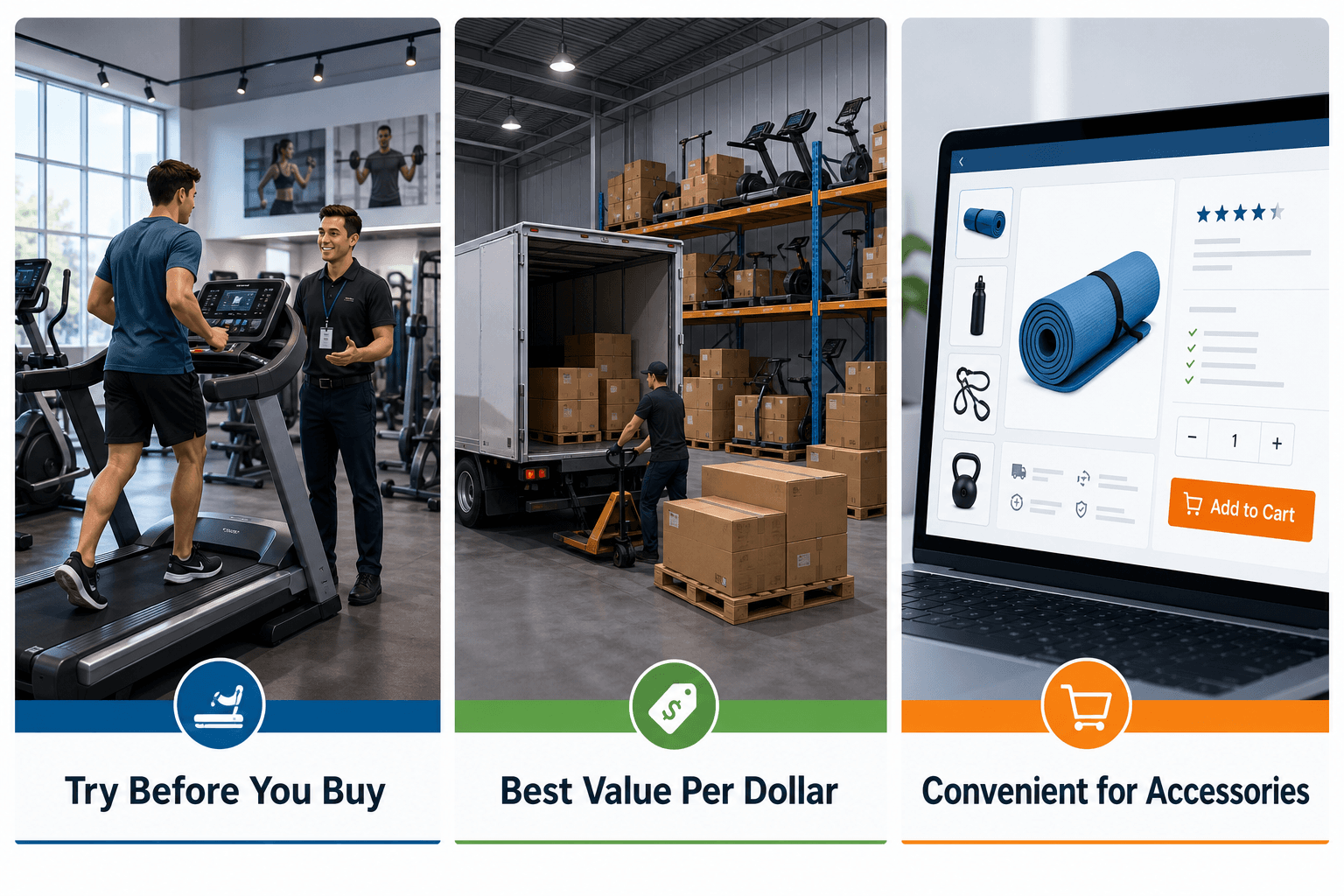
The Three-Factor Framework: How to Decide Where to Buy
The question of whether to buy exercise equipment in a physical store or online has no universal answer. A blanket recommendation — "always buy online for the best price" or "always buy in-store so you can test it" — ignores the reality that different equipment types carry different risks and benefits across channels. The right choice depends on three factors you must honestly assess before you start shopping.
Factor 1: Equipment Type and Category
Not all exercise equipment is created equal when it comes to the buying experience. Cardio machines — treadmills, ellipticals, exercise bikes — have ergonomics that vary significantly between models. The feel of a stride deck, the contour of a saddle, the noise level of a motor, and the reach to handlebars are all subjective. You cannot evaluate these from a spec sheet. Strength equipment — power racks, benches, barbells, dumbbells, plates — has more standardized dimensions and tolerances. A 45-pound plate is a 45-pound plate regardless of where you buy it. A power rack with a 1,000-pound weight capacity and 24-inch depth will perform the same function whether you see it in person or not.
Factor 2: Your DIY Comfort Level
Exercise equipment arrives in different states of assembly. Some items — like a set of kettlebells or a yoga mat — require zero assembly. Others — like a power rack or a treadmill — can take several hours and require specific tools. If you are comfortable with basic DIY tasks (using a socket wrench, reading an instruction manual, lifting heavy boxes), online purchases become more attractive because you can save on white-glove delivery fees. If you are not, the cost of in-store purchase often includes professional assembly and placement, which can be worth the premium.
Factor 3: Price-to-Weight Ratio and Shipping Complexity
The heavier and bulkier the item, the more shipping costs eat into any online savings. A 300-pound treadmill shipped via freight can cost $150 to $300 in delivery fees, and if you need to return it, you are often responsible for return shipping on a pallet-sized item. Lightweight accessories — resistance bands, foam rollers, heart rate monitors — have negligible shipping costs and are almost always better bought online. The price-to-weight ratio is a simple heuristic: if the item weighs more than 100 pounds and costs over $1,000, the shipping and return risk is high enough that in-store purchase deserves serious consideration.
- Lightweight (under 20 lbs): Almost always better online. Shipping is cheap, returns are easy.
- Medium (20–100 lbs): Online is usually fine, but check the return policy before ordering.
- Heavy (over 100 lbs): In-store or local pickup is lower risk. Freight shipping fees and return logistics can negate any price advantage.
When to Buy In-Store: Cardio Machines, Ergonomics, and Service
Physical retail stores remain the better choice for a specific set of scenarios. If your purchase falls into any of the following categories, visiting a showroom is worth the trip.
Cardio Machines Over $1,000
Treadmills, ellipticals, rowers, and exercise bikes in this price range are the strongest candidates for in-store purchase. The reason is simple: the ergonomic variables that determine whether you will actually use the machine — stride length, deck cushioning, seat comfort, handlebar position, noise level — cannot be evaluated from a product page. A treadmill that feels smooth in a showroom may have a jarring belt transition at home. An exercise bike with a saddle that seems fine in photos may become uncomfortable after 20 minutes of riding.
Stores like Johnson Fitness & Wellness (national chain with over 100 locations), Fitness Gallery (Denver area), Fitness Outlet (Washington and California), and Fitness Factory (Chicago) maintain showrooms where you can test multiple models side by side. This is particularly valuable for treadmills, where the feel of the belt, the responsiveness of the incline motor, and the stability of the frame at speed are all tactile experiences.
| Equipment Type | Why In-Store Matters | Key Things to Test |
|---|---|---|
| Treadmill ($1,000+) | Stride feel, deck cushioning, motor noise, belt alignment | Walk and run at multiple speeds; test incline at max setting |
| Elliptical ($1,000+) | Stride length, foot pedal angle, handlebar reach, smoothness | Use for 5+ minutes; adjust stride length if available |
| Exercise Bike ($800+) | Saddle comfort, handlebar reach, resistance feel, noise | Sit in riding position for 5 minutes; test resistance transitions |
| Rower ($800+) | Seat comfort, rail length, resistance type (air vs. magnetic), noise | Take 20–30 full strokes; check seat glide smoothness |
White-Glove Delivery and Assembly
Many brick-and-mortar retailers include white-glove delivery — where the store brings the equipment into your home, assembles it, and removes the packaging — as part of the purchase price or for a flat fee. For a heavy treadmill or an assembled elliptical, this service can save hours of work and avoid the frustration of a complex assembly process. Online retailers often charge extra for this service, and some do not offer it at all, leaving you to arrange freight delivery and assembly independently.
Local Service and Repair Support
If you live in an area with a dedicated fitness equipment store, the service relationship can be a significant advantage. Treadmills and ellipticals have motors, belts, electronics, and moving parts that will eventually need maintenance or repair. A local store that sold you the machine is more likely to service it — or at minimum, can recommend a local technician. Online-only purchases often require you to troubleshoot with a remote customer service team and ship parts yourself.
When to Buy Online: Strength Equipment, DTC Brands, and Accessories
Online shopping excels for equipment categories where specifications matter more than subjective feel, and where direct-to-consumer (DTC) brands offer better value by cutting out retail overhead.
Strength Equipment: Racks, Benches, Plates, and Dumbbells
Power racks, weight benches, barbells, weight plates, and dumbbells have largely standardized dimensions and performance characteristics. A REP PR-1100 power rack, for example, has a 1,000-pound weight capacity, 24-inch depth, and 72-inch height — specs that are identical whether you see the rack in person or order it online. The same applies to bumper plates, cast iron plates, and most barbells. The risk of buying sight unseen is low because the product's performance is determined by its engineering, not its ergonomic fit.
The price advantage of buying strength equipment online can be substantial. The REP PR-1100 rack is available online for around $380. A comparable power rack from a brand sold primarily through retail stores can cost $700 or more. That difference is not unusual — it reflects the DTC model's ability to offer better specs per dollar by eliminating the retail markup.
DTC Brands That Offer Better Value Per Dollar
Brands like REP Fitness, Rogue Fitness, Titan Fitness, and Bells of Steel operate primarily or exclusively online. They compete on value by offering commercial-grade specifications at consumer-grade prices. A Rogue Ohio Barbell, for instance, is a favorite among serious lifters and is available only through Rogue's website. You cannot find it in a retail showroom. If you want the best value in strength equipment, online is not just an option — it is often the only option.
Accessories and Small Items
Resistance bands, yoga mats, foam rollers, jump ropes, heart rate monitors, and other accessories are lightweight, inexpensive, and have no ergonomic variables that require in-person testing. Shipping costs are low or free, returns are straightforward, and the selection online is far broader than what any physical store can stock. There is no compelling reason to buy these items in-store.
| Equipment Type | Online Advantage | Risk Level |
|---|---|---|
| Power Racks | DTC brands offer better specs per dollar; standardized dimensions | Low — specs are objective |
| Weight Benches | Wider selection of incline/flat/adjustable options | Low — weight capacity and dimensions are clear |
| Barbells & Plates | Commercial-grade options at consumer prices | Low — performance is standardized |
| Dumbbells (Fixed) | Lower cost per pound; rubber vs. iron options | Low — weight is weight |
| Accessories | Broader selection; free shipping; easy returns | Very low |
The Hybrid Strategy: Test In-Store, Buy Smart
The most informed buyers use a hybrid approach: they visit a showroom to test equipment, then make a purchase decision based on the best total value — which may be from the store or from an online retailer.
How the Hybrid Strategy Works
- Identify the specific models you are considering. Use online research to narrow your list to 2–3 contenders.
- Visit a showroom that carries those models. Johnson Fitness & Wellness, Fitness Gallery, Fitness Outlet, and Fitness Factory are good starting points depending on your region.
- Test each model thoroughly. Spend at least 5–10 minutes on each machine. Take notes on what feels right and what does not.
- Ask the store about price matching. Some retailers will match online prices from authorized dealers, especially if you show them the competitor's price on your phone.
- If the store cannot match the online price, calculate the total delivered cost from both channels — including shipping, assembly, and any warranty differences. The store's white-glove service may be worth the premium.
Channel-by-Channel Guidance with Real 2026 Price Examples
The following table provides specific guidance for common equipment categories, using real price examples from 2026 data to illustrate the channel trade-offs.
| Equipment Type | Recommended Channel | Example 2026 Pricing | Key Considerations |
|---|---|---|---|
| Treadmill ($1,000+) | In-store | NordicTrack 1750: ~$1,800 in-store vs. ~$1,700 online + $200 freight | Test stride, cushioning, noise. White-glove delivery often included in-store. |
| Exercise Bike ($800+) | In-store | Peloton Bike+: ~$2,500 in-store vs. ~$2,500 online (same price) | Saddle comfort and handlebar reach are critical. Same price makes in-store the better choice. |
| Power Rack (under $1,000) | Online | REP PR-1100: ~$380 online vs. comparable rack at $700+ in-store | Standardized specs. DTC brands offer significantly better value. |
| Weight Bench ($150–$500) | Online | REP FB-5000: ~$300 online vs. $400+ in-store | Weight capacity and dimensions are objective. Online selection is broader. |
| Barbell ($150–$400) | Online | Rogue Ohio Barbell: ~$300 online (not available in-store) | DTC brands dominate this category. In-store options are limited. |
| Dumbbell Set ($200–$600) | Online | REP Quick-Draw Set: ~$500 online vs. $600+ in-store | Rubber hex dumbbells are standardized. Online has more weight increments. |
| Adjustable Dumbbells ($300–$600) | Online | Bowflex SelectTech 552: ~$400 online vs. $450 in-store | Check return policy — adjustable dumbbells have more mechanical parts that can fail. |
| Resistance Bands ($20–$50) | Online | Rogue Monster Bands: ~$40 online vs. $50 in-store | Lightweight, free shipping, broader selection online. |
| Yoga Mat ($20–$100) | Online | Manduka PRO: ~$100 online vs. $120 in-store | Thickness and material preferences are subjective, but reviews are sufficient. |
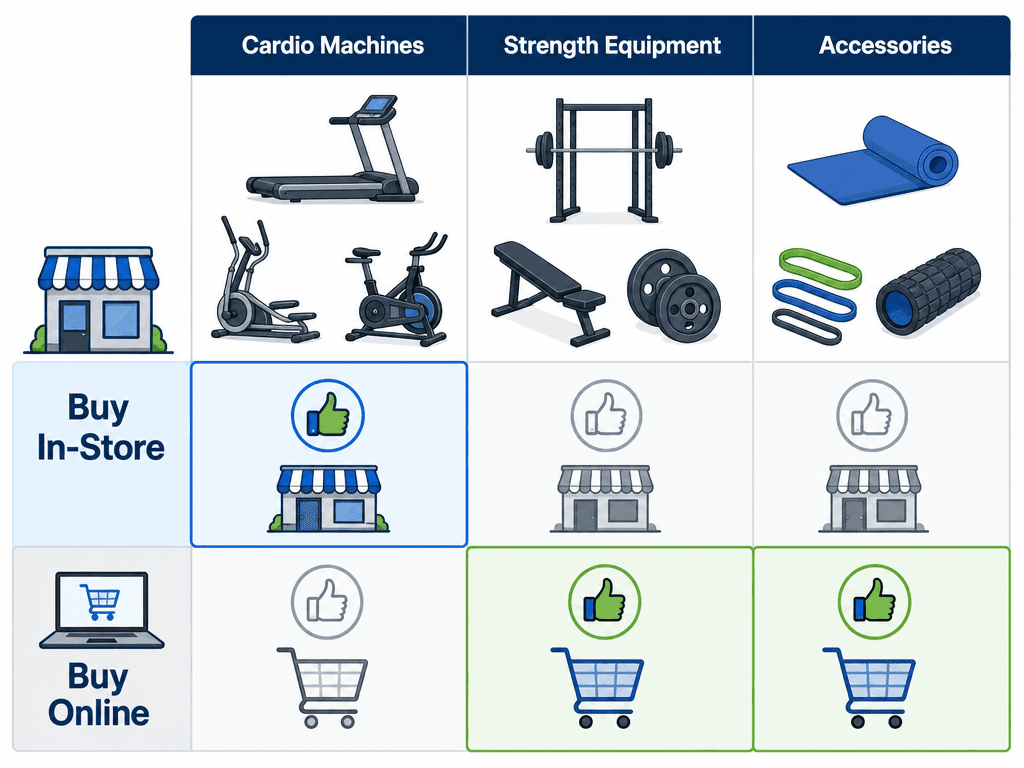
The pattern is clear: for cardio machines over $1,000, in-store purchase is generally the safer choice because the ergonomic variables are too important to evaluate remotely. For strength equipment and accessories, online purchase offers better value and broader selection.
Red Flags for Each Channel: What to Watch Out For
Both channels have pitfalls. Knowing what to watch for can prevent a costly mistake.
In-Store Red Flags
- Limited selection: Many physical stores only carry a handful of brands and models. You may not find the DTC brands that offer the best value.
- Higher prices: Retail overhead means prices are often 10–30% higher than online for the same model. Always check online prices before committing.
- Pushy sales tactics: Commission-based sales staff may steer you toward higher-margin models rather than the best fit for your needs.
- Lack of price transparency: Some stores do not display prices on the floor. You have to ask, which makes comparison shopping difficult.
Online Red Flags
- High shipping costs: Freight shipping on heavy items can cost $150–$300. Always calculate the total delivered price, not just the product price.
- Difficult returns: Returning a 300-pound treadmill purchased online often means arranging freight pickup at your own expense. Some retailers charge restocking fees of 15–25%.
- Assembly requirements: Many online purchases arrive in multiple boxes requiring hours of assembly. If you are not comfortable with DIY, factor in the cost of hiring a local assembler.
- Buying used cardio equipment sight unseen: The Reddit r/treadmills community strongly advises against buying used treadmills or ellipticals online without inspecting them in person. Belt wear, deck condition, motor health, and electronic issues are impossible to assess from photos.
The Middle Ground: Refurbished Equipment from Professional Dealers
Refurbished equipment from professional dealers offers a middle ground between the in-store and online channels. Companies like Gym Pros offer a 30-point certified refurbishment process on commercial-grade equipment, with warranties that consumer-grade equipment often lacks. This option is worth considering if you want commercial durability at a consumer price point, but it requires the same caution as any online purchase — verify the dealer's reputation, warranty terms, and return policy before committing.
Final Verdict: Match the Channel to the Equipment, Not the Other Way Around
The decision between buying exercise equipment in-store or online comes down to a simple principle: match the channel to the equipment type, not the other way around. Do not decide "I always buy online" or "I only buy in-store" and then try to fit every purchase into that preference. Instead, assess each purchase against the three-factor framework: equipment type, your DIY comfort level, and the price-to-weight ratio.
For cardio machines over $1,000, the in-store advantage is clear: you need to test ergonomics, and white-glove delivery and local service are valuable. For strength equipment, the online advantage is equally clear: DTC brands offer better specs per dollar, and standardized dimensions make sight-unseen purchase low-risk. For accessories, online is the obvious choice.
The hybrid strategy — test in-store, then buy from the channel that offers the best total value — is the most informed approach. It requires more effort, but for a high-consideration purchase that you will use for years, that effort is well invested.
Comments
Join the discussion with an anonymous comment.