
The $190 bike that outlasts the $340 bike
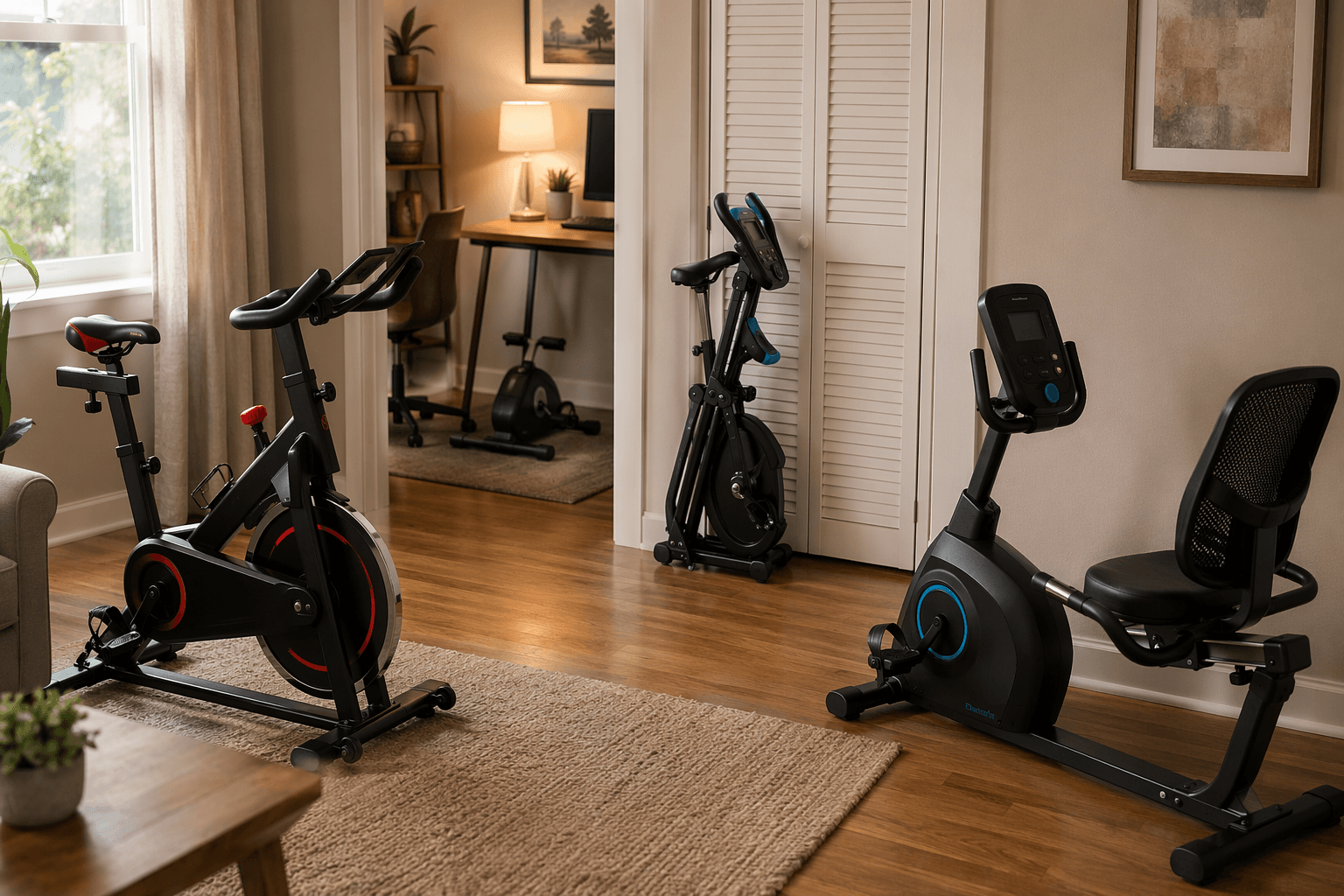
If you think a $340 bike is always better than a $190 one, you’re right about half the time. The Marcy Foldable Upright Exercise Bike costs $189 and sits on a 14-gauge steel frame with a 2-year warranty. The Yosuda Indoor Cycling Bike costs $340 — nearly double — and has a 35-lb flywheel with friction resistance and a 1-year parts-only warranty. The Marcy is cheaper and more durable for anyone who plans to ride more than twice a month.
This pattern repeats across every price tier. Best value is not about price alone; it’s about matching resistance type, warranty length, and subscription requirements to your actual weekly usage. Many buyers overpay for connected features they won’t use, or underspend on a bike that can’t handle regular riding. The Marcy has only 8 magnetic resistance levels and a 250-lb weight limit — fine for a beginner in a studio apartment, but a dead end for an intermediate rider who wants to push hard.
You may have seen the figure: the average cost of a worthwhile exercise bike is $1,409. That number comes from Garage Gym Reviews, based on testing over 25 bikes. It’s a useful benchmark, but it reflects one source’s methodology. Don’t treat it as a budget floor. There are excellent bikes well below that line — the Schwinn IC4, the Marcy, the Exerpeutic — and overpriced bikes above it.
The subscription trap
A bike’s retail price is only half the picture. Over five years, the gap between a subscription-free bike and a premium connected bike can be thousands of dollars.
| Bike | Price | Monthly Subscription | 5-Year True Cost |
|---|---|---|---|
| Peloton Bike+ | $2,695 | $44 | $5,335 |
| NordicTrack X24 | $2,299 | $39 (iFit family) | $4,639 |
| Schwinn IC4 | $999 | $0 | $999 |
| Peloton (used, $500 + $95 activation) | $595 | $44 | $3,235 |
The Schwinn IC4 — also sold as the BowFlex C6 — costs $999 and requires no subscription. It’s recommended by Wirecutter, Outdoor Gear Lab, and BarBend — a rare consensus across three independent testers. It delivers 100 levels of magnetic resistance, Bluetooth connectivity, and a 10-year frame warranty. Against the Peloton Bike+, it saves $4,336 over five years — enough to buy a second bike and still have cash left over.
Warranties tell you how long the bike will last
Manufacturers know exactly how long their bikes are designed to last. A 10-year frame warranty means the manufacturer expects the frame to hold up for a decade. A 1-year parts warranty means they expect parts to fail before year two. Here’s how the warranties stack up for the bikes most often recommended:
| Bike | Frame Warranty | Parts Warranty | Labor Warranty |
|---|---|---|---|
| Schwinn IC4 / BowFlex C6 | 10 years | 3 years | 1 year |
| Peloton Original | 5 years | 12 months parts & labor | 12 months |
| Marcy Foldable | 2 years | Not specified | Not specified |
| Industry Standard (GGR) | 10 years | 1 year | — |
The Schwinn IC4’s warranty is not just longer — it’s more comprehensive. Three years on parts means the manufacturer is covering the magnetic resistance unit, the console, and the drivetrain through the period when those components are most likely to fail. The industry standard of 10 years frame / 1 year parts is common, but the IC4 exceeds it on parts coverage.
Space and resistance: two limits you can't ignore
A bike’s footprint is the first thing to check after price. The average exercise bike takes up 8 square feet, but folding models can shrink to under 2 square feet when stored. Quick breakdown:
- Compact (< 6 sq ft): Marcy Foldable (4 sq ft, 37 lbs), Exerpeutic Folding Magnetic (4.09 sq ft, 300-lb limit), DeskCycle 2 (under-desk, 23 lbs)
- Standard (6–10 sq ft): Schwinn IC4 (~7.2 sq ft), Yosuda YB001R (~6.11 sq ft)
- Large (10+ sq ft): Schwinn 290 Recumbent (12.8 sq ft), NordicTrack X24 (~9.1 sq ft)
For a deeper look at small-space options, see our full guide to Best Exercise Bikes for Small Spaces and Apartments. And if you are planning a complete compact gym, the Compact Home Gym by Space Tier guide shows what you can build in 10, 30, 50, or 100 square feet.
Resistance levels and weight limits are the other hidden ceiling. A bike with only 8 resistance levels is fine for a pure beginner who rides twice a week for light aerobic work. But if you plan to progress — increase intensity, follow structured training, or ride for more than 20 minutes — you will hit the ceiling fast. The Marcy has 8 levels. The Schwinn IC4 has 100. Magnetic resistance is quieter and more consistent than friction (which uses felt pads that wear down). The Yosuda uses friction. Every tester across all sources agrees: magnetic resistance wins for home use. Weight limit also matters: 250 lbs (Marcy) vs 330 lbs (Schwinn IC4) vs 350 lbs (NordicTrack X24).
Three scenarios that match the bike to your week
I want Peloton-quality without the subscription
Get the Schwinn IC4 ($999). 100 levels of magnetic resistance, 10-year frame warranty, Bluetooth for Peloton and Zwift app compatibility, no required subscription. You can use the free JRNY app or any third-party app without an extra fee. The build quality is consistent with the $2,000+ class without the recurring cost.
I need something for a studio apartment
The Marcy Foldable ($189) or Exerpeutic Folding Magnetic ($190) are the best space-to-value picks. Both fold to under 4 sq ft, weigh under 40 lbs, and support 250–300 lbs. For something even smaller, the DeskCycle 2 ($199) fits under a desk and pairs with Apple Watch or Fitbit. See the Renter's Guide to a Compact Home Gym for noise and storage tips.
I'm recovering from a knee injury
A recumbent bike provides a lower-impact, more supported position. The Schwinn 290 Recumbent ($799) offers 25 magnetic levels, a 10-year frame warranty, and a 330-lb weight limit. Its seat is wider and more comfortable for longer sessions, and the pedals are positioned forward to reduce knee strain.
The $95 trap: used Peloton isn't always a deal
Used Peloton bikes often sell for $500–$700. That looks like a bargain against the original $1,445 price. But here’s the cost the market doesn’t advertise: Peloton charges a $95 used equipment activation fee. You still pay $44 per month for the subscription. Over three years, a used Peloton costs $2,279 — nearly the same as a new Schwinn IC4 plus zero subscription. The activation fee alone covers a year of JRNY free content on the IC4. The $95 figure comes from Outdoor Gear Lab, and it’s still active. If you’re considering a secondhand Peloton, factor in that fee and the subscription before you compare price tags.
The right bike is the one you'll ride three times a week next year
No single bike is best for everyone. But the decision framework is simple: match resistance type, warranty length, and subscription cost to your actual weekly usage. If you ride twice a week and never plan to push intensity, a $190 folding bike with 8 levels is fine — just know that it has a low ceiling. If you ride four times a week and want to improve, a $999 subscription-free bike with 100 levels and a 10-year warranty pays for itself in longevity alone.
Skip the subscription if you don’t use the content. Don’t skip the warranty if you ride consistently. The best exercise bike for home is the one that fits your space, matches your level, and has a frame warranty longer than your commitment to ride.
Comments
Join the discussion with an anonymous comment.