
8-Week Home Gym Workout Plan for Adjustable Dumbbells and Bench
This 8-week progressive training plan is built specifically for adjustable dumbbells and a weight bench — the most common home gym combination. Using double progression and science-based volume targets, it provides a complete roadmap for strength and muscle gains without requiring additional equipment.
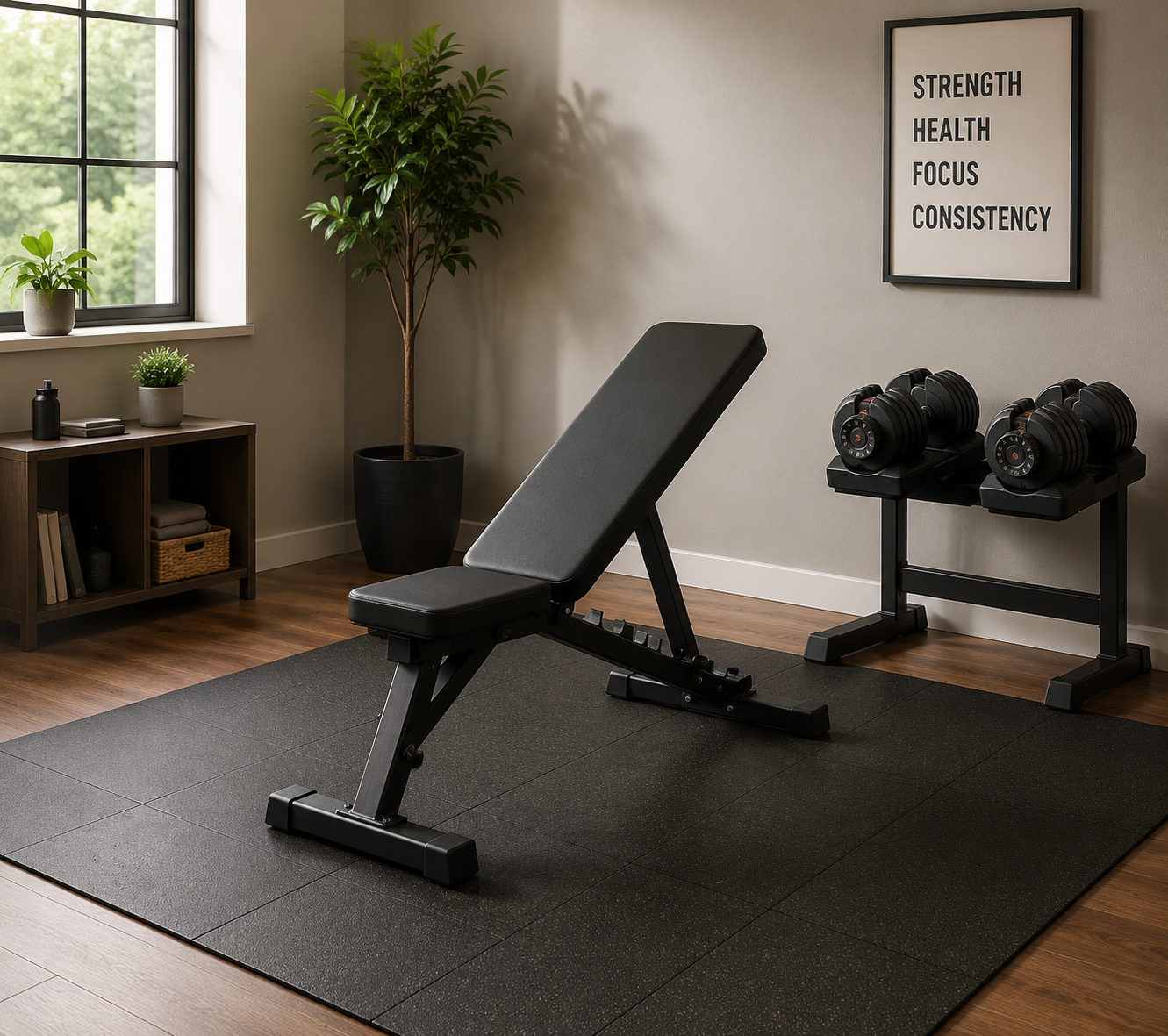
If your home gym is an adjustable dumbbell pair, a flat-to-incline bench, and enough floor space to step around both, this plan is built for that exact room. It does not assume a rack, cables, machines, pull-up bar, bands, or a “temporary” equipment upgrade in week four.
That setup can support meaningful strength and muscle progress for beginners and early intermediates when the programming is honest: compound lifts first, each major muscle trained repeatedly across the week, and double progression used so awkward dumbbell jumps do not derail the cycle. The popular Muscle & Strength dumbbell plan has drawn 10.5 million reads and uses an 8-week, 3-day full-body format with 45-minute sessions, which is worth noticing less as proof and more as a sign that this structure matches how many people can actually train at home.[1]
Who This 8-Week Plan Is For
Use this home gym workout plan if you can train three nonconsecutive days per week and your adjustable dumbbells are heavy enough that pressing, rowing, squatting, and hinging feel challenging inside normal rep ranges. Most beginners and early intermediates will get more from repeating these movements well than from rotating through a new exercise menu every week.
The plan assumes a bench that can lie flat and incline. If your bench is flat-only, you can still run the program by replacing incline presses with flat presses or floor presses, but the shoulder and upper-chest angles become less varied. If you are still deciding whether dumbbells and a bench are the right tier for your space, start with A Home Gym Workout Plan That Grows With Your Equipment before committing to this eight-week cycle.
This is not a maximal strength plan. Dumbbells are excellent, but they do not load like a barbell for very strong squatters, deadlifters, or bench pressers. This is also not a random “dumbbell burner.” The goal is to make the same few lifts measurable for eight weeks, then decide whether your equipment still matches your strength.
The Weekly Schedule
Train three days per week, leaving at least one day between sessions. A Monday-Wednesday-Friday schedule is the cleanest version, but Tuesday-Thursday-Saturday works just as well. The point is not the calendar; it is recovery between full-body sessions.
| Day | Workout | Main Emphasis | Expected Time |
|---|---|---|---|
| Day 1 | Workout A | Squat pattern, horizontal press, row | 40–50 minutes |
| Day 2 | Workout B | Hinge pattern, incline press, single-leg work | 40–50 minutes |
| Day 3 | Workout C | Unilateral legs, vertical-ish press, upper-back volume | 40–50 minutes |
Across the week, the major muscle groups are trained at least twice, with the larger muscles landing near the broad hypertrophy target of roughly 10 weekly sets. ACSM’s 2026 resistance training update supports training each muscle group at least twice weekly, using about 10 sets per muscle group per week for hypertrophy, resting 2–3 minutes on compound lifts, and treating home-based resistance training with tools like dumbbells as legitimate training rather than a consolation prize.[2]
If your space is still coming together, solve the boring room problems before the first workout: bench clearance, dumbbell storage, and flooring. The Compact Home Gym Decision Guide, Compact Home Gym Comparison, and home gym flooring guide are better places for those decisions than the middle of a training cycle.
Workout A
| Order | Exercise | Sets | Rep Range | Tempo | Rest | Target Effort |
|---|---|---|---|---|---|---|
| 1 | Dumbbell goblet squat | 3 | 8–12 | 3 seconds down, brief pause, controlled up | 2–3 minutes | RPE 7–8 |
| 2 | Flat dumbbell bench press | 3 | 8–12 | 2 seconds down, controlled press | 2–3 minutes | RPE 7–8 |
| 3 | One-arm dumbbell row | 3 per side | 10–15 | Full stretch, controlled pull, brief squeeze | 90–120 seconds | RPE 8 |
| 4 | Dumbbell Romanian deadlift | 2 | 8–12 | 3 seconds down, hips back, stand tall | 2 minutes | RPE 7–8 |
| 5 | Dumbbell lateral raise | 2 | 12–20 | Smooth lift, slow lower | 60–90 seconds | RPE 8–9 |
| 6 | Bench-supported dead bug or plank | 2 | 30–45 seconds | Controlled breathing | 60 seconds | Stop before form breaks |
Workout A starts with the lift most likely to expose limited loading: the goblet squat. If your dumbbells are already too light for goblet squats, slow the descent and pause at the bottom before rushing to buy something else. If that still leaves the set easy, the plan later moves you toward split squats and Bulgarian split squats, where the same dumbbell load becomes more useful.
The flat press and one-arm row are the anchors. Keep them boring. Same bench angle, same grip style, same range of motion, same logbook. If one side rows 12 clean reps and the other side only rows 10, record the weaker side and progress from there.
Workout B
| Order | Exercise | Sets | Rep Range | Tempo | Rest | Target Effort |
|---|---|---|---|---|---|---|
| 1 | Dumbbell Romanian deadlift | 3 | 8–12 | 3 seconds down, brief stretch, controlled up | 2–3 minutes | RPE 7–8 |
| 2 | Incline dumbbell bench press | 3 | 8–12 | 2 seconds down, controlled press | 2–3 minutes | RPE 7–8 |
| 3 | Rear-foot-elevated split squat | 3 per side | 8–12 | Controlled down, light pause, drive up | 2 minutes | RPE 8 |
| 4 | Chest-supported dumbbell row | 3 | 10–15 | Pause against bench support, slow lower | 90–120 seconds | RPE 8 |
| 5 | Dumbbell curl | 2 | 10–15 | No swing, full lower | 60–90 seconds | RPE 8–9 |
| 6 | Dumbbell calf raise | 2 | 12–20 | Pause at top and bottom | 60–90 seconds | RPE 8–9 |
Workout B is where the bench earns its floor space. The incline press gives you a different pressing angle without pretending you own a cable station, and the chest-supported row removes low-back fatigue after Romanian deadlifts and split squats. That matters in a small setup because the same pair of dumbbells often has to train legs, back, and arms in one session.
BetterMe’s home dumbbell guidance uses RPE targets and tempo prescriptions alongside double progression, which fits this kind of plan well: the load is only one way to progress, not the only way to make a set harder.[3]
Workout C
| Order | Exercise | Sets | Rep Range | Tempo | Rest | Target Effort |
|---|---|---|---|---|---|---|
| 1 | Dumbbell front-foot-elevated split squat or regular split squat | 3 per side | 8–12 | Slow down, light pause, controlled up | 2 minutes | RPE 8 |
| 2 | Seated dumbbell shoulder press | 3 | 8–12 | Controlled lower, steady press | 2–3 minutes | RPE 7–8 |
| 3 | Dumbbell hip thrust on bench | 3 | 10–15 | Pause at top, controlled lower | 90–120 seconds | RPE 8 |
| 4 | Incline dumbbell row or bench-supported row | 3 | 10–15 | Full stretch, clean pull | 90–120 seconds | RPE 8 |
| 5 | Lying dumbbell triceps extension | 2 | 10–15 | Controlled lower, elbows steady | 60–90 seconds | RPE 8–9 |
| 6 | Suitcase carry in place or slow march | 2 per side | 30–45 seconds | Tall posture, no leaning | 60 seconds | Stop before posture slips |
Workout C is not a novelty day. It fills the weekly volume gaps and gives the lower body a harder unilateral stimulus. For many home trainees, split squats and hip thrusts will remain useful longer than goblet squats because they make moderate dumbbells feel heavy without needing a rack.
Jeff Nippard’s minimalist programming framework emphasizes keeping sessions efficient by selecting exercises that cover a lot of muscle with limited time and equipment. That is the right standard here: every movement should either load a major pattern or solve a specific gap left by the larger lifts.[4]
How to Progress for All 8 Weeks
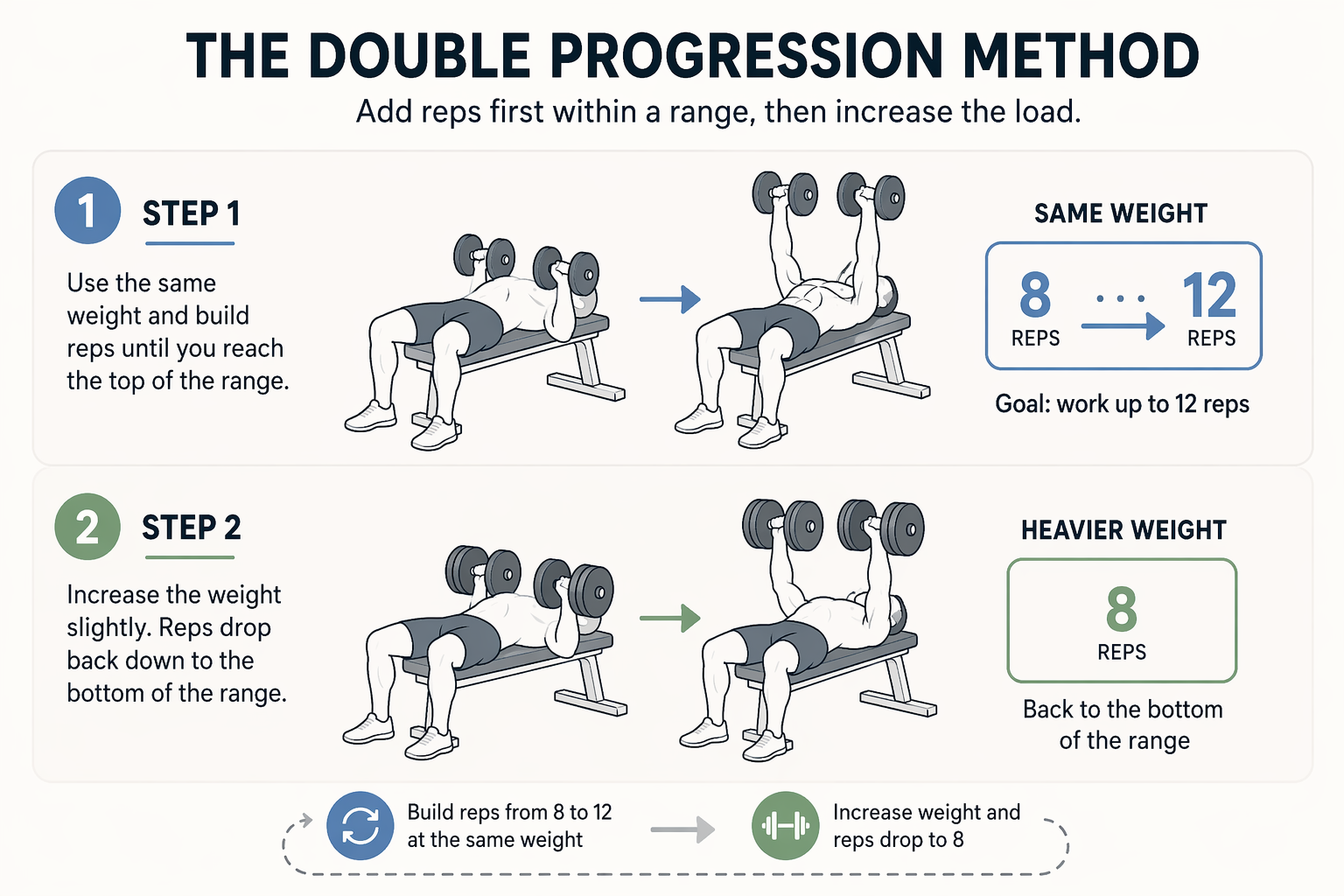
Double progression is the rule for almost every exercise in this plan: keep the same weight until you can hit the top of the rep range for all prescribed sets with the target effort and clean form. Then increase the dumbbell load at the next session and let the reps fall back toward the bottom of the range.
| Week | What to Do | How Hard It Should Feel |
|---|---|---|
| 1 | Find starting loads you can control near the lower-middle of each rep range | RPE 6–7, with several reps in reserve |
| 2 | Add 1 rep per set where form stayed clean in week 1 | RPE 7–8 on most work sets |
| 3 | Keep adding reps until sets approach the top of the range | RPE 7–8, occasional RPE 9 on small accessories |
| 4 | Increase weight only on exercises where all sets reached the top of the range | RPE 8 after the load jump, reps may reset lower |
| 5 | Build reps again at the new loads | RPE 7–8 on compounds |
| 6 | Push toward the top of the ranges without grinding | RPE 8, accessories may reach RPE 9 |
| 7 | Attempt final rep-range improvements or small load increases where earned | Hard but clean; no repeated failure |
| 8 | Deload, test rep quality, or transition depending on recovery and equipment limits | Reduced fatigue, sharper technique |
A clean example: if your flat dumbbell press is programmed for 3 sets of 8–12, you might use a weight that gives you 10, 9, and 8 reps in week 1. Next time, aim for 10, 10, and 9. When you can press 12, 12, and 12 with the same range of motion and no ugly last reps, increase the dumbbells and start again around 8–10 reps.
Do not increase weight because the first set felt good. Increase weight because all working sets reached the top of the range. That distinction prevents the classic home-gym stall: one heroic first set, two collapsing back-off sets, and no idea whether strength actually improved.
When Dumbbell Jumps Are Too Large
Adjustable dumbbells often jump in bigger increments than your shoulders, elbows, or smaller muscles want. If the next weight makes your reps drop below the bottom of the range, use one of these options before declaring the plan broken:
- Add reps first: stay with the current load until every set is at the top of the range.
- Slow the eccentric: use a 3-second lower on presses, rows, squats, and Romanian deadlifts.
- Add a pause: hold the hardest safe position for 1 second, such as the bottom of a split squat or stretched position of a row.
- Add a set only when needed: for one lagging movement, add 1 working set, then remove it after the next successful load increase.
- Use a harder variation: move from goblet squat to split squat, from regular split squat to rear-foot-elevated split squat, or from hip thrust to single-leg hip thrust.
The extra set is the option to use sparingly. More work is not automatically better when the plan already places most major muscles near the intended weekly volume. The cleaner fix is usually better reps at the same load.
How Close to Failure to Train
Most compound sets should end around RPE 7–8, meaning you likely had 2–3 good reps left. Accessories can drift closer to RPE 9 because lateral raises, curls, and triceps extensions are less systemically costly than hard Romanian deadlifts or split squats.
Failure is not banned, but it should not become the tracking method. If your logbook only improves when every session turns into a test, you are collecting fatigue as much as strength. A useful set is repeatable enough that next week’s performance still tells you something.
Warm-Up, Rest, and Session Flow
Start each session with 5 minutes of easy movement and two lighter ramp-up sets for the first lower-body lift and first press. The ramp-up sets are not working sets. They prepare the joints, practice the movement, and help you choose the day’s real load.
| Training Piece | Rule |
|---|---|
| Compound lifts | Rest 2–3 minutes between hard sets |
| Rows and secondary compounds | Rest 90–120 seconds |
| Isolation work | Rest 60–90 seconds |
| Tempo | Control the lowering phase; do not bounce through the hardest position |
| Logging | Record weight, reps, RPE, and any form change that affected the set |
If you want an app to track the plan instead of using a notebook, choose one that lets you repeat custom workouts and record reps by set. The limited-equipment strength training app guide is the better fork for that decision.
Week 8: Deload or Transition
Week 8 is not a punishment week and not a dramatic test week. Use it to reduce fatigue and decide whether the same setup still has runway.
| Situation at the End of Week 7 | Week 8 Choice |
|---|---|
| Most lifts are still progressing and joints feel good | Deload by doing the same workouts with 2 sets per exercise and RPE 6–7 |
| Reps are improving but several load jumps are still too large | Keep the same loads, reduce one set per exercise, and sharpen tempo |
| Lower-body work is too easy even with slower reps and harder unilateral variations | Finish the deload, then move to a higher equipment tier or add heavier loading options |
| You feel run down, sleep is poor, and performance has dropped across multiple sessions | Take the deload seriously before restarting; do not test max reps |
The anecdotal side of home dumbbell training is useful only when kept in its lane. A Muscle & Strength commenter reported progressing from 20 lb to 40 lb dumbbells over 12 months while losing 43 lb, but that is a human example of long-term consistency, not a controlled promise attached to this plan.[1]
After the 8 Weeks
If most exercises are still landing in the middle of their rep ranges and the load feels challenging, repeat the cycle with the same A/B/C structure. Change as little as possible: start week 1 of the new cycle with the loads you earned, keep the same progression rules, and let the logbook tell you where the next bottleneck is.
If only one or two lifts are limited by dumbbell weight, adjust those lifts rather than rebuilding the whole plan. Goblet squats can become split squats. Hip thrusts can become single-leg hip thrusts. Flat presses can use a slower eccentric and a pause. Rows can use stricter bench support and a full stretch.
If several major lifts are too easy even with stricter tempo, harder variations, and clean top-range reps, the setup has done its job. Continue only if you can still make the work measurable. Otherwise, move back to the broader equipment-tier path and decide whether heavier dumbbells, a rack, a barbell, or another loading option is the next honest step.
References
- 3 Day Full Body Dumbbell Workout, Muscle & Strength
- ACSM 2026 Resistance Training Guidelines, ACSM
- 3-Day Full-Body Workout Plan at Home (Dumbbell Only Required), BetterMe
- The Best Science-Based Minimalist Workout Plan (Under 45 Mins), Jeff Nippard
What a small equipment investment adds
We don't have a build tagged to this exact tier yet. Browse all builds.
How often should you repeat this?
See our recovery and rest reference for citation-anchored rest-interval guidance.
Spot something off?
Tell us if a movement, tier assumption, or duration didn't match your experience.