
How to Choose Home Gym Flooring Based on Your Training, Space, and Budget
A decision framework that helps you select the right home gym flooring by evaluating workout type, location constraints, and budget — no single material works for every setup.
Items included: —
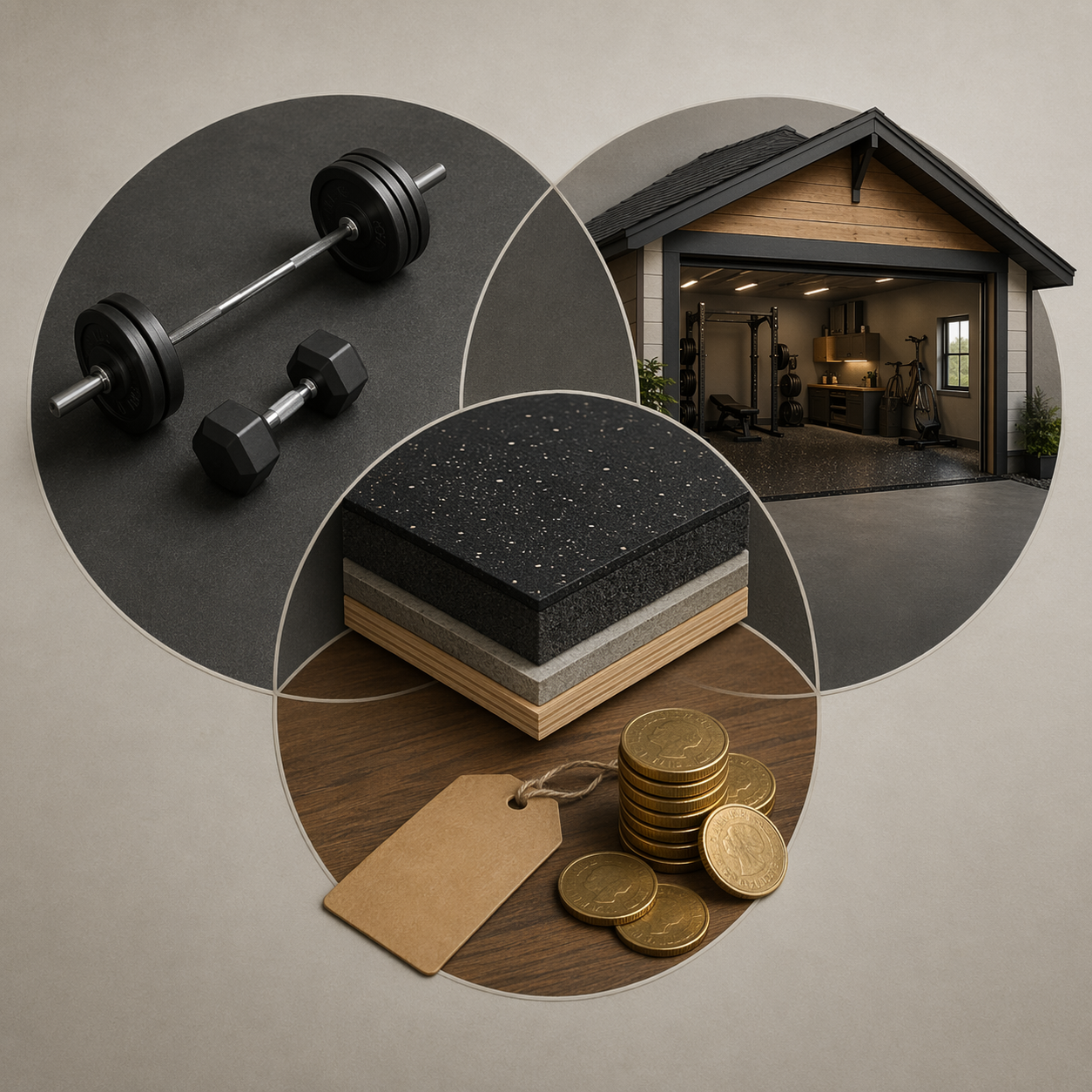
Most home gym flooring mistakes happen before anyone compares brands. The real question is simpler and more annoying: what are you asking the floor to survive? A yoga corner, a dumbbell setup, a garage rack, and a second-floor apartment workout space do not need the same surface. If you start with “best home gym flooring,” you will probably overbuy in one direction and under-protect in another.
Use three filters before you buy: your training style, your room, and your budget. Training decides thickness and density. Location decides smell, moisture, seams, noise expectations, and whether you can install something semi-permanent. Budget decides whether you are looking at foam, stall mats, rubber rolls, interlocking rubber tiles, or a platform instead of full-room coverage.
Start with the punishment, not the product
Rubber is the default recommendation for a reason. It is durable, grippy, and better at handling impact than foam in strength areas. REP Fitness describes rubber as a leading choice for gym flooring because of durability, shock absorption, and slip resistance; Garage Gym Reviews and Gray Matter Lifting reach similar practical conclusions after testing and long-term use in home gym settings.[1][2][3]
That still does not make rubber one-size-fits-all. A 3/4-inch stall mat can be a bargain in a garage lifting bay and a bad roommate in a tiny spare bedroom if the rubber odor hangs around. Foam can be perfectly reasonable for stretching and light bodyweight work, then feel squishy and unsafe under a loaded squat. Thickness matters, but density and use matter just as much.
| If you mainly do this | Start your search here | Watch out for |
|---|---|---|
| Yoga, mobility, stretching, light bodyweight work | Foam, rug-style exercise mats, thin rubber if you want a firmer surface | Foam compression and poor stability under heavy loads |
| General fitness with light dumbbells or machines | Around 8mm rubber, firmer modular tiles, or quality mats | Buying very thick soft foam and making balance worse |
| Dumbbell strength and rack work without dropping weights | Dense rubber tiles, rolls, or stall mats in the lifting zone | Thin flooring over fragile tile or uneven subfloors |
| Deadlifts, Olympic lifts, or regular heavy dropping | 1/2-inch rubber minimum, 3/4-inch rubber or a platform for frequent heavy drops | Assuming rubber alone will protect every building structure or silence impact |
| Heavy lifting in a garage | 3/4-inch stall mats or a DIY platform | Odor, mat weight, seams, and moisture under the mats |
Match flooring thickness to training style
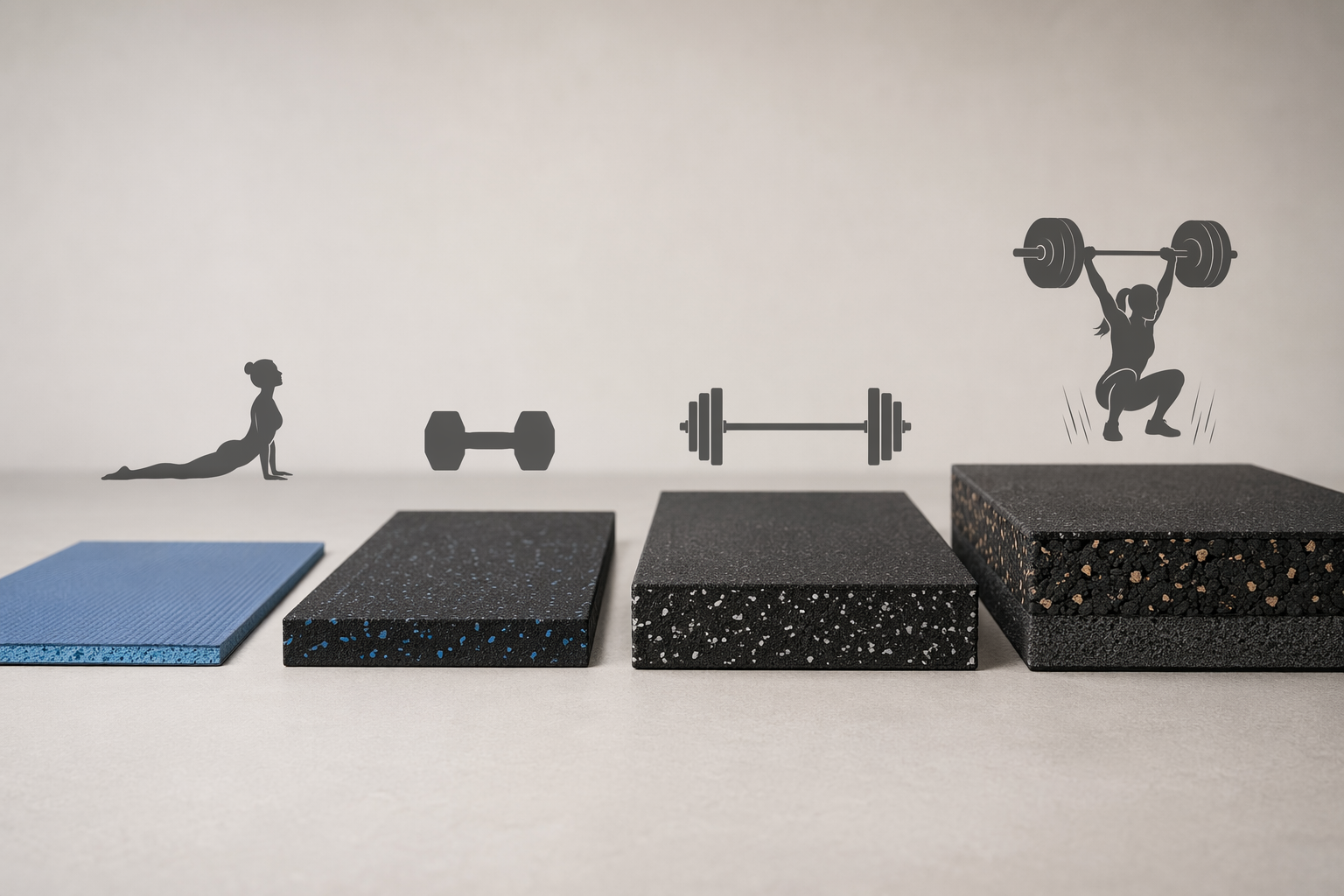
A useful thickness rule comes from Garage Gym Reviews’ 2026 guide, which cites Olympian Caine Wilkes: 8mm, or about 0.31 inch, for general fitness where weights are not being dropped; 1/2 inch minimum if weights are dropped from overhead; and 3/4 inch for regular heavy dropping.[4] That is one expert’s framing, not a law of physics, but it lines up with the broader direction of rubber flooring advice: the harder the impact, the more dense material and thickness you need.
Yoga, mobility, and bodyweight training
For yoga, stretching, mobility, Pilates-style work, and light bodyweight training, the floor is mostly there for comfort, grip, and a defined workout zone. Foam can work here. It is usually inexpensive, easy to move, and nicer on knees and elbows than bare concrete or hardwood.
The trouble starts when foam gets treated like strength flooring. Foam mats commonly cost under $1.50 per square foot, but multiple flooring guides caution that foam compresses under heavy weights and does not provide the same stable surface as rubber.[2][5][6] That compression is not just cosmetic. If a dumbbell stand sinks, a bench rocks, or your feet shift during a loaded lift, the bargain surface is now part of the risk.
General fitness and light dumbbell work
For circuits, light dumbbells, kettlebell work where you are not dropping the bell, adjustable bench work, and machine-based training, 8mm rubber is often enough. It gives you a firmer, more durable surface than foam without turning a spare room into a horse stall. It also keeps rolling dumbbells and bench feet more predictable than soft foam.
This is where people often overcorrect. A thicker floor is not automatically a better floor. A thick but soft mat can feel worse under lunges, split squats, or heavy dumbbell presses than a thinner, denser rubber surface. If you are not dropping weight, density and stability matter more than chasing the thickest listing.
Dumbbell strength, racks, and loaded benches
Once a rack, bench, heavier dumbbells, or loaded barbell work enters the room, foam should leave the main lifting area. Dense rubber tiles, rubber rolls, or stall mats make more sense because they resist compression and spread load better. The goal is not softness. The goal is a surface that stays put while the equipment and lifter move above it.
If the room has fragile tile, old hardwood, or an uneven subfloor, do not assume a thin mat will save it. Flooring can reduce scuffs and absorb some impact, but point loads from rack feet, dropped dumbbells, or a bar landing in the same spot repeatedly need a more serious plan. In small strength zones, that may mean thicker rubber only under the rack and lifting path instead of covering the whole room.
Deadlifts, Olympic lifts, and overhead drops
If weights are coming down hard, build for that reality. The 1/2-inch minimum for overhead drops and 3/4-inch recommendation for regular heavy dropping are good starting points.[4] For many garage lifters, that points straight to 3/4-inch stall mats or a lifting platform.
A DIY deadlift platform is worth considering when the heavy work happens in one lane. Garage Gym Reviews and Gray Matter Lifting both describe platform builds using two layers of 3/4-inch plywood with a 3/4-inch rubber top layer, creating roughly 1.5 to 2 inches of total protection depending on layout.[2][3] That can protect the lifting zone without paying for thick rubber across every square foot of the room.
There is a limit to what flooring can promise. Rubber helps with impact, grip, and surface protection. It does not magically soundproof a building. A loaded bar, box jumps, burpees, and repeated jumping can still send vibration through framing, concrete, and shared structures.
The room can overrule the material
A flooring choice can be technically durable and still wrong for where you live. Before ordering, picture the room after installation: who smells it, who hears it, who trips over the edge, who has to move it later, and what happens underneath when the floor gets damp.
Apartment corners
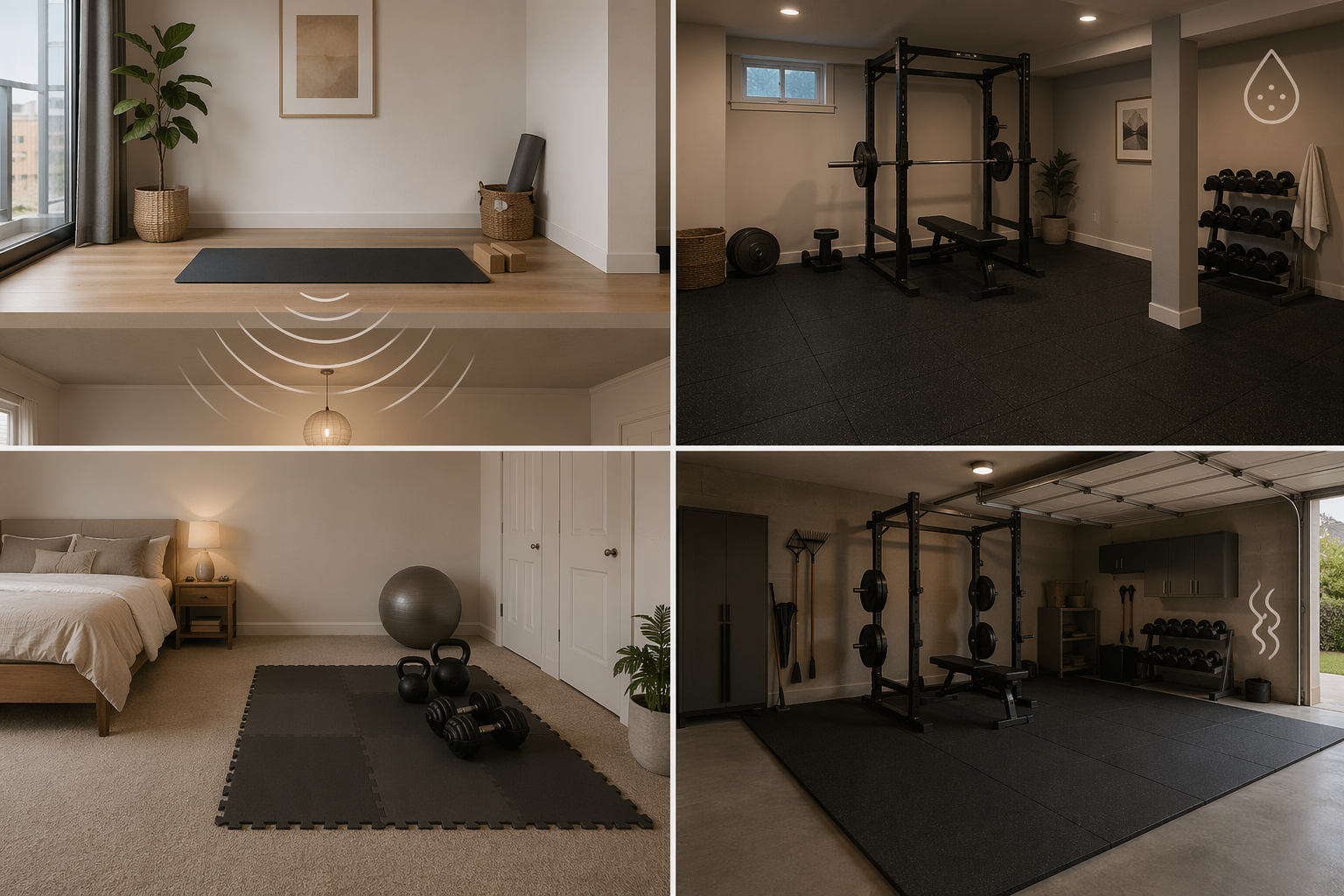
Apartment flooring has two jobs: protect the surface you rent and reduce avoidable impact. It should not be sold as a soundproofing fix. Rubber tiles or a dense exercise mat can quiet some clatter and make dumbbell handling less harsh, but jumping movements can still travel through the structure. If there is someone below you, exercise selection matters as much as flooring.
Interlocking rubber tiles often make sense in apartments because they are modular, easier to remove, and better for odd-shaped corners than rolls. Rug-style exercise mats can also work when the room has to look like a living room again by dinner. If you are still deciding what equipment belongs in that space, pair the flooring decision with a small-apartment setup plan like the Compact Home Gym Equipment Guide for Apartments.
Spare rooms and multipurpose rooms
A spare bedroom usually needs a cleaner compromise than a garage. Full stall-mat coverage may be durable, but 3/4-inch horse stall mats can have a strong rubber smell that lingers for weeks in enclosed spaces. That matters if the room also stores clothes, doubles as an office, or has weak ventilation.
In these rooms, interlocking rubber tiles, smaller rubber mats, or a defined platform area can be easier to live with. If the room is tiny, first confirm the footprint you actually have. A guide such as Compact Home Gym by Space Tier can keep you from buying 100 square feet of flooring for a training plan that only needs a rack lane and a warm-up mat.
Basements
Basements push moisture and seams higher on the list. Rubber rolls can be attractive because they create larger, cleaner runs with fewer seams than tiles. That helps when you want a more finished look or a broader training area. The trade-off is installation: rolls are heavier, harder to cut neatly, and less forgiving if you need to lift sections later.
Tiles are easier to stage and replace. If a basement has a column, closet jog, sump area, or awkward equipment layout, modular flooring may be worth the higher square-foot cost because mistakes are smaller and access stays simpler.
Garages
A garage is where stall mats shine. Concrete is already hard, the room usually tolerates an industrial look, and ventilation is better than in a bedroom. The classic 4-by-6-foot, 3/4-inch Tractor Supply stall mat has been cited around $2.38 per square foot, which is why garage gym builders keep coming back to it.[2][3] Pricing can vary by region and sale cycle, but the value-to-durability ratio is hard to ignore.
Still, check the garage before you cover it. Moisture, slope, cracked concrete, temperature swings, and vehicle use can change the right installation. Garage readers should use The Garage Gym Environmental Checklist before assuming thick rubber solves everything. For a broader look at expensive setup errors, the flooring section in 7 Garage Gym Mistakes That Cost You Money is also worth reading before the mats are unloaded.
Choose the format after you know the zone
Material gets most of the attention, but format determines how annoying the floor is to install, clean, move, and expand. The same rubber can behave very differently as a roll, tile, stall mat, or platform layer.
| Format | Best fit | Main compromise |
|---|---|---|
| Rubber rolls | Large basement or garage areas where seamless coverage matters | Heavy, harder to cut, less convenient to remove |
| Interlocking rubber tiles | Apartments, spare rooms, irregular layouts, renters | Usually higher cost per square foot |
| Horse stall mats | Garage lifting zones and heavy-use strength areas | Odor, weight, visible seams, industrial look |
| Foam tiles | Yoga, stretching, playroom-style bodyweight spaces | Compresses under heavy equipment and loaded lifting |
| Rug-style exercise mats | Multipurpose rooms where appearance and removability matter | Limited protection for heavy weights |
| DIY platform | Deadlift or Olympic lifting lane | Takes carpentry, height planning, and a fixed footprint |
Rolls make sense when you know the gym footprint is stable and you want fewer seams. Tiles make sense when you are renting, working around furniture, or building in stages. Stall mats make sense when you care more about impact durability than a finished-room look. A platform makes sense when the violence is concentrated in one place.
Use budget to narrow, not to justify the wrong surface
The rough mid-2026 price ladder looks like this: foam around $1.12 per square foot, stall mats around $2.38 per square foot, rubber rolls around $2.17 to $3 per square foot, interlocking rubber tiles around $5 to $10 per square foot, and poured rubber up to about $7.50 per square foot.[2][7][8] Those numbers are benchmarks, not guarantees. Region, shipping, thickness, finish, and sales can move the real price.
The useful lesson is the spread. Foam is cheap because it is solving a lighter-duty problem. Stall mats are cheap for how much abuse they take, but they bring odor, weight, and rougher aesthetics. Rolls can be cost-effective for larger areas, yet installation can be the catch. Interlocking rubber tiles often cost more, but the modularity may be worth it in rentals and odd rooms. Poured rubber is usually a specialty choice, not the first stop for a normal home gym.
If you want the full pricing breakdown by material and square footage, use the dedicated Home Gym Flooring Cost Per Square Foot Pricing (2026) guide. For this decision, the main budget move is to spend thick where impact happens and stay simpler where it does not.
A practical matching guide
If you lift heavy in a garage, start with 3/4-inch stall mats or a platform. That is the value play for most rack, deadlift, and barbell zones, as long as you can live with the smell, weight, seams, and garage-grade look.
If you want clean coverage across a basement or larger garage gym, rubber rolls are worth pricing. They are better when the layout is settled and you want fewer seams. They are worse when you expect to move, reconfigure, or frequently access the floor underneath.
If you rent, have an irregular small area, or need to build around furniture, interlocking rubber tiles may justify the higher cost. They let you cover only the training footprint, replace damaged pieces, and pull the floor up later with less drama than a full roll.
If you mostly do yoga, mobility, stretching, or light bodyweight workouts, foam can be adequate. Just do not promote it into heavy lifting duty. The same softness that feels good on knees can become wobble under load.
Once the floor is matched to the way you train, the next decision is equipment. A companion Home Gym Equipment Decision Framework can keep the same logic going: buy for the room you actually have, not the gym you saw in a product photo.
References
- What Type of Flooring Is Best for Your Home or Commercial Gym — REP Fitness
- Best Home Gym Flooring — Garage Gym Reviews
- The Best Home Gym Flooring — Gray Matter Lifting
- How Thick Should Gym Flooring Be? — Garage Gym Reviews, January 2026
- Rubber vs Foam Gym Flooring: Which One Should You Choose? — Living.Fit
- Interlocking Rubber Tiles vs Foam Gym Flooring — Rubber Flooring Direct
- Rubber Flooring Cost — HomeAdvisor, 2026
- How Much Does a Gym Floor Really Cost? A Square Foot Breakdown — The Final Floor, March 14, 2026
Some links on this page are affiliate links — they may earn us a commission at no extra cost to you. Our tier and tests are decided before we ever check which links pay; see our full affiliate disclosure.
Spot something off?
Noise and floor-damage claims carry real deposit-risk consequences if we get them wrong — tell us if your experience with this build didn't match what's above.