
No-Equipment MMA Workout Routine That Builds Real Power
Build real MMA strength and explosive power with only your bodyweight by using a force-velocity movement framework, eccentric tempos, and a balanced strength/power/speed split instead of chasing high reps.
- Equipment tier required
- none
- Duration
- 35 min
- Difficulty
- intermediate
- Target area
- full body
- Space footprint needed
- small (apartment-friendly)
- Noise level
- moderate
A no-equipment MMA home workout routine can build real power. The catch is that most home routines are not power training. They are fatigue management with fight words attached: max burpees, max push-ups, squat jumps until the landing gets ugly, then a sweaty caption about being built different.
That kind of work has a place if the goal is conditioning. It is a poor way to build a sharper sprawl, a harder frame, a quicker shot entry, or hips that fire when a scramble changes direction. For that, bodyweight training has to be organized by force and velocity, not by how many reps you can survive.
The useful question is not whether bodyweight exercises are “hard.” Plenty of useless things are hard. The useful question is whether a movement gives you a strength, power, or speed stimulus that transfers to fighting, and whether you can progress it without just adding more reps.
Stop Sorting Bodyweight Work by Body Part
Chest, legs, abs, cardio is gym-floor logic. It is not how a fight asks your body to produce force. In MMA, you are driving through the floor, changing levels, posting against pressure, recovering from bad positions, and switching between stiff frames and loose movement in fractions of a second.
That is why the SimpliFaster bodyweight framework is more useful than another random list of exercises. It organizes 13 fighter-relevant bodyweight movements by neurological demand and force-velocity profile, so the point is not “push-up equals chest.” The point is what kind of output the movement trains: high-force strength, explosive power, or high-speed elastic movement.[1]

On the strength end, the movement is slower because the force demand is high. Think single-leg squat variations, archer push-ups, deep split-squat positions, and other leverage-heavy exercises where your bodyweight feels much heavier because you changed the angle, range, or base of support. These build the ability to produce force when you do not have much speed available.
In the middle sits power: enough resistance to matter, but enough speed to express explosiveness. A plyometric push-up is not just a harder push-up. A skater jump is not just a sweaty lateral hop. These live closer to the moments that decide exchanges: punching off a planted foot, cutting an angle, popping the hips back on a shot, or exploding out of a staggered stance.
On the speed end, the force is lower and the ground contact is shorter. Pogo hops, quick bounds, fast stance switches, and sprint-start patterns are there to keep the nervous system sharp. They should feel crisp, not like punishment. If speed work turns into a breathless grind, it has stopped being speed work.
This is where many no-equipment routines go wrong. They take a power movement and dose it like conditioning. Ten clean explosive sprawls can train something. Fifty sloppy ones mostly teach you to be slow while tired.
The Routine Flow
The routine below combines the SimpliFaster force-velocity lens with Heatrick’s fighter programming split: 50% strength exercises, 35% power exercises, and 15% speed exercises for a strength-focused block.[1][2] That ratio matters because it keeps the session from becoming either slow strength work with no pop or jumpy conditioning with no force base.
| Block | Purpose | No-equipment examples | Dose |
|---|---|---|---|
| Warm-up | Raise temperature and open fight positions | Hip switches, scap push-ups, deep squat pry, low pogo hops | 5-8 minutes |
| Strength | Build force through leverage, tempo, and positions | 4-2-1 split squat, archer push-up, single-leg squat progression, wall sit or long lunge hold | About 50% of work |
| Power | Express force quickly | Sprawl-to-staggered-broad-jump, plyometric push-up, skater jump, plyometric lunge | About 35% of work |
| Speed | Keep contacts quick and intent high | Pogo hops, fast stance switches, sprint-start step-ins | About 15% of work |
| Balance work | Protect shoulders and offset pushing volume | Prone swimmers, reverse plank lifts, floor wiper press variation | Small but non-negotiable |
| Cool-down | Bring breathing down and restore positions | 90/90 breathing, couch stretch, thoracic rotation | 3-5 minutes |
Do this two or three times per week between MMA, boxing, wrestling, or BJJ sessions. If you are not in formal classes yet, leave at least one day between hard sessions. The goal is not to crawl away from the living room. The goal is to hit the high-output blocks with enough freshness that the reps look like something you would actually want in a fight.
Strength: Make Bodyweight Heavy Before You Make It Endless
Strength work is where the no-equipment routine either becomes legitimate or turns into high-rep filler. If a regular push-up or squat is too easy, doing 60 of them is usually not the answer. Change the leverage. Shift toward one limb. Increase the range. Slow the eccentric. Hold the weak position.
Heatrick’s 4-2-1 protocol gives this a simple structure: lower for 4 seconds, hold the bottom or most difficult position for 2 seconds, then come up in 1 second.[2] That one tempo turns ordinary floor exercises into actual strength work because it removes bouncing, exposes weak positions, and forces you to own the range.
| Exercise | How to load it without equipment | Fight-relevant carryover |
|---|---|---|
| Rear-foot-elevated split squat or long split squat | Use 4-2-1 tempo, keep the front foot planted, pause deep | Level changes, shot entries, clinch base |
| Archer push-up | Shift more weight to one arm and control the lowering phase | Posting, framing, one-sided upper-body force |
| Single-leg squat progression | Use a partial range first, then increase depth before reps | Base, balance, force from awkward stance positions |
| Long lunge isometric hold | Hold the lowest clean position without collapsing | Scramble strength and stance recovery |
A good working set here might be 4 to 6 controlled reps per side on split squats or archer push-ups, or a hard isometric hold that ends before posture breaks. The exact number matters less than the stimulus: the last rep should be slow because the position is demanding, not because you are doing cardio under another name.
For lower-body strength, do not rush past split-stance work. MMA is rarely symmetrical. You sprawl with one foot recovering first, shoot from a stagger, post off angles, and stand up from ugly half-kneeling positions. A slow split squat with a real pause often has more value than a pretty set of fast air squats.
For upper-body strength, archer push-ups and uneven push-up progressions are usually more honest than adding endless standard push-ups. Keep the shoulder blade moving, control the bottom, and avoid turning every set into a test. A fighter already gets plenty of pressing volume from striking, posting, and hand fighting. The home session should build usable stiffness, not just more front-side fatigue.
Power: Explode, Then Stop Before It Turns Slow
Power work needs intent. If you are doing a plyometric push-up, the hands should leave the floor because you drove hard, not because you wormed through the rep. If you are doing a skater jump, stick the landing like you may have to punch, sprawl, or change direction from that foot.
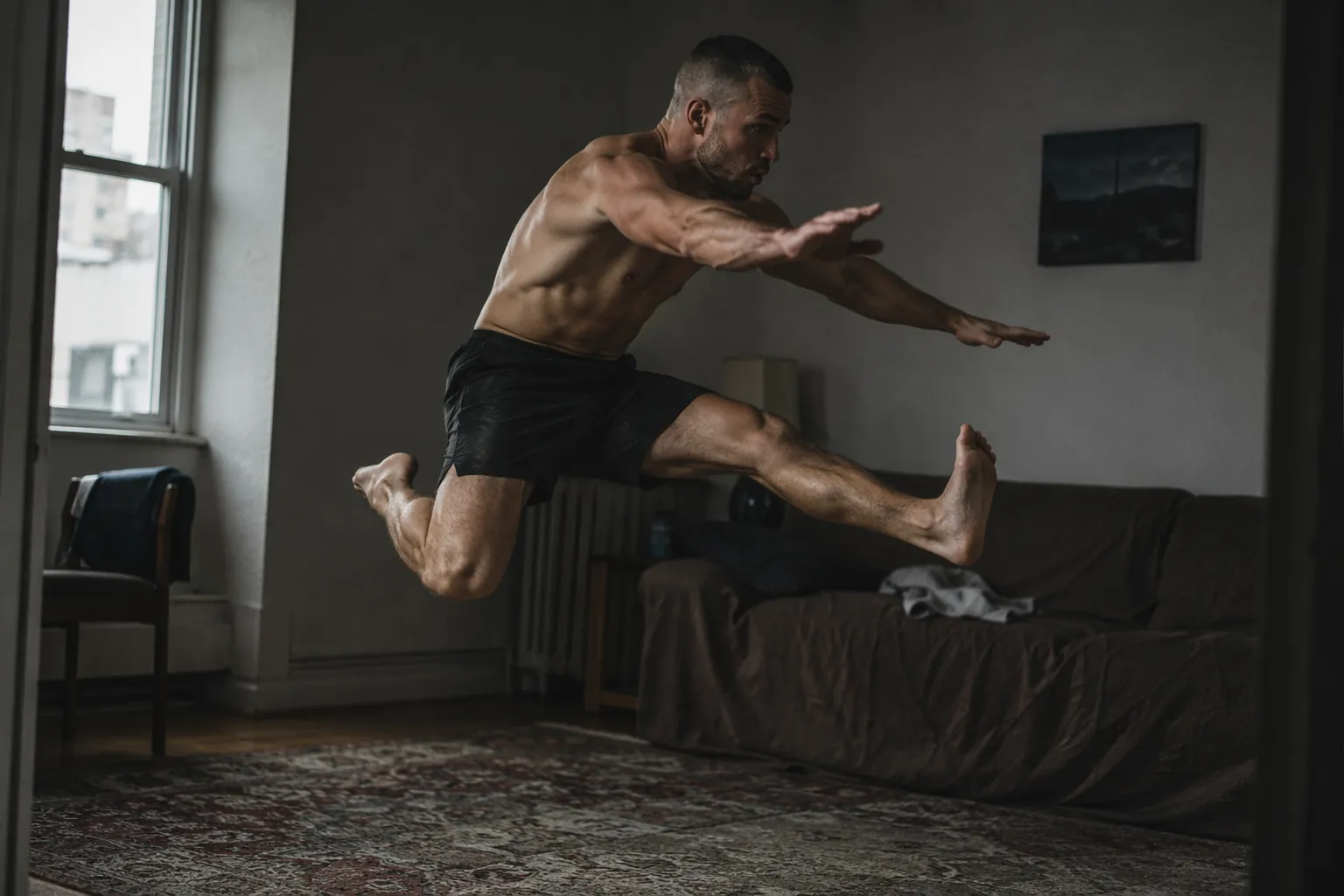
The sprawl-to-staggered-broad-jump is a good example of why the force-velocity framework beats exercise-name collecting. The movement starts with a reactive hip extension pattern, then asks you to recover the feet and project force forward from a staggered position. SimpliFaster uses fighter movements like this to show how bodyweight drills can be selected for the neurological quality they train rather than the muscle group they appear to hit.[1]
| Power drill | Keep it clean by watching | Stop the set when |
|---|---|---|
| Sprawl-to-staggered-broad-jump | Fast hips back, feet recover under you, jump from a stable stagger | The sprawl becomes a slow burpee |
| Plyometric push-up | Rigid trunk, aggressive press, quiet landing | The elbows flare and the chest sags |
| Skater jump | Lateral distance with a controlled single-leg landing | The landing turns into a stumble |
| Plyometric lunge | Straight vertical drive and clean foot switch | The back knee dives or the torso folds |
Use small sets: 3 to 5 reps for the more explosive drills, with enough rest to repeat the same quality. Apartment trainees can reduce noise by choosing lower-amplitude versions: fast step-back sprawls instead of jumping sprawls, skater bounds to a quiet stick, or incline plyometric push-ups with the hands on a sturdy surface if the floor version is too aggressive.
This is also where “no equipment” should not mean “no standards.” If your broad jump shortens every rep, your shoulder position collapses on plyo push-ups, or your skater landing is all ankle wobble, the set is over. Power is not proven by continuing after the adaptation has left the room.
Speed: Keep the Dose Small
Speed work is the smallest part of the session for a reason. In Heatrick’s split, it is only 15% of the block.[2] That is enough to keep fast contacts and quick starts in the program without letting them eat the strength and power work.
Pick one or two movements and keep them sharp: pogo hops, fast stance switches, sprint-start step-ins, or quick sprawls without the jump. The reps should feel snappy. Rest before they become bouncy conditioning. In a small apartment, speed can be trained in place if you respect the intent: short contacts, crisp rhythm, no grinding.
The Pulling Problem Is Real
Here is the part most no-equipment articles dodge: floor-based bodyweight training is weak for pulling. Fighters need pulling. They pummel, clinch, snap, wrestle, hand fight, and spend a lot of time balancing the shoulder stress created by punching and pushing.
Heatrick calls the pulling pattern the most critical but most neglected bodyweight movement for fighters, with horizontal pulling playing an important role in correcting shoulder imbalances from constant punching and pushing volume.[2] That is a sharper point than “train your back.” It is about keeping the shoulder complex from becoming all press and no retraction.
With truly zero equipment, you can use prone swimmers, reverse snow angels, reverse plank lifts, floor wiper press variations, and isometric scapular retractions. They are better than ignoring the pattern. They are not the same as a real horizontal pull or pull-up.
So keep the no-equipment version honest. Do floor-based shoulder-balance work now. If you stay with home training long enough, the first upgrade worth considering is not a shiny home-gym buildout; it is a cheap pull-up bar or band because it solves the one pattern the floor does not solve well. A broader home-gym setup can wait until you have actually outgrown bodyweight progressions.
A Complete No-Equipment Session
This is a strength-focused home session, not a fight camp replacement. Run it when you need useful work between classes or when the gym is not an option. Keep the strength block controlled, the power block explosive, and the speed block short.
| Block | Exercise | Sets and reps |
|---|---|---|
| Warm-up | Hip switches, scap push-ups, deep squat pry, low pogo hops | 1 easy round, 5-8 minutes total |
| Strength | 4-2-1 split squat | 3-4 sets of 4-6 reps per side |
| Strength | 4-2-1 archer push-up or uneven push-up | 3-4 sets of 4-6 reps per side |
| Strength | Long lunge isometric hold or single-leg squat progression | 2-3 hard sets per side |
| Power | Sprawl-to-staggered-broad-jump | 4-6 sets of 3 reps |
| Power | Plyometric push-up | 4-5 sets of 3-5 reps |
| Power | Skater jump | 3-5 sets of 3-5 reps per side |
| Speed | Pogo hops or fast stance switches | 4-6 short bursts |
| Shoulder balance | Prone swimmers, reverse snow angels, reverse plank lifts | 2-3 controlled sets |
| Cool-down | 90/90 breathing, couch stretch, thoracic rotation | 3-5 minutes |
Rest longer than a typical circuit would allow. For strength sets, rest enough that the next set still has control. For power sets, rest enough that the next set is still explosive. If you need a clock, think in terms of readiness rather than suffering: when the next rep can be fast and clean, go again.
Progress the routine by changing difficulty before volume. Move from regular split squats to longer split squats, from shallow single-leg squat progressions to deeper ones, from standard push-ups to archer push-ups, from small skater jumps to wider controlled bounds. Add reps only after the harder version still looks clean.
How This Fits Into a Week
If you train MMA or grappling two or more days per week, start with two home strength-power sessions. Put them away from your hardest sparring or wrestling day if possible. If you are only doing home training right now, three sessions per week is plenty, with easy mobility or skill shadow work on the days between.
| Day | Simple weekly layout |
|---|---|
| Monday | No-equipment strength-power session |
| Tuesday | MMA class, boxing, grappling, or easy mobility |
| Wednesday | Off or light technical shadow work |
| Thursday | No-equipment strength-power session |
| Friday | MMA class, conditioning, or off |
| Weekend | Optional third session only if joints and output feel good |
The 50/35/15 split is a useful anchor, not a prison. If you are beat up from wrestling rounds, reduce the plyometrics. If your power work is crisp but your positions collapse, put more attention into the 4-2-1 strength block. The ratio keeps the week honest; your joints and training schedule decide the exact dose.
For readers who later add a little gear, the same logic still applies. A band, pull-up bar, or dumbbell should solve a training problem, not decorate the apartment. The same progression mindset shows up in other home-athlete plans, like training like a college athlete at home with minimal equipment or using bodyweight plyometrics in a faster-mile home routine. The tool changes, but the standard stays the same.
What the Mike Swick Example Proves—and What It Does Not
The cleanest real-world proof that bodyweight-only training can coexist with elite fight performance is Mike Swick’s old UFC.com profile. In that 2012-era case, Swick was described as a UFC welterweight at about 4% body fat who trained with only push-ups, pull-ups, bodyweight squats, and neck work; the article listed 5 sets to failure for push-ups, 5 sets to failure for pull-ups, 2 sets of 100 bodyweight squats, and noted Knockout of the Night performances.[3]
That matters, but it should be kept in its lane. It is a historical proof-of-concept, not a current universal UFC protocol and not evidence that every fighter should train to failure with massive squat sets. It shows that elite fighters have used simple bodyweight work seriously. It does not replace programming logic.
For a home trainee, the better takeaway is not to copy the numbers. It is to stop treating bodyweight training as automatically inferior. If the movement is hard enough, the intent is high enough, and the progression is planned, the lack of barbells is not the limiting factor right away. Lazy programming is.
The Standard for Any No-Equipment MMA Routine
A good no-equipment MMA home workout routine should be easy to judge. Each movement should have a job. Strength movements create force through leverage, range, tempo, and holds. Power movements express force quickly and stop before speed degrades. Speed movements stay short and crisp. Shoulder-balance work addresses the pulling gap as honestly as floor training allows.
The routine does not need to destroy you to work. It needs to give you a reason to adapt. If the only progression is more reps, it will eventually become endurance work. If the progression changes the force demand, the velocity demand, or the position you can control, bodyweight training can build real fight-relevant strength and explosive power.
The honest promise is narrow and useful: you can build a serious no-equipment base for MMA at home, especially for lower-body force, pushing strength, hip extension, lateral power, and speed. Pulling is the weak link. Once floor-based progressions stop challenging you, a minimal upgrade may be the smartest move. Until then, judge every routine by two questions: what adaptation is this movement training, and how will I progress it without just doing more reps?
References
- The Performance-Based Advantages of Bodyweight Training for Fighters, SimpliFaster
- Bodyweight Training for Fighters – How to Do It Properly, Heatrick.com, August 2, 2020
- UFC Gym Training: No Machines, Just Muscle, UFC.com
What a small equipment investment adds
We don't have a build tagged to this exact tier yet. Browse all builds.
How often should you repeat this?
See our recovery and rest reference for citation-anchored rest-interval guidance.
Spot something off?
Tell us if a movement, tier assumption, or duration didn't match your experience.