The honest worry behind a 20 minute home workout for beginners is not whether it sounds convenient. It is whether 20 minutes is enough to count, or whether you are just doing the warm-up for a “real” workout.
The short answer is yes, it can count. The more useful answer is narrower: 20 minutes works when the session is structured so your body actually has to adapt. A gentle 20-minute shuffle around the room may be better than sitting, but it is not the same as a planned moderate-to-vigorous workout with warm-up, compound movements, short rests, and repeatable effort.
That distinction matters because official guidance is less hostile to short workouts than many beginners assume. In a March 2024 Harvard Gazette interview summarizing the U.S. Department of Health and Human Services Physical Activity Guidelines, I-Min Lee explained that about 21 minutes of moderate activity per day is tied to lower risk of heart disease, dementia, depression, and several cancers.[1] That figure is close enough to 20 minutes that a beginner does not need to apologize for starting there.
Intensity changes the math, too. Shape, citing UW Health and American College of Sports Medicine guidance, reports that 20-minute vigorous sessions three days per week can be comparable to 30-minute moderate sessions five days per week.[2] That does not mean every beginner should immediately chase vigorous training. It means the clock is only one variable. Effort, exercise choice, rest, and repeatability decide whether those 20 minutes are doing enough work.
There is also the less glamorous reason 20 minutes deserves respect: people are more likely to repeat it. Daily Burn, citing adherence research, reports that workout length is the single biggest predictor of long-term adherence.[3] For a sedentary or returning beginner, that may matter more than designing a perfect 45-minute plan that collapses after one week.
What Has To Happen Inside 20 Minutes
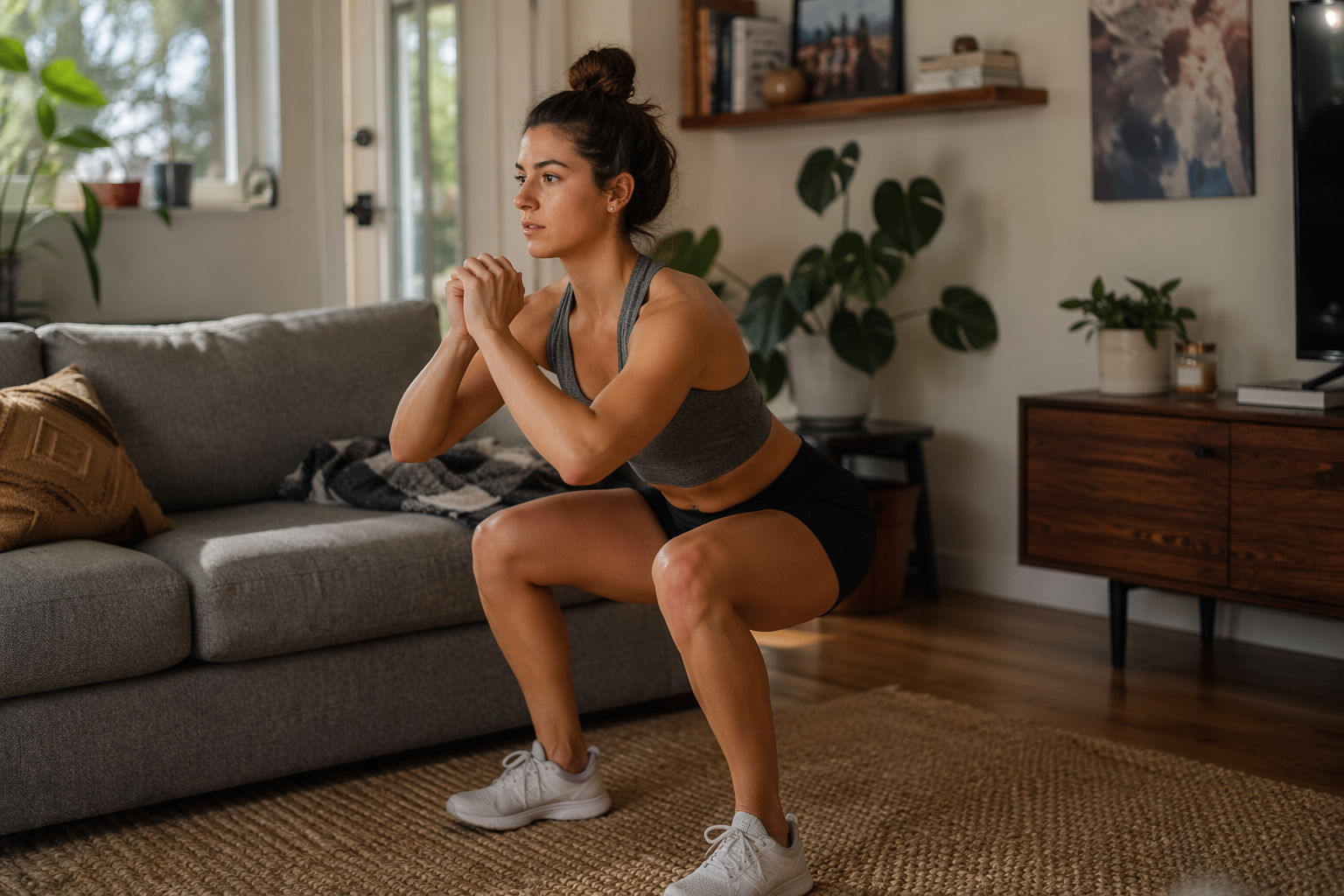
A useful beginner session has to do more than fill time. It should raise your breathing, use large muscle groups, give you enough rest to keep form clean, and be simple enough that you can do it again without negotiating with yourself for half an hour.
A practical intensity check is the talk test: during the working parts of the circuit, you should be able to speak in short phrases, but not comfortably chat through the whole interval.[4] If you can tell a long story without pausing, the session is probably too easy to deliver the adaptation most beginners are hoping for. If you cannot say a few words or your form is falling apart, you are pushing too hard for this stage.
For most beginners, the timeline is also worth making realistic. Cardiovascular adaptation can begin within 3 weeks, strength gains commonly show within 4–6 weeks, and visible body changes are more realistic around 8–12 weeks when training is repeated consistently.[1][2] Those are not promises that every person will see the same change on the same day. They are a better expectation than quitting after five workouts because the mirror has not caught up.
No equipment is a convenience, not a loophole. Bodyweight training can be enough when exercise selection and effort are handled well; readers who want the deeper evidence can read Bodyweight Training Actually Works: What the 2026 Science Says. For this workout, the point is simpler: you need floor space, a timer, and a willingness to scale the moves before your form turns messy.
The 20-Minute Beginner Home Workout
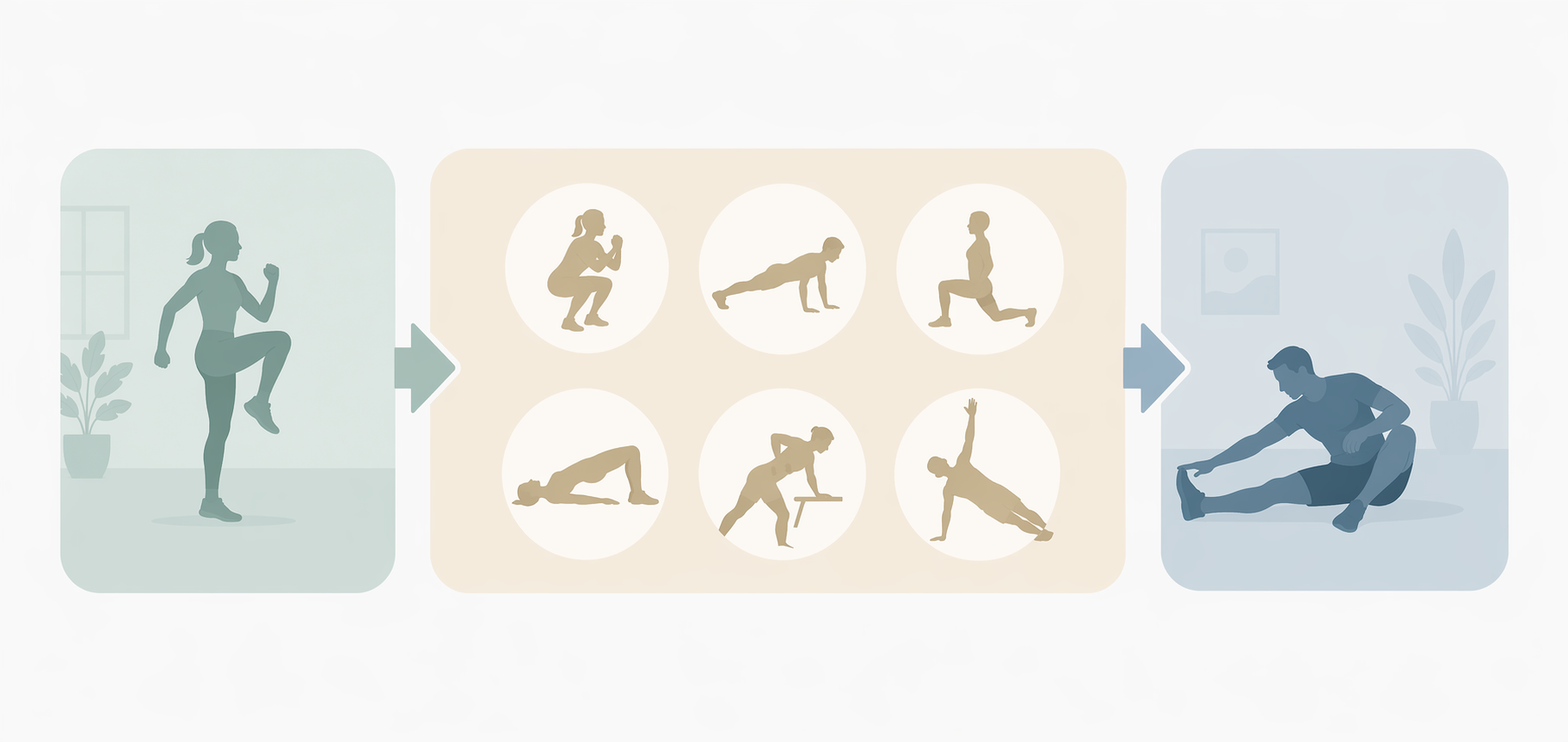
This session follows a straightforward beginner-friendly structure: a 3-minute dynamic warm-up, six compound bodyweight exercises performed for 45 seconds of work and 15 seconds of rest, repeated for two rounds, then a 3–5 minute cool-down stretch. The work section is about 12 minutes; the warm-up and cool-down make the full session land around 20 minutes.
| Part | Time | What You Do |
|---|---|---|
| Dynamic warm-up | 3 minutes | Move through easy, controlled mobility drills to raise temperature and prepare joints. |
| Circuit round 1 | 6 minutes | Do six compound exercises for 45 seconds each, resting 15 seconds between moves. |
| Circuit round 2 | 6 minutes | Repeat the same six exercises, adjusting pace or range of motion as needed. |
| Cool-down | 3–5 minutes | Slow breathing, stretch the main muscles used, and let your heart rate come down. |
Warm-Up: 3 Minutes
Set a timer for 3 minutes and move continuously, but easily. The warm-up should leave you more awake, not already tired.
- March in place for 45 seconds: swing your arms naturally and gradually lift your knees higher.
- Arm circles for 30 seconds: make small circles first, then slightly larger ones, keeping your ribs down.
- Hip hinges for 45 seconds: place hands on hips, push hips back, keep your back long, then stand tall.
- Alternating reverse lunges or step-backs for 45 seconds: use a small range of motion if your knees need it.
- Easy bodyweight squats for 15 seconds: sit back, stand up, and stop before your form feels forced.
Circuit: 45 Seconds Work, 15 Seconds Rest
Do the six exercises below in order. After the sixth move, start again from the top for round two. During the 15-second rests, breathe, shake out your arms or legs, and get into position for the next move. Rest longer if you need to keep good form; a clean workout beats a frantic one.
| Exercise | Main Cue | Beginner Modification |
|---|---|---|
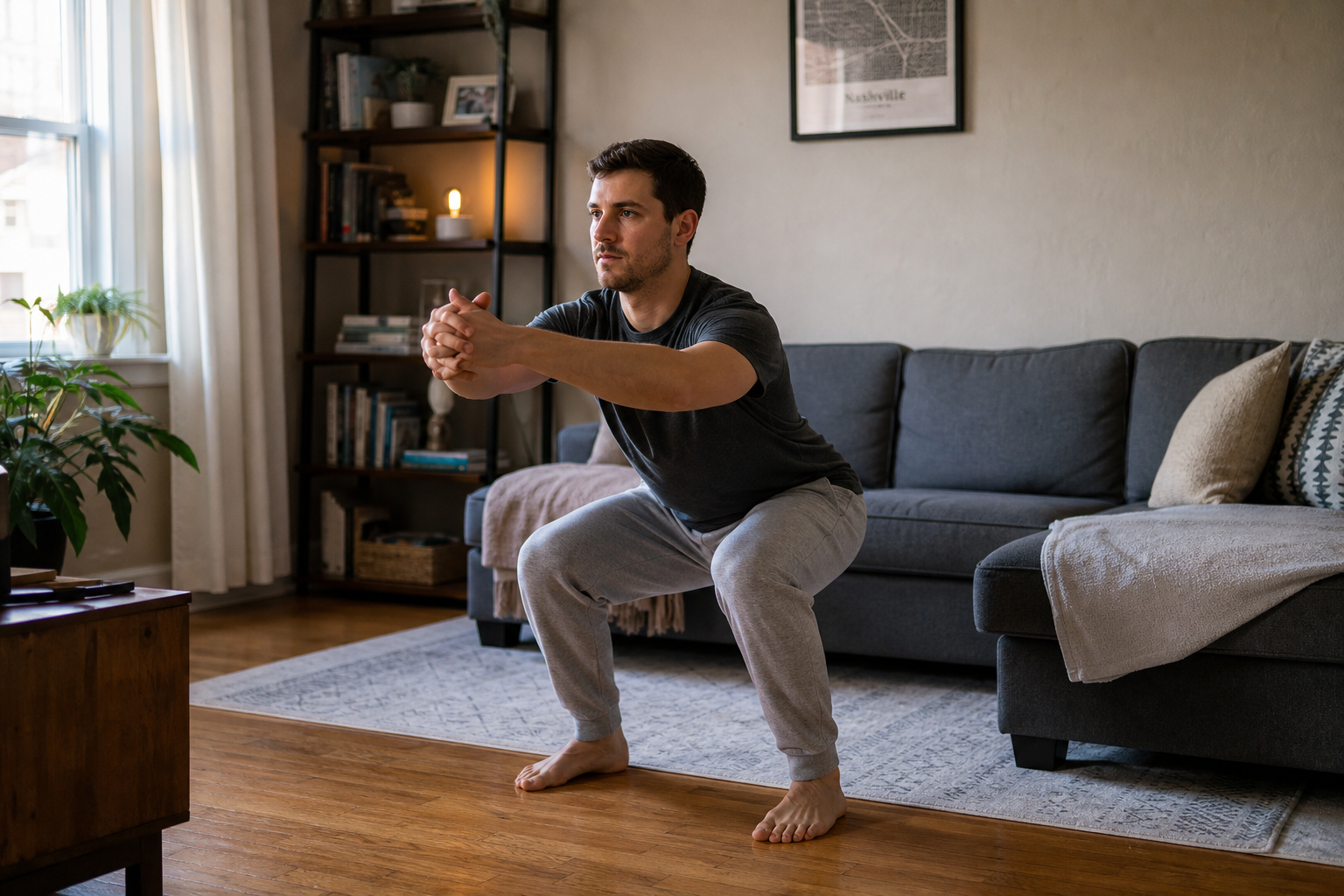
| Squat to reach | Sit hips back, press through the whole foot, then reach arms overhead as you stand. | Squat to a chair or reduce depth. |
| Incline or knee push-up | Keep a straight line from shoulders to hips and lower with control. | Place hands on a counter, sofa edge, or wall. |
| Reverse lunge | Step back softly, bend both knees, and drive through the front foot to stand. | Do alternating step-backs without lowering far. |
| Glute bridge | Press heels into the floor, lift hips, and avoid arching your lower back. | Pause at the top for one breath instead of moving quickly. |
| Plank shoulder tap | Brace your midsection and tap one shoulder at a time without rocking your hips. | Widen your feet, drop to knees, or hold a steady plank. |
| Low-impact mountain climber | Keep hands under shoulders and step one foot forward at a time. | Use a slower pace or place hands on an elevated surface. |
The first round is for learning the moves. The second round is where most beginners notice the effort build. That is fine. You do not need to sprint through the circuit; you need to work at a pace that brings you into that short-phrase zone without losing control.
Form Notes That Matter More Than Speed
- Squats: keep knees tracking roughly in the same direction as your toes; depth is optional, control is not.
- Push-ups: choose an incline before your shoulders creep toward your ears or your hips sag.
- Lunges: shorten the step and range of motion if balance is the limiting factor.
- Glute bridges: think ribs down and hips up, rather than trying to lift as high as possible.
- Plank work: a still torso with fewer reps is more useful than fast tapping with twisting hips.
- Mountain climbers: step instead of hop; the breathing challenge will still arrive.
Cool-Down: 3–5 Minutes
Do not use the cool-down as extra punishment. Its job is to help you downshift so the session feels finishable, not dramatic.
- Slow walk or march in place for 60 seconds.
- Standing quad stretch or couch-supported quad stretch for 30–45 seconds per side.
- Figure-four glute stretch for 30–45 seconds per side.
- Chest opener with hands behind back or arms wide for 30 seconds.
- Two or three slow breaths, letting your exhale last longer than your inhale.
How Hard Should It Feel?
For a beginner, the right effort usually feels like work you can manage, not work you have to survive. During the circuit, your breathing should rise. Your muscles should feel involved. You may need the 15-second rests. But you should not feel dizzy, sharp pain, or panic.
Use three simple adjustments before deciding the workout is too easy or too hard: change range of motion, change pace, or change the exercise angle. A wall push-up can become a counter push-up, then a sofa push-up, then a floor push-up. A shallow squat can become a deeper squat. A slow mountain climber can become faster only after your shoulders and core can hold the position.
If the session feels too easy and you can chat throughout, first clean up the tempo: lower slowly, stand or press with intent, and reduce wandering time between moves. If it still feels easy, choose the harder modification for one or two exercises rather than making every move harder at once.
How Often To Repeat It
Start with two sessions per week. That is enough to practice the movements and learn how your body responds without turning soreness into the whole story. If you finish two weeks and feel recovered between sessions, move to three times per week. Four times per week can work later if your sleep, joints, and motivation are holding steady.
| If This Is Your Current Starting Point | Use This Frequency |
|---|---|
| You have been mostly sedentary or are returning after a long break | 2 times per week |
| You recover well and the workout feels challenging but manageable | 3 times per week |
| You are consistent, not unusually sore, and want more practice | 4 times per week |
Progress does not have to mean making the workout longer. For the first several weeks, better progressions are cleaner reps, steadier breathing, fewer form breaks, slightly deeper squats, a lower push-up incline, or needing less extra rest between exercises.
If you arrived here unsure whether this is the right starting point, the Home Fitness Decision Guide can help you choose a routine that matches your current energy, space, and confidence. If this workout feels repeatable and you want a next commitment, move on to the 4-Week No-Equipment Home Workout Plan for Beginners.
Twenty minutes is enough for a beginner to build real fitness when the workout is structured, repeated, and performed at the right effort. It is not magic because it is short. It works because the starting cost is low enough to repeat, and the session itself is demanding enough to ask your body for change.
References
- Harvard Gazette interview with I-Min Lee on U.S. Department of Health and Human Services Physical Activity Guidelines, Harvard Gazette, March 2024.
- Shape article citing UW Health and American College of Sports Medicine guidance on vigorous and moderate workouts, Shape.
- Daily Burn article citing adherence studies on workout length and long-term consistency, Daily Burn.
- Talk Test, Centers for Disease Control and Prevention.
Comments
Join the discussion with an anonymous comment.