
How Much Should You Cut Indoor Workouts in Extreme Heat?
Working out in a hot home isn't just uncomfortable — heat measurably raises heart rate and cuts performance. Get the evidence-based cut numbers for intensity, duration, and rest during a heat wave, plus the heart-rate and warning cues that tell you when to stop.
- Equipment tier required
- none
- Duration
- 20-30 min
- Difficulty
- beginner
- Target area
- full body
- Space footprint needed
- compact
For indoor home workouts in extreme heat, start by cutting the session before the timer starts: reduce intensity by about 3–8% when the room feels meaningfully hot, shorten total work by 10–20% if your normal warm-up already feels elevated, and lengthen rest until your heart rate drops the way it usually does between sets or intervals. If heart rate is running 5–10 beats per minute higher than normal at the same pace or load, treat that as a sign that the workout is already more expensive than planned, not as a reason to prove fitness.
The useful rule is simple: heat changes the price of the same workout. COROS, in its athlete heat-training guidance, describes heart rate drifting 5–10 bpm higher at the same pace from around 77°F, with humidity amplifying perceived effort; its heat-index bands translate heat stress into rough pace reductions of 1–2% for mild stress, 3–5% for moderate stress, and 5–8% for high heat stress.[1] Those are vendor guidance numbers, not universal physiology law, but they are practical enough to stop the usual heat-wave mistake: keeping the workout identical and hoping effort will somehow stay identical too.

The same workout is no longer the same workout
A hot living room turns a familiar session into a different dose. The dumbbells did not get heavier, the bike resistance did not change, and the bodyweight circuit may look identical on paper. But the cardiovascular system is now spending more effort on heat management while you are asking it to train.
That is why the first adjustment should be mechanical, not emotional. Decide the cut while you are still calm, hydrated, and not halfway through round four. Once sweat is dripping into your eyes and the interval timer is beeping, “I’ll just see how it goes” becomes a negotiation with ego.
There is also a perception cost. In one Physiology & Behavior study reported by Runner’s World, cyclists exposed to localized heat from a heat pad had about a 9% drop in time to exhaustion even though core temperature and heart rate did not change.[2] That does not mean every hot home workout loses exactly 9%. It does mean warmth itself can make effort harder to tolerate before the usual dashboard numbers explain why.
Set the cut before you start
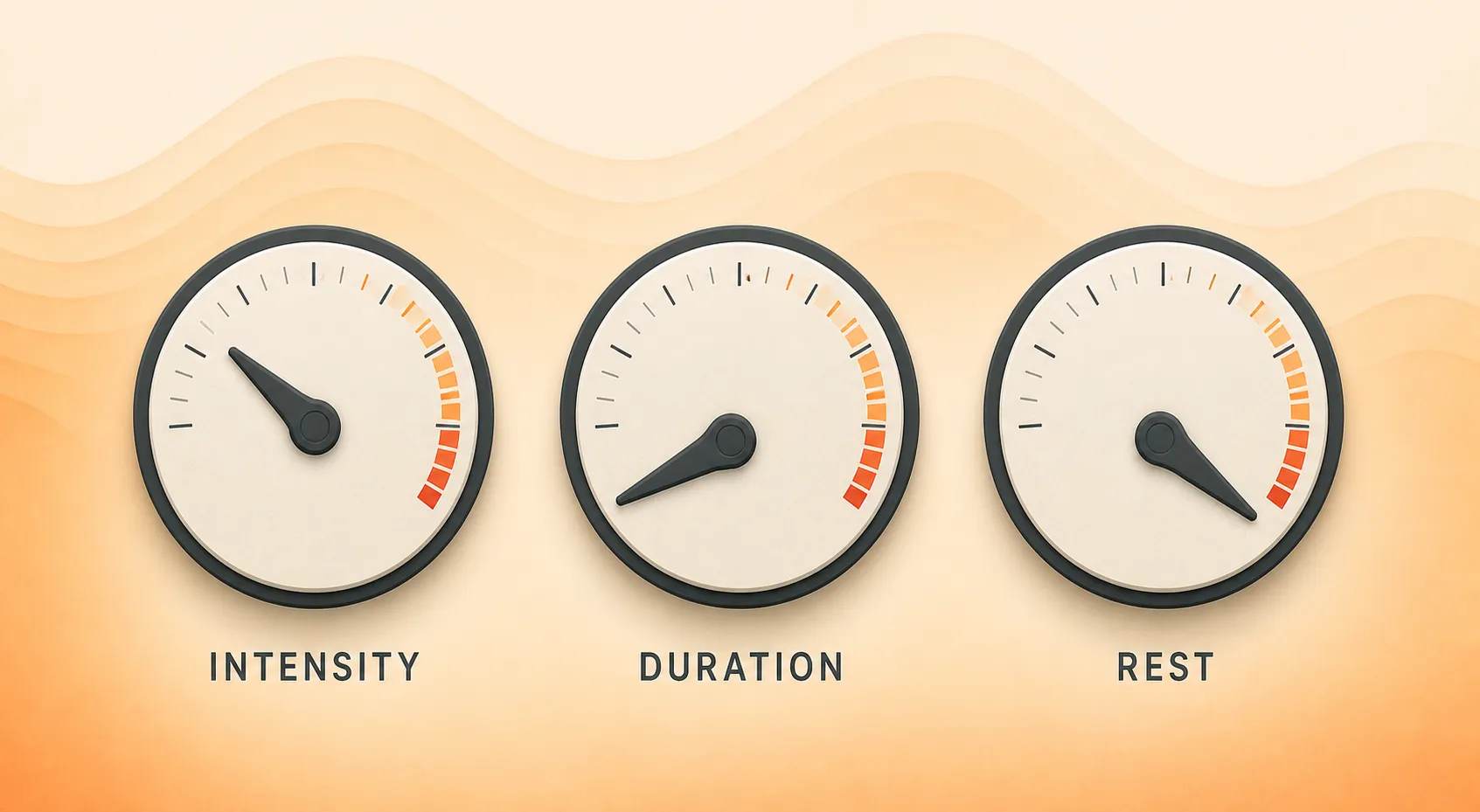
Use intensity, duration, and rest as three dials. You do not always need to turn all three equally, but in extreme heat it is usually safer to make a small cut across the whole session than to leave two dials untouched and slash only one at the end.
| What you notice before or during warm-up | Starting cut for the day | What this looks like at home |
|---|---|---|
| Warm room, but warm-up heart rate and breathing are close to normal | Cut intensity about 1–3%; keep duration normal or trim slightly | Use a slightly slower treadmill pace, lighter cadence target, or one easier resistance setting |
| Heart rate is about 5–10 bpm above normal at the same easy pace or load | Cut intensity about 3–5%, shorten work blocks or total time by about 10%, and add recovery | Turn 45-second intervals into 35–40 seconds, or remove one round from a circuit |
| Heart rate stays elevated between sets, perceived effort rises early, or humidity makes cooling feel poor | Cut intensity about 5–8%, reduce total work by 15–20%, and make rests clearly longer | Use lighter weights, fewer reps per set, longer walk-around breaks, and no finisher |
| Faintness, unusual weakness, or cramping appears | Stop the workout | Move to a cooler place and do not negotiate a lighter last round |
The 1–8% intensity range lines up with COROS’ heat-index pace-reduction bands, but home workouts are not outdoor races.[1] A percentage cut on a treadmill is easy. A percentage cut on squats, kettlebell swings, or a dumbbell complex is messier. Translate the number into a choice you can actually execute: one lower dumbbell pair, one less resistance level, a slower cadence, fewer reps per minute, or a lower jump option.
For strength work, do not chase your normal top sets in a hot room. A useful heat-wave version is to keep the movement pattern and remove the performance test. If the plan says heavy goblet squats, use a load that would normally feel like a clean warm-up or moderate work set. If the plan says push-ups near failure, stop several reps earlier than usual. Heat makes failure arrive with more noise and less usefulness.
For intervals, cut the work block before cutting the recovery block. A 40-second hard interval with a longer rest is usually easier to monitor than a 60-second interval performed at a fake “controlled” effort while heart rate keeps climbing. If you normally do 10 rounds, eight rounds in heat may be the whole workout, not the point where you decide whether to add a bonus core circuit.
Use heart rate to check whether the cut is enough
The most useful comparison is not today’s heart rate against someone else’s chart. It is today’s heart rate against your own ordinary version of the same workout. If easy cycling, marching, step-ups, or shadowboxing usually settles at one number and today it is 5–10 bpm higher at the same pace, the heat has already taken a slice of your capacity.[1]
During the session, watch the recovery pattern. In a normal workout, your heart rate may rise during a set, then fall predictably during rest. In a hot room, the warning sign is not just a high peak; it is a heart rate that refuses to come down before the next work block. That is the moment to turn another dial: lower the load, shorten the next interval, or extend the rest.
A practical check after the warm-up:
- If heart rate, breathing, and coordination feel normal, continue with the planned heat cut.
- If heart rate is 5–10 bpm high for the same easy work, cut intensity again or shorten the session.
- If heart rate does not drop during rests, lengthen rest before adding any more work.
- If effort feels strangely hard before the main set starts, remove the hardest block of the workout.
This is where a basic heart-rate display helps more than a complicated training platform. You are not trying to publish a physiology paper from your apartment. You are trying to catch the moment when the workout you wrote down and the workout your body is paying for have separated.
Cut duration when heat changes the recovery, not only when you feel tired
Duration is the dial people protect too long. They will lower the pace, promise to keep the weights “reasonable,” and still try to finish the full 45 minutes. In a hot apartment, total exposure matters. A session that is manageable for 20 minutes can become sloppy and risky at 35 minutes if the room is not helping you shed heat.
A clean way to cut duration is to remove the least important work first. Keep the warm-up because it tells you how the day is going. Keep the main pattern if it is still behaving. Remove finishers, density blocks, burnout sets, and “just because” core work. Those pieces are often designed to add fatigue; heat is already doing that for free.
| Normal plan | Heat-wave version |
|---|---|
| 30-minute steady cardio | 22–27 minutes at an easier pace, with permission to stop earlier if heart rate drifts |
| 10 rounds of intervals | 6–8 rounds, shorter work blocks, longer recovery |
| Full-body strength plus finisher | Main strength work only; skip the finisher |
| Circuit repeated until the timer ends | Fixed number of rounds with a hard stop |
If you need room setup tactics — fan placement, no-AC cooling, quieter apartment options, or body-cooling routines — use a dedicated heat protocol rather than trying to solve all of that mid-set. FitAtHome already has separate guides for indoor workouts during a heat wave, extreme-heat apartment workouts, and cooling a no-AC apartment for a quiet workout. This article’s job is narrower: decide how much workout to remove.
Rest is not dead time in extreme heat
In normal training, short rest can be a useful stressor. In extreme heat, short rest can hide the fact that the session has turned into one long heat-management problem. If the goal is strength, skill, mobility, or repeatable cardio, rest should be long enough for the next rep or interval to look like the one you meant to train.
For circuits, add rest between rounds even if the app does not. For dumbbell work, put the weights down earlier than usual and wait until breathing is no longer driving the set. For cardio intervals, start the next interval because recovery happened, not because the clock demanded it.
This matters especially in small spaces where the air around you gets warm and still. A compact setup can work well — fan, towel, water, heart-rate display, and clear floor space — but the equipment does not cancel the heat cost. If you are choosing gear for small rooms, quiet, easy-to-stop options are more useful in a heat wave than equipment that pressures you to maintain speed once you are already overheating. FitAtHome’s small-space home exercise equipment guide covers that equipment side separately.
The stop cues override the math
Cut numbers are guardrails, not permission slips. A 5% intensity reduction does not matter if symptoms say the session is over. The CDC advises athletes to stop activity and get to a cool place when they feel faint or weak, and it lists muscle cramping as a heat-related warning sign.[3][4]
Treat these as workout-ending cues:
- Faintness or feeling like you might pass out
- Unusual weakness that does not match the workout
- Muscle cramping in the heat
- Confusion, poor coordination, or a sudden inability to continue safely
Do not convert those signs into a lighter finisher. Stop, cool down, and move out of the hot training setup. If you want a more detailed escalation guide, use the FitAtHome home workout heat-illness symptom ladder before the next hot-weather session, not after symptoms have already appeared.
What changes after a week or two of heat exposure
Heat acclimatization is real, but it is not instant. GSSI describes heat acclimatization as typically requiring about 7–14 days, with adaptations including lower resting core temperature, increased sweat rate, and plasma-volume expansion; the same review notes plasma volume can expand roughly 4–12% within 5–7 days.[5] BBC Future also describes meaningful heat adaptation over roughly 7–14 days and notes that benefits can decay substantially within about three weeks without continued exposure.[6]

That timeline matters for indoor home workouts because heat waves often arrive faster than adaptation. The first hot day in an apartment is not the day to assume your body has solved the problem. If you have had repeated, tolerable heat exposure for a week or two, the same room may feel less punishing and your heart-rate response may look more familiar. If you have spent weeks training in cool rooms and then the apartment turns hot again, do not reuse the cuts from your best-adapted period.
Acclimatization should reduce the size of the cut only when the session data agrees. If the warm-up heart rate is back near normal, recovery between sets looks ordinary, and perceived effort matches the plan, you may gradually restore duration or intensity. Restore one dial at a time. Adding back full pace, full length, and short rests in the same session makes it hard to tell which part exceeded the day’s heat tolerance.
A same-day decision rule
Before starting, pick the heat-wave version of the workout. Cut intensity first, remove nonessential duration, and make recovery generous. After the warm-up, check whether heart rate and effort are behaving like a normal training day. If not, cut again before the main work begins.
During the session, the decision stays just as plain: if heart rate is drifting above your normal pattern, rest longer or reduce the next block; if it still will not settle, end the session. If faintness, weakness, cramping, confusion, or unsafe coordination appears, stop immediately. The correct move is not to finish carefully. It is to stop paying a physiological price that the planned workout did not include.
Explicit cut numbers are not a lapse in discipline. They are how a home exerciser keeps training consistent without pretending a heat-wave workout costs the same as the version done in a cool room.
References
What a small equipment investment adds
We don't have a build tagged to this exact tier yet. Browse all builds.
How often should you repeat this?
See our recovery and rest reference for citation-anchored rest-interval guidance.
Spot something off?
Tell us if a movement, tier assumption, or duration didn't match your experience.