
Can You Workout at Home in a Heatwave Without AC?
A heat-based decision framework for exercising at home during a heatwave without AC, grounded in measured temperature and humidity, with practical intensity, cooling, hydration, and stop rules.
- Equipment tier required
- none
- Duration
- 10 min
- Difficulty
- beginner
- Target area
- full body
- Space footprint needed
- mat-sized clear floor
- Noise level
- low-impact, no jumping
A no-AC apartment changes the workout question fast. The mat is already shifted toward the least awful corner. The fan is aimed where it can reach. The window is open, then closed, then open again because the hallway air somehow feels worse. At that point, working out at home during a heatwave without AC is not a motivation problem. It is a room measurement problem.
The number that matters is not just temperature. It is temperature plus humidity, because sweat only helps when it can evaporate. In sports settings, wet-bulb globe temperature is the better heat-stress measure, while the heat index is an outdoor shade metric rather than a perfect indoor workout tool. Most renters are not setting up a WBGT meter between the sofa and the laundry rack, so the practical home version is a thermometer-hygrometer reading, plus a little honesty about whether the air is stale, humid, and refusing to dry your skin [1].
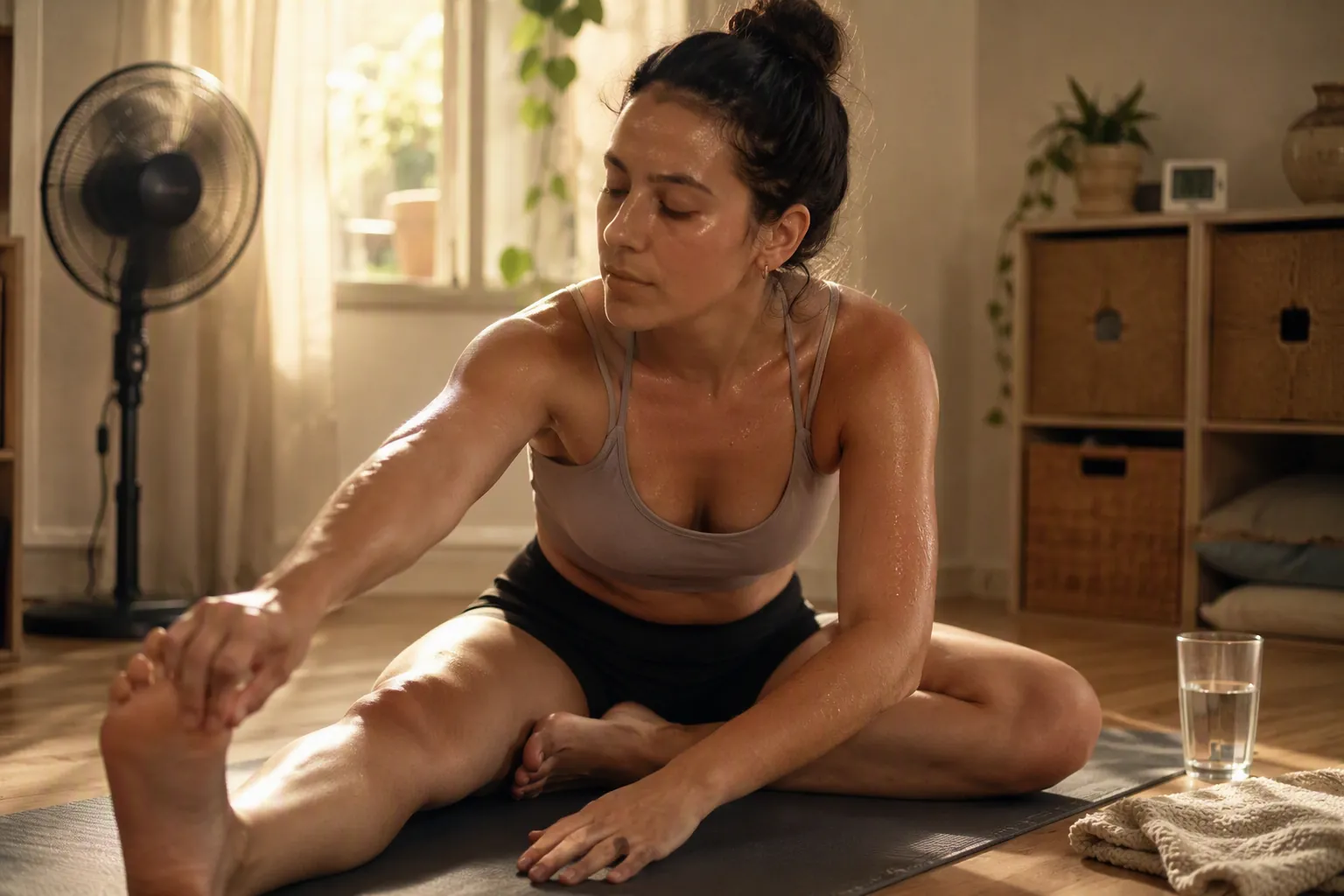
Measure the room before you pick the workout
Put the thermometer-hygrometer where you will actually exercise: not in direct sun, not inches from the fan, not beside a hot window frame, and not across the apartment in the one patch of air you are not using. If the bedroom is 86°F and sticky but the kitchen shelf says 79°F because it sits near a cracked window, the kitchen shelf is not doing burpees with you.
Then use the reading to downgrade the session before you start. COROS’ heat-training guidance gives useful temperature bands for adjusting training: below 75°F, no major change; 75–82°F, roughly 1–2% slower; 83–90°F, 3–5% slower; 91–99°F, 5–8% slower; and 100°F or hotter, only short controlled exposures [2]. Those bands were not written as a universal apartment law, and humidity can make the room feel worse than the dry-bulb number suggests. For a small, stale room, treat them as a ceiling, not permission.
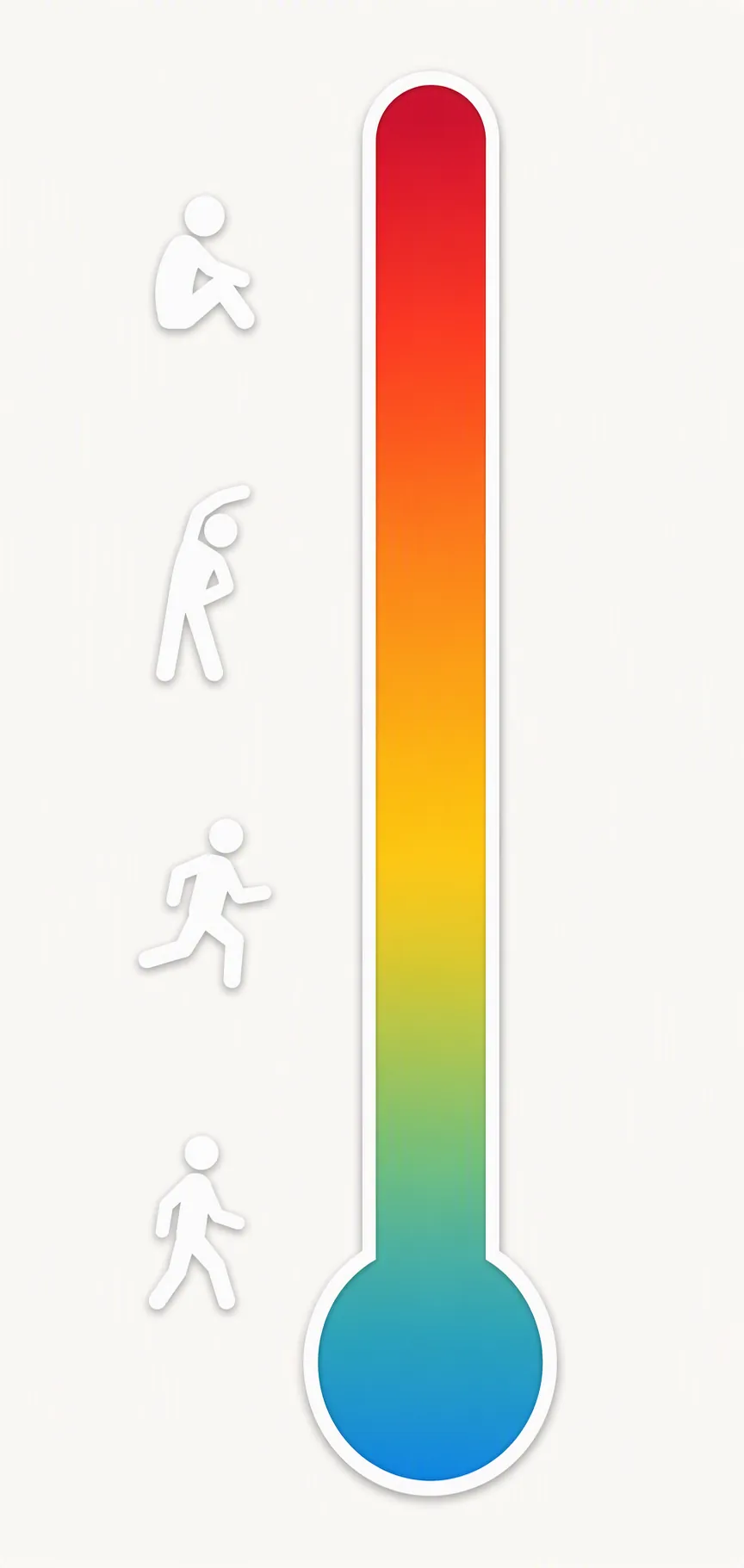
The no-AC heatwave workout table
| Room reading where you will train | Default decision | Workout type | Duration and intensity | Extra rule if humidity is high or sweat is not drying |
|---|---|---|---|---|
| Below 75°F | Usually OK for a normal home session if you feel well | Strength, mobility, low-impact cardio, normal mat work | Normal planned duration; keep water nearby | Stay normal only if the room feels ventilated and your skin can cool |
| 75–82°F | Train, but take the first downgrade | Moderate strength, controlled circuits, low-impact cardio | Shorten rest-free blocks; avoid turning the session into a sweat test | Drop jumping, long intervals, and dense circuits if the room feels muggy |
| 83–90°F | Change the workout, not just the attitude | Mobility, technique, easy bands, gentle core, low-impact movement | Keep it short and conversational; stop before heat starts deciding the pace | Downgrade one band: treat it like the low 90s if sweat beads but does not evaporate |
| 91–99°F | No normal workout | Only brief, low-intensity controlled movement if you are healthy, acclimated, and can cool afterward | Think mobility, breathing, range-of-motion, very easy band work; not a HIIT replacement | Skip the session if the room is humid, you cannot wet skin or cool down, or you have no safer recovery space |
| 100°F or hotter | Do not do a standard home workout | Recovery, stretching only if it genuinely feels cooling, or wait for a safer window | Short controlled exposure is the outer boundary in heat-training guidance, not a reason to force a routine in an apartment | Stop before starting if the room is oppressive, humid, or there is no reliable way to cool down |
The table is intentionally conservative for apartments. A runner on an open road can sometimes find shade, airflow, water fountains, or a quick exit. In a small rental, the exit may be a hotter hallway, a stairwell, or a shower that only helps once you have already stopped. The room is part of the workload.
How to use humidity without inventing fake precision
A cheap humidity reading is useful, but the exact cutoff is not as clean as people want it to be. The practical test is simpler: during the warm-up, is sweat evaporating, or is it just sitting on you? Does the room feel easier when the fan moves air across damp skin, or does it feel like a hair dryer? Are you cooling during rests, or staying hot between sets?
If the temperature band says “maybe” and the humidity test says “this room is not letting me cool,” move down a band. If the table says “only brief controlled movement,” that does not mean a normal workout with fewer reps. It means the session has changed category.
Why the same workout suddenly feels rude
You do not need a long physiology lecture to respect what is happening. COROS summarizes heat-related performance decline at roughly 1–3% per 5°C rise above about 18°C, and notes heart-rate drift of about 5–10 beats per minute around 25°C [2]. In an apartment, that can show up as a bodyweight circuit that used to feel easy but now spikes your heart rate during the warm-up.
That is why intensity has to move first. Reducing the workout by “just a little” while keeping the same intervals, the same jumps, the same rest times, and the same finish-at-all-costs mindset is not really a downgrade. It is the same heat load wearing a nicer label.
Match the workout to the band
Below 75°F, the room probably is not the main obstacle. You can train close to normal if you feel well, especially with a basic mat-and-band setup, open space, and water nearby. Still, if the heatwave has been grinding on for days and sleep has been bad, “normal” may already be a little lower than last week.
From 75–82°F, keep the session, but remove the parts that trap heat: long work blocks, minimal rest, fast transitions, and exercises that make the room shake for the people downstairs. A strength session can become sets with longer rests. A cardio session can become step-back movements, marching, shadowboxing without power punches, or easy cycling if you have equipment. This is also where lower-impact options from the Routines category make more sense than trying to recreate a gym class in a hot room.
From 83–90°F, stop thinking in terms of “getting the workout done.” Pick a shorter session that gives you movement without chasing fatigue: mobility, easy core, band pull-aparts, hip hinges, wall push-ups, slow split squats, balance drills, or sport-specific patterning. A compact routine like this bowling comeback home routine is the kind of low-space template that can be stripped down further when the apartment is hot: fewer rounds, more rest, no attempt to turn it into conditioning.
From 91–99°F, the useful question is not “Can I still train?” It is “Can I do a short, controlled exposure and cool down immediately?” That might mean ten easy minutes of mobility, a few very light band sets, or stopping after the warm-up because the room answers for you. If the session cannot stay easy, it does not belong in this band.
At 100°F or above, a no-AC apartment is no place for a standard workout. Heat-training guidance may discuss short controlled exposures at that level, but a renter in a stale room without a cool retreat should read that as a warning label. Recovery, a safer time window, or leaving for a cooler public space is the training decision.
Cooling methods that actually change the session
The cheapest useful cooling setup is not glamorous: move the session to the coolest part of the day, pre-cool before you start, keep skin wet enough for evaporation, and use airflow only while it is helping. That is different from simply pointing a fan at a hot body and hoping.
Timing is the first cooling tool because it changes the room before you ask your body to do anything. Heat-safety guidance commonly favors exercising before 9 a.m. or after sunset when possible, and avoiding the late-morning to mid-afternoon heat window, often described around 11 a.m. to 3 p.m. [5][6]. In an apartment, the best window may lag behind outdoor temperature because walls and floors hold heat, so measure again instead of assuming sunset fixed the room.
Pre-cooling can be simple: a cool shower, cold drink, damp towel, or a few quiet minutes in the coolest available place before the session. BBC Future’s 2026 heat-exercise coverage describes pre-cooling and water on the skin as ways to increase the buffer before core temperature climbs too far [4]. That buffer is not a license to train hard in a bad room. It is a way to make a reduced session less punishing.
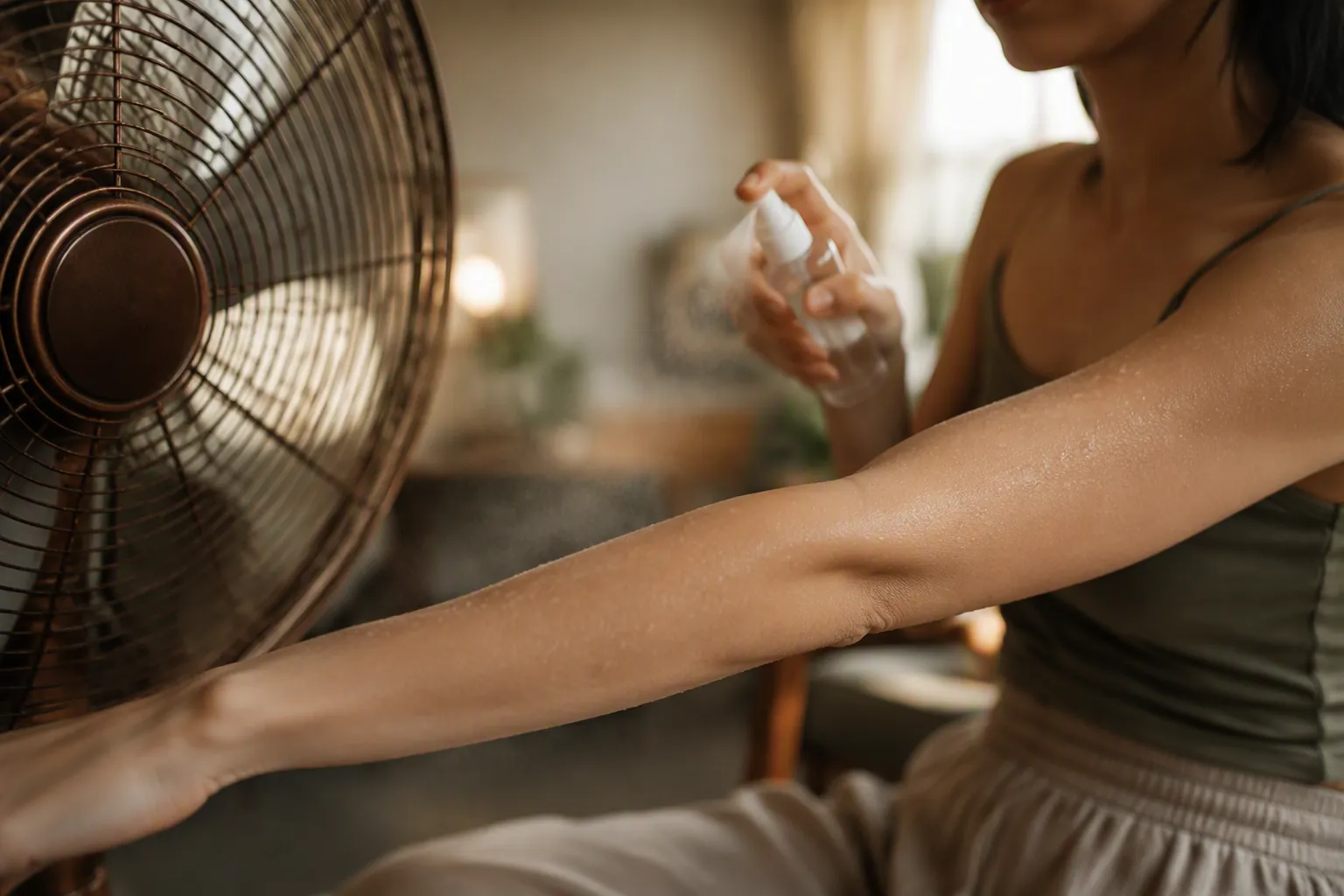
Fan plus wet skin beats fan as a charm
Fans are useful when they help sweat or added water evaporate. They are much less reassuring when the air is very hot. A 2024 Lancet Planetary Health critical review of fans in heatwave contexts found that fan-induced core cooling was modeled at less than 0.3°C above 33°C air temperature, and the review discusses a practical ceiling around 35°C, or about 95°F, beyond which a fan can add heat rather than relieve it [3]. The same review is not a perfect map for every exerciser in every apartment; it is heavily relevant to heatwave risk and older-adult contexts, and some findings are modeled. But it is enough to kill the fantasy that fan equals safety.
The better apartment version is fan plus wet skin at moderate room temperatures: mist your forearms, neck, and legs; use a damp towel; or rinse briefly and let moving air pass over the water. If the air is below the danger ceiling and not saturated with humidity, evaporation can help. If the fan feels like it is blowing warm exhaust across skin that stays wet and hot, stop treating it as cooling.
Hydration helps, but it cannot rescue the wrong session
Hydration should be planned before the mat comes out. ACSM’s practical numbers are 17–20 ounces of fluid before exercise and 4–8 ounces every 15–20 minutes during exercise, with electrolytes becoming more relevant for sessions longer than about 60 minutes [7]. For a no-AC heatwave workout, that last detail should make the session look suspicious. If you need a long electrolyte-managed effort to survive a living-room routine, the room may be asking for a shorter routine.
Do not wait until thirst feels dramatic. Also do not turn hydration into a dare where drinking enough water supposedly makes every room acceptable. Water supports heat management; it does not erase high temperature, high humidity, poor airflow, bad sleep, medication effects, or the lack of a cool place to recover.
Stop rules that override the plan
A good heatwave workout plan has an exit built in. The exit is not “when I feel like quitting.” It is when warning signs show up, when the room crosses the band you planned for, or when cooling stops working.
- Stop if you feel dizzy, faint, unusually weak, nauseated, chilled despite the heat, confused, or unable to bring your breathing and heart rate down during rest.
- Stop if you develop a headache, heavy sweating with weakness, muscle cramps that do not settle, or a sense that the room is closing in instead of cooling between sets.
- Stop if the fan and wet-skin setup no longer feels cooling, especially in the 90s°F.
- Stop if the room reading rises into the next band and your workout was not designed for that band.
- Stop before starting if you cannot cool down afterward.
Johns Hopkins Medicine describes exercise-related heat exhaustion as potentially involving a body temperature of 101–104°F with heavy sweating, dizziness, nausea, and weakness [8]. CDC/NIOSH describes heat exhaustion as a heat-related illness that can progress to heat stroke, with heat stroke requiring emergency medical attention [9]. For an apartment workout, those are not interesting facts to remember later. They are the reason the session ends early.
Older adults, people with chronic conditions, and people taking medications that affect fluid balance, sweating, heart rate, or heat tolerance should be more conservative, not more determined. Warm-weather activity guidance from the American Heart Association flags heat precautions for people with medical risks, and a no-AC room removes some of the usual safety margins [6].
So, can you work out at home in a heatwave without AC?
Yes, sometimes. A measured room below the hotter bands, manageable humidity, a reduced session, real cooling, planned hydration, and strict stop rules can make a home workout reasonable. That workout may look boring compared with the one on your calendar. Boring is fine. Boring is often the correct heatwave setting.
No, not always. If the room is in the 90s°F and humid, if the fan is only moving hot air, if symptoms appear, if you are in a higher-risk group, or if there is no cooler place to recover, the right workout is not a lighter version of toughness. It is stopping, cooling down, and waiting for a safer window.
References
- Wet-Bulb Temperature and Exercise Safety: What You Need to Know — Princeton Sports and Family Medicine
- Training and Racing in the Heat — COROS
- Electric fans for reducing adverse health impacts in heatwaves: a critical review — The Lancet Planetary Health, 2024
- How to keep exercising when it's really hot — BBC Future, June 22, 2026
- How to exercise safely during a heat wave — CNN, June 13, 2026
- How to stay active in warm weather — American Heart Association
- 9 Facts About Hydration and Electrolytes — American College of Sports Medicine
- Exercise-Related Heat Exhaustion — Johns Hopkins Medicine
- Heat-related Illnesses — CDC/NIOSH
What a small equipment investment adds
We don't have a build tagged to this exact tier yet. Browse all builds.
How often should you repeat this?
See our recovery and rest reference for citation-anchored rest-interval guidance.
Spot something off?
Tell us if a movement, tier assumption, or duration didn't match your experience.