
Which Home Workout Videos Actually Motivate Older Men?
Most motivation videos stop working for older men by week three. What actually sticks is a format, not a pep talk: short follow-along sessions, modifications shown on screen, and visible progress — and how to pick one that fits his space, ability, and equipment.
- Equipment tier required
- none
- Duration
- 10 min
- Difficulty
- beginner
- Target area
- full body
- Space footprint needed
- chair plus cleared floor
- Noise level
- low
The failure usually shows up in the third week. The first video looked encouraging enough. The instructor smiled, the music was bright, and someone in the family said, “This one is made for seniors.” He tried it once, maybe twice. Then a knee felt uncertain during a side step, the chair was in the wrong place, the pace moved on before he did, and the whole thing began to feel like another small public defeat, even though he was alone in his own living room.
That is the problem with searching for an elderly man home workout motivation video. The word “motivation” pulls up plenty of cheer: dramatic music, transformation talk, lists of senior fitness videos, and thumbnails that seem to be trying too hard. But the question that matters is not whether a video can make a man press play on Monday. It is whether the same video can get him through the awkward part after the novelty has gone.
The size of that gap is not small. In 2022, only 13.9% of U.S. adults age 65 and older met both the federal aerobic and muscle-strengthening guidelines; among men in that age group, the figure was 16.9%.[1] That does not prove older men do not know exercise matters. Most do. It points to the harder problem: keeping the routine usable after the first burst of good intentions.

A Good Video Solves the Next-Minute Problem
Federal guidance gives the destination in broad strokes: adults 65 and older should aim for aerobic activity, muscle-strengthening activity on at least 2 days a week, and balance work, with the plain reminder that some physical activity is better than none.[2] That is useful as a compass. It is less useful when a man is standing between the coffee table and the recliner, trying to decide whether the instructor’s “easy modification” is actually safe for his hip.
A home workout video earns its keep in those next few minutes. Does it show where the chair goes? Does the instructor demonstrate the easier version, not just mention it? Is there enough time to change position without fumbling? Can the viewer tell when one round is finished and what counts as progress? A video that answers those questions reduces the amount of decision-making required. That is not a small courtesy; it is the difference between finishing and switching the television off.
This is where adherence research is more useful than another top-10 video roundup. An umbrella review on exercise adherence in older adults and people with chronic diseases found that objective progress information and participant preference or background were each supported by 5 of 8 reviews. The same review also noted practical dropout reasons in technology-based programs, including usability problems, limited home space, and shame.[3] Those are not abstract barriers. They are the living room.
What to Look for Before Pressing Play
The best first test is not whether the instructor seems inspiring. It is whether the video makes the session hard to misunderstand. Older men are not all the same, and “senior” on a thumbnail does not tell you much. A retired runner with stiff shoulders, a man restarting after years of sitting, and someone managing balance trouble do not need the same pace. They do need the same basic respect: clear instruction, visible alternatives, and a setup that does not require a studio-sized room.
| Video Feature | Why It Matters at Home | What to Check Before Using It |
|---|---|---|
| Short follow-along session | A repeatable session has a better chance of surviving tired days and missed weeks. | Can he finish it without feeling trapped for too long? |
| Modification shown on screen | A verbal “just modify” leaves the viewer guessing when balance, knees, or shoulders are uncertain. | Is the seated, chair-supported, or smaller-range version demonstrated clearly? |
| Clear cueing over intensity | Older beginners often need timing and positioning more than hype. | Does the instructor say what is coming before the movement changes? |
| Visible progress marker | Progress feedback helps make the work feel real rather than vague. | Is there a timer, round count, checklist, calendar, or simple strength marker? |
| Small-room setup | Limited home space is a documented dropout reason in tech-based exercise programs. | Can it be done with a chair, cleared floor, and a screen he can see? |
| Low embarrassment factor | Shame can stop use even when the exercise itself is suitable. | Would he be willing to do this while someone else is in the house? |
That last question is easy to overlook. A video can be medically gentle and still feel foolish. If the instructor talks to a 70-year-old man as if he were a child, or if the moves look like a stage performance shrunk for older adults, the video may fail for reasons nobody writes down on a tracking sheet. Competence matters. So does dignity.
The Chair Is Not a Prop
For many older men starting at home, the chair is the difference between a workout and a near-miss. It should be sturdy, not rolling, not folding, and not placed so close to the wall that he has to twist to use it. If a video includes balance work but never shows how to use a chair safely, that is a mark against it.
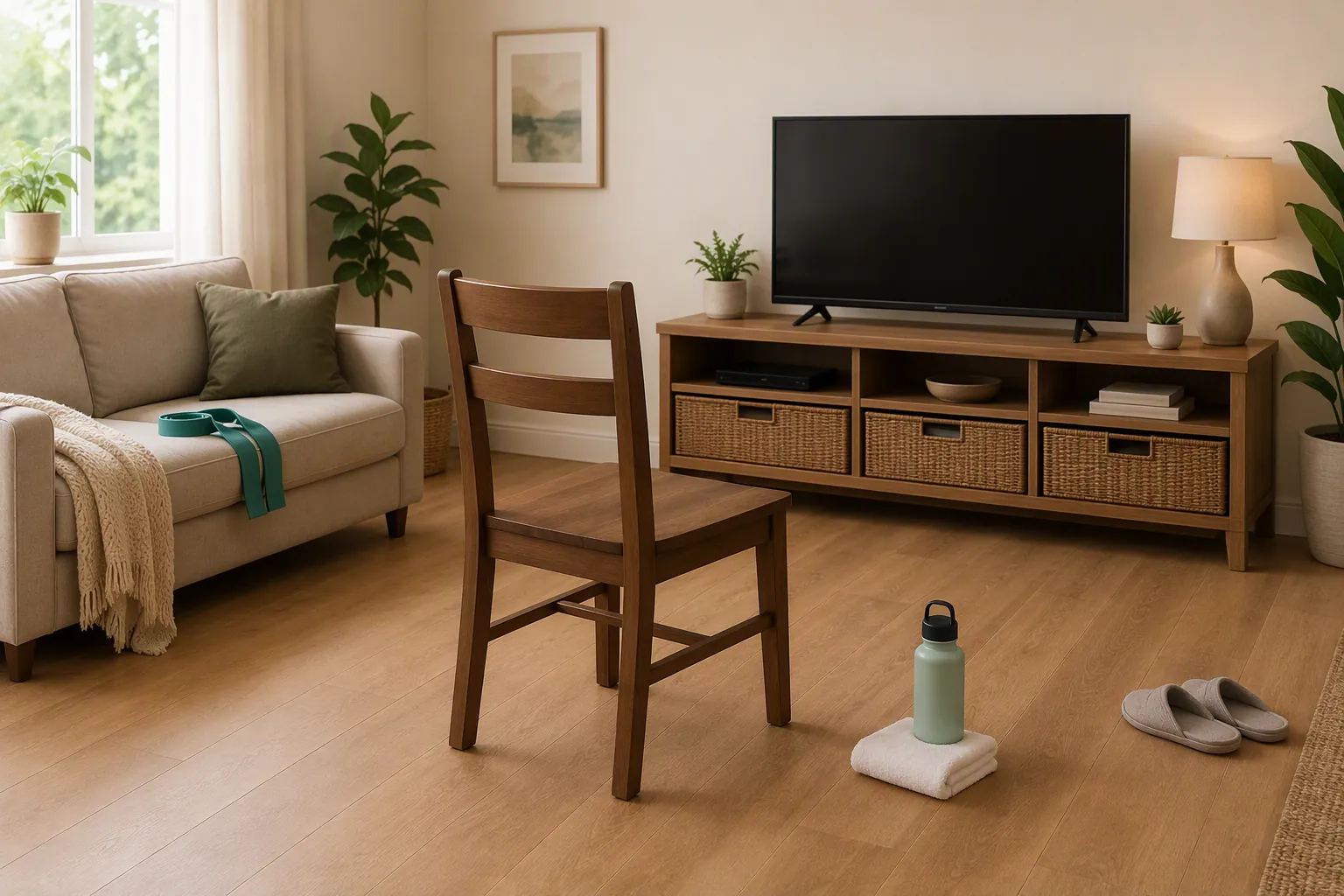
A workable setup is plain: a cleared patch of floor, a chair within easy reach, the screen high enough that he is not craning his neck, water nearby, and shoes or bare feet chosen for the surface rather than habit. Optional light dumbbells or a resistance band can come later. If the room is tight, small-footprint movement is not second best; it is the correct design constraint. For more space-conscious ideas, FitAtHome’s indoor practice drills are a useful match for apartment-safe training.
Equipment should not become the excuse that delays the first session. A $0 setup can still cover sit-to-stands, heel raises, marching, wall pushups, and supported balance work. A modest second step might add a resistance band or light weights, but only after the routine is already being repeated. The better purchase is often not gear; it is a video that fits the room he actually has.
Strength, Steadiness, and Mastery Beat Beach-Body Talk
The motivational frame matters, especially for men who already feel they are being managed by doctors, adult children, pill organizers, and appointment calendars. “Look younger” is a thin reason to keep doing squats beside a chair. “Stand up from the sofa with less effort” is sturdier. So is “carry groceries without needing a rest,” “steady yourself before stepping off a curb,” or “add two good repetitions this month.”
Research on gender and physical-activity motives should be handled with care here. One study of Malaysian adults ages 20 to 64 found that men were more motivated by mastery and competition or ego-related motives than women.[4] That is not a direct study of U.S. men over 65, and it should not be treated as if every older man wants competition. Still, the pattern lines up with what many families see: competence often lands better than appearance-based encouragement.
A good video for an older man does not have to turn the living room into a contest. It can build mastery quietly. The instructor might repeat the same movement pattern often enough that the viewer improves. The session might offer a clear “today, do 6 clean sit-to-stands; next time, try 7 if that felt steady.” The progress is small, but it belongs to him.
Strength work deserves a place in that frame, provided it starts low enough and progresses sensibly. The goal is not to prove toughness. It is to keep enough useful force in the legs, hips, back, and arms to make daily life less negotiated. FitAtHome’s guide to low-impact strength training fits that better than any video that rushes from one flashy move to the next.
The Social Hook Helps, Even If He Wants Independence
Some men will say they do not want fuss. Fair enough. Nobody needs a committee to do heel raises. But the evidence and plain observation both suggest that a little social structure can keep the routine from evaporating. The National Council on Aging advises older adults to make exercise fun, make it social, visualize outcomes, set attainable goals, and track progress; it also cites a 2018 study in which walkers with companions stuck with walking more than those without companions.[5]
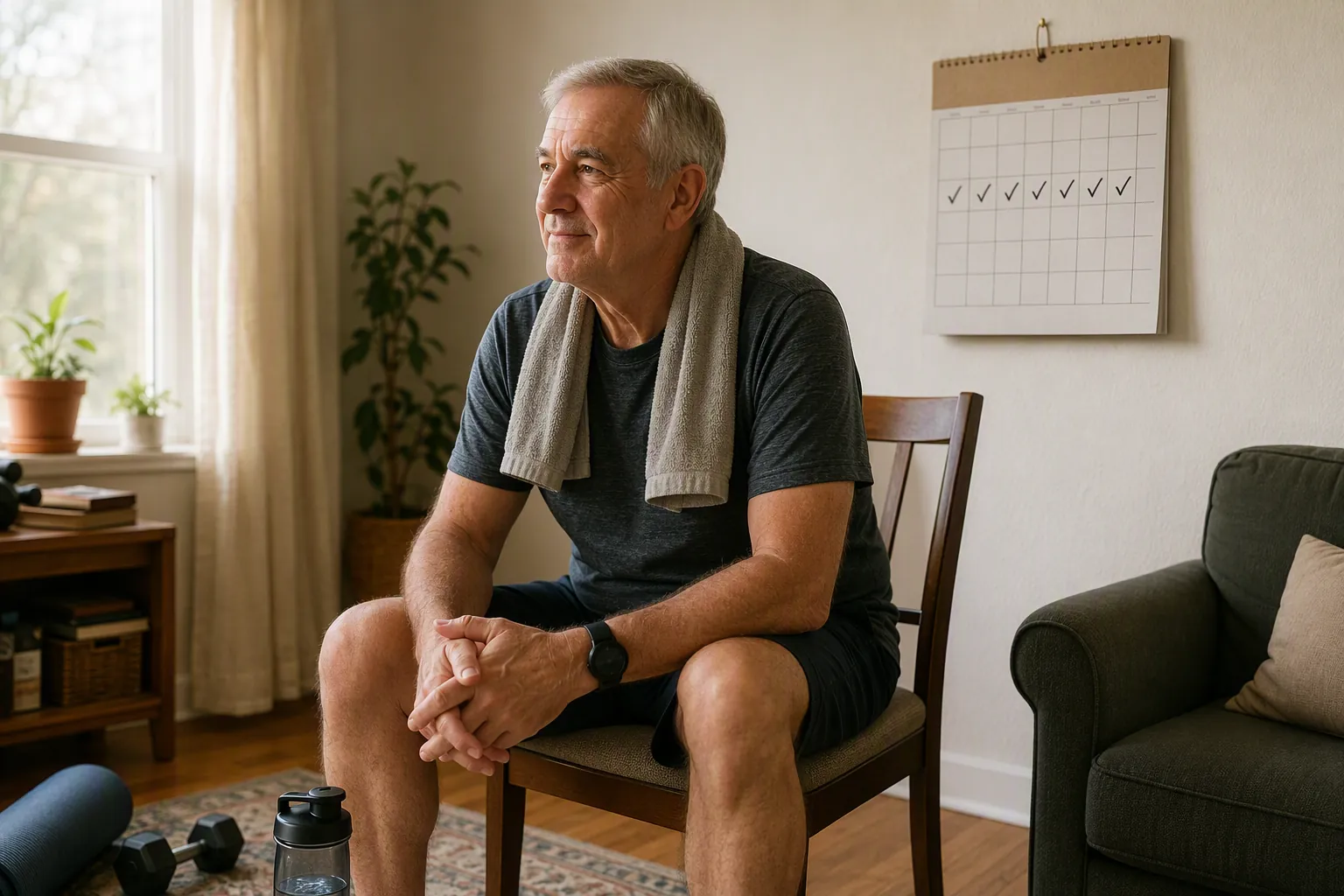
That does not mean turning every home workout into a group class. The social hook can be lighter: a son who texts “Did the 10-minute one today?”; a neighbor who uses the same video on the same mornings; a paper calendar where a spouse can see the check marks without making a speech. The point is not surveillance. It is making the next session a little less easy to forget.
A Safe Start Is Part of Motivation
A man who gets scared by a bad first session is not being lazy when he quits. He is responding to information. Anyone with chronic conditions, new symptoms, recent inactivity, surgery history, dizziness, chest discomfort, unusual shortness of breath, or unexplained pain should talk with a clinician before starting or changing a routine. That conversation is not red tape; it keeps the first few weeks from becoming a guessing game.
The same applies when family members are choosing videos on someone else’s behalf. Do not hand over a link and call it solved. Ask what movements feel uncertain. Check whether standing balance is an issue. Make sure the volume, captions, and screen size work. If recovery, pain, or medical limits are part of the picture, FitAtHome’s pieces on discussing a home routine and phase-based recovery exercises show the kind of caution that belongs at the start, not after something goes wrong.
Useful Starting Points, Judged by Format
Specific videos can help, but they should be treated as test cases, not trophies. Before recommending any YouTube session to an older man, verify the current video details yourself: actual duration, pace, whether modifications are shown, whether standing balance is required, whether ads interrupt the session, and whether the channel is still maintained. Search snippets are not enough.
The National Institute on Aging’s 15-minute workout for older adults is a sensible first place to inspect because it comes from a public health source and is built around a short session length.[6] Short does not automatically mean safe for every viewer, but it does make repeat attempts more realistic. If a man has been inactive, a 15-minute follow-along that can be paused or shortened is more believable than a long class that quietly becomes an all-or-nothing test.
ElderfitTV is another channel worth checking for older-adult-focused follow-along material.[7] The name alone is not the reason to use it. The reason to inspect it is whether the instruction shows supported versions, gives enough setup time, and keeps the viewer oriented. A channel with many senior videos can still be wrong for a particular man if the pace or posture demands do not match him.
The Body Coach TV’s 10-minute seniors workout has the advantage of a very short stated duration, which can lower the barrier on low-energy days.[8] Ten minutes is not magic, but it is hard to argue with a session a man can finish before he has time to talk himself out of it. The check, again, is practical: can he follow it without rushing, and are the easier options visible enough to use without embarrassment?
More Life Health’s senior exercise video library is useful less as a single recommendation than as a place to match format to need: balance, strength, mobility, or general follow-along work.[9] A library can help once the first routine is established, because boredom is real. It can also overwhelm a beginner. Pick one suitable video, repeat it long enough to learn it, and only then rotate.
Better5’s senior-video selection advice is commercial guidance, not independent research, but some of its format criteria are still sensible to check against: moderate session length, built-in modifications, and clear cueing.[10] Treat that kind of source as a shopping checklist, not as proof that one branded program will improve adherence.
How to Pick One Tonight
If the goal is to choose a video tonight rather than collect options for another month, use a narrow test. Do not start with the most exciting video. Start with the one most likely to be repeated.
- Choose a short follow-along session first, especially if the man is inactive or restarting.
- Watch the first 2 minutes before exercising to check volume, pace, chair placement, and camera angle.
- Reject any video that says “modify” without clearly showing the easier version.
- Favor sessions that include a timer, rounds, repetitions, or another progress marker.
- Use the same video for several sessions before deciding whether it works.
- Track completion with a calendar check mark, not a complicated app, unless he already likes apps.
The first session should end with useful information, not exhaustion. Could he hear it? Could he see the movement? Did the chair feel stable? Was there a moment where he felt foolish or unsafe? Did he know when he had done enough? Those answers matter more than whether the instructor sounded encouraging.
Progress can be plain. Count how many controlled sit-to-stands he completes from the chair. Note whether he can march in place a little longer without grabbing the backrest. Track whether he finishes the same video with fewer pauses after a few tries. Objective progress information is one of the adherence factors that shows up in the review evidence, and it has the added benefit of giving the man proof he can feel.[3]
If the first video fails, do not treat that as a verdict on exercise. Treat it as a bad fit. Maybe the room was too crowded. Maybe the screen was too low. Maybe the instructor moved too fast. Maybe the video asked for floor work from a man who does not yet trust getting down and back up. Change the format before blaming the person.
What the Right Video Feels Like
The right home workout video for an older man is rarely the loudest one. It is the one that lets him begin without a lecture, keep his balance without guessing, and finish with some evidence that the work counted. It respects the room, the chair, the joints, the pride, and the ordinary interruptions of a real week. Motivation lasts longer when the session is short enough to repeat, modified clearly enough to use, and measurable enough to show progress before he loses interest. That is the practical judgment: the best video is the one he can safely repeat, modify without embarrassment, and use to see progress before motivation runs out.
References
- QuickStats: Percentage of Adults Aged ≥18 Years Who Met Both the Aerobic and Muscle-Strengthening Physical Activity Guidelines, by Age Group and Sex — National Health Interview Survey, United States, 2022, PubMed
- Older Adults: Physical Activity Guidelines, Centers for Disease Control and Prevention
- Key Factors Associated with Adherence to Physical Exercise in Patients with Chronic Diseases and Older Adults: An Umbrella Review, PMC, 2021
- Motives for adult participation in physical activity: type of activity, age, and gender, PMC, 2015
- 5 Tips to Help Older Adults Stay Motivated to Exercise, National Council on Aging
- 15-minute Workout for Older Adults, National Institute on Aging
- ElderfitTV, YouTube
- 10 Minute Seniors Workout, The Body Coach TV
- Senior Exercise Videos, More Life Health
- Best Senior Workout Videos, Better5
What a small equipment investment adds
We don't have a build tagged to this exact tier yet. Browse all builds.
How often should you repeat this?
See our recovery and rest reference for citation-anchored rest-interval guidance.
Spot something off?
Tell us if a movement, tier assumption, or duration didn't match your experience.