
How Fast Is a 'Good' Tennis Serve? Improve Yours at Home
Published serve-speed data shows most recreational players overestimate what a 'fast' serve really is — club-level first serves average roughly 67–78 mph, far below televised 100+ mph figures. This guide puts those numbers in perspective with honest targets and a six-week at-home plan that uses technique cues and conditioning to add a realistic, measurable few mph.
- Equipment tier required
- none
- Duration
- 15 min
- Difficulty
- beginner
- Target area
- full body
- Space footprint needed
- small corner
- Noise level
- low
The fastest way to improve your tennis serve at home is to stop chasing a fake number. A lot of recreational players talk as if “good” begins at 100 mph because that is the number they hear on television, on highlight clips, or from the guy at the next court who has never met a radar gun he could not round up by 18 mph. Published serve-speed data is less flattering, and much more useful.
In one study of 11- to 14-year-old players, club-level boys averaged about 74 mph on the serve and club-level girls averaged about 78 mph; the same paper cites adult male data in which beginners averaged about 67 mph, intermediate club players about 92 mph, and elite players about 105 mph.[1] Those numbers are not universal norms. They come from specific samples. But they are enough to make one thing clear: a first serve in the 70s is not automatically embarrassing, and a jump from the high 60s to 100 mph is not a normal home-training promise. It is usually marketing.
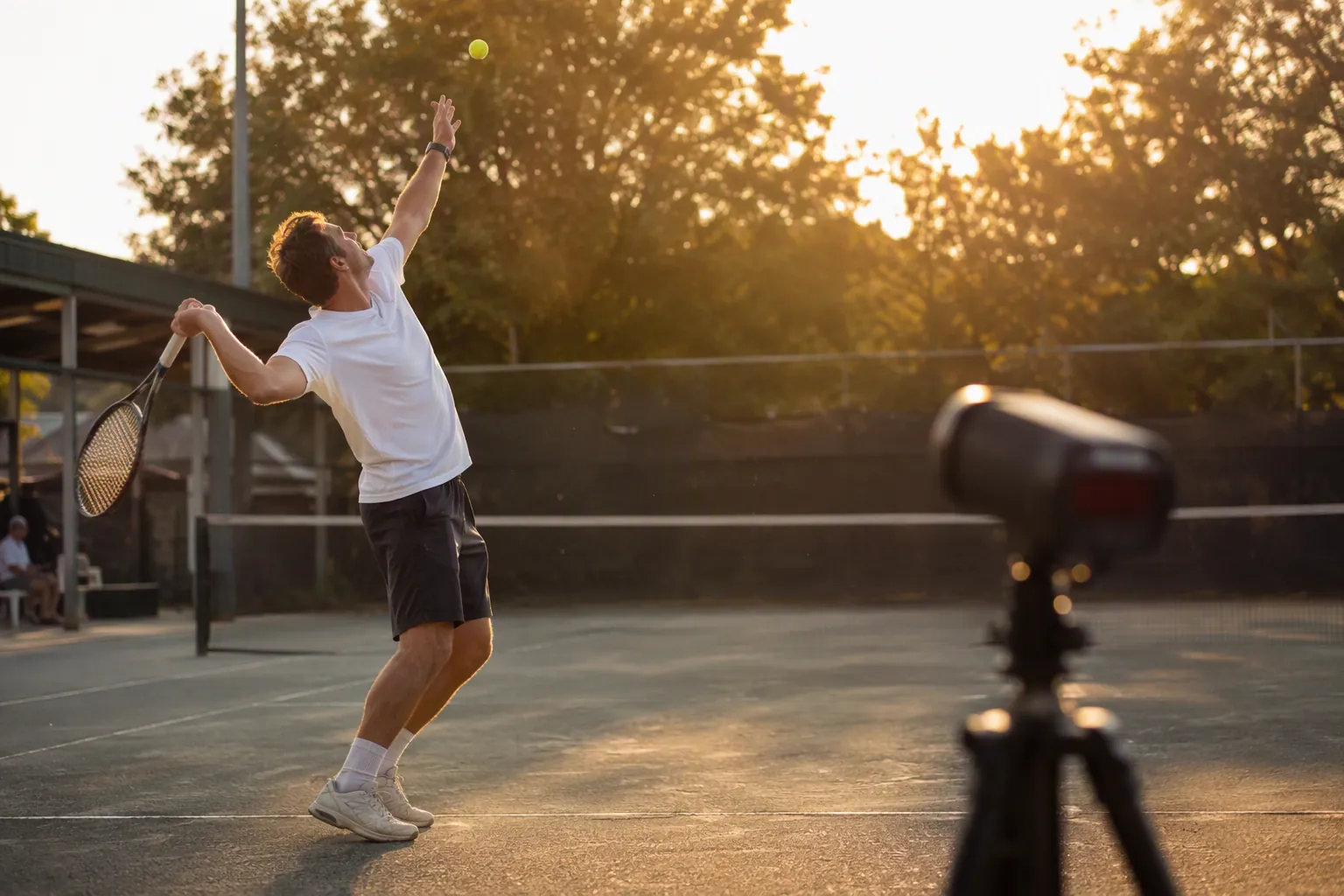
What a “good” serve speed looks like when you stop using TV as the yardstick
The useful question is not whether your serve resembles a professional serve. It almost certainly does not. The useful question is whether your serve is fast enough for your level, repeatable enough to hold up under pressure, and measurable enough that you can tell whether training changed anything.
| Group in the available data | Reported average serve speed | How to use it |
|---|---|---|
| Adult male beginners, cited from Girard et al. | About 67 mph | A reality check for many recreational players who assume they are already near 90 mph.[1] |
| Club-level boys ages 11–14 in Söğüt | About 74 mph | A study-specific junior benchmark, not a universal adult standard.[1] |
| Club-level girls ages 11–14 in Söğüt | About 78 mph | Another study-specific junior benchmark that makes the high 70s look more respectable than many club players admit.[1] |
| Adult male intermediate club players, cited from Girard et al. | About 92 mph | A different level from casual beginner play; do not blend this with lower club or junior samples.[1] |
| Adult male elite players, cited from Girard et al. | About 105 mph | Useful mainly to show why elite comparisons distort recreational expectations.[1] |
That table should make target-setting calmer. If your measured first serve is in the mid-60s, a reliable move into the high 60s or low 70s is real progress. If you are already in the mid-70s, cleaning up the toss, balance, and leg drive may matter more than trying to swing harder. If you are actually near 90 mph, the problem probably is not a lack of YouTube tips; it is whether the serve goes in often enough to be useful.
The ceiling on home improvement is also humbler than most serve-speed videos suggest. A six-week conditioning intervention summarized by Performance Health used 30 nationally ranked male juniors, with one group doing one hour of conditioning three times per week for six weeks; the program included core work, resistance tubing, and medicine-ball throws, and serve velocity improved by about 4.9% while controls did not change.[2] That is an interesting result, not a guarantee. It was not a study of adult club players training quietly in a living room after work.
A realistic home goal: a few mph you can prove
For a recreational player, the honest six-week target is not “add 25 mph.” It is: measure a baseline, rehearse the pieces of a faster serve without needing a court every day, retest under the same conditions, and see whether the number moved. A few mph, or a small percentage gain, is a successful home outcome if the serve is also smoother and more repeatable.
The home plan below uses four levers that can be practiced in a small space: a higher toss, relaxed racket-head speed, balance, and leg drive. Those line up with coach Jack Edward’s serve-speed cues: feel as if you are throwing the racket, toss as high as your full racket reach, stay balanced, and add leg drive after the basic rhythm is there.[3] The leg-and-trunk emphasis is not decoration. Kovacs and Ellenbecker describe the legs and trunk as generating roughly 51–55% of the kinetic energy delivered to the hand in the serve.[4]
That does not mean you need to jump around your apartment or smash balls into drywall. It means the serve is a whole-body throw. If the toss drifts, the shoulder tightens, the front foot wanders, or the legs never contribute, the racket has to rescue everything at the last second.
Measure first, or you are just voting on vibes
If you have access to a radar gun, use it. It does not have to be glamorous. What matters is that you test the same way at the start and the end: same court if possible, same ball type, same placement of the device, and the same definition of a counted serve. Do not compare one loose warm-up swing from week one with one perfect bomb from week six.
A simple baseline session works well:
- Warm up normally before measuring. Cold-shoulder hero swings are a bad test and a worse habit.
- Hit a fixed number of first serves, such as one basket or one short sequence you can repeat later.
- Record the fastest serve, the average of your better serves, and how many landed in. The speed number alone can flatter a serve you would never trust in a match.
- Write down the testing conditions: date, court, balls, radar position, and whether you were serving from deuce or ad court.
- Film from behind if possible. The video will explain why the radar number changed.
If you do not have a radar gun, video and serve-speed apps can still help, but treat them as consistency tools rather than laboratory instruments. Use the same phone, same angle, same court, and same app settings each time. If the app says you gained speed and the video also shows a cleaner toss, better balance, and a ball that arrives heavier, that is useful. If the app produces one heroic number while the serve lands two feet long, do not build a training plan around it.
At home, track inputs rather than pretending you can measure true ball speed in the living room. Count toss reps, shadow swings, balance holds, foam-ball contacts, and conditioning sets. Your speed test happens on court at the beginning and end. The room is where you make the motion less chaotic.
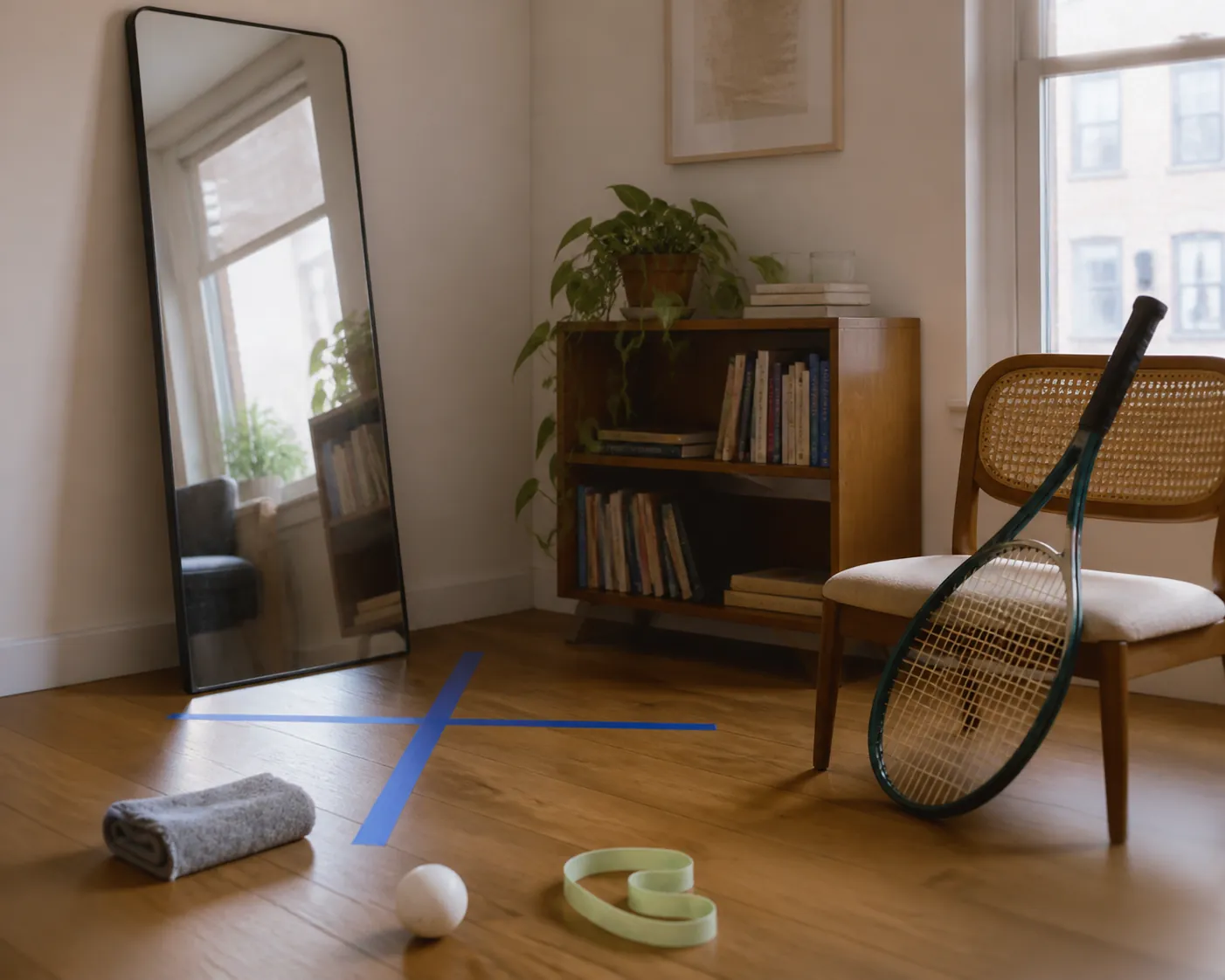
The six-week home plan
You need a racket if ceiling height allows it, a towel if it does not, painter’s tape, a mirror or phone camera, a foam ball, and optionally a light resistance band. If you use a band with a door anchor, set it up carefully; a snapped anchor is not “functional training.” Use a dedicated safety check like this resistance band door-anchor guide before pulling hard against a closed door.
For apartment practice, foam balls, towel swings, and daytime sessions are the sane choices. If noise is your limiting factor, the same small-space thinking used in quiet pickleball practice at home applies here: reduce impact, control rebounds, and avoid turning the floor into a drum.
| Weeks | Main job | Home work |
|---|---|---|
| Before Week 1 | Baseline | Radar or video test on court; record speed, makes, and conditions. |
| Weeks 1–2 | Toss and balance | Painter’s-tape stance, mirror checks, toss-to-target reps, freeze-finish holds. |
| Weeks 3–4 | Relaxed racket speed | Towel throws, shadow serves, foam-ball contacts, light shoulder and trunk support. |
| Weeks 5–6 | Leg drive and sequencing | Slow serve rehearsals from the ground up, controlled band or core work, final rhythm sessions. |
| End of Week 6 | Retest | Repeat the baseline test as closely as possible; compare numbers without changing the rules. |
Weeks 1–2: make the toss boring
A serve can look powerful and still be doomed by the toss. At home, put a small painter’s-tape mark on the floor for your front foot and another for your back foot. Stand in your serving stance without a ball first. Rock into the motion, lift the tossing arm, and freeze where you would normally release. If your front foot keeps stepping around to save the toss, the tape will tell on you.
Now add the ball. Toss to a comfortable high target, using the coach cue of reaching as high as your full racket reach rather than tossing low and rushing.[3] Indoors, do not chase a ceiling mark that forces bad mechanics. If your room is low, use a foam ball or rehearse the arm path without releasing. The point is a repeatable lift and release, not decorating the ceiling.
- Toss-only reps: start in the taped stance, toss, and let the ball drop. Do not swing. Check whether it would land in a useful contact window.
- Freeze-finish balance: rehearse the serve motion slowly and hold the finish for a few seconds without hopping sideways.
- Mirror or phone check: look for a tossing arm that lifts smoothly and a head that does not yank down before contact.
These first two weeks may feel too quiet for anyone addicted to speed. Good. A serve that needs a last-second lunge is not ready for more racket-head speed.
Weeks 3–4: swing faster by gripping less
The racket-head-speed cue that survives the most nonsense is the simplest one: feel as if you are throwing the racket. That does not mean letting it go. It means the arm is not muscling the whole motion from the shoulder while the rest of the body stands there watching. Talking Tennis frames this as pace before strength, with a relaxed throwing action before adding more force.[3]
A towel is useful here because it punishes stiffness. Hold a small towel by one end and make slow serve swings. If the towel drags through the motion like a dead rope, you are probably steering. If it snaps after the upward throw, you are closer to the feeling you want. Keep the reps smooth and stop before the shoulder starts complaining.
When you add the racket, leave the ball out at first. Shadow-serve in front of a mirror or phone camera, then alternate one towel swing with one racket shadow swing. The towel exaggerates looseness; the racket teaches you to keep that looseness with the actual tool in your hand.
- Towel serve swings: smooth, upward, and relaxed; stop if you feel pinching or sharp shoulder discomfort.
- Racket shadow swings: use the same taped stance from Weeks 1–2 and keep the finish balanced.
- Foam-ball contacts: if space allows, serve a foam ball into a curtain, net, or soft target. Keep this controlled; the target is rhythm, not room damage.
- Light band support: external-rotation and rowing patterns can support the shoulder, but keep the resistance easy enough that the serve motion does not get tighter afterward.
Weeks 5–6: add the legs without losing the serve
Leg drive is where a lot of recreational serves become theater. Big knee bend, dramatic jump, ball nowhere near the box. The better use of the legs is quieter: load, rise, and let the upward drive support the throw. The kinetic-chain research is the reason this belongs in the plan, but the home version should stay controlled. You are teaching timing, not auditioning for a slow-motion broadcast graphic.[4]
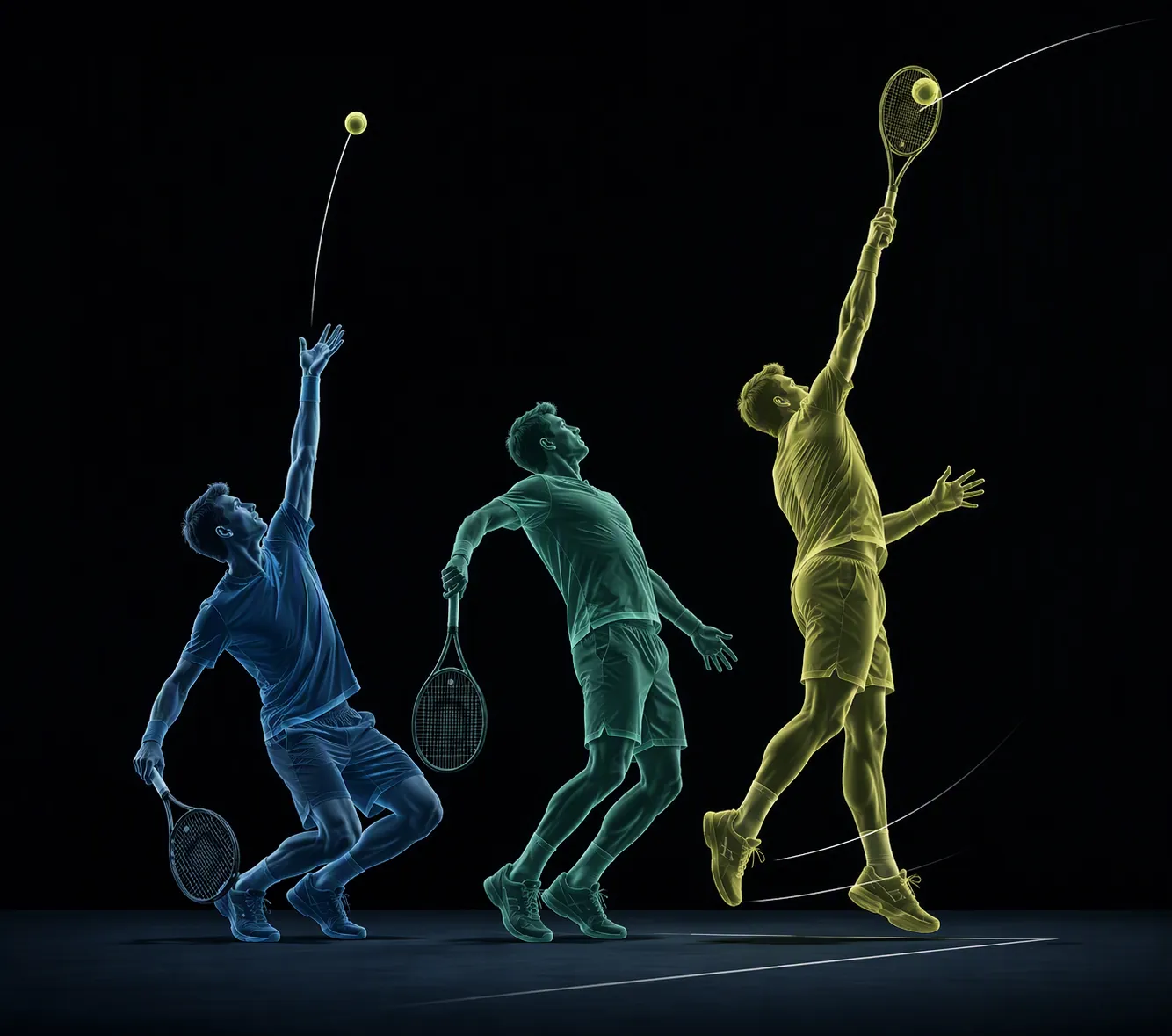
Start with a no-ball rehearsal. From your taped stance, let the knees soften, lift the tossing arm, and rise into the swing. Freeze the finish. If adding the legs makes your toss drift or your body fall left or right, reduce the movement until it behaves. The legs are there to send force upward through a stable shape; they are not there to create a new timing problem.
This is also where short conditioning blocks fit. The six-week junior study used conditioning sessions with core work, tubing, and medicine-ball throws and found the 4.9% serve-velocity improvement already mentioned.[2] For the adult at home, that supports a modest idea: trunk and shoulder work can help, but it should serve the motion instead of replacing it.
- Core control: dead bugs, side planks, or slow anti-rotation holds if you have a band.
- Lower-body support: split-squat holds, calf raises, and slow squat-to-reach patterns that mimic rising into the serve.
- Medicine-ball substitute: if you do not have space or a safe wall, use a towel throw pattern instead of throwing a heavy object indoors.
- Band work: keep it light and clean. If your setup is part of a larger low-budget home routine, the same budget-first equipment logic in this home golf workout routine applies: buy only what you will use safely.
What to do each week, without turning it into a second job
A useful home session can be short. The mistake is not brevity; it is doing random serve gestures for six weeks and then hoping the radar is impressed. Use the same sequence often enough that changes become visible.
| Session piece | Time or volume | Purpose |
|---|---|---|
| Toss and stance check | A few quiet minutes | Keep the ball placement and feet from changing every rep. |
| Towel or shadow swings | Enough smooth reps to feel rhythm, not fatigue | Build relaxed racket-head speed without needing a court. |
| Balance finish | Short holds after selected reps | Stop the body from leaking force sideways. |
| Foam-ball contact | Only if space and noise allow | Connect the motion to a ball without pretending it is a full serve test. |
| Support strength | Brief core, leg, or band block | Support the kinetic chain without making the arm tight. |
| Weekly note | One sentence | Record what felt better, worse, or unstable. |
The weekly note matters more than it sounds. Write things like “toss drifting behind head,” “better balance when I slow the start,” or “band work made shoulder tight, reduce resistance.” That gives your retest some explanation. Speed without context is just a number looking for an excuse.
Retest after six weeks
At the end of Week 6, repeat the baseline test as closely as possible. Same warm-up style, same radar or video setup, same number of serves, same way of counting makes. If the original test was sloppy, resist the temptation to “fix” the method only at the end. You can start a better testing cycle next time, but you cannot honestly compare two different tests and call the difference training.
Look at three things:
- Did your best speed increase?
- Did your better serves as a group get faster, rather than just one outlier?
- Did enough serves land in that the speed would matter in actual play?
If your serve went from the high 60s to the low 70s, that is not small in the way club players like to pretend it is small. It is a measurable change that moves you within the range of published lower-level club and beginner figures. If you were already faster and gained only a few mph, but the motion looks smoother and the serve lands more often, that is still a win. The available six-week conditioning result gives a useful scale: about 4.9% in one junior study, not a magic rate you are owed.[2]
The cleanest result is not a fantasy jump into professional territory. It is a serve you can measure, repeat, and build on: a better toss, a looser throwing action, a steadier finish, and enough leg drive to make the ball arrive heavier without your shoulder doing all the begging.
References
- A Comparison of Serve Speed and Motor Coordination between Elite and Club Level Tennis Players, Journal of Human Kinetics, 2017
- The Best Exercises for Tennis Players: Improve Your Serve, Performance Health
- How to get a faster first serve – four simple tips for more speed, Talking Tennis
- An 8-Stage Model for Evaluating the Tennis Serve, Sports Health, 2011
What a small equipment investment adds
We don't have a build tagged to this exact tier yet. Browse all builds.
How often should you repeat this?
See our recovery and rest reference for citation-anchored rest-interval guidance.
Spot something off?
Tell us if a movement, tier assumption, or duration didn't match your experience.