
Can Home Workouts and Diet Lower Cholesterol?
A research-backed weekly plan that combines 150 minutes of moderate cardio and two resistance sessions with diet changes to lower cholesterol naturally. Learn the exact dosage, timeline, and which home exercises deliver measurable results.
- Equipment tier required
- none
- Duration
- 30 min
- Difficulty
- beginner
- Target area
- full body
- Space footprint needed
- small
- Noise level
- low
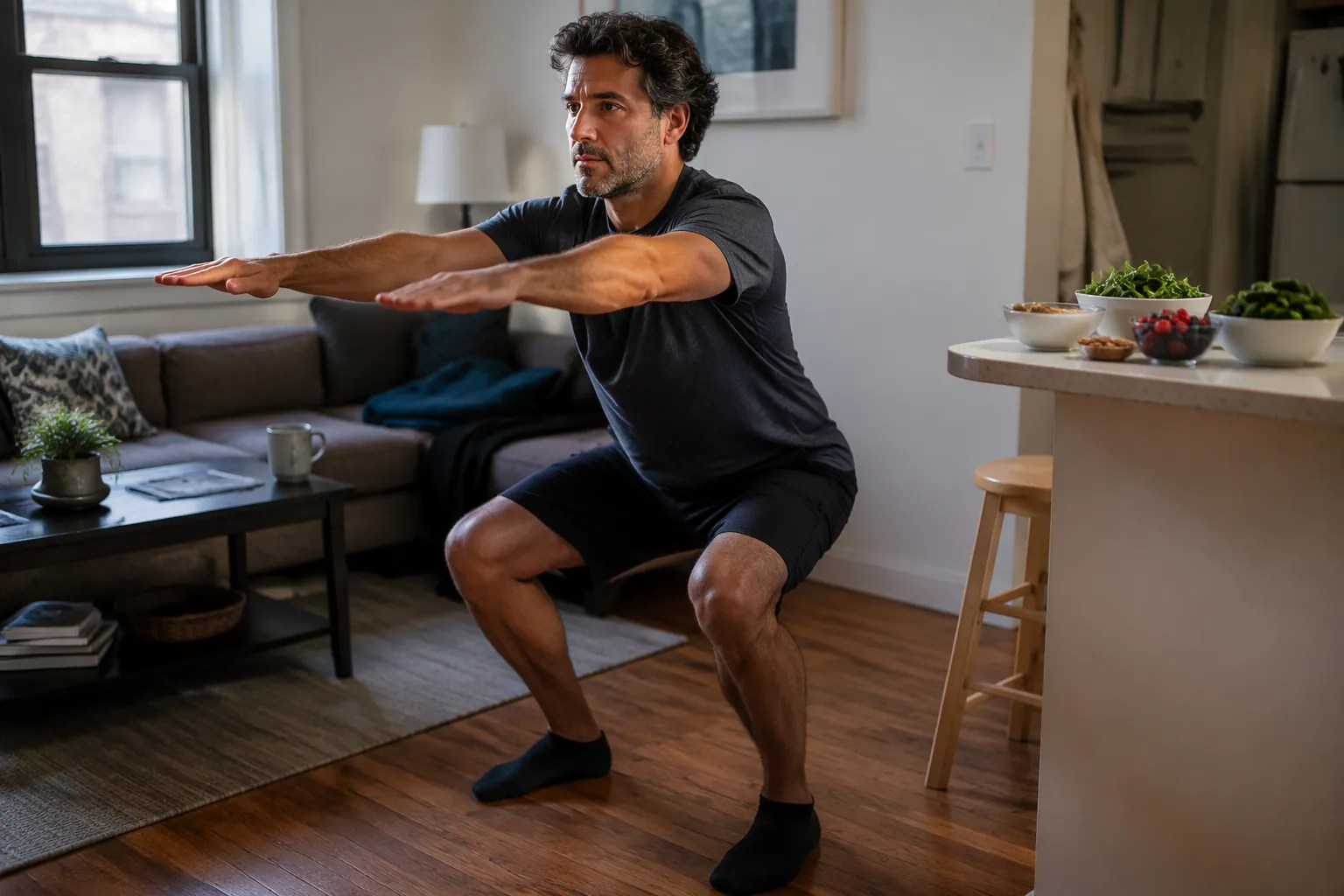
Yes, you can use home workouts and diet to lower cholesterol, but the useful version is more specific than “move more.” A defensible 12-week plan means 150 minutes per week of moderate cardio, two resistance-training sessions, and food changes that directly target LDL cholesterol. The American Heart Association recommends at least 150 minutes of moderate-intensity aerobic activity per week, plus moderate- to high-intensity muscle-strengthening activity at least two days per week. [1]
That matters if your lab result says “borderline high” and the next instruction is vague. The plan below is built for a small apartment, no treadmill, no training history, and no assumption that exercise replaces medical care. If your clinician has prescribed medication, monitoring, or a specific diet, treat this as lifestyle support to discuss with them, not as a substitute.
The 12-week home plan
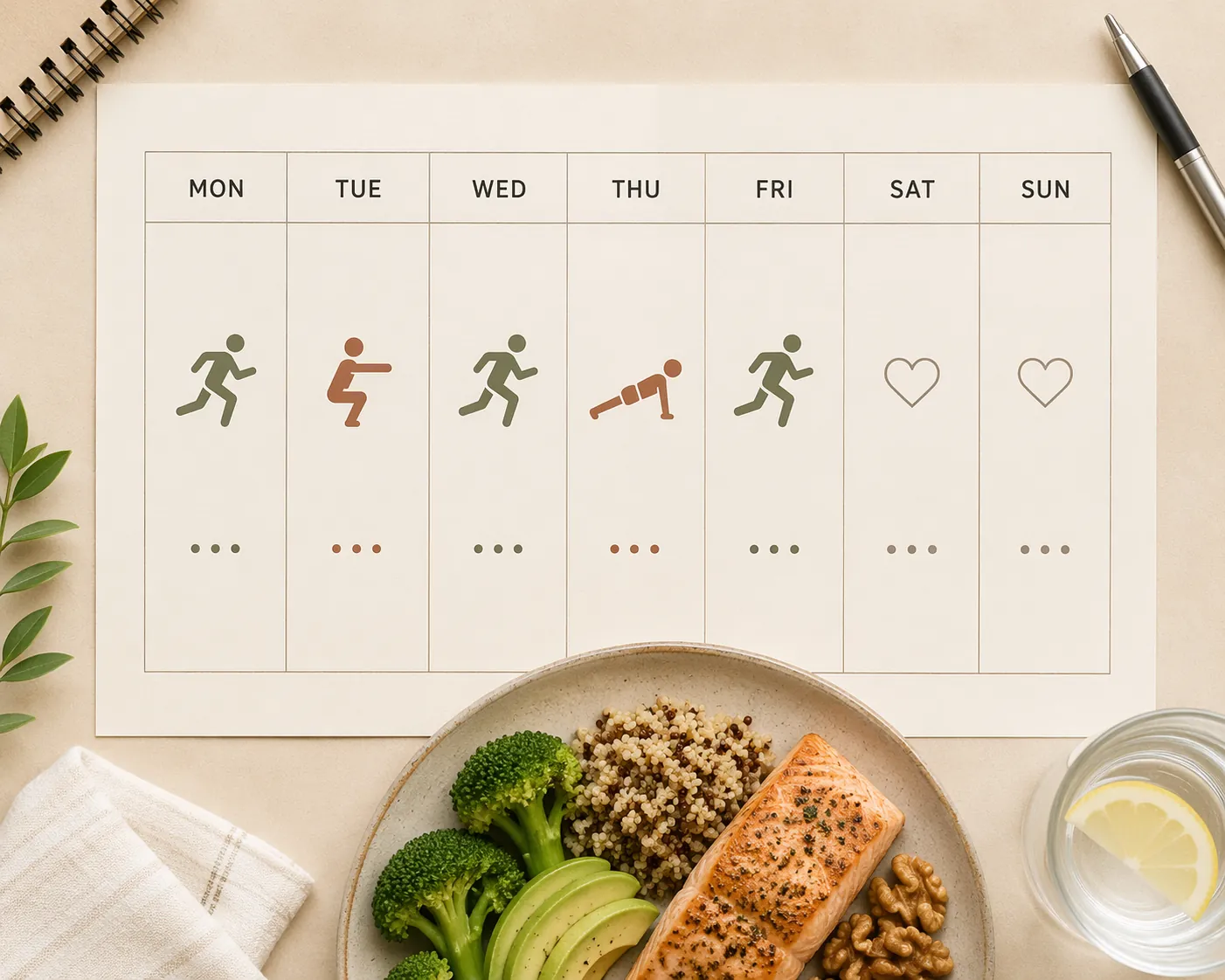
Start with the weekly dose. The exact exercises can vary; the minutes and consistency cannot vary much if you want a fair shot at seeing change on a lipid panel.
| Day | Workout | What to do | What counts |
|---|---|---|---|
| Monday | Moderate cardio, 30 minutes | Brisk indoor walk, outdoor walk, low-impact march, step-touch intervals, or easy cycling if you have a bike | You can talk in short sentences, but singing would be hard |
| Tuesday | Resistance session A, 25–35 minutes | Squats, incline push-ups, reverse lunges, plank, glute bridge, step-ups | Controlled sets that feel challenging by the last few reps |
| Wednesday | Moderate cardio, 30 minutes | Repeat Monday or use a different low-impact option | Steady moderate effort, not a casual stroll |
| Thursday | Resistance session B, 25–35 minutes | Sit-to-stand squats, wall or floor push-ups, split squats, side plank, hip hinge, calf raises | Two to three rounds with rest as needed |
| Friday | Moderate cardio, 30 minutes | Brisk walk, marching circuit, dancing, stairs, or step-ups at an aerobic pace | Breathing is elevated and sustained |
| Saturday | Moderate cardio, 45 minutes | Longer walk or a split session: 25 minutes morning, 20 minutes later | Both parts count if they reach moderate intensity |
| Sunday | Moderate cardio, 15 minutes or recovery walk | Easy-to-moderate walk, mobility, light movement | Use this to finish the 150-minute total |
The cardio can be split across the day. Ten minutes before work, ten minutes after lunch, and ten minutes after dinner are still useful if the effort is truly moderate. What does not count toward the 150 minutes is normal room-to-room walking, gentle stretching, or a few scattered squats while waiting for coffee.
If you already follow a home program, keep it if it meets the same weekly dose. If you need a broader routine library, the workout routines category is the better place to compare formats without losing the cholesterol target.
How hard Monday should feel
Moderate cardio is not punishment cardio. It is the effort level where your breathing changes, your body warms up, and you could hold a conversation in fragments. For most beginners at home, that can be a brisk walk outside, marching in place with arm swings, stair walking, dancing, low-impact step jacks, or a simple step-up pattern on a stable bottom stair.
A 30-minute no-equipment cardio block can look like this: five minutes easy march, 20 minutes alternating one minute brisk march with one minute step-touch or low-impact jacks, then five minutes slower walking. If you have knee, hip, balance, or heart symptoms, choose the lowest-impact option and ask your healthcare provider what intensity is appropriate.
The beginner mistake is making the first week heroic. A plan that leaves you too sore to repeat is not a cholesterol plan; it is one hard day. Use the first two weeks to build the habit of showing up for the minutes. From week three onward, gradually make the same minutes more purposeful by walking faster, adding gentle hills, increasing step height, or reducing unnecessary pauses.
The two resistance sessions are real training
Resistance training belongs in this plan because cholesterol improvement is not only about burning calories during cardio. A review in Sports Medicine found that aerobic exercise, resistance training, and combined exercise can affect cholesterol and lipid profiles, and it does not require machines for the movements to be legitimate. [2]
For each resistance session, do two rounds in weeks one and two. Move to three rounds when the workout no longer feels challenging. Rest 45 to 90 seconds between exercises, longer if your form starts to fall apart.
| Exercise | Beginner version | Progression | Target |
|---|---|---|---|
| Squat | Sit to a chair and stand | Bodyweight squat without the chair | 8–12 reps |
| Push-up | Hands on wall or counter | Hands on sofa, then floor | 6–10 reps |
| Reverse lunge | Step back lightly while holding a wall | Full reverse lunge | 6–10 reps per side |
| Step-up | Low stair or sturdy platform | Higher step or slower lowering | 8–12 reps per side |
| Glute bridge | Two feet on floor | Pause at the top or use one-leg emphasis | 10–15 reps |
| Plank | Hands on counter | Forearms on floor | 15–40 seconds |
A resistance band or a pair of dumbbells can make progression easier, but they are not required to begin. If you like building by equipment level, the bodyweight-to-bands-to-dumbbells structure used in this home workout routine by equipment level is a useful model: start with the version you can repeat, then add load only when the pattern is stable.
Why the exercise dose is set this way
The 150-minute target is not random. Cleveland Clinic summarizes the common recommendation as at least 150 minutes of moderate-intensity exercise per week, and notes that exercise can help raise HDL, lower triglycerides, and improve how the body handles cholesterol. [3]
The research picture is encouraging, but not clean enough to promise the same LDL drop to every person. The Sports Medicine review by Mann and colleagues reported that exercise training can improve lipid profiles, with effects varying by exercise mode, intensity, duration, and baseline health. [2]
That is why the plan uses both aerobic work and resistance training instead of treating one as optional decoration. Cardio supplies most of the weekly minutes. Resistance training helps preserve and build muscle, makes daily movement easier, and gives the plan a second route for metabolic improvement.
Diet does the LDL-heavy work
This is where many home-workout articles overpromise. Exercise is valuable, but exercise alone is not a guaranteed LDL lever. Harvard Health describes research in which dietary changes reduced LDL and total cholesterol, while exercise alone did not significantly reduce those measures in that analysis; adding aerobic exercise enhanced the benefits of the heart-healthy diet. [4]
So the food side is not a wellness garnish. For lowering cholesterol with home workouts and diet, the diet has to carry specific jobs: reduce saturated fat, increase soluble fiber, emphasize unsaturated fats, and make the weekly exercise easier to repeat because meals are steady enough to support energy.
- Add soluble fiber most days: oats, beans, lentils, apples, pears, barley, and other high-fiber plant foods.
- Shift fat quality: use nuts, seeds, avocado, olive oil, and fish more often than butter, high-fat processed meats, and full-fat dairy.
- Build Mediterranean-style plates: vegetables, legumes, whole grains, fruit, fish or lean protein, and unsaturated fats.
- Make breakfast boring in a useful way: oatmeal with fruit and nuts is more cholesterol-focused than a pastry grabbed after a workout.
- Plan protein without turning every meal into a saturated-fat delivery system.
Mayo Clinic includes eating heart-healthy foods, exercising on most days, quitting smoking, weight management, and limiting alcohol among lifestyle changes that can improve cholesterol. [5]
If nutrition is where the plan usually breaks, connect it to repeatable meals rather than motivation. The ideas in daily eating habits for home fitness recovery can be adapted toward cholesterol by putting more emphasis on fiber-rich carbohydrates, unsaturated fats, and lower-saturated-fat protein choices.
What may change after 12 weeks
Twelve weeks is a reasonable first checkpoint because lipid changes need time to show up. In a 12-week exercise study of 115 healthy young men, both moderate- and high-intensity exercise improved lipoprotein profile and cholesterol efflux capacity; the moderate-intensity group raised HDL-C by 6.6% and lowered LDL-C by 7.2%. [6]
That study is useful for timing and direction, not as a guarantee for every reader. The participants were healthy young men, so the result does not automatically transfer to women, older adults, people taking lipid medication, or people with cardiovascular disease. Still, it supports the idea that a consistent 12-week training block is long enough to measure, while two enthusiastic weeks usually are not.
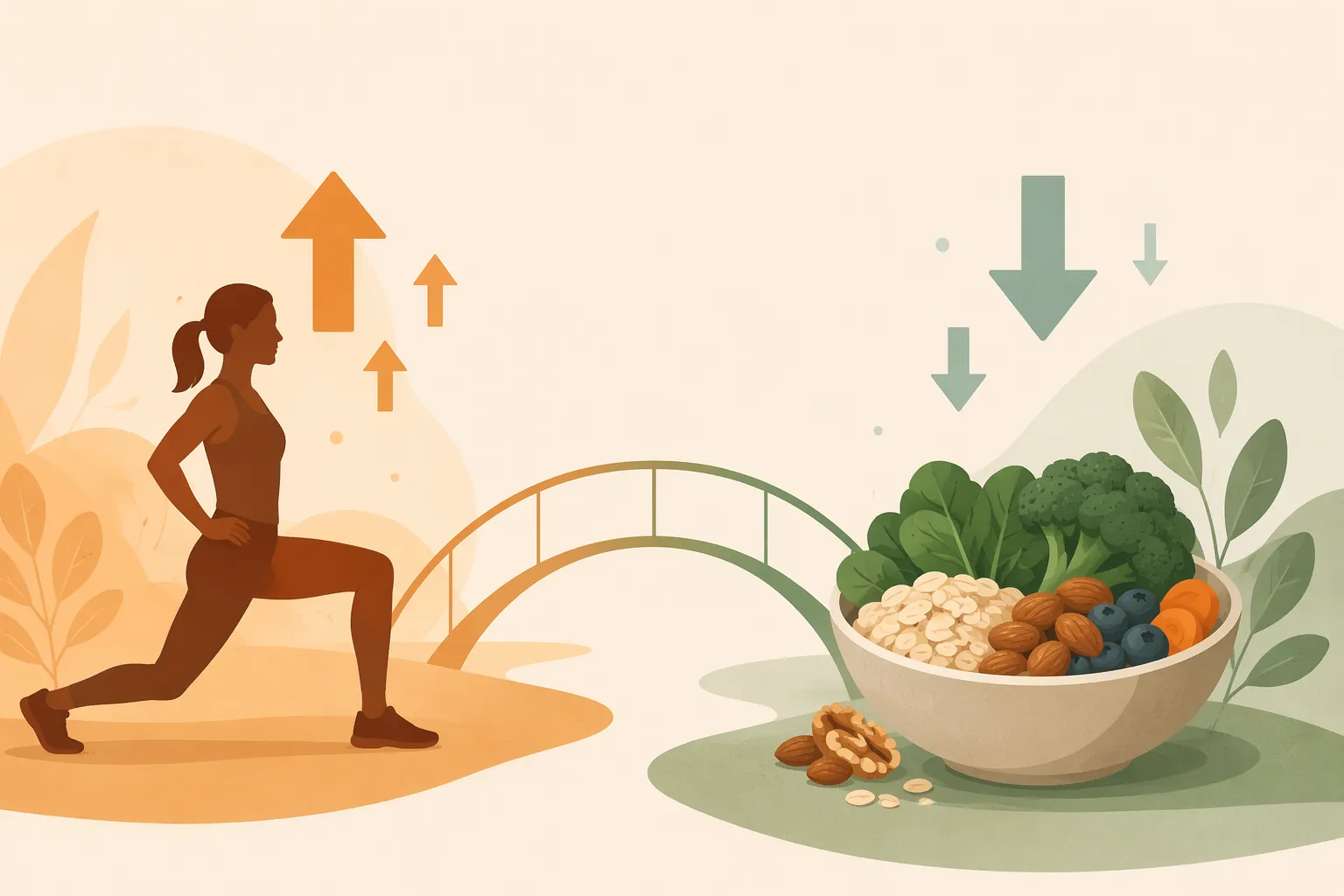
The changes you are looking for are not limited to LDL. Exercise often gets more credit for raising HDL, lowering triglycerides, improving fitness, and changing how cholesterol is transported and cleared. Diet usually has the more direct assignment for LDL and total cholesterol. That division is the practical reason to keep both parts in the same plan.
If your week falls apart
A missed workout does not ruin the plan. A missed pattern does. If Monday disappears, move the 30-minute cardio block to Tuesday and do resistance on Wednesday. If you cannot find 45 minutes on Saturday, split it. If your knees dislike step-ups, walk, march, cycle, or use low-impact dance instead.
| Problem | Adjustment |
|---|---|
| No 30-minute opening | Use three 10-minute moderate blocks |
| Apartment noise | Choose marching, step-touch, shadow boxing without jumps, and slow strength reps |
| No equipment | Use chair squats, wall push-ups, lunges, bridges, planks, and stairs |
| Low confidence | Repeat week one for another week before progressing |
| Air quality or weather issue | Move cardio indoors and use a low-impact circuit |
For days when outdoor walking is not sensible, the small-space options in how to work out at home during an air quality alert fit the same logic: protect the habit, keep the effort moderate, and do not turn a missed walk into a missed week.
When to be more cautious
Talk with a healthcare provider before starting or intensifying exercise if you have chest pain, unusual shortness of breath, dizziness, known cardiovascular disease, uncontrolled blood pressure, diabetes complications, recent surgery, pregnancy-related restrictions, or any medical instruction to limit exertion.
Also be careful with interpretation. A lower LDL number after 12 weeks may reflect exercise, diet, medication adherence, weight change, alcohol changes, smoking changes, or several of those at once. A number that does not move does not mean the workouts were useless; HDL, triglycerides, blood pressure, glucose control, waist measurement, and fitness may still be improving. Your clinician can help decide what the lipid panel means for your overall risk.
The cleanest home strategy is not complicated, but it is specific: 12 weeks of 150 moderate cardio minutes, two resistance sessions, and cholesterol-focused eating. Squats and planks help. Oats, beans, unsaturated fats, and lower saturated fat help. The measurable plan is the combination.
References
- American Heart Association Recommendations for Physical Activity in Adults and Kids
- Differential Effects of Aerobic Exercise, Resistance Training and Combined Exercise Modalities on Cholesterol and the Lipid Profile — Mann et al., Sports Medicine
- Does Exercise Lower Cholesterol? — Cleveland Clinic
- How to lower your cholesterol without drugs — Harvard Health
- Top 5 lifestyle changes to improve your cholesterol — Mayo Clinic
- Moderate- and High-Intensity Exercise Improves Lipoprotein Profile and Cholesterol Efflux Capacity in Healthy Young Men — JAHA
What a small equipment investment adds
We don't have a build tagged to this exact tier yet. Browse all builds.
How often should you repeat this?
See our recovery and rest reference for citation-anchored rest-interval guidance.
Spot something off?
Tell us if a movement, tier assumption, or duration didn't match your experience.