
How far can you run on Manhattan's car-free Summer Streets?
Manhattan Summer Streets still has two car-free Saturdays left — August 8 and 15, 7am-3pm. Here's the Brooklyn Bridge-to-Inwood route (roughly 7-8 miles one-way, 14-16 out-and-back), the closures and water stops, and the pre-9am quiet window runners need to plan a long run.
- Equipment tier required
- none
- Duration
- 480 min
- Difficulty
- intermediate
- Target area
- full body
The practical answer is simple: Manhattan Summer Streets still has two Saturdays left, August 8 and August 15, and both run from 7am to 3pm. August 1 is already behind us, so those are the planning targets now; the official event is free, rain or shine, and does not require RSVP. [1]
What the corridor actually is
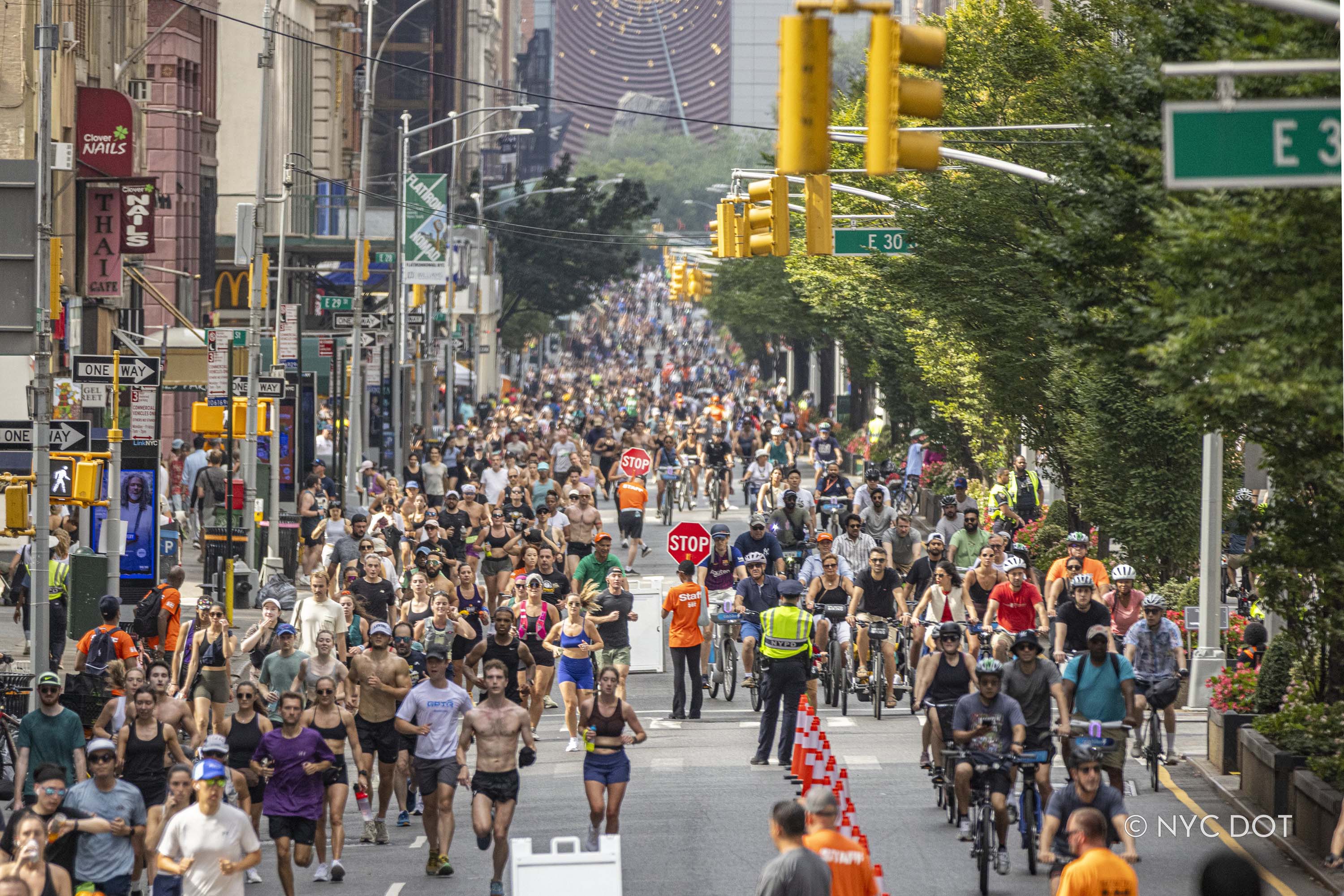
DOT describes the Manhattan corridor as a nearly eight-mile car-free spine from the Brooklyn Bridge up to Inwood. For runners, the useful part is the street list: Lafayette St and Park Ave from the Brooklyn Bridge to E 110th, E 110th St between Park Ave and Broadway, Adam Clayton Powell Jr Blvd between W 110th and W 113th, and Broadway between W 110th and Dyckman St. [1]
| Segment | What it means for a runner |
|---|---|
| Lafayette St & Park Ave, Brooklyn Bridge to E 110th | The south-to-north spine that gives the route its longest uninterrupted feel. |
| E 110th St, Park Ave to Broadway | The east-west crossover that keeps the corridor continuous. |
| Adam Clayton Powell Jr Blvd, W 110th to W 113th | The official west-side connector; use the DOT map if you have seen a longer version elsewhere. |
| Broadway, W 110th to Dyckman St | The final northbound stretch into Inwood. |
For planning, the honest working number is about 7-8 miles one way, which makes a roughly 14-16-mile out-and-back realistic if you turn at the far end and do not overcomplicate the route. That is long-run distance, not a novelty loop. [1]
How to use the window
Runner chatter tends to put the quietest block in the first two hours after opening, roughly 7am-9am. Treat that as community experience rather than an official rule. If you want tempo work, that is still the safest bet; once the corridor fills, the session starts feeling more like controlled survival than steady pacing.
Before you commit, check the AQI guide and the hourly weather decision; if the heat is already winning, the heat-illness guide and heat-acclimation piece are the relevant follow-ups.
Use the official rest-stop waypoints as meet-up and refill cues, not as your whole hydration plan: Foley Square area, Astor Place, E 26th, Park Ave at E 40th-41st, E 109th, Broadway at W 125th-126th, W 159th, W 175th, and Dyckman. [3] Carrying your own bottle is still the safer default for an August long run.
Leave extra time for getting in and out of the corridor, because this is still a city street closure, not a controlled race start. Roads are closed from 5am to 3:30pm, parking is restricted from midnight to 4pm, and MTA buses are rerouted, so the cleanest running plan can still have messy edges. [3]
A short 5K note
The first Manhattan NYRR Start Line Series 5K ran on August 1, starting at Park Ave and E 80th, with bib pickup from 6am to 7:30am, bag check at E 77th-78th, and a single fluid station on Park Ave between 109th and 108th. [2] It matters here mainly as a second use case for the corridor; for the dates still ahead, the long-run math is the bigger story.
For a New York runner trying to fit one clean summer session into a Saturday, this is the route that matters. Start at opening, keep your bottle with you, and treat Manhattan Summer Streets as a real long-run surface rather than a race substitute. That is enough to make the miles happen without improvising every mile.
References
- Summer Streets — NYC Department of Transportation — https://nyc.gov/summerstreets
- NYRR Start Line Series: Manhattan — New York Road Runners — August 1, 2026 — https://events.nyrr.org/nyrr-start-line-series-manhattan
- Summer Streets 2026 closures and rest stops — CBS New York — August 1, 2026
What a small equipment investment adds
We don't have a build tagged to this exact tier yet. Browse all builds.
How often should you repeat this?
See our recovery and rest reference for citation-anchored rest-interval guidance.
Spot something off?
Tell us if a movement, tier assumption, or duration didn't match your experience.