
No Equipment? Try This 6-Week MMA-Style Home Workout
A 6-week MMA-inspired home plan using shadow-boxing rounds, wrestling-style bodyweight movements, and plyometrics — zero equipment, with effort targets and progression built into every phase. It shows what this training can genuinely build and where it stops: contact skill and accurate striking speed need a partner, a bag, or sport-specific practice.
- Equipment tier required
- none
- Duration
- 20 min
- Difficulty
- beginner
- Target area
- full body
- Space footprint needed
- 2x2 meters minimum; 3x3 meters for fuller footwork
- Noise level
- moderate; quiet substitutions available
A useful MMA-inspired home workout with no equipment has to do two things at once: give you enough structure to train hard for more than one random sweat session, and stay honest about what solo training can and cannot teach. Shadow boxing, sprawls, push-ups, squats, lunges, hops, and floor movement can become a real six-week conditioning block. They will not make you sparring-ready by themselves.
The plan below uses round timing, weekly frequency, space minimums, and effort anchors from a published six-week no-equipment MMA home workout framework: four training days per week, progressing from foundation work to build weeks to peak fight-simulation rounds. I’m using that structure as the load-bearing frame, not treating every claim around it as independently verified research.[1]
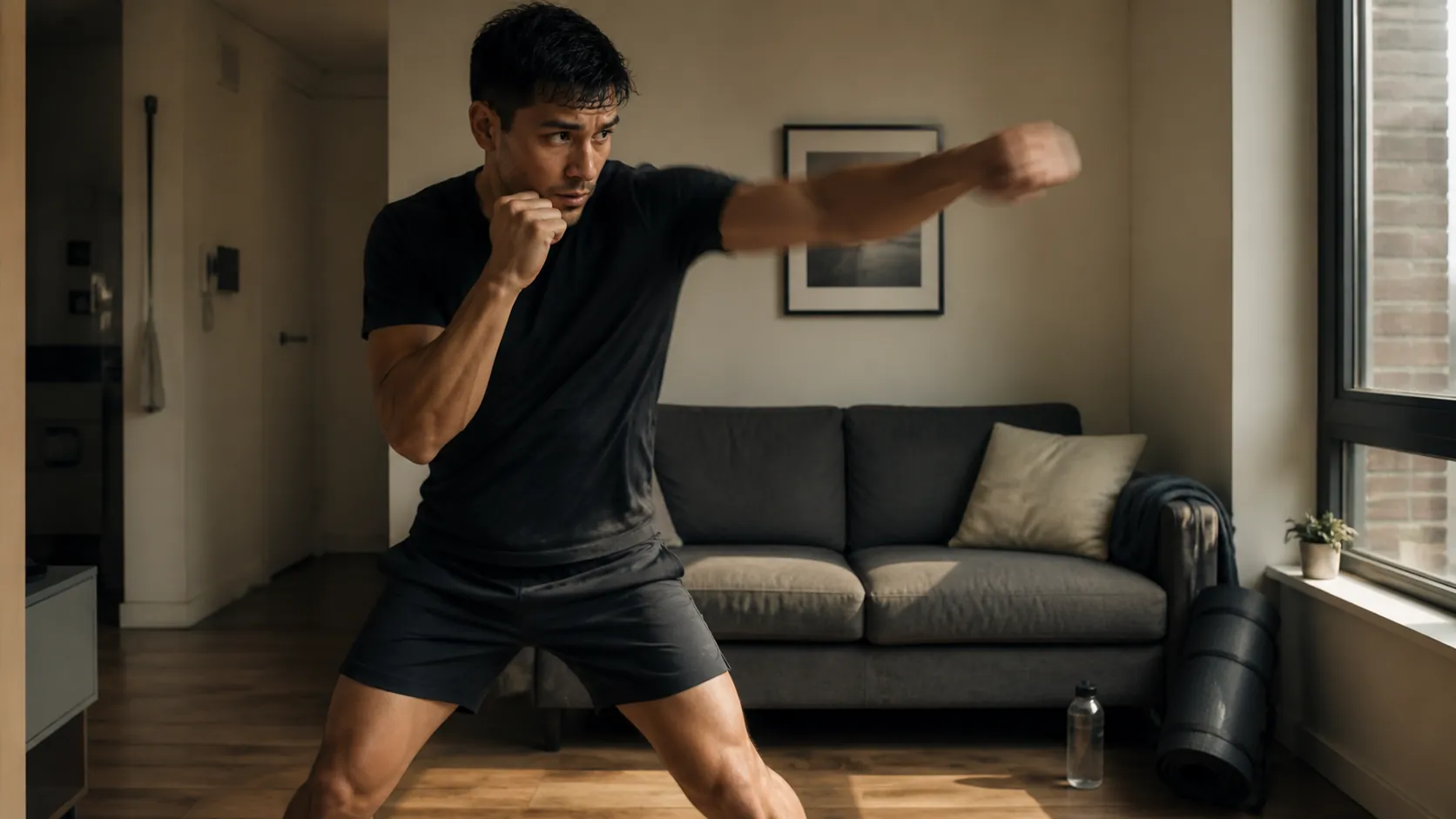
The six-week routine at a glance
Train four days per week. Keep at least one easier or off day after the hardest sessions. The main work is round-based: shadow-boxing combinations, stance switches, sprawls, wrestling-style floor movement, and short plyometric bursts. The progression is simple enough to tape to a wall, which is the point.
| Phase | Weeks | Frequency | Main round structure | Effort target | Rest | Job of the phase |
|---|---|---|---|---|---|---|
| Foundation | 1–2 | 4 days/week | 6 × 3-minute shadow-boxing rounds | About 60% effort; roughly RPE 6/10 | 60 seconds | Build rhythm, stance control, breathing, and repeatable movement |
| Build | 3–4 | 4 days/week | 8 × 2-minute rounds | About 80% effort; intervals can reach RPE 8.5–9/10 | 45 seconds | Raise pace, shorten recovery, and add sharper sprawls and plyometrics |
| Peak | 5–6 | 4 days/week | 5 × 3-minute fight-simulation rounds | Hard but controlled; recover enough to keep mechanics clean | 60 seconds | Blend striking, level changes, ground movement, and fast resets under fatigue |
Do not add equipment to make the plan feel more serious. No dumbbells, no bag, no pull-up bar required. If you already have a pull-up bar, it can be optional extra strength work, but it is not part of the no-equipment routine.
Use the four training days this way
The weekly layout should make the rounds feel different instead of turning every session into the same frantic living-room HIIT circuit. The movements repeat, but the emphasis changes.
| Day | Emphasis | Main ingredients | What to avoid |
|---|---|---|---|
| Day 1 | Striking rhythm and base conditioning | Shadow-boxing combinations, stance switches, slips, step-backs, easy sprawls | Throwing every punch at full speed in week one |
| Day 2 | Wrestling-style strength endurance | Squats, reverse lunges, push-ups, plank shoulder taps, bear crawls, technical stand-ups | Letting floor work become noisy or sloppy |
| Day 3 | Speed changes and plyometrics | Fast combinations, skater hops, squat jumps or quiet squat-to-calf-raise, sprawls, mountain climbers | Adding jumps if your knees, floor, or neighbors are not ready |
| Day 4 | Mixed simulation | Strike, level change, sprawl, reset, circle, repeat | Pretending this is sparring; it is conditioning with MMA vocabulary |
A rest day can mean a walk, mobility work, or nothing. If you want another small-space movement session that stays low on equipment and floor impact, the living-room format in these tennis footwork drills is a useful cousin, but do not stack extra footwork on top of this plan until the four weekly days feel recoverable.
Weeks 1–2: foundation rounds should feel controlled, not easy
The first two weeks are six 3-minute rounds with 60 seconds between rounds, held around 60% effort or about RPE 6/10.[1] That is not a warm-up pace. It is the pace where you can still make decisions: hands return to guard, feet do not cross, breathing stays mostly nasal or steady through the mouth, and you can speak in short phrases if someone asks whether you are alive.
Use these rounds to learn the room. A jab-cross does not need a runway. A sprawl does need a clear landing zone. A pivot needs enough space that your heel does not clip a coffee table. The source framework gives 2 × 2 meters, or 4 square meters, as enough for stationary combinations, and 3 × 3 meters for fuller footwork.[1] In a compact apartment, that usually means furniture pushed back, mat rolled out only if it does not slide, and every round starting from the same safe center point.
A foundation striking round can be plain and still useful: jab-cross, reset; jab-cross-hook, reset; slip left, slip right; step back, step in; sprawl once, stand up, breathe. The goal is not to invent twenty combinations. The goal is to stop leaking energy every time you change levels.
On the wrestling-strength day, keep the same round clock but change the texture. For example: slow squats, reverse lunges, push-ups, plank shoulder taps, bear crawl forward and back if space allows, then a technical stand-up. Move continuously, but not desperately. If your push-ups collapse after the first minute, elevate your hands on a sturdy couch or do controlled knee push-ups. The no-equipment rule does not require pretending you are stronger than you are.
A simple foundation session
- Round 1: jab-cross, guard reset, easy footwork.
- Round 2: jab-cross-hook, slip-slip, step back.
- Round 3: bodyweight squats, reverse lunges, plank shoulder taps.
- Round 4: shadow-boxing with one sprawl every 20–30 seconds.
- Round 5: push-ups, bear crawl or plank walkout, technical stand-up.
- Round 6: light mixed round — strike, level change, reset, breathe.
If you finish week two feeling like you could have done more, good. That is different from finishing week one so wrecked that week two becomes negotiation.
Weeks 3–4: shorter rounds, less rest, sharper movement
The build phase changes the pressure. You move to eight 2-minute rounds, rest only 45 seconds, and work around 80% effort, with harder intervals reaching about RPE 8.5–9/10.[1] The total round time is not wildly longer, but the shorter rest makes laziness show up quickly.

This is where the routine starts to feel more MMA-inspired and less like cardio with punches. Add a level change before the sprawl. Add a defensive motion before the counter. After a squat jump, return to stance instead of standing around admiring the jump. The reset is part of the rep.
A build-phase round might run like this: 20 seconds of fast jab-cross-hook, 10 seconds of footwork, one sprawl, stand up into stance, 20 seconds of cross-hook-cross, 10 seconds of slips, then repeat until the bell. Another round can be strength-biased: push-ups, squat-to-knee-drive, mountain climbers, plank shoulder taps, then pop back to stance. It should feel athletic, but still organized.
Plyometrics belong here only if you can land quietly. Skater hops can become side steps. Squat jumps can become fast squats with a calf raise. Split jumps can become reverse lunges with an aggressive knee drive. Apartment training has a built-in honesty test: if every landing sounds like a dropped toolbox, the movement is not controlled enough for your space.
The build-phase rule
Increase density before you increase chaos. First shorten the rest as planned. Then make transitions cleaner. Then add speed. Only after that should you add higher-impact movements.
Weeks 5–6: fight-simulation rounds without the sparring fantasy
The peak phase uses five 3-minute fight-simulation rounds with 60 seconds rest.[1] That phrase can get silly fast, so keep it grounded. A fight-simulation round at home means you are combining striking rhythm, level changes, sprawls, ground-to-stand transitions, and fast resets under fatigue. It does not mean you have learned to take a punch, read an opponent, or manage real contact.
Each round should have a job. One round can emphasize long combinations and exits. One can emphasize sprawls after every combination. One can use push-ups and squat jumps as fatigue inserts. One can force stance switches. One can be the cleanest mixed round you can manage after the previous four.
| Peak round | Focus | Example flow |
|---|---|---|
| Round 1 | Striking volume | Jab-cross-hook, exit step, reset; add slips between combinations |
| Round 2 | Level changes | Combination, level change, sprawl, stand, circle |
| Round 3 | Strength under fatigue | Push-ups, squats, mountain climbers, then return to stance work |
| Round 4 | Power bursts | Short fast combinations, skater hops or quiet lateral steps, sprawls |
| Round 5 | Mixed control | Strike, defend, level change, ground movement, stand, reset |
The last round is not a license to flail. If your hands drop, your feet tangle, and every sprawl lands like a fall, the round has exceeded its purpose. Back the pace down until you can still move like you meant to do it.
How hard should it feel?
The plan’s effort targets are more useful than any calorie estimate. In weeks 1–2, RPE 6/10 should feel like steady work: warm, focused, breathing harder, but still able to speak in short phrases. In weeks 3–4, RPE 8.5–9/10 intervals should feel uncomfortable and time-limited: you can say a word or two, not hold a conversation. In weeks 5–6, the hard rounds should still leave enough control to keep stance, guard, and landing mechanics intact.[1]
- If you cannot talk at all during week-one rounds, you started too hard.
- If your rest periods are spent bent over and missing the next bell, reduce speed before reducing range of motion.
- If your punches get faster but your feet stop moving, slow down and rebuild the whole pattern.
- If plyometrics make the session louder but not cleaner, use quiet substitutions.
A timer matters more than a tracker. Use any interval app, oven timer, watch, or playlist cut into round lengths. If music helps you keep pace, pick tracks that support the round instead of dragging you into a tempo you cannot sustain.
Progress without equipment
No equipment does not mean no overload. It means the overload has to come from pace, density, range, tempo, transitions, and exercise difficulty.
| Progression lever | How to use it | Best phase |
|---|---|---|
| Density | Do the same quality work with less rest, following the planned 60-second to 45-second shift | Weeks 3–4 |
| Tempo | Lower slowly, pause, then drive up on push-ups, squats, and lunges | All phases, especially strength rounds |
| Transition speed | Stand up from sprawls or floor positions faster without losing balance | Weeks 3–6 |
| Range of motion | Use deeper squats, cleaner lunges, and full push-up positions only when control is present | Weeks 1–6 |
| Impact | Add jumps only after quiet landings and joint comfort are reliable | Weeks 3–6 |
Tempo is the easiest upgrade to miss. In a UFC.com bodyweight-training piece, coach Andy Hennebelle describes a 4-2-1 method: four seconds lowering, two seconds holding, one second coming up. The same article notes that bodyweight work can target major muscle groups with movements such as squats, lunges, push-ups, and pull-ups, while also describing Mike Swick’s long-term bodyweight-only training habits.[3]
For this plan, keep the useful part and drop what violates the premise. Pull-ups require a bar, so they are optional if you already have one. The 4-2-1 tempo works perfectly well on push-ups, squats, split squats, reverse lunges, and plank walkouts without buying anything.
Make it fit a small apartment
The biggest apartment mistake is designing the workout for a room you do not have. Start with the smaller movement vocabulary: stationary combinations, slips, step-backs, sprawls, squats, lunges, push-ups, planks, mountain climbers, and technical stand-ups. Add circling footwork only if you have the larger clear area.
- Use tape, a mat edge, or floorboards to mark your center point.
- Throw combinations at shoulder height without fully locking the elbow.
- Replace forward-backward running with stance switches or step-backs.
- Replace bear crawls with plank shoulder taps if the floor space is too short.
- Replace squat jumps with fast squats or squat-to-calf-raise when noise matters.
- Practice sprawls on a stable surface; a sliding mat turns conditioning into furniture roulette.
A quiet version is not a lesser version. It is often the version that lets you train four days a week without dreading the floor impact.
What this routine can genuinely build
The strongest evidence here is not that shadow boxing in a living room magically transfers to fighting. It is that structured strength and power work can improve physical qualities that matter in combat sports.
A 2023 systematic review by Cid-Calfucura and colleagues examined 20 strength-training studies involving 504 Olympic combat-sport athletes across judo, boxing, karate, wrestling, and fencing. The review reported significant improvements in maximal strength, muscle power, flexibility, and balance after programs lasting 4 to 20 weeks, performed 2 to 6 sessions per week.[2]
That does not prove this exact no-equipment block will reproduce the same results in every apartment exerciser. The athletes, sports, and training methods in the review were broader than this routine. The practical takeaway is narrower and still useful: progressive strength and power training is not decorative for combat-sport conditioning. It is one of the physical inputs worth training.
In this plan, the strength and power stimulus comes from repeated push-up variations, squat and lunge patterns, sprawls, ground-to-stand transitions, and controlled plyometrics. The conditioning stimulus comes from the escalating round structure: longer controlled rounds first, then shorter harder rounds with less rest, then mixed 3-minute simulations.
What it cannot replace
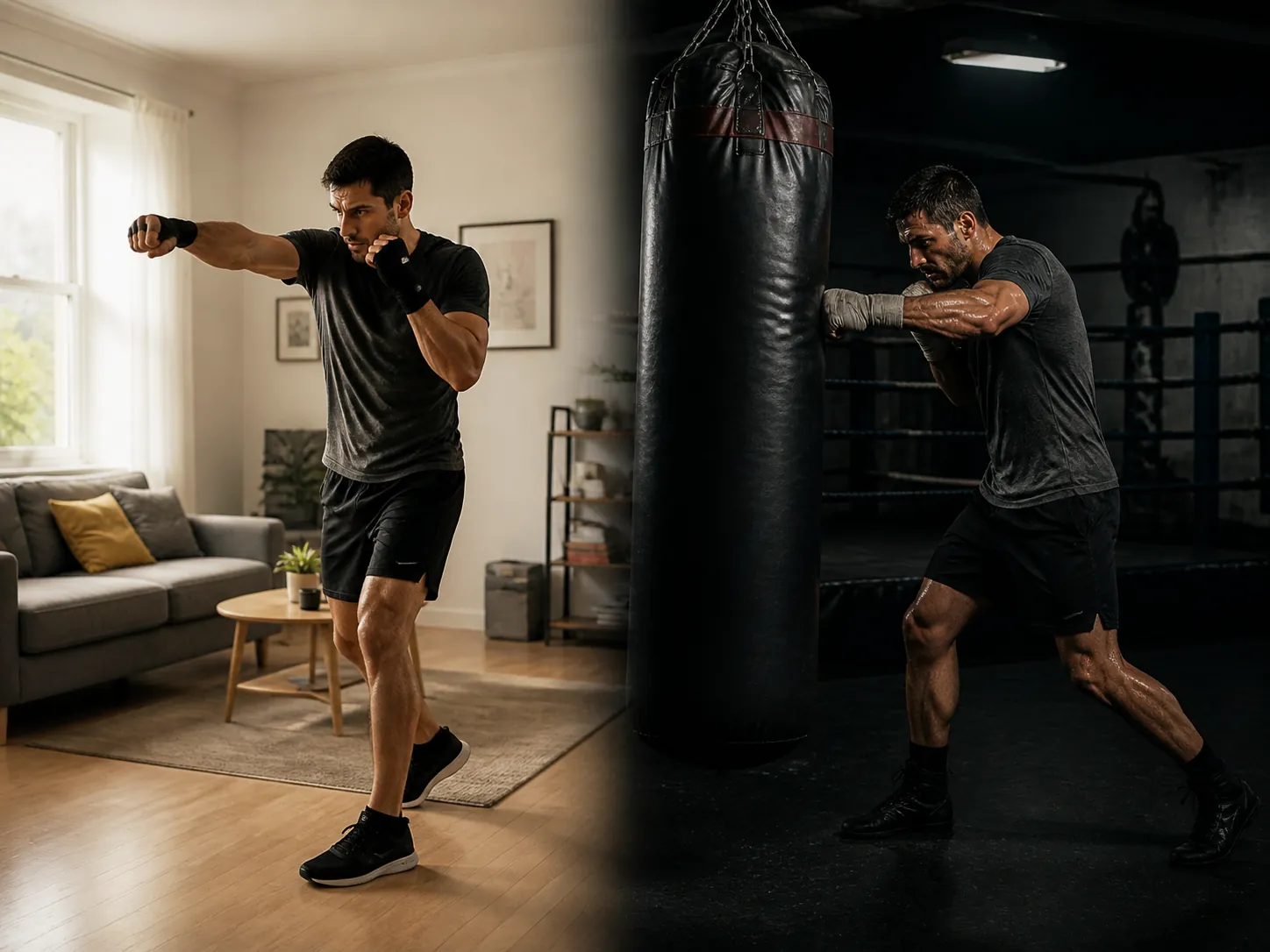
Solo rounds can improve rhythm, repeat conditioning, and make you more comfortable moving through MMA-shaped patterns. They cannot teach impact absorption, clinch pressure, distance against a resisting person, or what your punch does when it meets a target.
The speed boundary matters too. Voigt and Klausen’s 1990 study in the European Journal of Applied Physiology found that strength training alone did not increase unloaded punch speed, while specific punch training did.[4] That is a useful warning for home workouts: stronger shoulders and harder conditioning do not automatically become accurate striking speed.
Followed progressively, this is a serious no-equipment conditioning block: shadow-boxing rounds, wrestling-style bodyweight work, plyometrics, effort targets, and recovery all have a place. Contact comfort, distance management, impact timing, and accurate striking speed require a partner, a bag, or sport-specific practice.
References
- MMA Home Workout Plan: 6 Weeks No Equipment Combat Conditioning, 369MMAFIT
- Effects of Strength Training on Physical Fitness of Olympic Combat Sports Athletes: A Systematic Review, 2023
- UFC Gym Training: No Machines, Just Muscle, UFC.com
- Velocity of unloaded punching movements in relation to strength training, European Journal of Applied Physiology, 1990
What a small equipment investment adds
We don't have a build tagged to this exact tier yet. Browse all builds.
How often should you repeat this?
See our recovery and rest reference for citation-anchored rest-interval guidance.
Spot something off?
Tell us if a movement, tier assumption, or duration didn't match your experience.