
No Court? These Tennis Footwork Drills Fit Your Living Room
You don't need a court to get faster on one: the average movement burst in modern tennis is about 4.5 m, well within a typical living room's clear floor space. This 15–20 minute no-ball session mirrors real match patterns and work-to-rest ratios — with a quiet tier for apartments — so footwork carries over when you're back on court.
- Equipment tier required
- none
- Duration
- 15-20 min
- Difficulty
- beginner
- Target area
- legs
- Space footprint needed
- 4x4 m
- Noise level
- low
The useful number is smaller than the excuse. In recent Australian Open tracking, the average between-shot movement cycle was 4.5 m for men and 4.2 m for women, and 80% of cycles were 6 m or less. That means the movement problem in tennis often fits inside a roughly 4×4 m clear patch of floor — about 13×13 ft — if the drill is built like tennis instead of like random cardio. [1]
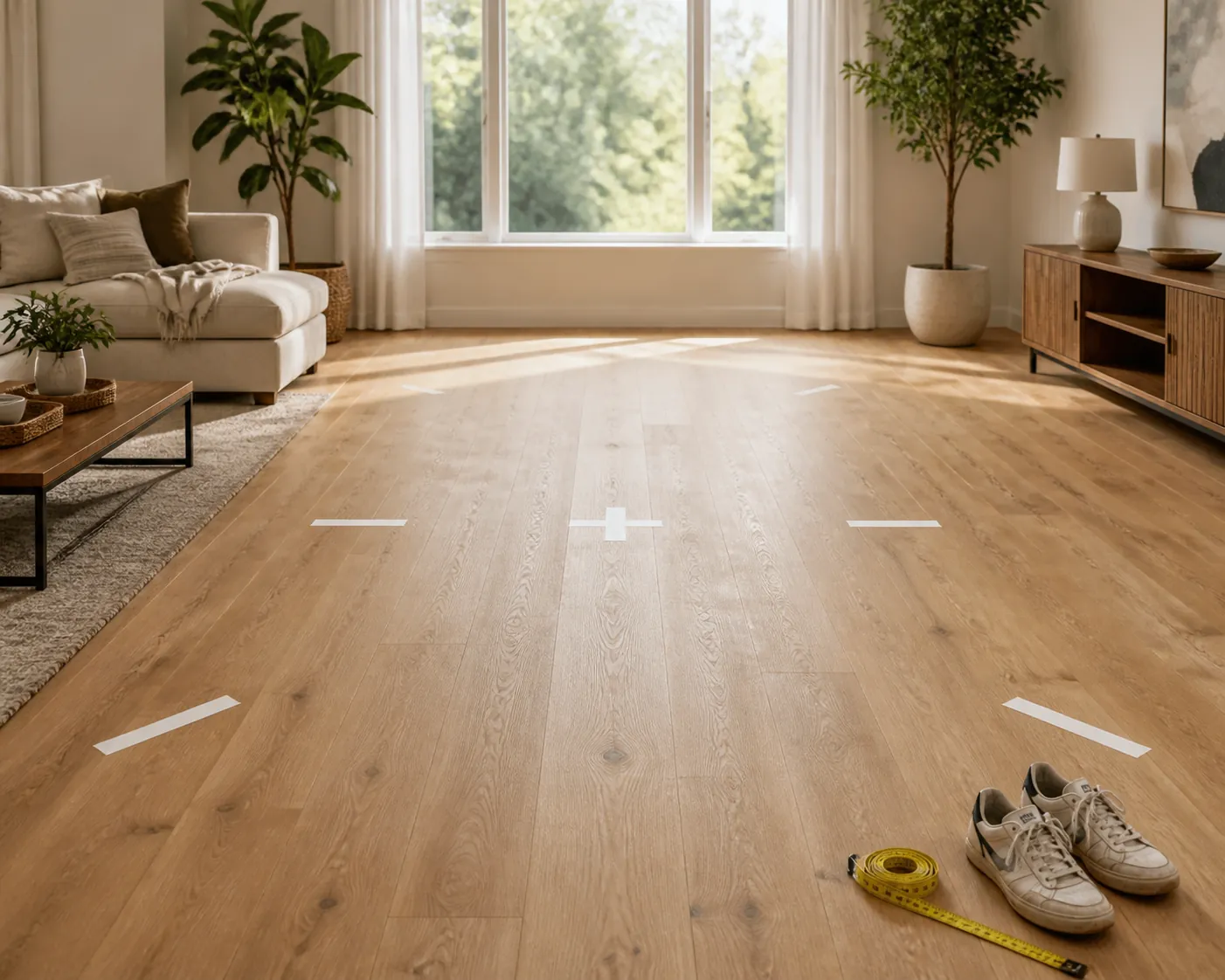
So the answer for home tennis footwork with no court is not a giant menu of ladders, spiders, and cone patterns. It is a short session that keeps repeating the movement cycle you need when a ball is coming: split step, first step or crossover, hit-position footwork, then recovery. No ball. No court. Fifteen to twenty minutes. Quiet enough to make sense in an apartment if you choose the low-impact version.
Start with a tiny court, not a drill list
The Australian Open data is elite hard-court data, not a promise that your Tuesday-night doubles match produces the same numbers. The study used Hawk-Eye tracking from the 2021–22 Australian Open, covering 155 men’s and 168 women’s match files, so it is best treated as a reference for what the modern game asks of players at the top level. Still, it gives home training a very practical shape: tennis movement is usually short, repeated, and directional. [1]
It also keeps us from leaning too hard on older, smaller-distance tennis clichés. The newer hard-court tracking found that fewer than 10% of movement cycles were under 2.5 m, while most still stayed within 6 m. That is the sweet spot for a room session: not huge running, not toe-tapping in place, but short bursts that make you leave center and come back. [1]
The timing matters just as much as the floor plan. A review of tennis match-play intensity describes typical work bouts of 4–10 seconds, followed by 10–20 seconds of rest, with hundreds of high-intensity efforts across a best-of-three match. That is why the session below uses short intervals instead of long “agility burnouts.” [2]
Tape the room like this
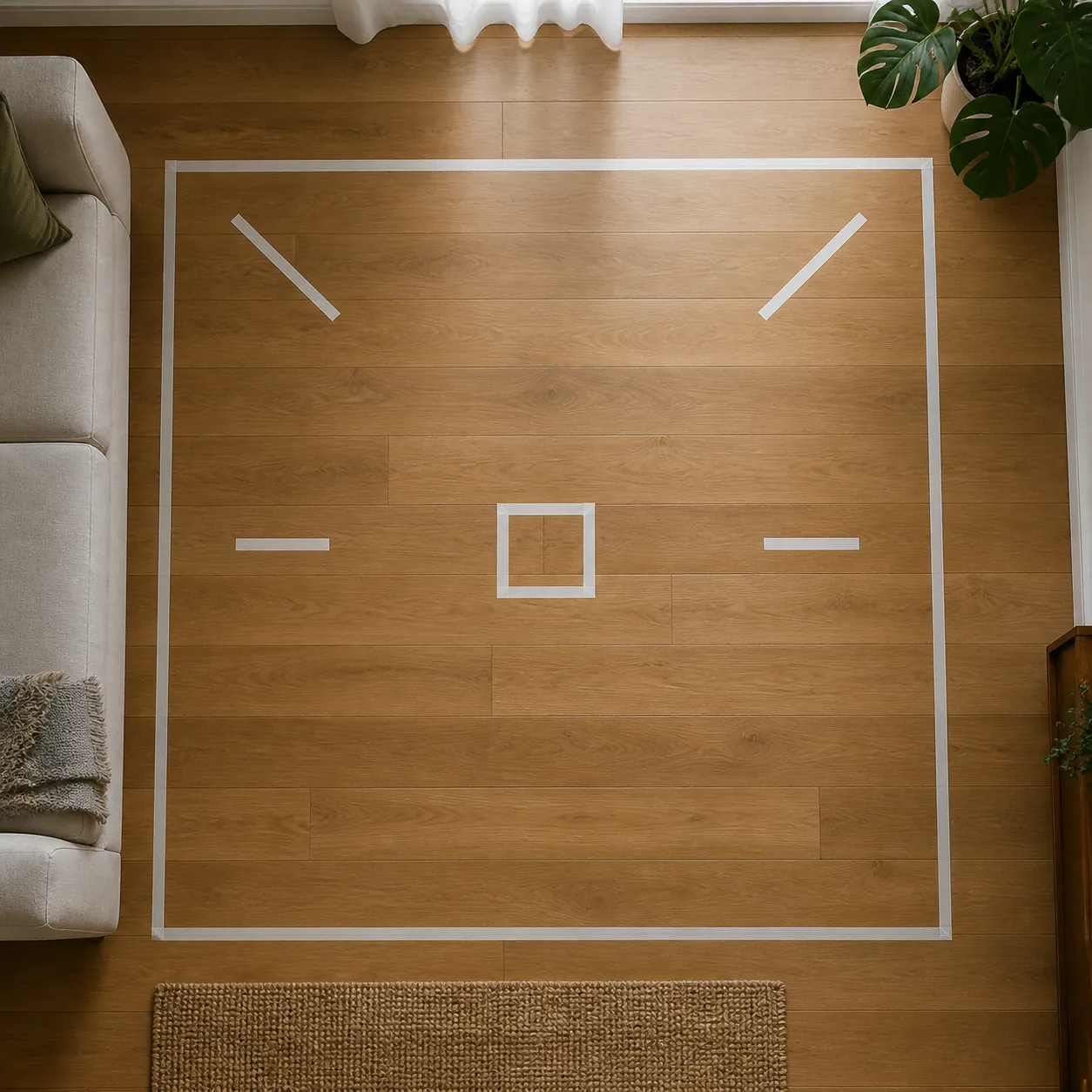
Clear as much floor as you realistically can. The full version assumes about 4×4 m. If you have less, keep the center mark and shorten the targets; do not compensate by rushing your feet into sloppy little stamps. Tape and chalk are enough — USTA’s at-home agility ladder work uses the same basic idea of marking floor patterns without equipment. [3]
| Mark | Where it goes | What it trains |
|---|---|---|
| Center recovery mark | Middle of your clear space | Your split-step and reset point after every movement |
| Left and right lateral marks | About 1.5–2 m from center if space allows | Baseline shuffle, outside-leg loading, and recovery |
| Front-left and front-right diagonal marks | Forward diagonals from center | Approach steps, short-ball movement, and volley positioning |
| Optional back-left and back-right marks | Behind the center if your room is long enough | Recovery after being pulled wide or backward |
For apartments, skip jump-heavy split steps, rope work, and pogo hops. Use a “quiet split”: rise onto the balls of the feet, make a tiny unweighting action, then land soft enough that you would not notice it from the next room. If your floor is slippery, protect yourself before you protect the workout; a thin rug that slides is worse than no rug. For more floor-specific setup ideas, the guides to small-space workout mats and soundproof apartment gym flooring are more useful than pretending every living room is a rubberized training studio.
The 15–20 minute living-room session
Set a timer where you can see it. The default rhythm is 6 seconds of work and 12 seconds of rest. That sits inside the match-play window without turning the session into conditioning mush. If you are newer, use 4 seconds on and 12–16 seconds off. If you move well and can stay quiet, use 8 seconds on and 16 seconds off.
| Time | Block | Main pattern |
|---|---|---|
| 0:00–3:00 | Warm-up and quiet split-step timing | Ready position, soft split, shadow swing, reset |
| 3:00–7:00 | Baseline lateral cycles | Split → shuffle → load outside leg → recover |
| 7:00–11:00 | Wide-ball crossover cycles | Split → crossover first step → brake → recover |
| 11:00–14:30 | Approach and volley footwork | Split → diagonal close → volley stance → recover |
| 14:30–17:30 | Short star or spider points | One or two targets, then back to center |
| 17:30–20:00 | Optional quality round | Repeat your weakest block or cool down |
There is nothing sacred about the exact minute marks. What matters is that the work stays sharp, the rest is long enough for the next rep to look like tennis, and every rep begins from a believable ready position.
0:00–3:00 — Warm up the pattern you are about to use
Start at the center mark. Spend one minute moving from ready position into a soft split step, then freezing in balance. Your feet should land just wider than hip width, knees soft, chest over the toes. If the landing thumps, make it smaller.
- 30 seconds: quiet split step, pause, reset.
- 30 seconds: split step, one shadow forehand, recover to center.
- 30 seconds: split step, one shadow backhand, recover to center.
- 30 seconds: split step, small lateral step left or right, recover.
- 60 seconds: mix the above without speeding up.
This is where a lot of home footwork goes wrong. Fast feet that never organize into a split step do not solve the tennis problem. You need the little timing event before the move, because that is what lets the first step happen in the right direction.
3:00–7:00 — Baseline lateral cycles
Use the left and right tape marks. Each rep starts at center. On “go,” quiet split, shuffle to one side, plant the outside foot, shadow a compact groundstroke, then shuffle back to center. Rest. Alternate sides.
- Default: 8 reps of 6 seconds work / 12 seconds rest.
- Small room: one shuffle step out, one step back; keep the same rhythm.
- Quiet tier: no hop on the split step; lift the heels, unweight, and place the feet softly.
- Progression: start the rep facing slightly cross-court, then recover square to center.
This block is the home version of staying alive in a baseline rally. Lateral shuffle work shows up again and again in tennis footwork teaching because it lets you adjust without crossing your legs when the ball is close enough to play from balance. On Running’s footwork guidance, for example, emphasizes the split step and lateral shuffle as basic court-movement tools. [4]
7:00–11:00 — Wide-ball crossover cycles
Now use the same side marks, but change the first step. From center, quiet split, then drive into a crossover step toward the wide mark. Brake before you run out of room, shadow the shot, and recover with controlled shuffle steps.
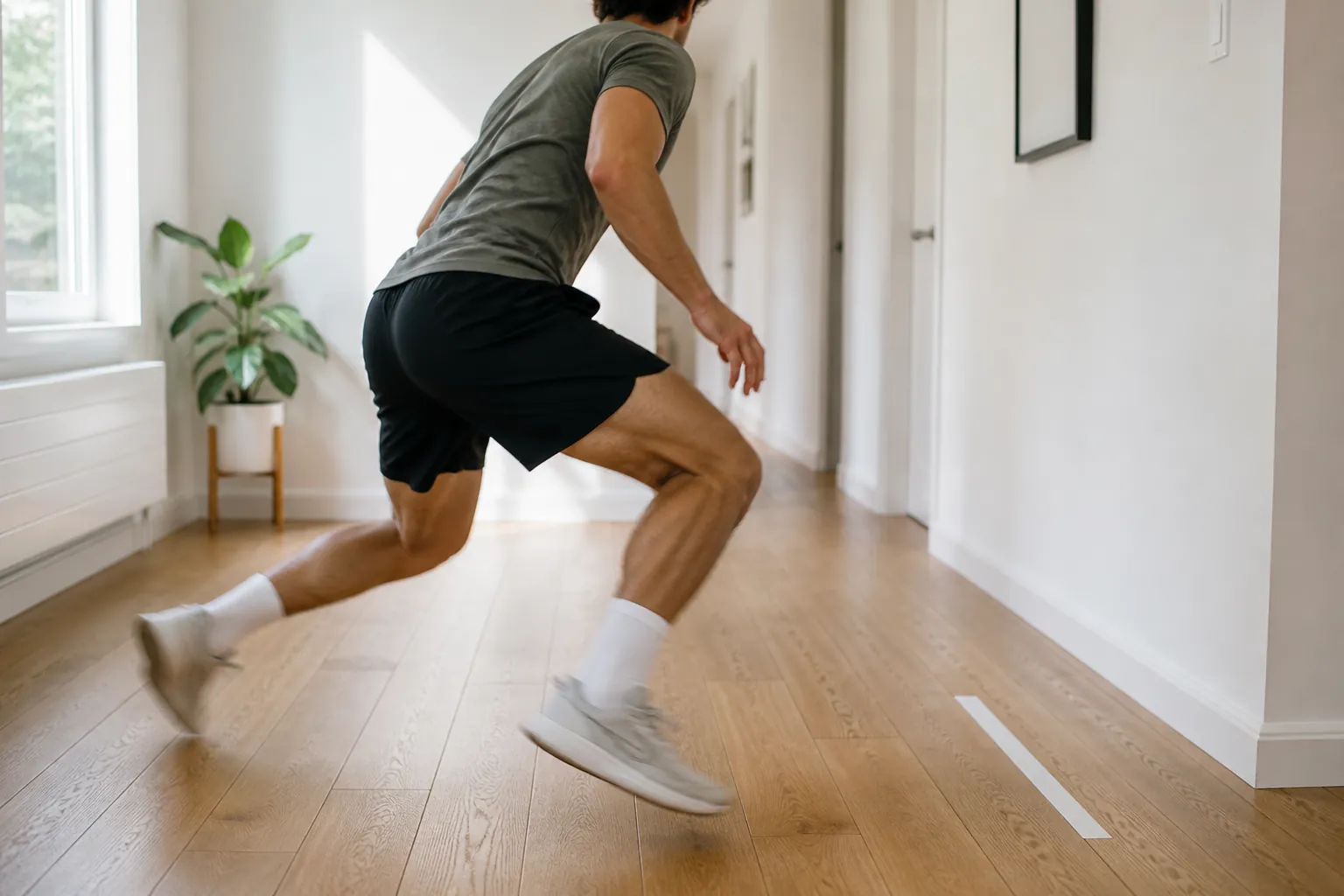
- Default: 8 reps of 6 seconds work / 12 seconds rest.
- Small room: make the crossover smaller, then add a stronger brake and cleaner recovery.
- Quiet tier: keep the hips low and step through; do not leap into the crossover.
- Progression: call “forehand” or “backhand” out loud before each rep so the first step is a reaction, not a memorized dance.
This is the part that makes the living-room setup feel less silly. Recreational players often shuffle too long toward a ball that needed a crossover immediately. UTR’s footwork material includes split-crossover-shuffle patterns and shadow movement because that sequence is closer to how players actually cover a wider ball than a generic ladder run. [5]
11:00–14:30 — Approach and volley footwork
Move to the front diagonal marks. Start at center, quiet split, take a diagonal first step toward the front-left or front-right mark, close the distance with one or two controlled steps, land in a volley stance, then recover backward to center. Do not sprint into your coffee table. The useful skill here is arriving organized, not winning a hallway race.
- Default: 6 reps of 6–8 seconds work / 12–16 seconds rest.
- Forehand volley rep: split, diagonal step, opposite foot closes, hold the volley shape.
- Backhand volley rep: split, diagonal step, keep the shoulders quiet, recover under control.
- Small room: remove the second closing step and make the freeze at the volley mark cleaner.
Approach and volley footwork belongs in a no-court session because many players only train side-to-side at home, then look surprised when a short ball asks them to move forward, decelerate, and hit without drifting. UTR’s drill guidance includes approach and volley footwork as a distinct movement pattern, which is exactly how it should be treated here. [5]
14:30–17:30 — Short star points, trimmed for tennis
Star and spider drills can be useful, but they get silly fast when every target is treated like an equal emergency. Keep this version short. Start at center. Move to one called target, recover. If you still have time in the work interval, move to a second called target and recover again. Stop when the timer ends, even if you feel fresh.
- Default: 6 reps of 8 seconds work / 16 seconds rest.
- Targets: left, right, front-left, front-right.
- Rule: every target must return to center before the next move.
- Quiet tier: no sprinting; use crisp steps, low hips, and soft braking.
Functional Tennis lists no-equipment agility options such as Spider, Star, Mirror, Zig Zag, and lateral sprint drills, but for a small room the filter is simple: keep the ones that preserve tennis posture and recovery, and shrink the ones that turn into frantic floor-touching. [6]
17:30–20:00 — Repeat the weakest block or stop clean
If one block exposed you — late crossover, noisy split, sloppy recovery, drifting on the volley — repeat that pattern for another four to six reps. If the quality has dropped, stop at 17 or 18 minutes. Tennis footwork practice is one of the least heroic places to chase fatigue. Once the feet are just slapping the floor, you are rehearsing the problem.
How to make it harder without making it louder
Progress by improving the tennis demand, not by adding random jumping. The easiest upgrade is decision-making: write four target names on scraps of paper, use a timer app with random beeps, or have someone call “wide forehand,” “wide backhand,” “short forehand,” or “short backhand.” The body still does the same cycle, but the first step has to respond.
| If the session feels too easy | Use this progression | Keep this rule |
|---|---|---|
| You recover comfortably every rep | Move from 6 seconds work to 8 seconds work | Rest at least twice as long as the work interval |
| Your first step is automatic | Add random target calls | No guessing before the call |
| Your room is too small for full distance | Increase the quality of braking and recovery | Do not add noisy hops to fake intensity |
| You lose posture late | Cut the rep count and keep the interval sharp | End the set before the movement turns upright |
For a conditioning sibling to this style of interval work, the 5-5 second method uses the same basic idea: short, sport-shaped work bouts instead of long, vague hustle. If your main limitation is noise, the apartment systems in apartment football conditioning drills and apartment-safe BJJ drills are worth stealing from: define the quiet tier first, then build intensity inside it.
A simple way to track progress
Use three measurements: session completed, clean reps, and rough step count. The step count is not proof that your tennis improved, but it is a useful no-equipment benchmark. Runner’s World, using Fitbit data, reported about 10,680 steps per hour in recreational singles and described top-level match movement as the walking equivalent of roughly 4–5 miles, which is a reminder that tennis volume is high even though the bursts are short. Treat that as context, not lab-grade validation. [7]
- Session completed: did you finish 15–20 minutes without the movement falling apart?
- Clean reps: how many reps had a visible split step, decisive first step, and balanced recovery?
- Step count: did the same session produce slightly more controlled movement over time without extra noise?
The clean-rep count matters most. A phone may count steps while you are fidgeting between reps; it cannot tell whether your first step was late or your recovery left you leaning into the next imaginary ball.
If you only have a hallway
A hallway version can still work if you stop pretending it is a full court. Put the center mark in the middle, one target ahead, one target behind, and one tiny lateral mark if the width allows it. The session becomes more about split timing, first-step quality, approach footwork, and recovery control. Save the wider crossover reps for a room, garage, driveway, or court.
- Best hallway block: split → diagonal or forward step → shadow volley → recover.
- Useful small-space block: split → one crossover step → brake → recover.
- Skip: full spiders, sprint turns, rope work, and anything that makes you land hard.
If you are training in a genuinely tiny space, the win is not covering the same distance as the Australian Open data. It is rehearsing the order of operations: see or hear the cue, split, choose the first step, arrive balanced, recover. When you finally get back on court, that sequence is what keeps the first two steps from feeling rusty.
The no-court rule
A court gives you the ball, the opponent, the bounce, and the pressure. A living room cannot replace that. But it can train the movement cycle that keeps appearing between those things. Respect the space, keep the work bouts short, rest long enough to move sharply again, and choose drills that look like split step → first step or crossover → recovery. That is enough to make “no court” a constraint, not a reason to stop getting faster.
References
- Navigating the Court: A Comparison of Distance Demands between Sexes in Grand Slam Tennis — Journal of Sports Science and Medicine, 2024
- Intensity of tennis match play — British Journal of Sports Medicine, 2006
- Cardio Tennis with Michael Harper: Agility Ladder Exercises — USTA, 2020
- 7 tennis footwork drills to step up your game — On Running, 2024
- Tennis Footwork Drills: Proven Routines to Move Faster and Win — UTR Sports, 2025
- 5 Agility & Footwork Drills for tennis players that need no equipment — Functional Tennis, 2026
- US Open 2023 | How Much Do Tennis Players Run Per Match? — Runner’s World
What a small equipment investment adds
We don't have a build tagged to this exact tier yet. Browse all builds.
How often should you repeat this?
See our recovery and rest reference for citation-anchored rest-interval guidance.
Spot something off?
Tell us if a movement, tier assumption, or duration didn't match your experience.