
How Hot Is Too Hot to Work Out in a No-AC Apartment?
Use indoor temperature and humidity to make the go/no-go call on working out in a no-AC apartment during a heat wave: when a fan stops helping and starts adding heat, how to lower the heat load on your body and the room, and which heat-illness symptoms mean stop immediately.
- Equipment tier required
- none
- Duration
- 15 min
- Difficulty
- beginner
- Target area
- full body
- Space footprint needed
- one yoga mat
- Noise level
- no jumping
Before you choose a workout, check the apartment. Read the indoor temperature, note the humidity or heat index if you have it, and then decide whether the room can support exercise. In a heat wave, “I planned to train” is not a safety measure.
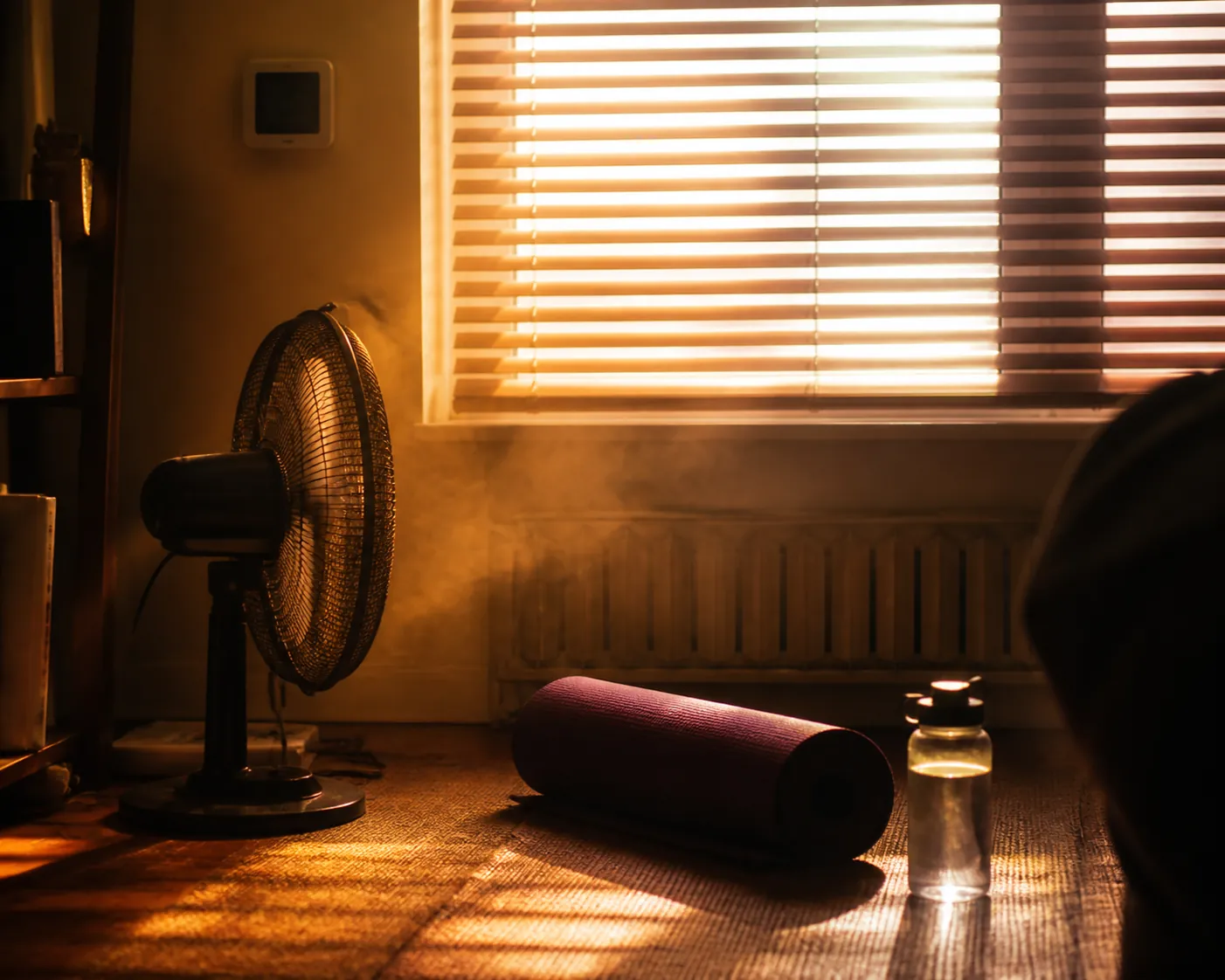
Start with the numbers, not your motivation
There is no single official indoor-workout cutoff that applies to every apartment. Public-health guidance gives a range for when fans stop being useful: the CDC says indoor fans help only below about 90°F; the National Weather Service advises using a fan only when the heat index is below the high 90s; and the Global Heat Health Information Network places the upper fan threshold at 104°F, or 40°C.[1][2][3] Those are different warnings for different contexts, not one universal green light.
| Room check | Workout decision | What to do |
|---|---|---|
| Below the applicable fan ceiling; no symptoms; humidity manageable | Proceed cautiously | Choose low-heat-load movement, start slowly, keep the session shorter, and keep checking how you feel. |
| Heat index is 91°F or higher, humidity is making the room feel oppressive, or the room is approaching the relevant fan guidance | Reduce heat load | Cool the room and your body first, avoid HIIT and jumping, use cooler hours, and reassess before training. |
| At or above the applicable fan ceiling, or the room remains intensely hot and humid despite cooling attempts | Do not train | Skip the workout. Move the session to a cooler time or choose recovery work only if you can do so comfortably. |
| Dizziness, nausea, headache, faintness, weakness, confusion, or worsening cramps | Stop immediately | End activity, get to a cooler place, and treat heatstroke symptoms as a medical emergency. |
A heat index of 91°F or higher already warrants precautions, according to Mayo Clinic guidance.[3] That does not mean every person must stop every form of movement at 91°F. It does mean a normal workout plan deserves scrutiny, especially when the room is humid, poorly ventilated, or already warm from the day.
Humidity matters because sweat cools the body less effectively when the surrounding air is already holding substantial moisture. The NWS gives a useful example: 96°F air at 65% relative humidity can feel like 121°F. Its full-sun adjustment can add as much as 15°F, although that particular addition matters less for a decision made inside an apartment.[2]
If you have only a thermometer, use it. If you also have a hygrometer or a reliable heat-index reading, use both. A room that looks acceptable by temperature alone may be a poor place for strenuous exercise once humidity enters the calculation.
Why hard exercise changes the calculation
Exercise adds another heat source: your working muscles generate metabolic heat. OSHA describes this internal heat as something that stacks with environmental heat, increasing the strain on the body.[6] In a cool room, that added heat is usually manageable. In a hot, humid apartment, the same effort can push you from uncomfortable to impaired more quickly.
That is why HIIT, circuits with little rest, fast boxing rounds, burpees, jumping rope, and other high-output sessions are the first things to remove. They create a large heat load while making it harder to notice how quickly you are deteriorating. Floor-based strength work, mobility, controlled stretching, and quiet low-impact movement give you more opportunities to pause without continuing to generate heat at the same rate.
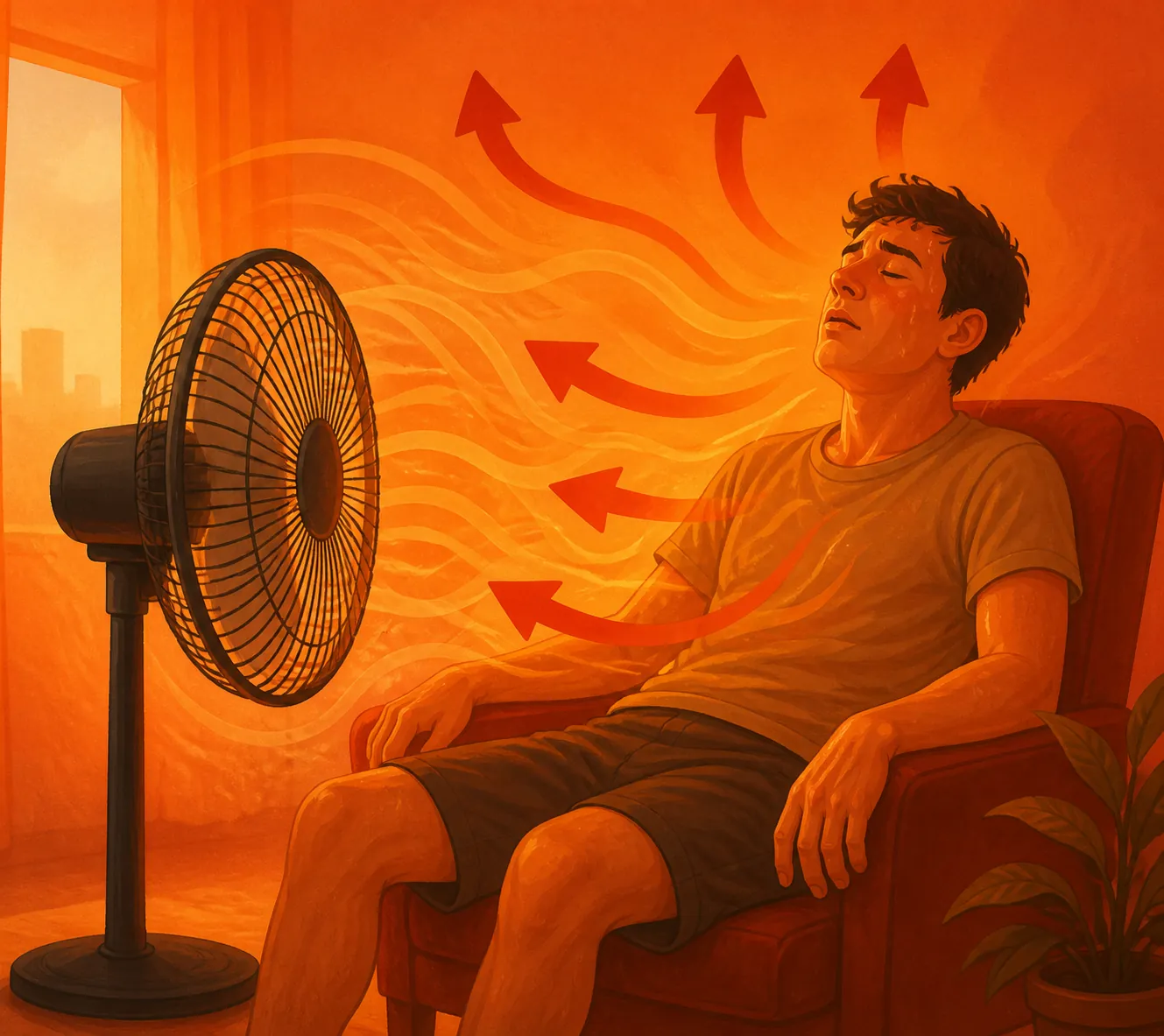
The fan paradox in a no-AC room
A fan feels like the obvious answer because moving air can improve sweat evaporation and make a person feel cooler. But a fan does not lower the room’s air temperature. Once the surrounding air is hot enough, it can move heat onto the body instead of removing it. The CDC specifically warns that a fan can increase body temperature above about 90°F indoors.[1]
The higher thresholds from the NWS and GHHIN explain why the guidance cannot be compressed into one number: one source frames the warning around heat index in the high 90s, while GHHIN says fans help below 104°F and heat the body above that.[2][5] Treat these as agency-dependent ceilings for fan use, not as permission to perform a hard workout below the highest figure.
If the fan is blowing hot air across your face and your skin is no longer cooling, turn it down or off. It may still help earlier in the day, near an open window when outdoor air is cooler, or during a period when sweat can evaporate. It is not a substitute for a cooler room.
Lower the heat load before you unroll the mat
The safest modification often happens before exercise begins. Use cooler morning or evening hours when the outdoor air and apartment have had a chance to shed heat. At night, use available cooler air to ventilate the home; during the day, close blinds or shutters and limit direct sun through windows. GHHIN also recommends personal cooling methods such as cool showers, damp cloths, sprays, and wet light clothing.[5]
- Cool your body first with a shower, damp cloth, spray bottle, or lightly wet breathable clothing.
- Block daytime solar heat with blinds or shutters, particularly near bright west-facing windows.
- Drink before you feel thirsty. WHO guidance gives one cup of water per hour and at least 2–3 liters per day as general heat guidance, not as a personalized prescription.[9]
- Begin at an easy pace and leave more recovery time between movements.
- Keep the fan decision tied to the room and heat index, rather than assuming a higher speed is always better.
Apartment location can complicate the check. Urban areas retain heat, and building design, window exposure, ventilation, and floor level can create different microclimates within the same neighborhood.[10] There is not enough evidence here to assign a typical heat-wave temperature to a top-floor apartment, so measure your own room instead of relying on a building stereotype.
What a heat-adjusted session can look like
When the numbers allow a cautious session and you feel normal, keep the design deliberately undramatic: warm up on the floor, use controlled bodyweight movements, take frequent breaks, and avoid jumping or sustained all-out effort. A short round of slow squats to a comfortable depth, glute bridges, wall or incline push-ups, dead bugs, and gentle mobility is a different heat problem from a maximal circuit.
For a ready-made quiet, no-jump option, use the existing quiet storm-day apartment workout or small-apartment bodyweight workout, but cut the duration and intensity if the room is hot. The routine is secondary to the room check.
The CDC recommends pacing activity, starting slowly, scheduling exercise for cooler times, drinking before thirst, and stopping all activity if you feel faint or weak.[4] That makes a shorter session a successful adjustment, not a failed version of the original plan. It also leaves room for the most sensible adjustment of all: postponing the session.
The abort ladder: cramps are a warning, confusion is an emergency
Heat illness can progress from muscle cramps to heat exhaustion and then heatstroke. The NWS presents that progression as a reason to recognize symptoms early rather than trying to finish a planned workout.[7]
| What you notice | What happens next |
|---|---|
| Muscle cramps | Stop the effort, move to a cooler place, rest, and reassess. Do not resume simply because the cramp eases. |
| Dizziness, nausea, headache, unusual weakness, faintness, or worsening symptoms | Stop immediately. Get out of the hot room and seek appropriate medical guidance. MedlinePlus identifies dizziness, nausea, headache, and confusion as reasons to abort activity.[8] |
| Confusion, altered mental status, collapse, or signs consistent with heatstroke | Treat it as a medical emergency and call emergency services. Do not try to push through or continue monitoring while exercising. |
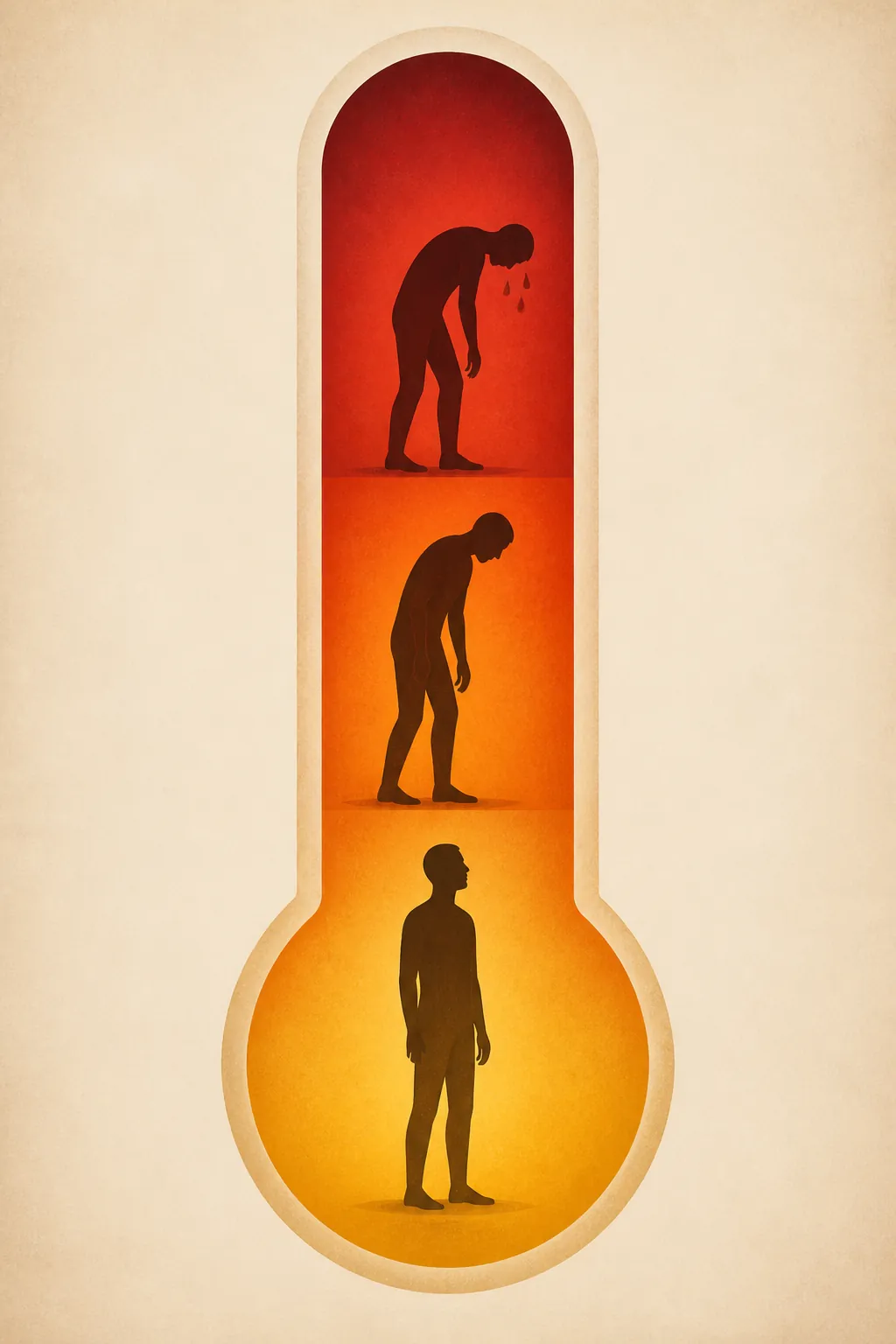
Heatstroke is not simply a more uncomfortable workout. It is a medical emergency. Mayo Clinic describes heatstroke as involving a core body temperature of 104°F or higher, but you should not wait for a thermometer reading before responding to serious symptoms.[3] This article cannot diagnose heat illness or replace emergency medical advice; confusion, collapse, or rapidly worsening symptoms warrant urgent help.
Acclimatization can improve heat tolerance, but Mayo Clinic notes that it takes several weeks.[3] A few hot days in an apartment do not make a hard workout safe, and previous fitness does not cancel the room’s heat load.
Make the final call from the room you actually have
Read the temperature and humidity before training. If the conditions are below the applicable fan guidance and you have no symptoms, lower the heat load and choose easy, low-impact movement. If the heat index is already high, cool yourself and the room before reassessing. If the room crosses the relevant fan ceiling, or your body produces warning symptoms, skipping is the correct training decision.
For broader context on interpreting indoor heat conditions, see how to work out in an apartment when the heat index is high. The immediate question here remains narrower: what do the numbers, the fan, and your symptoms say about training in this no-AC room today?
References
- About Heat and Your Health — CDC
- Heat Index — National Weather Service
- Heat Exhaustion — Mayo Clinic
- Heat and Athletes — CDC
- Keep Cool — Global Heat Health Information Network
- Heat Exposure — Occupational Safety and Health Administration
- Heat Illness — National Weather Service
- Heat emergencies — MedlinePlus
- Climate change and health: Heat and health — World Health Organization
- Heat Island Effect — U.S. Environmental Protection Agency
What a small equipment investment adds
We don't have a build tagged to this exact tier yet. Browse all builds.
How often should you repeat this?
See our recovery and rest reference for citation-anchored rest-interval guidance.
Spot something off?
Tell us if a movement, tier assumption, or duration didn't match your experience.