
Quiet weight-loss home workout for a small apartment
A no-jump, quiet weekly weight-loss plan for small apartments: four to five 20- to 35-minute bodyweight sessions that meet the CDC's 150-minute weekly target in a roughly 6x6-foot space. It includes progression rules, neighbor-friendly movement swaps, and an honest look at how exercise and a modest calorie deficit share the workload.
- Equipment tier required
- none
- Duration
- 35 min
- Difficulty
- beginner
- Target area
- full body
- Space footprint needed
- 6x6 feet
- Noise level
- Low (no jumping)
A weight loss home workout routine for a small apartment has to solve the apartment problem first. No jumping. No dropped weights. No burpees that make the ceiling fan downstairs tremble. The working area is roughly a 6x6-foot patch of floor, ideally a mat over a rug, with a wall, a sturdy chair or sofa edge, and enough space to lie down for bridges and planks.
That does not make the routine soft. It just changes where the work comes from: slower squats, longer wall sits, controlled lunges, planks, glute bridges, step-back conditioning, and short rests. The floor stays quiet because the muscles, not the impact, carry the load.
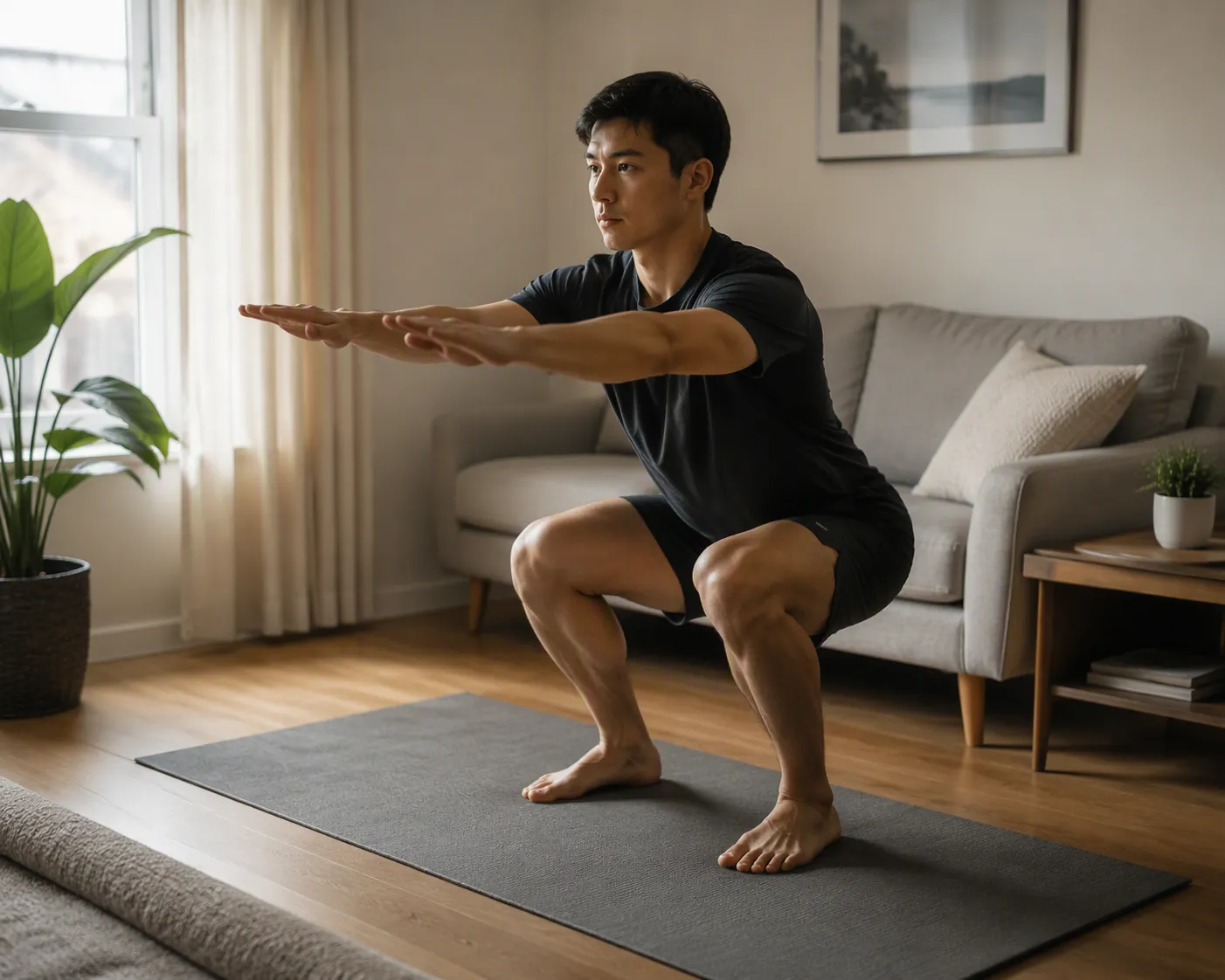
The weekly target is simple enough to build around. The CDC recommends at least 150 minutes of moderate-intensity aerobic activity per week for adults, plus muscle-strengthening work on 2 or more days; it also notes that activity can be split into smaller chunks, such as 30 minutes a day across 5 days. [1]
So the plan below uses five quiet sessions. Four are real workouts. One is a shorter low-impact recovery-conditioning day that helps the week reach the 150-minute mark without asking your knees, lease, or downstairs neighbor for forgiveness.
The week at a glance
| Day | Session | Duration | Main job | Noise rule |
|---|---|---|---|---|
| Monday | Quiet Strength A | 30 minutes | Full-body strength: squat, push, hinge, core | Feet stay planted or step softly |
| Tuesday | Low-Impact Conditioning | 30 minutes | Moderate cardio without jumping | No hops, no fast pivots, no stomping |
| Wednesday | Rest or easy walk | 0-20 optional minutes | Recovery, errands, light mobility | Keep it easy enough to recover |
| Thursday | Quiet Strength B | 35 minutes | Lower body, glutes, upper body, holds | Slow tempo instead of impact |
| Friday | Rest | 0 minutes | Let joints and connective tissue catch up | No need to “make up” work |
| Saturday | Mixed Quiet Circuit | 35 minutes | Strength plus conditioning density | Short rests, still no jumping |
| Sunday | Quiet Recovery Cardio + Mobility | 20 minutes | Finish the weekly activity total | Soft steps or floor-based flow |
If your week can only handle four formal workouts, keep Monday, Tuesday, Thursday, and Saturday. That gives you 130 minutes. Add two 10-minute easy walks, quiet step sessions, or low-impact mobility-cardio blocks after meals to bring the week to the same 150-minute target. The important part is not whether the fifth session looks like a “workout”; it is whether the weekly dose actually happens.
Before each session: the four-minute quiet warm-up
Do the same warm-up every time so the routine starts quickly, even in a half-cleared living room.
- 60 seconds: soft marching in place, lifting the knees only as high as you can without stomping.
- 45 seconds: hip hinges with hands on hips, sending the hips back and keeping the feet quiet.
- 45 seconds: slow sit-to-stand from a chair or sofa edge, or bodyweight squats if that feels comfortable.
- 45 seconds: shoulder circles, arm reaches, and wall push-ups.
- 45 seconds: alternating reverse steps, touching one foot back lightly and returning to standing.
The cue is “quiet contact.” If your heel is slapping the floor, slow down. If the floorboards creak under fast direction changes, shrink the step. The warm-up should raise your temperature, not announce the session.
Monday: Quiet Strength A, 30 minutes
This is the first strength anchor of the week. Move through the circuit below for 3 rounds. Work for 40 seconds, rest for 20 seconds, then move to the next exercise. Rest 60 seconds between rounds. Including the warm-up, the session lands close to 30 minutes.
| Move | How to do it quietly | What it trains |
|---|---|---|
| Slow bodyweight squat | Lower for 3 seconds, pause briefly, stand without locking out hard | Quads, glutes, conditioning under tension |
| Incline push-up on wall, counter, or sofa edge | Keep the hands fixed and step the feet back only as far as you can control | Chest, shoulders, triceps |
| Reverse lunge to balance hold | Step back lightly, lower under control, return slowly; hold the top for 1 second | Single-leg strength, balance, glutes |
| Glute bridge | Press through the heels, lift the hips, pause at the top, lower softly | Glutes, hamstrings, posterior chain |
| Forearm plank | Brace the ribs down; use knees-down plank if your low back takes over | Core stiffness, shoulders |
| Dead bug | Move one arm and opposite leg slowly while the low back stays heavy on the mat | Deep core control |
The reverse lunge is the only move here that can get thumpy. If stepping back is loud or unstable, use a split-squat hold instead: set your feet once, lower a few inches, and hold. You keep the single-leg training effect without repeatedly contacting the floor.
Tuesday: Low-Impact Conditioning, 30 minutes
This day is cardio by accumulation, not by bouncing. Use a 40-seconds-on, 20-seconds-off rhythm for 4 rounds. Rest 60 seconds between rounds. The intensity should feel like steady work: you can speak in short sentences, but you would not want to hold a long conversation.
| Move | Quiet version | If it bothers the floor |
|---|---|---|
| Step-back jacks | Step one foot out as both arms reach overhead, then switch sides | Keep arms lower and step narrower |
| Shadow boxing | Plant the feet, rotate gently through the torso, punch at chest height | Remove the pivot and punch from a staggered stance |
| Standing knee drive | Pull one knee up, return the foot softly, alternate sides | Tap toes behind you instead of lifting the knee high |
| Good-morning hinge | Hands behind head or across chest, hips back, stand tall | Slow the descent and shorten the range |
| Wall sit | Slide down the wall until thighs are comfortable, hold steady | Stand slightly higher and extend the hold |
| Low-impact skater step | Step side to side without hopping, reach the opposite hand across | Make it a lateral weight shift only |
Quiet conditioning works best when you stop chasing dramatic-looking exercises. A wall sit after step-back jacks is not a break; it is a way to keep the heart rate up while the floor gets a minute off.
Thursday: Quiet Strength B, 35 minutes
Thursday adds more lower-body and glute work, then finishes with upper body and core. Do 3 rounds. For the first 4 moves, work for 45 seconds and rest for 15 seconds. For the final 3 moves, work for 35 seconds and rest for 25 seconds. Take 75 seconds between rounds if needed.
| Move | Apartment-friendly execution | Make it easier |
|---|---|---|
| Tempo squat | 4 seconds down, 1-second pause, normal stand | Squat to a chair |
| Split-squat hold | Hold the bottom half of the range without bouncing | Hold higher or use wall support |
| Single-leg glute bridge | One foot on floor, opposite knee bent, hips lift slowly | Use a two-leg bridge |
| Wall push-up to slow negative | Push away normally, lower back toward wall for 3 seconds | Stand closer to the wall |
| Triceps dip on chair or sofa edge | Bend elbows slightly, keep hips close to the support | Do a smaller range or swap for close-grip wall push-ups |
| Side plank | Forearm under shoulder, knees bent or legs straight | Use knees-down side plank |
| Bird dog | Reach opposite arm and leg, pause, return softly | Move only the legs or only the arms |
Chair dips are useful only if the chair is stable and the floor surface grips well. If the chair slides, skip the move. A close-grip wall push-up is quieter, safer, and still trains the triceps.
Saturday: Mixed Quiet Circuit, 35 minutes
Saturday is the densest session of the week. It blends strength and conditioning without changing the noise rule. Set a timer for 5-minute blocks. In each block, cycle through the listed moves at a steady pace. Rest only as needed, then take 60 seconds before the next block.
| Block | Work | Quiet coaching point |
|---|---|---|
| Block 1 | 8 slow squats, 8 incline push-ups, 20-second plank | No fast transitions; place hands and feet before working |
| Block 2 | 8 reverse lunges per side or 20-second split-squat hold per side, 12 glute bridges | Use the hold if stepping is loud |
| Block 3 | 30 seconds step-back jacks, 30 seconds shadow boxing, 30 seconds wall sit | Conditioning comes from continuous effort |
| Block 4 | 10 hip hinges, 8 chair sit-to-stands, 20-second side plank per side | Control the chair contact; do not drop onto the seat |
| Block 5 | Dead bug, bird dog, slow mountain climber from an incline | For mountain climbers, step one foot at a time |
If “mountain climber” means pounding your toes into the floor, change it immediately. Put your hands on a counter, sofa back, or wall and step one foot forward at a time. The training purpose is trunk control plus heart-rate pressure, not speed for its own sake.
Sunday: 20 minutes to finish the week
Sunday should not feel like another hard circuit. Pick one of these options and stop at 20 minutes:
- A quiet indoor low-impact flow: 2 minutes soft marching, 2 minutes hip hinges, 2 minutes step-back jacks, 2 minutes wall push-ups, 2 minutes mobility, repeated twice.
- A brisk outdoor walk if that is simpler and safer than trying to create cardio on a creaky floor.
- A mat-based recovery session with glute bridges, dead bugs, bird dogs, child’s pose breathing, and easy standing mobility if the week left your joints tired.
The outdoor walk is often the most neighbor-friendly cardio machine available to a renter. If weather, safety, or schedule keeps you inside, keep the movement low and continuous rather than trying to force intensity through impact.
Where these exercises come from
The movement library is deliberately ordinary: squats, glute bridges, wall sits, planks, dead bugs, step-back jacks, lunges, dips, and push-up variations. Quiet home-workout programming from Greatist uses the same general category of low-impact, neighbor-conscious bodyweight work, with a medically reviewed routine built with certified trainers. [2]
That kind of exercise list is useful, but the list is not the routine. The routine is the weekly dose, the rest placement, the progression, and the swaps that keep the plan usable when the floor is thin or the living room is not fully cleared.
Progress without making the workout louder
For the first week, finish the sessions as written and leave a little in reserve. Starting too hard is how quiet routines become abandoned routines: form gets sloppy, steps get heavy, and every plank turns into a negotiation.
From week 2 onward, change one lever at a time.
| Progression lever | How to apply it | Good first use |
|---|---|---|
| Longer holds | Add 5-10 seconds to wall sits, planks, split-squat holds, or glute bridge holds | When your form stays steady for the full interval |
| Slower eccentrics | Lower for 4-5 seconds on squats, push-ups, split squats, or dips | When you need more challenge without more reps |
| Extra round | Add 1 round to Monday or Tuesday, not both in the same week | When the session feels too short and recovery is fine |
| Shorter rest | Cut rest by 5-10 seconds between exercises | When breathing recovers quickly and movement stays quiet |
| Harder variation | Move from wall push-up to counter push-up, two-leg bridge to single-leg bridge, chair squat to free squat | When the easier version feels smooth and repeatable |
| Band resistance | Add a mini band to bridges, squats, or lateral steps | When bodyweight progress stalls but you still want quiet training |
A good apartment progression rule is boring but effective: if a harder version makes you land harder, wobble into furniture, or rush the lowering phase, it is not the right progression yet. Choose time under tension before speed.
A mat-and-bands tier is the first sensible upgrade. Bands add resistance without the floor risk of dropped dumbbells, and a thicker mat reduces pressure during planks, bridges, and dead bugs. If you later add adjustable dumbbells, treat them as a separate apartment-noise and floor-load decision, not a required step. For gear comparisons, this site’s apartment noise and floor testing is the better continuation path than guessing from product photos.
Swaps for the moves most likely to thump
Noise usually comes from three places: repeated foot contact, fast transitions, and furniture shifting. The fix is not to remove intensity; it is to preserve the training job with a quieter pattern.
| If the plan says... | Use this quieter swap | Training purpose preserved |
|---|---|---|
| Reverse lunges | Split-squat hold or slow split squat | Single-leg leg strength |
| Step-back jacks | Side step with overhead reach | Low-impact cardio |
| Mountain climbers | Incline slow mountain climbers or dead bug | Core plus conditioning |
| Fast squats | Tempo squats or wall sit | Leg fatigue without impact |
| Skater steps | Lateral weight shifts | Side-to-side conditioning |
| Chair dips | Close-grip wall push-ups | Triceps and pressing strength |
If you want a wider bank of no-cost bodyweight substitutions, the quiet substitution library is useful after you have run this weekly plan once and know which moves your floor dislikes.
Set up the room so the plan survives contact with real flooring
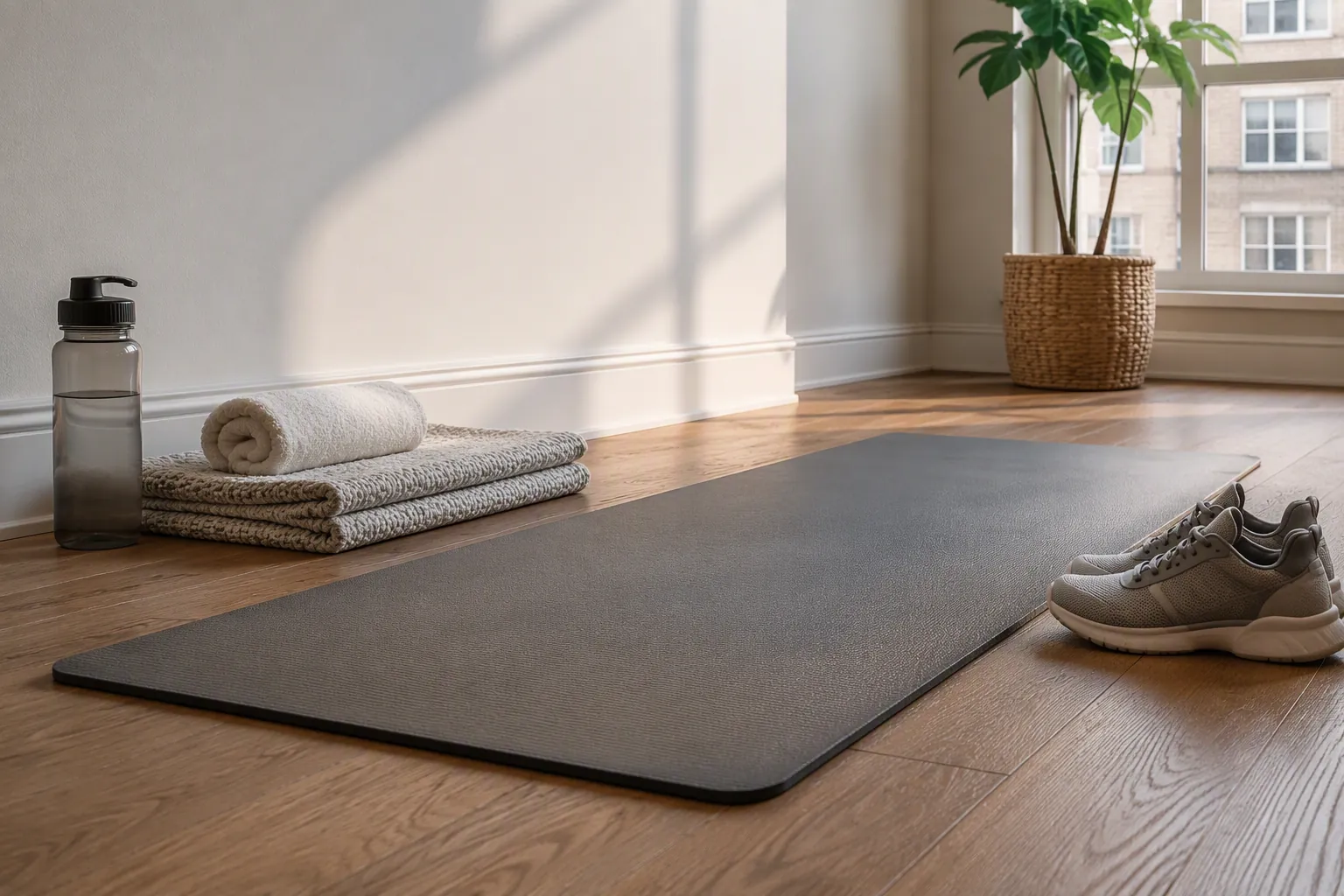
The setup is small, but it matters. Apartment workout guidance from TurboTenant and Heyday both point toward low-impact exercise, mats or padded surfaces, and household substitutes as practical ways to train in limited space. [7][8]
- Put a mat over a rug if you have hard floors. A mat alone helps comfort; a rug underneath can soften contact and reduce sliding.
- Move the coffee table once, not between exercises. The routine should fit the cleared space from the start.
- Test each standing move for 10 seconds before the timer starts. If the floor complains during the test, swap the move before the circuit begins.
- Keep water, towel, and phone timer inside arm’s reach. Wandering around a small room between intervals makes the session less smooth than the exercises themselves.
- Use a wall, counter, sofa edge, or stable chair only if it does not slide. If furniture moves, the exercise changes.
The first session is also a noise audit. Do not wait for a complaint to learn that a move is too loud. Try the reverse lunge, step-back jack, and incline mountain climber at the pace you plan to use. If you can hear foot slap through your own music or fan, the neighbor below probably gets a version of it too.
What this can realistically do for weight loss
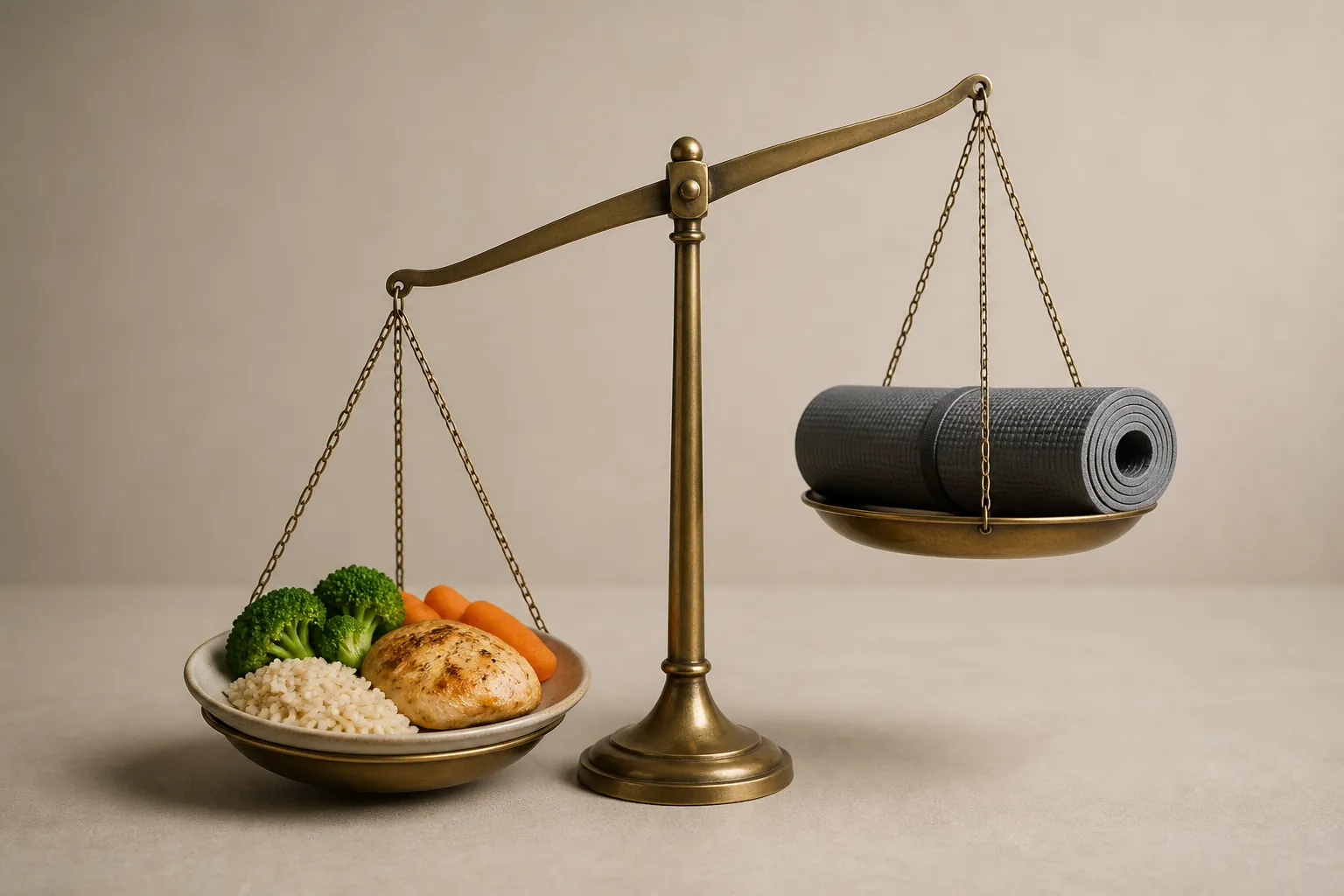
The routine gives the week structure and helps you spend energy consistently. It does not cancel unlimited eating. Harvard Health’s calorie estimates list 30 minutes of moderate calisthenics at about 135-189 calories for people weighing 125-185 pounds, and vigorous calisthenics at about 240-336 calories for the same body-weight range. [4]
Those are useful reference numbers, not a receipt for your exact workout. Body size, exercise selection, pace, rest periods, fitness level, and measurement method all change the result. A quiet 30-minute circuit with wall sits and slow squats may feel hard, but it should still be treated as one contributor to the deficit, not the entire deficit.
Mayo Clinic frames weight loss around a calorie deficit and gives the example that cutting 500-750 calories per day can lead to about 1.5 pounds of weight loss per week, while also emphasizing that diet tends to have the stronger effect on losing weight and exercise is especially important for keeping weight off. [5]
The established ACSM position stand is also cautious about dose. It describes 150-250 minutes per week of moderate-intensity physical activity as producing only modest weight loss, with greater amounts associated with more clinically significant loss, while resistance training is still valuable for improving strength and fat-free mass. [6]
There is also evidence that home-based exercise can be feasible. In a 6-month randomized trial of 203 non-obese Brazilian women, a home-based exercise program plus slight caloric restriction produced greater weight loss than diet alone, with reported losses of 1.4 kg versus 0.8 kg and compliance around 78-86%. [3]
That trial supports the basic idea that people can follow exercise at home, but it is not proof that this exact routine will produce the same result for every renter. It was one study, in a specific population, with a specific intervention. The useful takeaway is narrower and more practical: home training can be organized well enough to matter when it is paired with dietary restraint.
How to progress after week 1
Week 1 is the baseline. Learn the moves, test the floor, and finish each session with enough control that you could repeat the week.
- Week 2: Add 5 seconds to wall sits, planks, split-squat holds, and glute bridge holds.
- Week 3: Slow the lowering phase on squats and push-ups by 1-2 seconds, while keeping the same number of rounds.
- Week 4: Add one round to either Monday or Tuesday, or shorten rests by 5 seconds if adding a round would push the session too long.
- Week 5 and beyond: Move one exercise at a time to a harder variation, or add bands if the bodyweight version no longer challenges you.
If soreness lingers, sleep is poor, or joints feel irritated rather than worked, do not progress that week. Keep the same plan and make the Sunday session easier. For more on when recovery, fatigue, or low energy should change a home workout, use the site’s recovery and workout-readiness guide as a next read.
This week, the commitment is concrete: five quiet sessions, 150 planned minutes, two strength days, no jumping, no machines, and one modest calorie deficit that food has to help create. The workout is serious because it is repeatable in the apartment you actually have.
References
- Adult Activity: An Overview, CDC.
- Home Workout: A Quiet Home Routine That Won't Annoy Neighbors, Greatist.
- The effect of home-based exercise in the treatment of obese women, Mediano et al., 2010.
- Calories burned in 30 minutes for people of three different weights, Harvard Health.
- Exercise for weight loss, Mayo Clinic.
- Appropriate physical activity intervention strategies for weight loss and prevention of weight regain for adults, Medicine & Science in Sports & Exercise, 2009.
- Apartment Workouts, TurboTenant.
- Here’s How To Exercise in Your Small Apartment, According to Personal Trainers, Heyday.
What a small equipment investment adds
We don't have a build tagged to this exact tier yet. Browse all builds.
How often should you repeat this?
See our recovery and rest reference for citation-anchored rest-interval guidance.
Spot something off?
Tell us if a movement, tier assumption, or duration didn't match your experience.