
Which Wellness Tech Deals Pass the Apartment Noise Test?
Apartment dwellers comparing August 2026 recovery-tech sales need deals that stay quiet through shared walls, not just big markdowns. Verified massage-gun and compression-boot prices are matched against measured decibel ratings, separating rental-safe buys from discounts that are still too loud, too bulky, or too pricey to justify.
- Test space profile
- Compact studio/one-bedroom apartment with shared walls; tested beside the couch, including evening/night use and floor vibration transfer.
- Decibel reading
- 32 dB quietest tested setting; ~40–55 dB quieter budget picks; 55–65 dB louder models. dB
- Floor damage risk
- low
- No-drill compatible
- ✓
- Test date
- Methodology reference
- FitAtHome small-apartment shared-wall noise protocol
The apartment test comes before the discount
A wellness-tech deal for home fitness is only a deal if it can be used where home fitness actually happens: beside a couch, after work, with a neighbor on the other side of the wall. That is why the first filter here is not stall force, app polish, or how dramatic the markdown looks. It is measured sound.
The useful surprise in the current recovery-tech sale pile is that massage-gun price and apartment friendliness do not move in the expected direction. In Verywell Fit’s 2026 testing of 60 massage guns, tested sound levels ran from quiet settings near 32 dB up to louder models in the 55–65 dB range; its quieter budget picks generally tested around 40–55 dB, while massage guns overall sat in a broad $50–$600 category spread.[1]
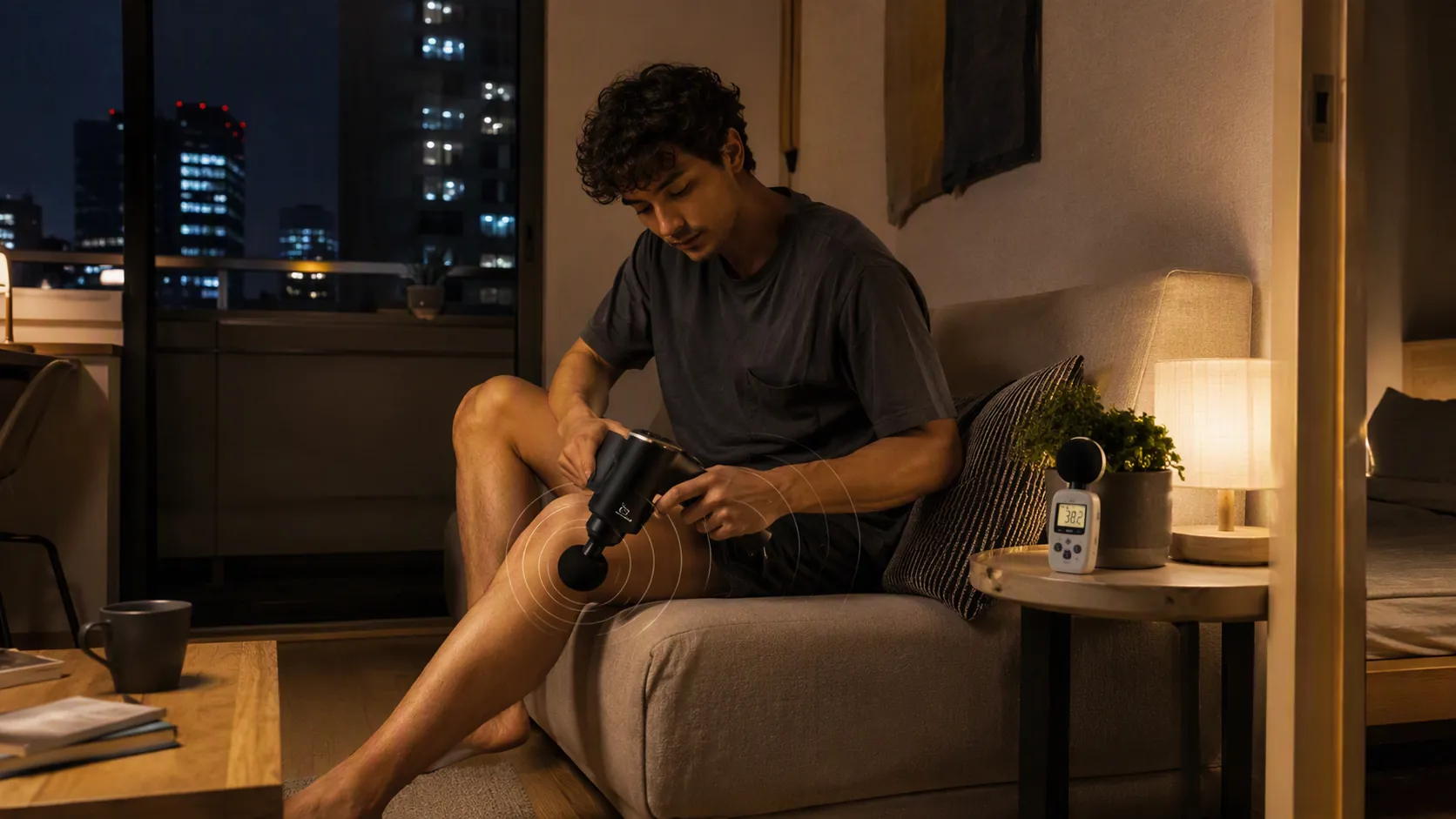
Those numbers matter more than the brand order on the shelf. A cheaper massage gun that stays in the low-to-mid dB band is easier to live with than a prestige model that makes the room manage itself around the noise. In a detached house, “a little loud” may be tolerable. In an apartment, it can mean turning up the TV, stopping when a roommate is asleep, or deciding the tool only comes out on weekends.
| Measured or reported sound band | What it means for an apartment shopper | Deal consequence |
|---|---|---|
| Around 32 dB on quietest tested settings | This is the range that makes late-night use plausible if vibration transfer through the floor is also controlled. | A modest sale price can be genuinely valuable here; the quiet result is doing the work, not the markdown. |
| About 40–55 dB for quieter budget picks | This is the practical sweet spot for many shared-wall homes: audible nearby, but less likely to dominate a room. | A budget massage gun in this band deserves serious consideration if the specific model has dated, source-backed sound testing. |
| About 55–65 dB for louder models | This is where the tool starts competing with normal apartment life, especially TV, calls, and sleeping rooms. | A bigger discount does not fix the basic problem if the device is annoying to use at home. |
This is also why a generic “quiet motor” line on a product page is weak evidence. The useful version says who measured it, when they measured it, and whether the result belongs to that exact model. External office and home tests are still helpful, but they are not the same thing as FitAtHome’s own apartment protocol with shared-wall context, floor transfer, and nighttime use in mind. For more on how we treat noise in small rooms, see the small-apartment home gym build.
Massage-gun deals: the quiet cheap picks are not automatically second-tier
The massage-gun category is the strongest place to look first because the price floor is low and the measured noise evidence is better than it is for most recovery gadgets. A sale gun near the budget end can be a rental-safe buy if its tested dB result holds up. A premium gun can still fail the apartment test if it sounds like a tool you would apologize for using after 10 p.m.
Wirecutter’s 2026 massage-gun guide is useful here because it does not treat brand polish as a substitute for the room experience. It describes the Mebak 3, a roughly $100 massage gun with seven attachments, as one of the quietest models it has tried; in the same guide, the Theragun Prime 6th Gen is described as sounding like a small power tool and interfering with TV.[2]
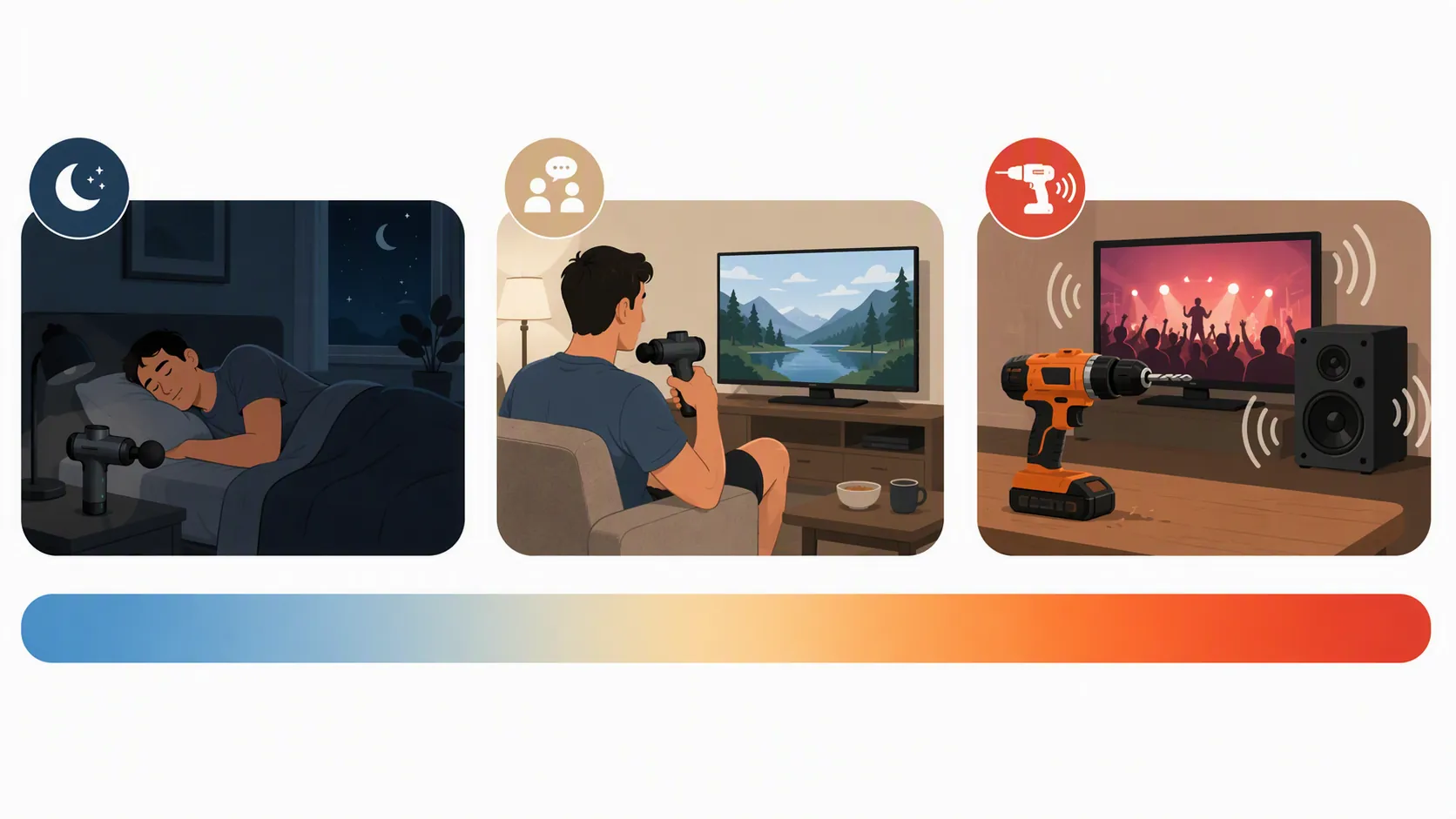
That contrast is the whole apartment problem in miniature. The Mebak 3 is not interesting because it is cheap in the abstract. It is interesting because the cheapness does not appear to come with the usual penalty: a motor that turns recovery into a room event. The Theragun Prime example cuts the other way. Even if the build, ergonomics, or brand story appeal to someone, “interferes with TV” is not a small footnote in a studio or one-bedroom apartment.
| Model or deal anchor | Price signal available for August 2026 shopping | Noise evidence available here | Apartment verdict |
|---|---|---|---|
| Mebak 3 | Wirecutter places it at roughly $100 | Described by Wirecutter as one of the quietest massage guns it has tried | Strong apartment candidate if the current listing matches the tested model and return terms are acceptable |
| Hypervolt 2 | WIRED listed it at $183 during Prime Day fitness-tech deal coverage | No per-model dB result is provided in the materials used here | Interesting price for a known recovery brand, but not a noise-safe buy until the exact model’s sound is verified |
| Theragun Relief | Athletech News listed it at $100 in Prime Day wellness deal coverage | No per-model dB result is provided in the materials used here | Potentially compelling as a low-price entry point, but the deal alone does not answer the shared-wall question |
| Theragun Prime 6th Gen | Premium-category comparison point rather than the strongest apartment deal anchor here | Wirecutter says it sounds like a small power tool and interferes with TV | Hard to recommend for apartments unless a buyer has tested the noise in their own room and accepts the tradeoff |
The Hypervolt 2 and Theragun Relief prices are still worth watching. WIRED’s Prime Day fitness-tech coverage listed the Hypervolt 2 at $183, and Athletech News listed the Theragun Relief at $100.[3][4] But neither price, on its own, proves apartment fit. A low sale price gets a model onto the check list; measured or clearly reported sound keeps it there.
For a renter, the practical screen is simple. If the deal page does not identify the exact generation, do not borrow noise impressions from a different version. If the source says only “quiet,” treat that as incomplete. If an independent tester gives a dB range or a plain room consequence, such as interfering with TV, weigh that more heavily than attachment count or recovery-language packaging.
What a good massage-gun deal has to show
- A current price checked on the publication date, not only an old Prime Day badge.
- A model name and generation that match the test source.
- A measured or clearly described sound result, ideally with a dB range.
- A return window long enough to test it in the actual room where it will be used.
- A storage plan that does not require keeping the box forever because the attachments have nowhere to go.
The last point is less glamorous than stall force, but it decides whether a recovery tool survives past the first week. A compact massage gun that lives in a drawer and can be used during TV is more likely to become part of a home routine than a louder, larger device that has to be scheduled around everyone else in the apartment.
If you are comparing massage guns against other small recovery tools, the home fitness recovery tools buyer’s guide is the better place to sort by budget, storage, and use case rather than by sale urgency.
Compression boots need a stricter gate
Compression boots look more dramatic in sale coverage because the category starts bigger, stores worse, and can show deeper-looking discounts. Runner’s World highlighted Prime Day compression-boot deals starting at $129 for the AllJoy model, listed as 42% off, while WIRED’s Prime Day fitness-tech coverage included Therabody JetBoots Pro Plus at $900 after a $250 discount.[5][3]
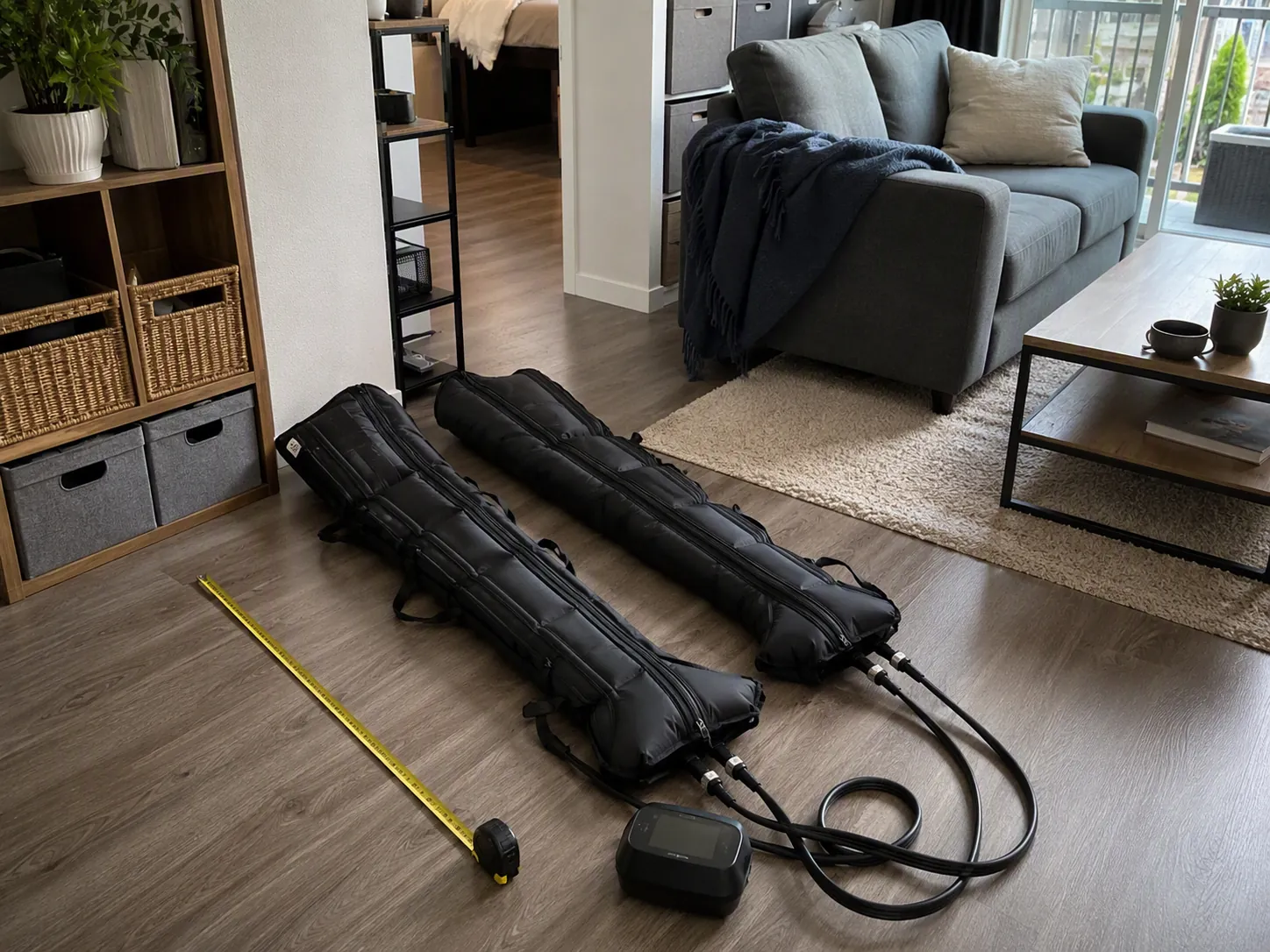
That $129-to-$900 spread is exactly why compression boots should not be judged by markdown size first. A massage gun can be wrong and still be easy to return, store, or ignore. Boots claim floor space while in use, cabinet space when not in use, and a longer session commitment. The buyer is not just buying a device; they are buying a setup ritual.
They also should not be rejected just because they are bulky. For runners or home trainers who already recover consistently, know they like compression, and have a repeatable place to use the boots, a discounted pair may make sense. The standard is higher because the opportunity cost is higher. In a small apartment, a large recovery tool has to beat cheaper recovery habits and smaller tools, not merely undercut its usual retail price.
This is where the broader recovery hierarchy matters. Expensive recovery gadgets sit below the basics that actually make training repeatable: sleep, sane training volume, food, hydration, and enough rest between hard sessions. The home fitness recovery pyramid lays out that evidence-first order in more detail. Compression boots can still belong in the stack, but a sale tag should not move them above the basics.
| Compression-boot question | Why it matters more in an apartment |
|---|---|
| Where will the boots lie during use? | A couch setup that blocks the walkway or living-room floor becomes annoying fast. |
| Where will they live between sessions? | If the answer is “on the floor,” the deal is quietly renting space from the apartment. |
| Who is the actual user? | A runner using them several times a week has a clearer case than a casual buyer chasing a steep discount. |
| What recovery problem are they solving? | General soreness is not specific enough to justify the largest and most expensive device in the room. |
| Is the return policy realistic? | Boots are harder to trial casually because fit, pressure feel, tubing, controls, and storage all matter. |
The fair comparison is not $250 off versus full price. It is $900 boots versus a quieter massage gun, a foam roller, a better sleep setup, or doing nothing because the body simply needs a rest day. That comparison will not flatter every compression-boot sale, and that is fine. A deal guide should protect the floor as much as the wallet.
Date-stamp every deal before trusting it
The deal anchors in this article trace back to June 23–26, 2026 Prime Day and post-Prime Day residual coverage, checked as of August 2, 2026. That makes them useful as buying signals, not permanent prices. The Hypervolt 2 at $183, Theragun Relief at $100, AllJoy compression boots at $129, and JetBoots Pro Plus at $900 after discount all need a visible same-day price and availability check before publication or purchase.[3][4][5]
There is also a source-quality difference between a tested noise result and a sale mention. A deal article can verify that a price existed at a point in time. It does not necessarily verify that the motor is quiet, that the current listing is the same generation, or that a device behaves well in a shared-wall apartment. When those pieces are missing, the safer label is “price worth checking,” not “apartment-safe pick.”
The buyer-safe shortlist
For apartment shoppers, the best tested wellness-tech deals for home fitness are not the ones with the loudest discount language. They are the ones where the price, the exact model, and the sound evidence all point in the same direction.
- Start with massage guns, because the category has the best mix of low prices, compact storage, and usable noise evidence.
- Treat quiet budget models seriously when independent testing places them around the lower sound bands.
- Be cautious with premium massage guns if testers describe them as power-tool-like or disruptive to TV.
- Move compression boots onto the shortlist only when the user has a clear recovery case and a real storage plan.
- Re-check every Prime Day carryover price on the day of purchase, especially if the article or listing does not show a current timestamp.
If you want a small-tool comparison before committing to a massage gun, the Hyperice Hyperslide tests are useful counterweights: start with the Hyperice Hyperslide home review or the Nike Hyperslide apartment recovery test. The same rule applies there: the tool that fits the room is usually the one that keeps getting used.
References
- The 7 Best Budget Massage Guns of 2026, After Testing 60 Top Options — Verywell Fit
- The 4 Best Massage Guns of 2026 — Wirecutter
- 22 Best Prime Day Fitness Tech Deals (2026) Up to $250 Off — WIRED
- Last Call on Prime Day: Oura, Whoop & Nike Among the Best Fitness & Wellness Deals — Athletech News
- Compression Boots Are Usually Pricey—But for Prime Day, Deals Start at Just $129 — Runner’s World
This result comes from one real apartment under the stated conditions — it is a strong signal, not a guarantee your space will measure identically.
Builds this evidence supports
No build currently links to this specific test. Browse all builds with a matching tag.
Spot something off?
If this result didn't match your own space, let us know — floor-damage and noise claims carry real deposit-risk consequences if we get them wrong.