
Is Iron Deficiency Behind Poor Home Workout Recovery?
Persistent fatigue, breathlessness on familiar sets, and slowing soreness are often blamed on overtraining — but iron deficiency is a common, under-tested cause that a simple blood test can rule out. Even iron deficiency without anemia can blunt endurance, aerobic adaptation, and recovery, so it deserves a clinician-guided check (ferritin plus CRP and a CBC) before you rewrite your program.
- Citation source
- CDC/NCHS and Swiss Society of Sports Medicine
- Evidence level
- Restrained inference
The first clue that iron deficiency may be affecting home workout recovery is often not dramatic fatigue. It is the awkward mismatch: the same dumbbell circuit, the same corner of the living room, the same rest periods, and suddenly the set that used to feel controlled feels like altitude training. You finish, but your breathing takes longer to settle. The soreness from ordinary work hangs around. Your next session starts with a body that already feels behind.
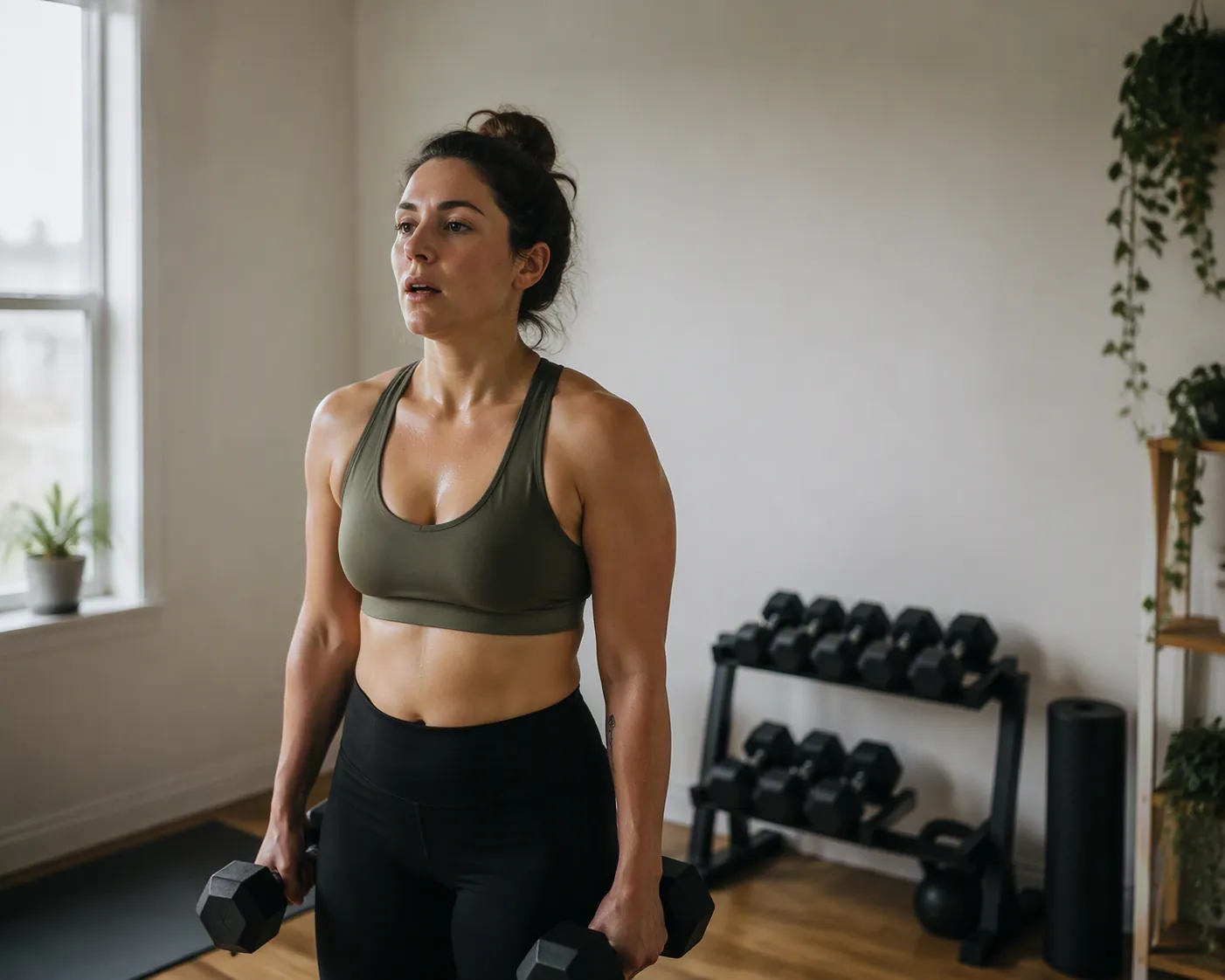
That pattern is easy to misread when nobody else is watching. A coach might notice that a familiar workload has changed. A training partner might hear you breathing differently. At home, the explanation often becomes private and blunt: maybe I am losing fitness, maybe I am aging badly, maybe I need a tougher plan.
Sometimes the answer really is workload, sleep, illness, low food intake, stress, or a program that has been pushed too long without adjustment. If you are still sorting out those dials, a basic look at home training workload management belongs in the process. But before rewriting the whole routine or labeling the slump as overtraining, iron status is worth checking. Not assuming. Checking.
The pattern is not “training feels hard.” It is “my normal workload changed.”
Hard sessions are supposed to feel hard. A new split, heavier weights, shorter rest, heat, a poor night of sleep, or a stressful week can all make a home workout feel worse than usual. The recovery pattern that deserves closer attention is different: the work has not changed much, but your response to it has.
For a consistent home trainer, the practical signals are usually concrete:
- Breathlessness appears earlier in familiar sets, especially during circuits, lower-body work, or short-rest intervals.
- You need longer than usual to feel normal after a session, even when the workout was not unusually long or intense.
- Soreness resolves more slowly than it used to after the same exercises.
- Endurance feels flat: the warm-up feels like work, the middle of the session sags, or conditioning sets stop improving.
- Progress stalls despite consistent training, rather than because sessions have become sporadic.
None of those signs diagnose iron deficiency. They are also not cleanly separable from stress, under-fueling, poor sleep, recent infection, medication changes, or simply too much training load. The reason iron belongs on the short list is that the symptoms can look exactly like a programming problem while the missing variable is physiological.
If you already track resting heart rate, HRV, perceived exertion, or soreness, those notes can make the pattern less vague. A recovery log such as a resting-HR and HRV recovery tracker is useful here because it separates “I feel off today” from “the same workouts have been costing more for a while.”
Iron deficiency is common enough to rule out, especially in women who train
The general-population numbers are already hard to dismiss. CDC FastStats reports that 22.6% of U.S. females ages 12–49 had iron deficiency, defined there as inflammation-adjusted ferritin below 15 μg/L, in NHANES 2017–March 2020 data. The same CDC page reports anemia prevalence of 13.0% in females and 5.5% in males, which matters because iron deficiency and anemia are related but not identical findings [1].
Training populations add a second, separate reason to pay attention. A 2023 review on athletic performance reports iron deficiency without anemia in 15–35% of female athletes and 5–11% of male athletes [2]. Those athlete numbers should not be pasted onto every person doing dumbbell workouts at home. They do, however, make one point clearly: consistent training does not protect someone from low iron status. In some groups, training is part of the risk picture.
This is where many recovery articles get sloppy. They either turn every fatigue story into overtraining or jump from “iron matters” to “take iron.” The safer conclusion is narrower and more useful: if recovery has changed in a persistent, disproportionate way, iron deficiency is common enough and testable enough that it should be ruled out with a clinician rather than guessed at from symptoms.
It can affect training before hemoglobin looks abnormal
Many people think of iron only through anemia, but the recovery question often sits earlier than that. Iron deficiency without anemia means iron stores are low while hemoglobin remains within the normal range. That distinction matters for home trainers because breathlessness, fatigue, and poor adaptation can appear before a simple “am I anemic?” answer captures the whole picture.
Human training data support that concern. The Swiss Society of Sports Medicine consensus paper cites Brownlie’s 2004 work showing that iron deficiency without anemia impaired aerobic-training adaptation in previously untrained women with normal hemoglobin [3]. That is not the same as proving that every plateau in a trained home lifter is caused by iron, but it does push against the comforting idea that normal hemoglobin automatically clears iron as a recovery variable.
There is also a plausible muscle-level mechanism, though the boundary around the evidence matters. In a 2021 mouse model, non-anemic iron deficiency reduced one-hour endurance by about 15% and mitochondrial complex I activity in oxidative muscle by about 30% [4]. Mouse data are not human proof. They are useful here because they show why low iron could affect more than oxygen transport in the blood; it may also interfere with the muscle machinery that helps repeated work feel sustainable.
The causal link is strengthened by intervention data, but not in a way that turns into a home treatment plan. The IRONWOMAN randomized trial reported that correcting non-anemic iron deficiency improved fatigue scores and exercise economy within 4 weeks: scores improved by 13% on the Multidimensional Fatigue Inventory, by 22% on the Piper Fatigue Scale, and exercise economy improved by about 5% [5]. The trial used IV iron, so it should be read as evidence that correction can matter under medical supervision, not as a reason to self-prescribe iron.
The test is simple. The interpretation is not.
The most useful next step is not a supplement aisle decision. It is a clinician-guided blood-work conversation that includes ferritin, CRP, and a CBC. Ferritin gives a window into iron stores. A CBC looks at the blood picture, including whether anemia is present. CRP helps interpret ferritin because ferritin rises with inflammation and can look more reassuring than it really is when the body is inflamed.
Ferritin is the number many active people end up staring at, but it should not be treated as a universal pass-fail score. The CDC prevalence figure above uses inflammation-adjusted ferritin below 15 μg/L for its definition of iron deficiency in U.S. females ages 12–49 [1]. Sports-medicine discussions use different cutoffs depending on the population, the research question, and whether the concern is basic deficiency, athletic performance, or treatment decisions [2][3]. A lab’s reference range, a research definition, and a performance-oriented threshold are not the same thing.
Timing can also blur the picture. After a hard effort, inflammation can distort ferritin for roughly 72 hours, so a ferritin result taken right after unusually hard training may not represent your calmer baseline. If scheduling allows, it is reasonable to ask your clinician whether the test should be timed away from recent hard sessions, races, very demanding circuits, or illness. That does not mean skipping testing indefinitely until conditions are perfect; it means giving the result the best chance of being interpretable.
| Ask about | Why it matters for recovery | What can make it misleading |
|---|---|---|
| Ferritin | Helps estimate iron stores, including possible deficiency before anemia appears. | Can rise with inflammation or recent hard training, so it should not be read alone. |
| CRP | Helps show whether inflammation may be inflating ferritin. | A normal or abnormal value still needs clinical context. |
| CBC | Shows whether anemia is present and gives the clinician the broader blood picture. | A normal CBC does not automatically rule out low iron stores. |
This is the part where a small amount of extra precision prevents a lot of bad advice. A single ferritin value may be enough to start a conversation, but it is not enough to diagnose yourself, pick a dose, or decide that the entire recovery problem has been solved. The combination of symptoms, ferritin, CRP, CBC, menstrual history when relevant, diet pattern, recent illness, and training load is what makes the result meaningful.
Training itself can complicate iron status
For home exercisers, it can feel strange that a healthy habit might complicate a nutrient problem. The point is not that workouts are bad for iron status. It is that regular training changes the context in which iron intake, absorption, and losses happen.
One reason is hepcidin, a hormone that helps regulate iron absorption. Exercise Right notes that hepcidin can rise 2–4 fold around 3 hours after exercise, which can depress dietary iron absorption during that window. The same source describes exercise-related iron losses of about 3–5 mg per day on top of baseline losses [6]. Those numbers do not create a complete nutrition protocol, but they do explain why “I eat pretty well” and “I train consistently” do not automatically rule out low iron.
Diet pattern can matter too, especially for plant-based eaters who rely on non-heme iron sources. If that is part of your situation, it is better handled with a full food-pattern review than a random supplement decision. A practical place to start is a plant-based training meal framework such as plant-based home workout meals, then bring the blood-work question to a clinician if the recovery pattern fits.
Keep the other explanations on the table
Iron deficiency is worth ruling out because it is common, measurable, and easy to miss. It is not the only explanation for poor recovery. A home program can accumulate too much volume. A new medication, a calorie deficit, illness, inadequate sleep, perimenopause, heavy stress, or low carbohydrate intake can make the same workout feel strangely expensive.
That is why the symptom pattern matters. If the main issue is one bad session after a poor night of sleep, iron testing may not be the first lever. If the main issue is breathlessness on usual sets, stubborn fatigue after normal sessions, slow soreness resolution, and stalled endurance despite reasonable programming, blood work deserves space in the investigation.
For the breathlessness piece, effort monitoring can help you describe the change clearly. A simple talk-test approach, like the one used in a heart-healthy home workout routine, gives you language beyond “I felt tired.” For soreness that lingers oddly, it can also help to separate ordinary delayed soreness from a recovery red flag; a guide to home workout soreness relief can support that distinction without turning soreness into a diagnosis.
What to ask your clinician
The appointment does not need to begin with a conclusion. It can begin with the mismatch.
- “My usual home workouts have started causing unusual breathlessness and fatigue.”
- “My soreness and recovery time have changed even though the program has not changed much.”
- “Can we check ferritin with CRP and a CBC, rather than ferritin alone?”
- “Should I time the blood draw away from recent hard training or illness so the ferritin result is easier to interpret?”
- “If the results are low or borderline, what is the safest treatment plan for my situation?”
That last question matters. The evidence supports checking and correcting deficiency under medical guidance; it does not support guessing your status or treating every home-workout plateau with iron. If the recovery drop is persistent and disproportionate, ask about ferritin with CRP and a CBC, time the test away from recent hard training when possible, and interpret the result with a healthcare professional.
References
- Anemia — CDC/NCHS FastStats.
- The IRONy in Athletic Performance — 2023.
- Iron deficiency in sports – definition, influence on performance and therapy — Swiss Medical Weekly, 2015.
- Iron Deficiency without Anemia Impairs Mitochondrial Complex I Activity and Endurance Capacity in Mice — 2021.
- Intravenous iron improves fatigue and exercise economy in iron-deficient non-anaemic women: the IRONWOMAN randomised controlled trial — British Journal of Sports Medicine, 2026.
- What you need to know about exercise and low iron levels — Exercise Right.
This is general fitness education, not medical advice. For diagnosis or treatment of pain or injury, consult a qualified clinician.
Pick your next session
Browse all routines to find an appropriately-spaced next session.
Spot something off?
This content sits adjacent to health guidance — tell us if a citation or figure needs a correction.