
20-Minute Pickleball Home Workout for Small Spaces
This 20-minute bodyweight circuit builds the lateral speed, rotational power, and single-leg strength you need to improve your pickleball game — all in a 10x10 foot space with no jumping or loud equipment.
- Equipment tier required
- none
- Duration
- 20 min
- Difficulty
- beginner
- Target area
- full body
- Space footprint needed
- 10x10 ft
- Noise level
- low
Most pickleball points are not lost because someone lacked a heroic sprint. They are lost in the tiny stuff: the late split step before a return, the extra shuffle after a dink, the off-balance backhand where the outside leg never quite caught up. That is good news if you train in an apartment, because the movements worth practicing are usually short, lateral, reactive, and quiet enough to fit between a couch and a coffee table.
The best case for a small-space pickleball home fitness routine is the sport itself. Recreational rallies are often described as lasting about 3–8 seconds, with players covering roughly 5–12 feet per rally, according to rally data cited by The Dink Pickleball.[1] That is not a license to skip conditioning. It means the most useful home workout should look less like treadmill punishment and more like repeated, controlled court reactions: shuffle, set, rotate, lunge, recover.
So if you arrived looking for a pickleball home fitness routine cast inspired, the useful version is not tied to a specific show or celebrity workout. It is inspired by the movement style you see in good doubles players: low hips, quick feet, a ready paddle side, and enough single-leg control to reach without turning every save into a stumble.
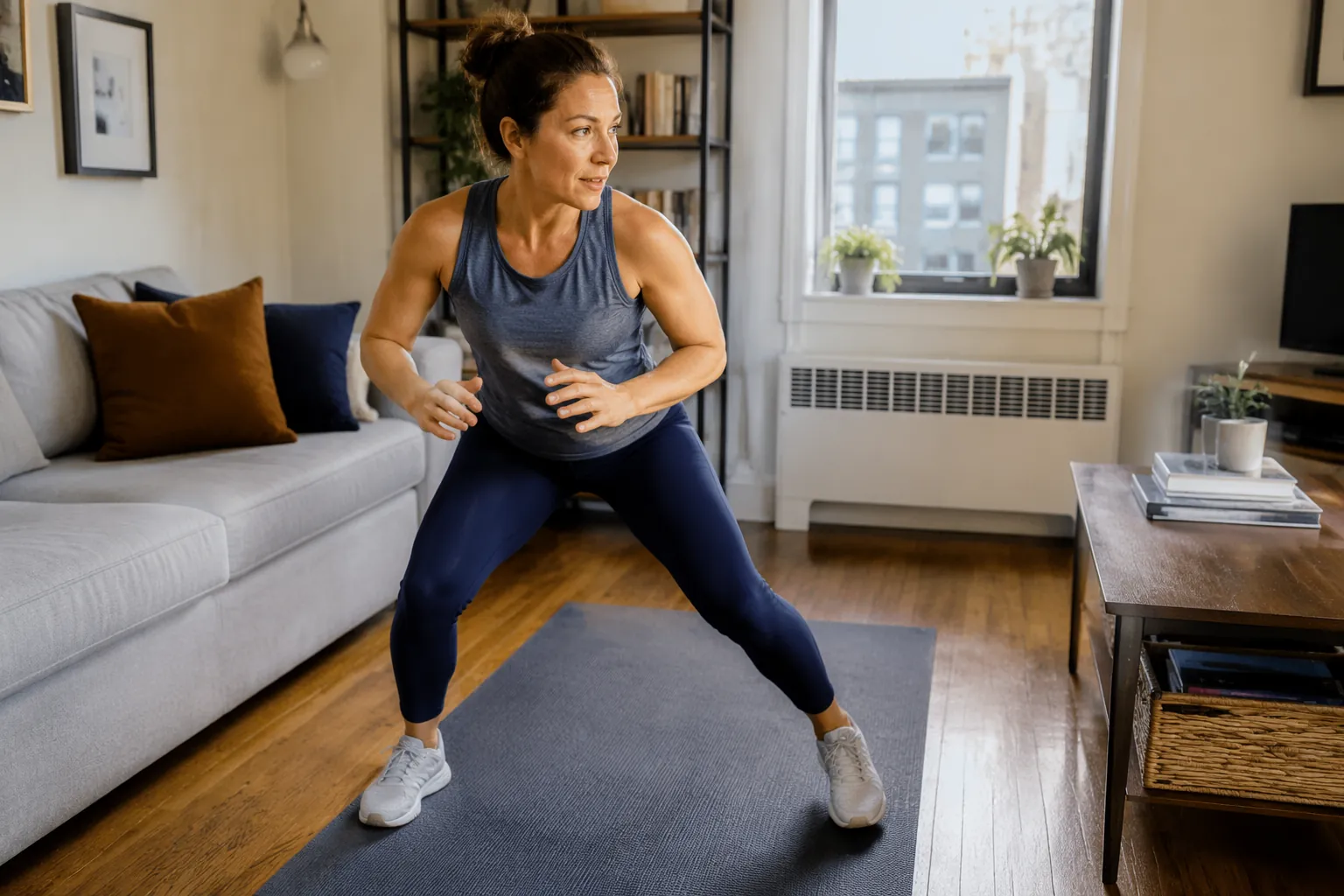
The 20-Minute Small-Space Circuit
Clear about a 10x10-foot patch if you can. A yoga mat is enough. Shoes are optional if your floor is safe and grippy, but socks on slick flooring are asking for drama. Keep every rep quiet: no jumping, no stomping, no medicine ball, no equipment being dropped on a neighbor’s ceiling.
| Block | Time | What You Do | Noise Note |
|---|---|---|---|
| Warm-up | 3 minutes | March, hinge, reach, and shift into a ready stance | Feet stay soft |
| Circuit Round 1 | 7 minutes | 7 exercises, 40 seconds work and 20 seconds transition | No hopping |
| Circuit Round 2 | 7 minutes | Repeat the same 7 exercises | Move faster only if control stays quiet |
| Cool down | 3 minutes | Hip flexor, calf, hamstring, and trunk breathing resets | Mat-based or standing |
Use a timer set for 40 seconds on, 20 seconds off. During the 20 seconds, reset your space, breathe through your nose if you can, and start the next move from a pickleball-ready stance rather than standing tall and waiting.
Warm-Up: 3 Minutes
- 0:00–0:45: Quiet march with paddle-ready hands. Keep the ribs stacked over the hips and let the arms move as if you are preparing for a return.
- 0:45–1:30: Hip hinge to reach. Push the hips back, reach both hands forward, then stand tall without snapping the knees.
- 1:30–2:15: Side-to-side weight shifts. Step one foot out, bend that knee slightly, and let the other leg lengthen without collapsing.
- 2:15–3:00: Ready-stance pulses. Feet just outside hip width, knees soft, heels light, chest calm.
The warm-up is not there to make you tired. It is there to find the stance you will keep returning to on court: low enough to move, relaxed enough to react.
Move 1: Lateral Shuffle to Stick
Shuffle two small steps to the right, pause for one count, then shuffle two small steps to the left. Keep your feet from crossing, keep your shoulders level, and make the pause quiet. The pause matters because court coverage is not just getting to the ball; it is arriving balanced enough to do something useful with it.
On court, this is the movement behind covering a middle dink, adjusting after your partner takes a ball, or getting your body behind a backhand instead of stabbing at it with only the wrist. If your apartment space is tighter than 10 feet, take one step each way and make the stick cleaner.
Move 2: Quiet Split-Step Reset
Start in ready stance. Rise slightly onto the balls of your feet, then settle back down into bent knees without leaving the floor. As you settle, shift your weight right, center, left, center. Hands stay in front as if the paddle is waiting between forehand and backhand.
A split step does not have to be a noisy hop to be trainable. For a downstairs-neighbor version, think of it as a timed pressure change through the feet. The useful feeling is readiness: you are not flat-footed, and you are not bouncing so much that you cannot change direction.
Move 3: Reverse Lunge to Kitchen-Line Reach
Step one foot back into a shallow reverse lunge, then return to standing and reach both hands forward at chest height. Alternate sides. The front knee tracks over the middle toes; the back knee does not need to touch the floor. Keep the reach long but not rounded, as if you are taking a soft ball out of the air near the kitchen line.
This trains the unglamorous part of a lunge: getting out of it. A lot of recreational points get messy after the first reach, when the player is still leaning forward and the next ball comes back. Stand up under control before the next rep.
Move 4: Standing Rotational Paddle Swing
Stand with feet about shoulder width. Pretend you are holding a paddle with both hands. Rotate through the ribs and hips to one side, then return to center and rotate to the other side. The goal is not a wild backswing. Let the back heel turn slightly, keep the knees soft, and stop before your lower back starts doing all the work.
Pickleball power is usually compact. This drill teaches the torso and hips to help the paddle side instead of making the shoulder supply every ounce of force. It also gives you a cleaner reset after a drive or a rushed counter.
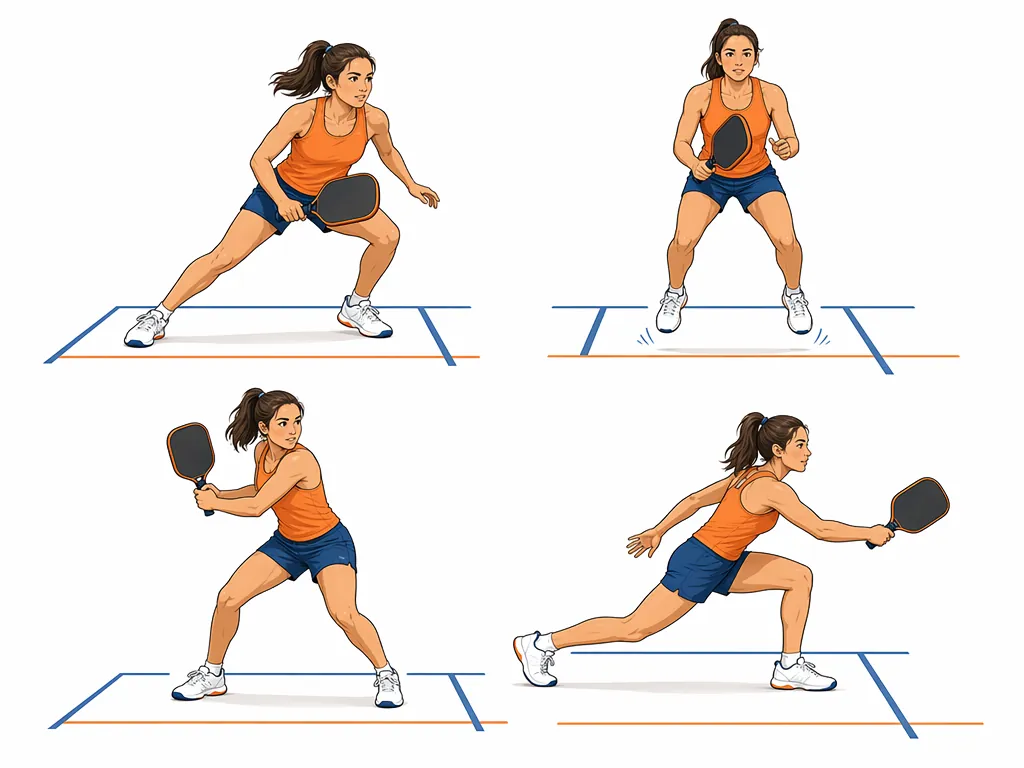
Move 5: Single-Leg Balance With Backhand Tap
Stand on the right leg with the left toes lightly touching behind you like a kickstand. Bring both hands across the body into a small backhand-tap motion, then return to center. Switch legs halfway through the interval. If balance is easy, float the back foot off the floor for two seconds at a time.
This is not circus balance. It is the kind you need when one foot reaches for a wide ball and the upper body still has to aim. For older recreational players especially, controlled single-leg work is worth keeping in the week because sprains, strains, and falls are among the injury patterns pickleball players are trying to avoid. The routine cannot promise injury prevention, but it can train the deceleration and recovery positions that show up before many awkward saves.
Move 6: Low-to-High Diagonal Reach
From a soft squat, reach both hands toward the outside of one knee, then rotate and reach diagonally up across the body. Alternate sides. Keep the movement smooth, with the hips and ribs turning together. If the knees dislike the squat, make the low reach higher and put more emphasis on the rotation.
This pattern connects legs, trunk, and paddle side. It is useful for players who can get to the ball but hit from a disconnected position, with the legs stopped and the arm flinging late.
Move 7: Forward-Back Court Line Steps
Imagine a kitchen line running across the front edge of your mat. Step forward with the right foot, bring the left foot in lightly, then step back to your starting spot. Repeat on the other side. Stay low and quiet. Do not turn it into running in place.
This is the living-room version of closing a short ball and getting back before the next shot. The important part is the brake. If your front foot lands loudly, slow down and shorten the step.
Why This Works Better Than a Random Leg Day
Pickleball doubles is active enough to demand conditioning. A study cited by Men’s Health reported that doubles pickleball increased caloric expenditure by 36% and perceived exertion by 44% compared with walking.[2] That does not mean playing a few games automatically supplies all the strength work your knees, hips, trunk, and ankles need. Court time gives you repetitions; it does not always give you controlled practice of the weak positions.
The four qualities in this routine line up with what keeps happening in doubles:
- Lateral shuffling helps you cover the kitchen line without crossing your feet and arriving twisted.
- Split-step timing gives you a small reset before deciding forehand, backhand, block, or retreat.
- Rotational core power lets the torso contribute to compact paddle force.
- Unilateral leg strength helps with lunges, reaches, braking, and getting back under your center of mass.
That framework is consistent with how several fitness outlets now discuss pickleball-specific strength training: not as bodybuilding with a paddle nearby, but as lower-body strength, trunk rotation, balance, and agility work aimed at the positions players repeatedly enter.[2][3][4] The Dink Pickleball has also cited a 2025 study reporting that sport-specific agility training improved reactive movement speed in recreational pickleball players by up to 18% within six weeks.[1] That figure is encouraging, but it should be treated as support for the direction of training, not a guarantee that one apartment circuit produces the same result for every player.
How to Scale It Without Making It Loud
The easiest way to ruin an apartment workout is to make “harder” mean “bouncier.” For pickleball, harder can mean cleaner, lower, slower, or more controlled.
| If This Describes You | Use This Version | Avoid |
|---|---|---|
| Beginner or returning after a layoff | 30 seconds work, 30 seconds transition; one circuit round after the warm-up | Deep lunges and fast direction changes |
| Knee-sensitive player | Shallow lunges, higher diagonal reaches, shorter forward-back steps | Letting the knee cave inward or chasing depth |
| Downstairs neighbors | Barefoot or quiet shoes on a mat; slow deceleration; no hops | Heel slams, fast pivots, and jumping split steps |
| Stronger recreational player | Same 40/20 timing, lower stance, longer pauses, cleaner stops | Adding speed before balance is stable |
For knee-sensitive players, the best rule is simple: make the range smaller before you remove the movement entirely. A shallow reverse lunge that you can exit cleanly is more useful than a deep lunge that makes you twist, shove off the front knee, and dread the next rep.
For noise, listen to your landings and stops. A good rep has very little soundtrack. If the floor thuds when you shuffle or step forward, reduce speed and make the foot placement softer. The court does not reward loud feet either.
Optional Upgrades Once Bodyweight Feels Easy
Do the bodyweight version for at least a couple of weeks before adding resistance. The point is not to collect equipment. The point is to make the same court positions stronger and more repeatable.
- Mini band: Place it above the knees during lateral shuffle to stick. Keep the knees tracking outward without waddling.
- Light dumbbell: Hold one dumbbell at the chest during reverse lunges or low-to-high diagonal reaches. Stop if the weight pulls you out of alignment.
- Paddle: Hold your actual paddle during split-step resets and backhand taps if it helps the movement feel more court-specific.
- Timer app: Use audio cues if you do not want to keep looking at your phone between intervals.
Strength and conditioning recommendations for pickleball often include progressive loading, power, balance, and agility work, but progression does not have to start with heavy equipment.[3] In a rental, progression may simply mean the second round looks as controlled as the first.
Where It Fits Around Actual Pickleball
If you play two or three evenings a week, use this routine two times weekly on nonconsecutive days. If you play four times a week, one full session plus one shorter version may be enough. The goal is to arrive at games sharper, not with legs that feel rented from someone else.
| Playing Schedule | Home Routine Frequency | Best Placement |
|---|---|---|
| 2 games per week | 2 full 20-minute sessions | Day before a rest day or light day |
| 3 games per week | 1–2 full sessions | At least 24 hours away from your hardest games |
| 4 games per week | 1 full session plus 1 short round | Use the short round as movement practice, not conditioning |
Before a casual game, you can also steal the 3-minute warm-up and one round of split-step resets, lateral shuffles, and forward-back court line steps. That is not a full workout; it is a way to remind your feet what the first few points usually ask from them.
The number of people trying to solve this problem keeps growing. SFIA reported 24.3 million U.S. pickleball players in 2025 and 479% growth from 2020 to 2025.[5] A lot of those players do not have a garage gym or a private court. They have a mat, a hallway, and a narrow window after work.
A Simple Progression for the Next Four Weeks
| Week | Target | Progression |
|---|---|---|
| Week 1 | Learn the movements | Use 30/30 timing if needed and keep every stop quiet |
| Week 2 | Complete the full circuit | Use 40/20 timing for two rounds |
| Week 3 | Improve control | Add a one-count pause to shuffles, lunges, and forward steps |
| Week 4 | Increase court transfer | Hold a paddle during split-step resets, rotations, and backhand taps |
Once this 20-minute circuit feels easy, pair it with a full weekly pickleball training plan if you want more structure across strength, mobility, and court days. If you prefer guided timers and apartment-friendly sessions, a roundup of free workout apps for limited equipment and apartment spaces can help you build the habit without buying anything first.
This routine will not replace court time, coaching, or a full strength program. It does give you a quiet way to practice the movements that keep showing up in recreational doubles: the short shuffle, the ready reset, the compact rotation, the one-leg reach, and the recovery step after you barely got there.
References
- 5 Pickleball Workout Routine Drills to Boost Agility — The Dink Pickleball
- The Ultimate Pickleball Workout Plan to Build Strength for the Game — Men’s Health
- The Ultimate Pickleball Workout Plan: Build Speed, Power, Agility & Endurance — Muscle & Fitness
- 10 Strength Exercises That'll Power Up Your Pickleball Game — Peloton Blog
- 2025 U.S. Pickleball Participation Statistics — SFIA
What a small equipment investment adds
We don't have a build tagged to this exact tier yet. Browse all builds.
How often should you repeat this?
See our recovery and rest reference for citation-anchored rest-interval guidance.
Spot something off?
Tell us if a movement, tier assumption, or duration didn't match your experience.