
Pochettino's 'Believe Work Compete' Keeps You Training at Home
Learn how to apply Mauricio Pochettino's three-word mantra — Believe, Work, Compete — as a structured self-coaching system for solo home soccer training. This framework replaces the missing coach and teammates with a repeatable loop that builds real skill through measured effort.
- Equipment tier required
- none
- Duration
- 20 min
- Difficulty
- beginner
- Target area
- legs
- Space footprint needed
- small
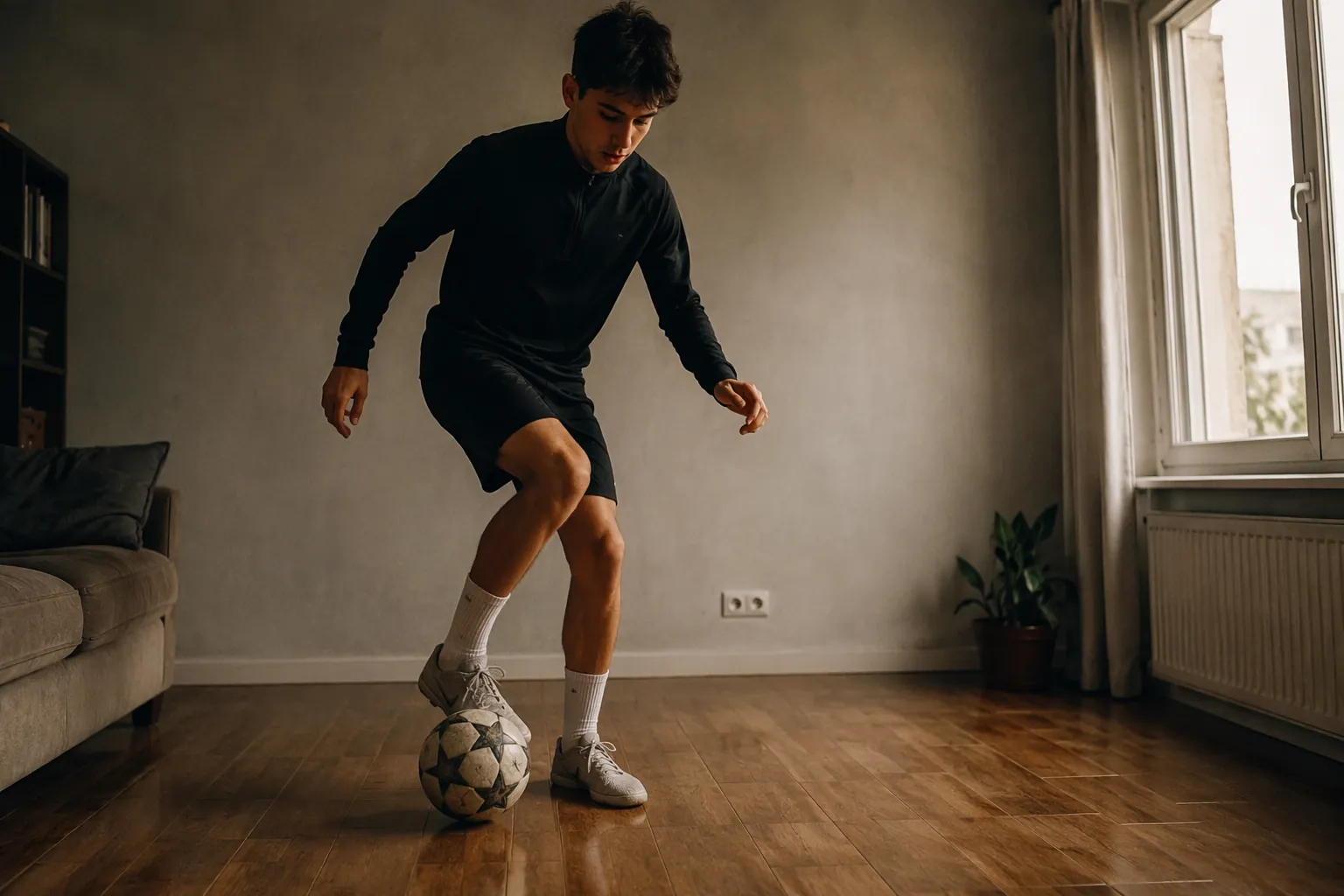
Home soccer training usually breaks at the quietest point. Not when the workout is written. Not when the player is excited. It breaks ten minutes in, when the wall pass is sloppy, the ball rolls under the couch, nobody is counting, and stopping early would leave no witness.
That is where most motivation advice is too soft. A phrase can get you onto the floor with a ball. It cannot, by itself, make you finish the final minute with the same care as the first. If Pochettino's motivation ideas are going to help with home soccer training, the words have to become actions you can repeat when you are alone.
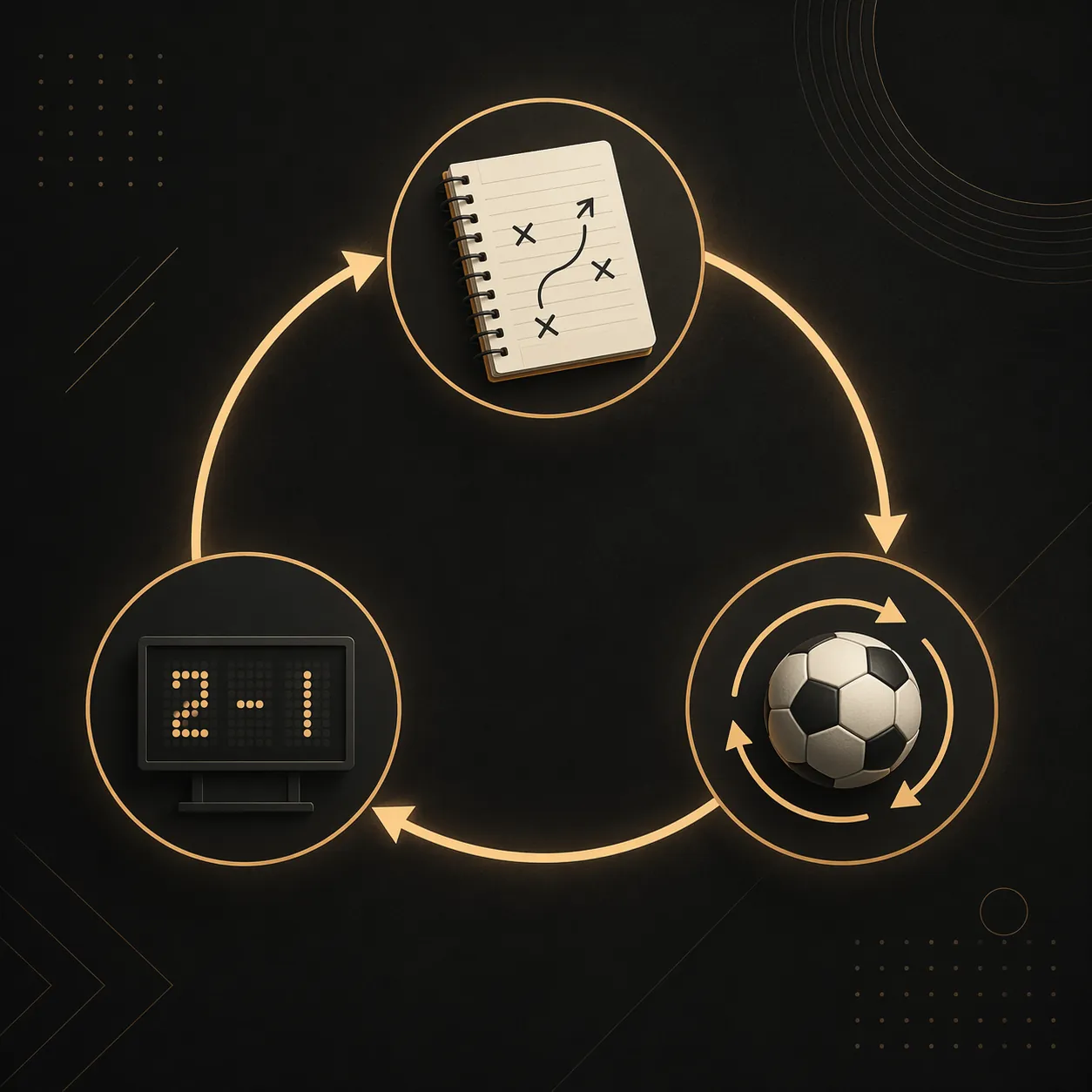
Mauricio Pochettino’s three-word wall mantra is useful for that reason: Believe Work Compete. Goal.com reported in June 2026 that Pochettino wrote those words as a circular system on his office wall and explained that “without one of these, it’s a disaster.”[1] The important part is not that the words sound clean. The important part is that they depend on each other. Belief gets you to start. Work gives the belief a body. Competition checks whether the work was real.
Pochettino has not published a living-room training plan. This is a translation of a professional coaching idea into a small-space routine. That distinction matters. A teenager doing wall passes in an apartment is not reproducing a USMNT session. But the loop can still be made honest: write the reason, do measured reps, record the score, then let the score tell you what tomorrow’s belief is worth.
The Loop Before the Drills
The mistake is treating “Believe Work Compete” as three separate moods. At home, it has to run like a session protocol.
| Word | Home-training translation | Proof it happened |
|---|---|---|
| Believe | A short pre-session script that names the player you are trying to become today | You read it before touching the ball |
| Work | Timed ball contacts, wall passes, and small-space circuits | You complete the minutes and record the reps |
| Compete | A personal scoreboard for juggling, passing, dribbling, or first-touch targets | You try to beat or defend a number |
That table is plain on purpose. If you cannot tell whether the step happened, it is not a self-coaching system yet. “I felt focused” is too slippery. “I read two sentences, made 184 wall passes, and beat my cone-dribble time by one round” gives you something to answer to.
Believe: Write the Reason Before the Ball Moves
Belief is the easiest word to fake because it feels good before the session starts. Pochettino’s better use of belief is more demanding. In a November 2025 team meeting, he reportedly asked the USMNT, “Why not us?” as part of framing a bigger World Cup ambition.[1] That is not a technical cue. It is an identity cue. It asks the player to enter the work as someone who belongs in the attempt.
For a solo player, the home version should be written, short, and specific enough that it survives a bad first touch. Before the timer starts, put two or three lines in a notebook or phone note:
- “Why not me for 20 honest minutes?”
- “Today I train like a player who can receive clean under pressure.”
- “If the first touch is bad, I reset the ball and keep the count.”
That is belief doing a job. It does not promise that you are already excellent. It tells you what kind of player is walking into the next repetition.
Another Pochettino wall line, reported by the Los Angeles Times, pushes the same idea in bigger language: “If I dream of touching the moon, maybe I can get close to it. If I only dream of getting close, I’ll stay on Earth.”[2] Used badly, that becomes decoration. Used well, it gives permission to set a serious standard even when the training space is humble.
A player in a small room does not need to pretend the room is a stadium. The useful move is smaller: decide that today’s juggling record, wall-pass target, or weak-foot block belongs to a larger version of you. Pochettino has also described decisions and relationships as matters of energy, and that is a fair way to think about the first minute of solo training too.[3] Energy is not hype. It is the state you choose before the work asks for payment.
Work: Turn Motivation Into Contacts
This is where the whole thing either becomes real or collapses. Work is not “train hard” written in a caption. Work is the timer, the target, the foot surface, the wall distance, the recovery, and the decision not to quit when the ball feels clumsy.
Elite references can set the tone, but they cannot be copied blindly. The Athletic reported that Pochettino showed USMNT players data indicating their defensive intensity against Belgium was “at about half” of previous matches.[4] That is professional match analysis, not a home-drill prescription. The lesson for a solo player is narrower and still valuable: serious coaches measure intensity because effort often lies to the athlete who is doing it.
So the home version measures what the player can actually control. Not GPS load. Not international pressing metrics. Ball contacts. Clean repetitions. Timed rounds. Rest kept honest.
A useful 15–20 minute translation starts with ball mastery because it gives the feet repeated information before the player asks for speed. Anytime Soccer’s at-home training guide emphasizes ball mastery as a foundation and connects consistent repetition with myelination, the process by which repeated neural firing helps skills become more automatic.[5] That does not mean every touch is magic. It means sloppy, irregular practice is a poor bargain when you are already training without teammates.
A 20-Minute Believe Work Compete Session
| Time | Action | Measure |
|---|---|---|
| 1 minute | Read your Believe script | No ball touches until it is read |
| 4 minutes | Ball mastery in place: toe taps, foundations, sole rolls, inside-outside touches | Count clean 30-second blocks |
| 5 minutes | Wall passing: two-touch right, two-touch left, one-touch if space allows | Count completed passes that return under control |
| 4 minutes | First-touch work: receive from wall, open body, move ball across your body | Count clean first touches into the next action |
| 3 minutes | Cone or object dribble circuit | Record best clean round |
| 2 minutes | Compete finisher | Beat one number or defend yesterday’s score |
| 1 minute | Write the result | Scoreboard updated before leaving |
The order matters more than the variety. Ball mastery first wakes up touch. Wall passing adds rhythm and return speed. First-touch work forces preparation. Dribbling adds control while tired. The finisher puts pressure on the last minutes, when home players most often drift.
If the room is small, shrink the drill instead of abandoning the standard. Use socks or soft shoes. Replace cones with two water bottles. Use a rebounder, a safe wall, or a firm couch base only if it will not damage the space. If wall passing is not possible, replace it with controlled sole rolls, V-pulls, L-turns, and inside-inside touches against a marked line on the floor. The point is not to imitate a training ground. The point is to remove the excuse before it becomes the session plan.
Reports on Pochettino’s coaching often connect his training with repetition and intensity, including small-sided games, transitional drills, and positional rondos.[6] Those are team tools. At home, their equivalent is not a fake rondo with one player. It is a drill where the ball keeps coming back, the body must adjust, and the clock refuses to flatter you.
What to Count When Nobody Is Watching
Counting should be strict enough to matter and simple enough to maintain. A wall pass only counts if the return is playable without lunging. A juggling touch only counts if the ball stays under control. A dribble round only counts if no cone or object is hit. A weak-foot repetition only counts if the weak foot actually does the work instead of being rescued by the strong foot.
- Wall passes: completed controlled returns in 60 seconds
- Juggling: best unbroken streak, plus best weak-foot-only streak if appropriate
- Cone dribble: fastest clean round, not fastest messy round
- First touch: clean receives into the next action in a timed block
- Completion: whether the final two minutes were finished at full attention
That last measure sounds soft until you coach enough players to see the pattern. Plenty of players can look sharp for the first drill. Fewer keep their standards when the record is out of reach and the session is nearly over. The final two minutes are where “work” stops being a word and becomes a habit.
Compete: Build a Scoreboard You Cannot Argue With
A coach supplies pressure by watching. Teammates supply pressure by raising the pace. At home, pressure has to be manufactured. The simplest tool is a scoreboard that records numbers you respect.
The scoreboard should not be complicated. Use four columns: date, drill, score, note. The note is not a diary entry. It explains the result in one line: “left-foot returns broke down,” “too far from wall,” “best round came after slowing first touch,” or “quit mentally in final minute.”
| Date | Drill | Score | Note |
|---|---|---|---|
| Today | Wall passes, right foot, 60 seconds | Your number | Only count controlled returns |
| Today | Juggling | Your best streak | Restart after every drop |
| Today | Cone dribble | Your clean time | No contact with objects |
| Today | First touch from wall | Your clean reps | Touch must prepare next action |
Competing at home does not mean chasing a personal record every day. That can turn training into impatience. Some days the target is to beat yesterday. Some days it is to defend the standard on your weaker foot. Some days it is to finish the full session after a bad start. The scoreboard keeps those claims honest.
This is also where belief gets tested without drama. If your script says you are becoming a cleaner midfielder, but the scoreboard shows your first touch collapses whenever the pass comes faster, that is not an insult. It is tomorrow’s work order. If your juggling record improves but your wall-pass quality does not, the next session should not reward you with more tricks. It should return you to receiving, passing, and preparing the body early.
Run the Circle, Do Not Worship the Words
Here is what the full home loop looks like when it is not pretending to be a professional session:
- Believe: read a short script that names the player you are training as today.
- Work: complete the timed ball-mastery, wall-pass, first-touch, and dribble blocks.
- Compete: finish with one measurable challenge and record the result.
- Return: let the result choose the first target for the next session.
The return step is the part many players skip. They train, feel good or bad, and leave the next session to mood. Pochettino’s circular mantra is harder than that. If one element is missing, the system weakens. Belief without work becomes fantasy. Work without competition becomes busy movement. Competition without belief becomes a scoreboard that only tells you what you are not.
Start with one clean loop, not a heroic plan. Fifteen minutes done with a timer, a ball, a wall or marked floor space, and a written score is more useful than an hour-long routine that disappears after two days. Once the loop is reliable, expand the content around your position. If you want that next layer, the FitAtHome guide on how to train as a soccer midfielder at home on any budget is a natural place to apply the same Believe Work Compete structure inside a more specific role.
The useful question before the next session is simple: where will the timer sit, what number are you chasing, and what will you do when the first touch is bad for ten minutes?
References
- 'Why not us?' — Inside Mauricio Pochettino's USMNT World Cup dream, Goal.com, June 2026.
- Mauricio Pochettino USMNT World Cup success, LA Times, June 25, 2026.
- Mauricio Pochettino leadership energy USMNT, The Athletic, June 30, 2026.
- USMNT World Cup Pochettino intensity Belgium Portugal, The Athletic, March 30, 2026.
- The Ultimate Guide to At-Home Soccer Training, Anytime Soccer.
- Mauricio Pochettino: Building the Future of U.S. Soccer, Soccer-Coaches.com.
What a small equipment investment adds
We don't have a build tagged to this exact tier yet. Browse all builds.
How often should you repeat this?
See our recovery and rest reference for citation-anchored rest-interval guidance.
Spot something off?
Tell us if a movement, tier assumption, or duration didn't match your experience.