
Why Motivation Isn't the Problem With Senior Home Workouts
Explains why older adults quit home workout videos and what actually keeps them coming back - enjoyment, social connection, self-efficacy, progress feedback, and routine fit - with evidence-grounded, actionable steps for seniors and family members researching on their behalf.
- Equipment tier required
- none
- Duration
- 10 min
- Difficulty
- beginner
- Target area
- full body
If you keep starting senior home workout videos and then drifting away from them, it is tempting to make the whole story about character: I must not be motivated enough. I must be lazy. I must need a firmer lecture. But if motivation alone explained exercise follow-through, the national numbers would look very different. In a 2022 U.S. snapshot, only 13.9% of adults age 65 and older met both the aerobic and muscle-strengthening parts of the federal physical activity guidelines.[1]
That number is not useful as a scolding stick. It is useful because it makes the private embarrassment less private. Many older adults know exercise matters and still struggle to repeat it. The more helpful question is not “How do I make myself want this badly enough?” It is “What would make me come back to this video tomorrow, next week, and after the novelty has worn off?”
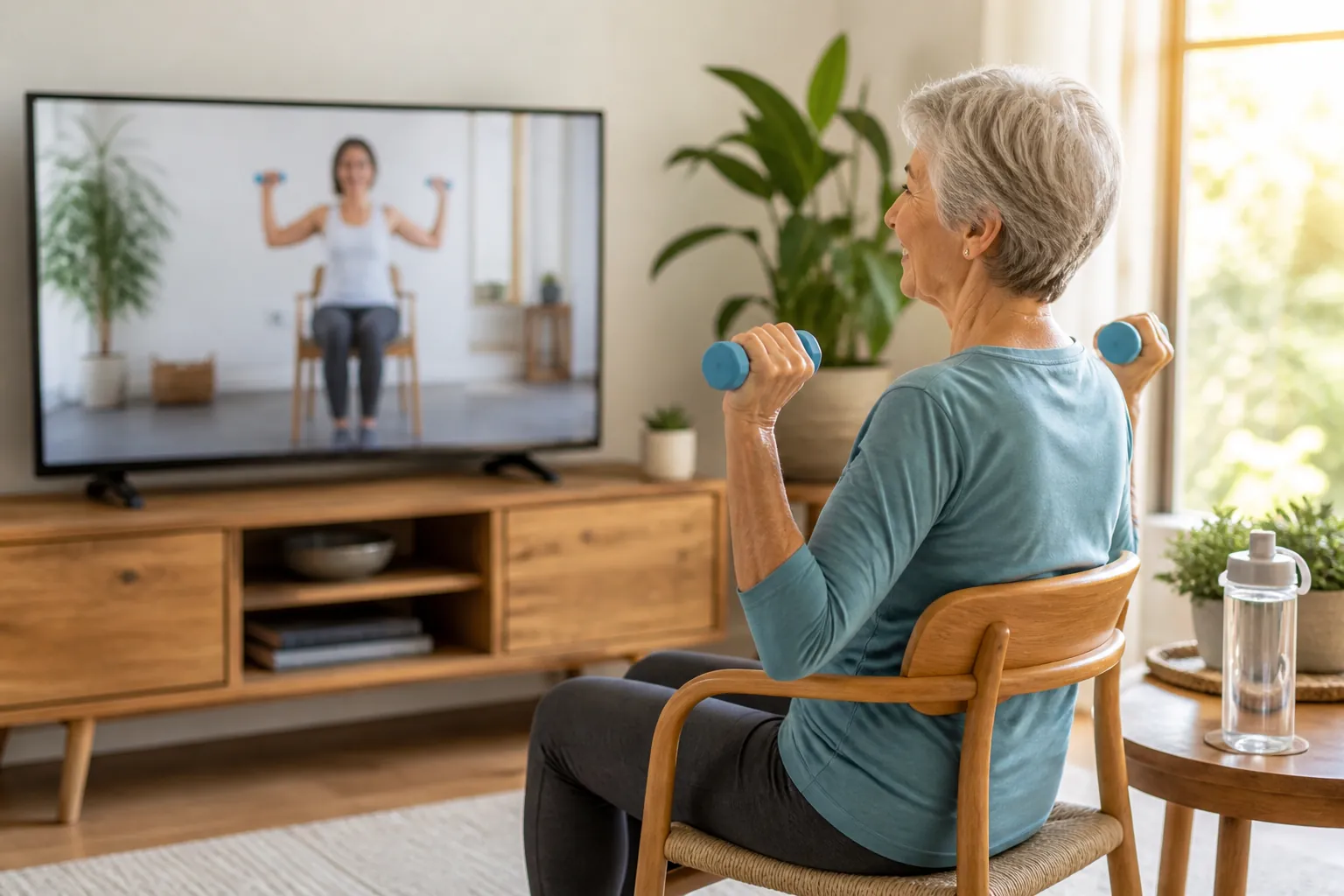
The guideline matters, but it does not do the sticking for you
The CDC’s basic target for adults 65 and older is 150 minutes a week of moderate-intensity aerobic activity, at least 2 days a week of muscle-strengthening activity, and balance activities as needed; it also says plainly that some physical activity is better than none.[2] For the full “what belongs in a healthy aging plan” discussion, the practical companion is this 3-pillar home exercise plan for healthy aging.
But a weekly target does not answer the kitchen-table problem. It does not tell you what to do when the instructor is cheerful in a way that makes your teeth clench, when the video jumps from warmup to lunges too fast, when your knee is good on Monday and unpredictable on Thursday, or when the person who promised to “check in” forgets after week two.
Home videos remove some barriers: no driving, no locker room, no waiting for a class time. They also remove some supports. Nobody notices if you skip. Nobody slows the room down. Nobody says, “That version is enough today.” A video routine has to replace at least some of that support by design.
What adherence research says actually helps
A 2021 umbrella review by Collado-Mateo and colleagues looked across 55 reviews on exercise adherence in older adults and people with chronic diseases. It identified 14 key adherence factors. The most frequently cited factor was exploring barriers and facilitators before participation, appearing in 36 of the 55 reviews. Social support appeared in 22 reviews, self-efficacy in 21, and enjoyment was described as an immediate reward that can help people continue exercising.[3]
That sounds academic until you put it beside the television. Before pressing play, the useful questions are small and specific: Is the chair already in place? Is the screen easy to see? Is the sound pleasant? Is there a shorter version for a tired day? Does the person know what counts as success if they cannot finish the whole session?
The same review also noted that roughly half of participants in physical activity programs drop out within the first 6 months, and 10 reviews found that longer interventions were associated with lower adherence.[3] That does not mean long-term exercise is hopeless. It means the first month’s enthusiasm should not be treated as a permanent fuel supply.
Enjoyment is not decoration
Delayed benefits are real, but they are poor company on an ordinary Tuesday. “This may reduce my future risk” is true; it is also abstract. Enjoyment gives the workout a reason to exist today.
Enjoyment does not have to mean grinning through every march in place. It may mean the instructor’s voice is calm, the music is familiar but not blaring, the movements feel dignified, the session ends before irritation takes over, or the workout leaves a person feeling looser rather than punished. If two videos meet the same physical goal, choose the one the person dislikes less. That is not lowering standards; it is removing a predictable reason to quit.
Self-efficacy is built or broken by the video
Self-efficacy is the sense that “I can do this.” For home workouts, it is not a personality trait floating in the air. It is trained by repeated experiences. A video that constantly leaves someone behind teaches one lesson: this is not for me. A video that offers seated options, slower pacing, visible modifications, and permission to pause teaches another: I have a way to stay in the session.
This is why “beginner” on a video title is not enough. A useful beginner video shows the safer version before the harder one, gives time to change position, and does not treat modification as failure. For many older adults, the most motivating video is the one that lets them finish with some pride left.
Social connection still matters at home
A home workout can be solitary, but it does not have to feel abandoned. Social support was one of the commonly cited adherence factors in the umbrella review.[3] In practice, that may be a daughter who calls after lunch on workout days, a neighbor who does the same 15-minute chair video in her own apartment, a senior center calendar where people mark sessions without competing, or simply an instructor who becomes familiar enough to feel welcoming.
The tone matters. A check-in that sounds like inspection can sour the whole arrangement. “Did you do your exercises?” may land very differently from “Do you want to try the short one today or take a walk to the mailbox?” The older adult is not a compliance project. The support should make the next session easier to begin, not add another person to disappoint.
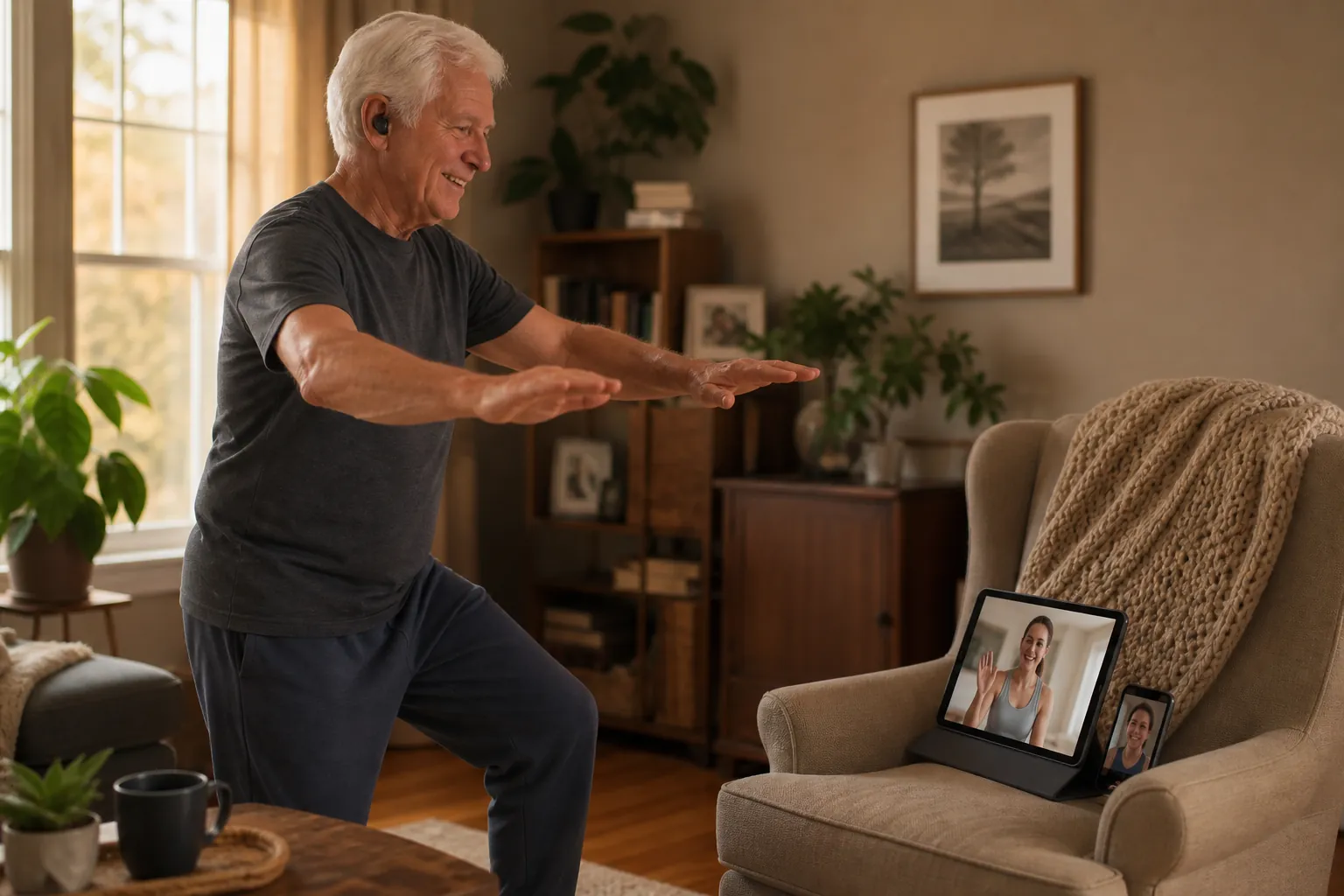
Progress feedback should be visible enough to believe
Home workouts often fail quietly because progress is too vague. The scale may not move. Pain may vary for reasons that have nothing to do with effort. A person may not notice that standing from the chair is a little smoother until someone points it out.
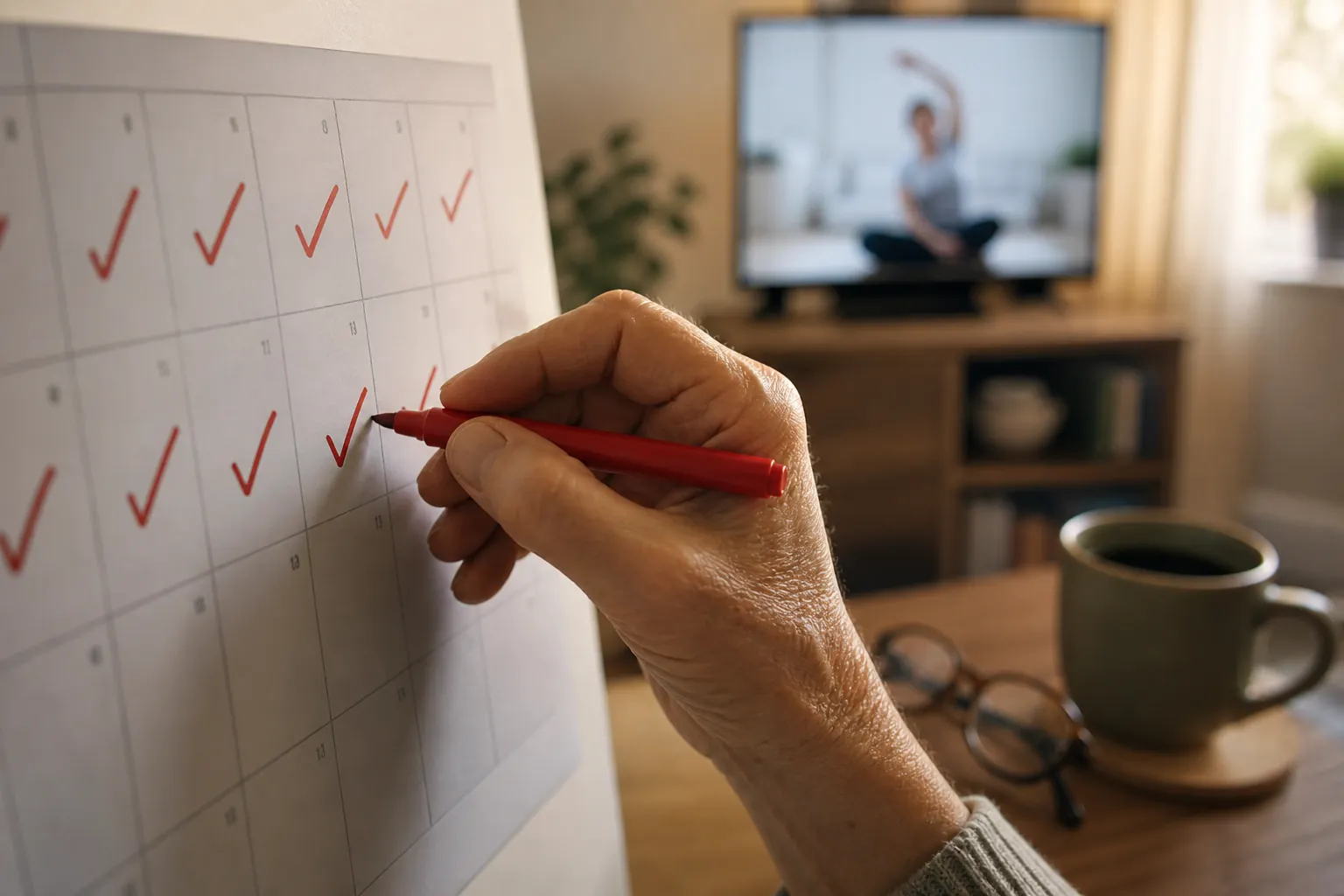
The simplest feedback is often a visible checkmark calendar. Not a punishment chart, not a public scoreboard. Just evidence: I showed up Monday. I did 10 minutes Wednesday. I paused Friday and still came back Saturday. For strength or balance videos, progress can also be written in plain language: “used soup cans,” “stood for the first half,” “held the counter less,” “finished the warmup without stopping.”
Plan around the quit points before they arrive
Rivera-Torres and colleagues reported common self-described barriers to long-term physical activity maintenance: lack of self-motivation at 41%, time constraints at 33%, illness or injury at 29%, and family obligations at 23%.[4] These are not exotic problems. They are the usual reasons a routine that looked sensible on Sunday gets interrupted by real life.
| Likely quit point | What to change before pressing play |
|---|---|
| “I am not motivated today.” | Start with a 5- to 10-minute minimum version. Count the short session as real, not as a failed full workout. |
| “I do not have time.” | Attach the video to an existing habit, such as after morning coffee or before the evening news, and choose a session short enough for that slot. |
| “My knee, back, shoulder, or energy level is unpredictable.” | Keep a seated or lower-intensity alternative ready so the choice is not full workout or nothing. |
| “Family obligations interrupted me.” | Use a weekly target with flexible days instead of a rigid schedule that collapses after one missed session. |
| “The video makes me feel behind.” | Switch to an instructor who demonstrates modifications early and gives enough transition time. |
The short-session point deserves more respect than it usually gets. A 10-minute seated routine after coffee may look unimpressive beside a 45-minute class, but the better comparison is not the fantasy class. It is the session that never happens. A small repeatable routine can become the doorway to more activity; an overlarge plan often becomes another thing to avoid.
After illness, injury, or a painful flare, the emotional barrier can be as real as the physical one. The question is no longer only “Can I move?” but “Can I move without feeling foolish, frightened, or set back?” That neighboring problem is covered more directly in home workout motivation after injury.
Choosing the video is mostly choosing the environment
There are plenty of lists that rank channels, apps, and instructors. They can be useful, but the better first filter is not popularity. It is fit.
- Can the person hear the instructor clearly without straining?
- Does the instructor explain how to make movements easier?
- Is the pace slow enough for safe transitions?
- Does the video require equipment that is already available and easy to reach?
- Can the first session be short enough that starting does not feel like a production?
- Would the person tolerate hearing this instructor twice a week for several months?
For older men who are turned off by the usual tone or format of senior fitness videos, the more specific video-selection question is handled in which home workout videos actually motivate older men. The point here is broader: a video does not have to be perfect, but it does have to reduce the number of small frictions that make skipping attractive.
A promising home-video case, with limits
The PERMANENTO online home-based exercise program is a useful example of what better-designed video exercise can look like, as long as it is not turned into a universal promise. In a follow-up of 82 adults with a mean age of about 74, 79.3% were still engaged at 6 months and 70.7% at 12 months. High adherence, defined as at least 2 sessions per week, was 51.3% at 6 months and 47.8% at 12 months. The report contrasted those figures with typical long-term digital or home-exercise adherence below 30%.[5]
Those figures are encouraging. They are also from a small, specific group of mostly female, highly educated Czech adults.[5] That matters. A program that sustains engagement for that group may not produce the same result for an older adult with less internet comfort, more pain, lower income, caregiving responsibilities, or no quiet place to exercise.
It is also fair to keep the larger tension on the table: supervised programs have often shown stronger adherence than unsupported home formats, while some video-based programs can sustain engagement when the design supplies enough structure and support.[3][5] So the practical lesson is not “online videos beat classes.” It is that home videos need more than a play button.
A modest test before you commit to a video
Before choosing a senior home workout video as “the routine,” try it once as a test. Do not judge only whether it seems medically sensible or whether the instructor has good credentials. Watch what happens to the person doing it.
- Does the video make the person feel capable within the first few minutes?
- Is there at least some immediate reward: comfort, pleasure, calm, looseness, or satisfaction?
- Does it feel socially less lonely, either through the instructor, a shared schedule, or a gentle check-in?
- Can progress be seen or recorded without turning it into pressure?
- Can the session fit into the person’s actual day, not the day everyone wishes they had?
If the answer is no, the problem may be the setup, not the senior. Try a shorter video, a different instructor, a seated alternative, a clearer screen, a scheduled phone call, or a calendar checkmark. These are not tricks. They are the conditions that make repetition less lonely and less brittle.
Older adults, especially anyone with chronic conditions, pain, falls risk, recent illness, or recent injury, should check with a healthcare professional before changing activity. Within that boundary, motivation is not something to sit around waiting for. The workout environment can drain it, or it can quietly support it.
References
- Characteristics of Older Adults Who Met Federal Physical Activity Guidelines for Americans: United States, 2022, NCHS/CDC, 2022.
- Physical Activity Guidelines for Older Adults, CDC.
- Key Factors Associated with Adherence to Physical Exercise in Patients with Chronic Diseases and Older Adults: An Umbrella Review, 2021.
- Adherence to Exercise Programs in Older Adults: Informative Report, 2019.
- Revolution or Empty Promise? A 6- and 12-Month Follow-Up to an RCT of the PERMANENTO Online Home-Based Physical Exercise Program, Clinical Interventions in Aging.
What a small equipment investment adds
We don't have a build tagged to this exact tier yet. Browse all builds.
How often should you repeat this?
See our recovery and rest reference for citation-anchored rest-interval guidance.
Spot something off?
Tell us if a movement, tier assumption, or duration didn't match your experience.