
RICE Is Out: What Works for Soft Tissue Recovery at Home
The old RICE default (rest, ice, compression, elevation) no longer matches the evidence for recovering from a strain or sprain at home. The current standard is PEACE & LOVE — short protection, then pain-guided movement and progressive loading — and this guide provides the home pacing rules, the limited role ice still plays, and the red-flag signs that end DIY care.
- Equipment tier required
- none
- Duration
- varies min
- Difficulty
- beginner
- Target area
- full body
- Space footprint needed
- small
- Noise level
- quiet
You tweak an ankle during lunges, pull something in your calf stepping off a plyo box, or take a hard bump into a doorframe during a cramped apartment workout. The old reflex is familiar: stop everything, grab ice, wrap it, elevate it, and wait. That reflex is RICE. It is also no longer the best default for most manageable soft-tissue injuries at home.
The current framework is PEACE & LOVE: protect the injury briefly, then restore movement and loading in a pain-guided way. Dubois and Esculier introduced it in the British Journal of Sports Medicine as a soft-tissue injury management model, with “protect” limited to about 1–3 days and the later phase built around loading, optimism, vascularization, and exercise rather than prolonged rest [1]. ACSM has also described the shift away from total rest, noting that the original popularizer of RICE later redacted routine total rest and icing advice, and that total rest can impair recovery [2].

That does not mean every strain, sprain, or contusion is now a do-it-yourself project. Increasing pain, numbness or tingling, inability to bear weight, and severe swelling are reasons to stop self-managing and seek medical assessment [3]. NHS inform also treats lack of improvement and next-day worsening as important warning signs during home recovery [4]. A recovery protocol is useful only while the injury is behaving like something you can safely monitor.
The practical change: stop treating stillness as the cure
For soft tissue injury recovery at home, the evidence-backed question is not “Which acronym wins?” It is “What should I do in the next 24 hours, and what will tell me I did too much?” PEACE & LOVE answers that better than the old RICE habit because it separates early protection from the much longer job of rebuilding tolerance.
| Phase | What it asks you to do at home | What it is not |
|---|---|---|
| PEACE | Protect for roughly 1–3 days, elevate if useful, avoid routine anti-inflammatory dependence, use compression when appropriate, and educate yourself instead of chasing passive fixes [1]. | A command to lie still until the area feels perfect. |
| LOVE | Load gradually, stay optimistic without pretending pain is meaningless, use pain-free aerobic work when appropriate, and rebuild mobility, strength, and proprioception through exercise [1]. | A license to test the injury hard because you are bored. |
That “protect” step matters. If the tissue was just irritated, stretched, compressed, or partially torn, the first day or two is not the time to prove toughness. You reduce activities that clearly aggravate it. You may use a wrap. You may elevate. You may choose an easier route to the bathroom or skip loaded squats. But the point of protection is to stop additional damage, not to start a week of automatic couch rest.
A simple home distinction helps: protection means “I am not poking the bruise.” Total rest means “I am avoiding movement even when the movement is tolerable.” PEACE & LOVE keeps the first and pushes back on the second.
The 24-hour pacing rule that actually helps
The most useful home rule is not dramatic. Keep activity within a 0–5 out of 10 pain range, then check whether the injury feels worse the next morning. NHS inform uses that ceiling for soft-tissue injury activity: 0 means no pain, 10 means the worst pain imaginable, and activity should not make symptoms worse the following day [4].
That gives you a feedback loop. If a careful walk to the kitchen, a few unloaded ankle circles, or a gentle range-of-motion drill stays under 5/10 and tomorrow morning is no worse, that was probably within your current tolerance. If the same choice spikes pain, changes your gait, or leaves you clearly worse the next morning, it was too much for now.
- During the first 1–3 days: reduce the movements that clearly aggravate the injury, but do not assume all movement is harmful [1].
- During early movement: stay at 0–5/10 pain and avoid limping, bracing, or changing your mechanics to force the activity [4].
- The next morning: if pain, swelling, stiffness, or function is worse, reduce the load or volume the next day [4].
- When symptoms settle: add a little more range, time, resistance, or complexity—one variable at a time.
For a home trainee, this is more useful than a calendar. A mild calf strain and a badly swollen ankle sprain do not deserve the same schedule. A small apartment also changes the menu: you may have room for marching in place, heel raises at a countertop, unloaded hinges, or short hallway walks, not a full clinic progression. The rule still works because it is based on response, not equipment.

A home progression can be boring, and that is fine
Progressive loading does not have to look like rehab content on social media. It may start as moving the joint through a comfortable range. Then standing with weight shared evenly. Then a short walk. Then a slow bodyweight version of the pattern that caused no next-day flare. Then a partial return to training.
The mistake is not being cautious. The mistake is letting caution turn into complete unloading long after the injury has stopped demanding it. If you need help planning that return-to-training side, the same idea carries into broader home workout load and recovery: adjust the dose, observe the response, and stop pretending soreness is a moral test.
Ice still has a job. It is just a smaller job.
Ice is the emotionally sticky part because it feels like doing something. Cold can reduce pain in the short term. That is real enough. What has not been shown well is that routine ice speeds soft-tissue healing.
A cryotherapy review in the Journal of Athletic Training looked at 22 randomized controlled trials and found an average PEDro quality score of 3.4 out of 10. The authors reported that ice reliably decreased pain in the short term, but evidence that it hastened return to activity was unclear; they also noted that the reviewed studies did not cover muscle strains or contusions [5]. That is not a clean foundation for “ice everything until it heals.”
Dubois and Esculier’s PEACE & LOVE editorial also states that there is no high-quality evidence for ice in soft-tissue injury management [1]. Wang and Ni go further in their review, arguing that traditional cold therapy may interfere with parts of the inflammatory, angiogenesis, and macrophage response involved in repair [6]. That argument supports being careful with routine icing; it does not prove that a brief cold pack for pain relief ruins an injury.
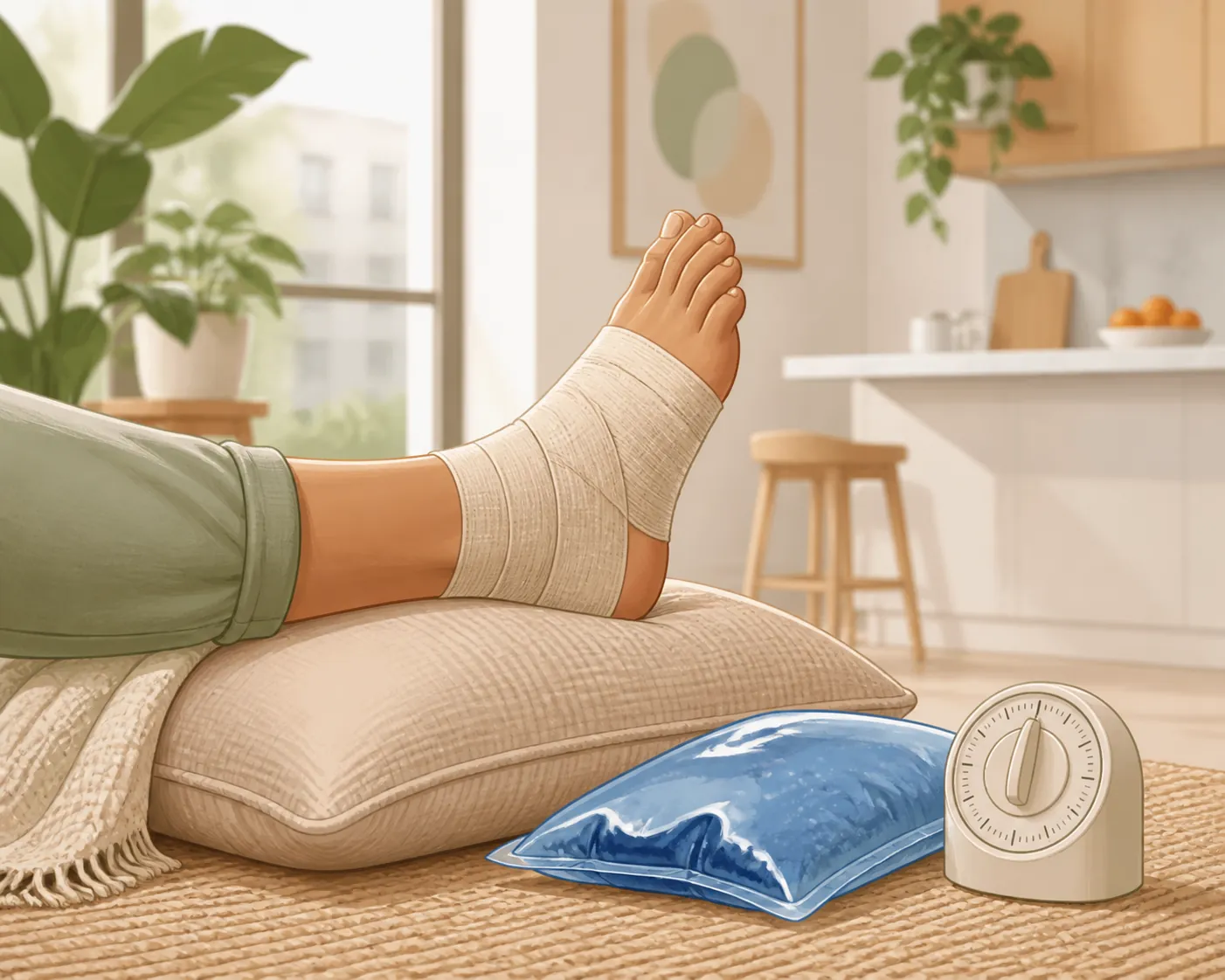
A reasonable home use is narrow: use cold briefly if pain is the main thing stopping you from settling down, sleeping, or tolerating very gentle movement. Do not use numbness as permission to load the tissue harder. Do not make repeated icing the main treatment while movement, loading, sleep, and red flags go unexamined.
This is also where recovery gadgets should stay in their lane. If you want a broader evidence hierarchy for tools, cold, foam rolling, and passive recovery, the companion home fitness recovery pyramid is a better place for that sorting. For a fresh sprain or strain, the decision in front of you is simpler: pain relief is not the same thing as tissue repair.
Why inflammation is not the enemy you were told to crush
The old RICE habit made swelling and inflammation sound like mistakes. They are messier than that. After soft-tissue injury, the early bleeding and inflammatory response is part of cleanup and repair signaling. Physiopedia’s soft-tissue healing summary describes bleeding as lasting about 6–8 hours, with crush-type injuries potentially bleeding up to 24 hours; it places the inflammatory peak around 1–3 days, proliferation beginning from about 24–48 hours onward, the bulk of scar tissue forming by about 2–3 weeks, and remodeling continuing over months [7].
Those ranges are not a personal recovery calendar. They explain why the advice changed. Early protection makes sense because the area can be irritable and vulnerable. Later loading makes sense because repair tissue needs an appropriate mechanical signal. A week of unnecessary unloading may feel safe, but it does not teach the tissue how to tolerate your stairs, squats, hinges, calf raises, or runs again.
Compression, elevation, and anti-inflammatories without the ritual
Compression and elevation survived the acronym shift because they can still be useful. PEACE includes elevation and compression, with the practical aim of controlling excessive swelling and helping comfort, not magically rebuilding tissue [1]. If a wrap makes walking easier without numbness, tingling, color change, or increased pain, it may be a sensible short-term support. If it makes the area throb or your toes feel odd, loosen it or stop.
Anti-inflammatory medication needs more caution than internet recovery advice usually gives it. PEACE advises avoiding anti-inflammatory modalities early because inflammation contributes to tissue repair [1]. NHS inform also cautions about early NSAID use in soft-tissue injury advice [4]. That is general guidance, not an instruction to ignore a clinician, pharmacist, prescription, medical condition, or personal risk factor. If you already have medical instructions, they outrank an article.
What “load” means when you are training at home
Loading is not a single exercise. It is the gradual return of demand. Range of motion is load. Standing is load. Walking is load. A slow calf raise is load. A split squat is more load. A jump, sprint, or heavy deadlift is much more load. The LOVE phase asks you to rebuild that ladder, not leap to the top because the swelling looks better.
Dubois and Esculier include vascularization in the LOVE phase: pain-free aerobic activity can begin a few days after injury to improve motivation and blood flow to the injured structures [1]. In a small apartment, that might mean an easy stationary bike if you have one, a short flat walk if gait is normal, or a non-irritating upper-body circuit if the injury is lower-body. “Pain-free” matters here. Conditioning is not supposed to be a loophole for aggravating the tissue.
For lower-body injuries, gait is a useful honesty check. If you cannot walk normally, you probably have not earned loaded lower-body training yet. If you can walk normally but a bodyweight squat changes your mechanics or raises pain beyond the 0–5/10 range, regress the movement. Use a shallower range, support yourself on a counter, or choose an isometric position that stays tolerable.
- Progress range before resistance: restore comfortable motion before adding meaningful load.
- Progress resistance before speed: slow, controlled work comes before bouncing, hopping, or sprinting.
- Progress volume carefully: more sets and more daily steps can be just as provocative as heavier weight.
- Let the next morning judge the session: if symptoms are worse, the dose was too high.
Ankle-injury research in athletes gives one useful endpoint, though it should not be copied blindly to every injury. Chinn and Hertel describe return-to-activity criteria including full range of motion, about 80–90% of preinjury strength, normal gait, and completing a full practice or work session without pain or swelling; they also note that up to about 30% of people with acute ankle sprains may develop chronic ankle instability [8]. The lesson for home training is plain enough: “I can tolerate daily life” is not always the same as “I am ready for full-speed training.”
When home care stops being the right setting
There is no prize for managing the wrong injury alone. Stop the PEACE & LOVE experiment and get assessed if pain is increasing, swelling is severe, you cannot bear weight, or you have numbness or tingling [3]. Do the same if the injury is not improving, if normal walking or daily function keeps getting worse, or if the next-morning response repeatedly tells you the load is too much despite backing off [4].
For manageable strains, sprains, and contusions, the home plan is now more active than the old freezer-pack routine: protect briefly, keep movement tolerable, use the 0–5/10 and next-morning checks, add load gradually, and keep ice in the smaller box of optional short-term pain relief. If the red flags show up, the correct recovery move is not a better acronym. It is leaving DIY care.
References
- Soft-tissue injuries simply need PEACE and LOVE, Br J Sports Med, 2020
- Resting After an Injury: A Thing of the Past, ACSM
- Soft Tissue Injury: What It Is, Types, Causes & Treatment, Cleveland Clinic
- Soft tissue injury advice, NHS inform
- Does Cryotherapy Improve Outcomes With Soft Tissue Injury?, J Athl Train, 2004
- Is it time to put traditional cold therapy in rehabilitation of soft-tissue injuries out to pasture?, World J Clin Cases, 2021
- Soft Tissue Healing, Physiopedia
- Rehabilitation of Ankle and Foot Injuries in Athletes, Clin Sports Med, 2010
What a small equipment investment adds
We don't have a build tagged to this exact tier yet. Browse all builds.
How often should you repeat this?
See our recovery and rest reference for citation-anchored rest-interval guidance.
Spot something off?
Tell us if a movement, tier assumption, or duration didn't match your experience.