
Plan Your Home Workout Load and Recovery Without a Coach
A practical, evidence-backed system for deciding how much to train at home and how to schedule recovery — no coach, app, or wearable needed. It combines CDC and ACSM baseline minimums, a two-number weekly load score, the ~10% progression guideline, and rest-day and deload ranges that respect the evidence's limits.
- Equipment tier required
- none
- Duration
- 150 min
- Difficulty
- beginner
- Target area
- full body
- Space footprint needed
- small space
- Noise level
- low
The home-workout question is usually not “What is the perfect program?” It is Tuesday night, your legs are still heavy from Sunday, sleep was bad, and the dumbbells are sitting beside the sofa. Should you train, rest, or do a smaller version of the plan?
A usable answer starts with a floor, not a fantasy week. For general adult health, the CDC recommends 150 minutes of moderate-intensity aerobic activity, or 75 minutes of vigorous activity, plus muscle-strengthening activity on 2 or more days per week that works all major muscle groups.[1] ACSM’s 2026 resistance-training update points in the same practical direction: the biggest gains come from consistent training of all major muscle groups at least twice weekly, and effective routines can be built with bands, bodyweight, and home-based resistance work, not only gym machines or barbell setups.[2]
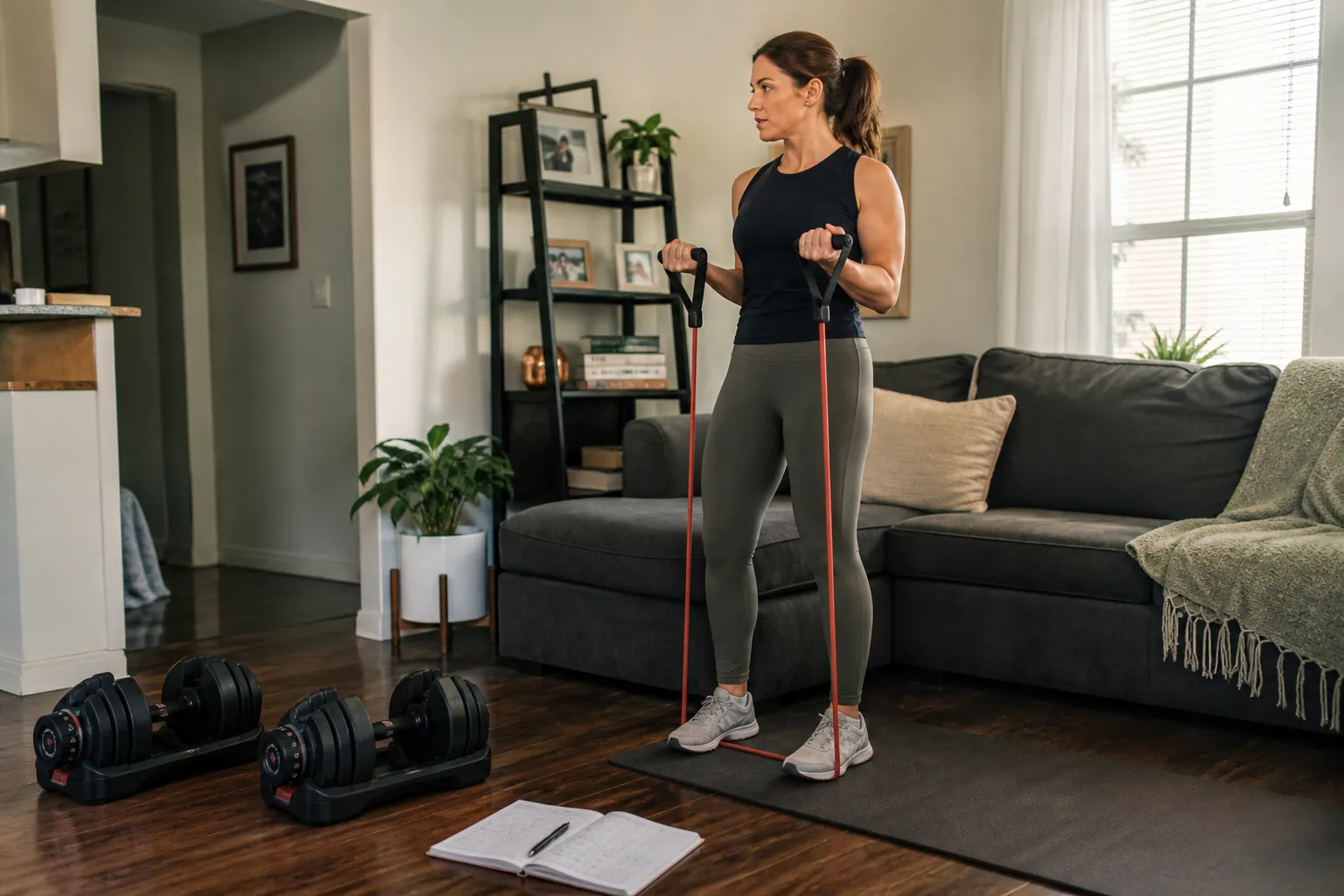
From there, planning workout load and recovery at home can be much simpler than most coaching dashboards make it look. Use this weekly loop:
| Decision | Home version |
|---|---|
| Set the floor | Aim for the CDC aerobic minimum and at least 2 full-body or split strength days across major muscle groups. |
| Score the week | For each session, record how much you did and how hard it felt. |
| Compare to last week | Look at the total load for strength and aerobic work separately. |
| Progress cautiously | If recovery is normal, add a small amount; keep weekly increases around 10% or less. |
| Place recovery first | Keep at least 1 full rest day weekly, and usually give hard-trained muscle groups 48–72 hours before repeating hard work. |
| Adjust when signals stack up | Hold or reduce the plan when soreness, poor sleep, low motivation, or unusual fatigue keeps showing up. |
Start with the weekly floor, then build only what you can repeat
The CDC minimums are not a ceiling. They are the line that keeps a beginner from turning “I should train more” into a six-day plan that collapses by week three. If you are currently doing very little, a good first planning target is not a perfect split. It is some aerobic work most weeks and 2 strength sessions that cover squatting or lunging, hinging, pushing, pulling, bracing, and some loaded carrying or anti-rotation work when space allows.
That can be done with adjustable dumbbells, resistance bands, a backpack, a chair, or bodyweight. ACSM’s 2026 update is useful here because it does not treat home equipment as a consolation prize. The update drew from 137 systematic reviews and more than 30,000 participants, and its public summary emphasizes consistency and coverage of major muscle groups over complicated programming.[2]
If you already have a routine, use the floor as a check rather than a command to add more. A 3-day dumbbell plan, a 2-day full-body plan, or a bodyweight program can all fit. The important question is whether the same muscles are being trained often enough, whether the week includes some aerobic work, and whether the plan leaves room for recovery instead of borrowing energy from next week.
For examples of plans that can be put through this weekly-load system, see Turning 40? Start a Home Workout You Can Actually Keep, Prevent Sarcopenia Over 40 With Strength Training at Home, or A Perimenopause Strength Training Routine You Can Do at Home. The routine can differ; the review process stays the same.
What a small equipment investment adds
We don't have a build tagged to this exact tier yet. Browse all builds.
How often should you repeat this?
See our recovery and rest reference for citation-anchored rest-interval guidance.
Spot something off?
Tell us if a movement, tier assumption, or duration didn't match your experience.