
A Perimenopause Strength Training Routine You Can Do at Home
A practical guide for women in perimenopause who want to start strength training at home with minimal equipment. Learn which exercises to do, how often, and what results to expect based on current science.
- Duration
- 30 min
If you are searching for perimenopause strength training at home, the useful answer is not a lecture about becoming a different person. It is: get a few weights or bands, learn six basic movement patterns, repeat them twice a week, and make the work slightly harder when it becomes repeatable.
| Category | Beginner setup |
|---|---|
| Workout type | Full-body strength routine |
| Level | Beginner |
| Equipment | Dumbbells or resistance bands, mat, sturdy chair |
| Session length | 25–35 minutes |
| Starting frequency | 2 days per week |
| Next step | 3 days per week when recovery feels steady |
| Main movements | Squat, hinge, push, pull, single-leg, carry or carry substitute |
Perimenopause is a good time to stop treating strength work as an optional add-on to walking, yoga, or cardio. Declining estrogen during this transition is linked with changes in muscle function and faster age-related muscle loss, and one practical review cited two weekly progressive resistance-training sessions as enough to halt or reverse muscle atrophy in this context.[1] That does not mean every woman needs an aggressive lifting program this month. It means the minimum effective routine deserves a real place on the calendar.
What you need before the first workout
A home strength routine does not require a rack, bench, mirror wall, or gym vocabulary. A full-body home circuit can be built with dumbbells, a mat, and a chair, and one physical therapy guide describes a 25–30 minute full-body circuit using those basic items to train major muscle groups.[2]
- Dumbbells: start with a few pairs around 5–15 lb if you are new. Over time, many beginners will want at least one pair in the 20–25 lb range for lower-body moves.
- Resistance bands: a reasonable budget substitute if dumbbells are not available yet, especially for rows, presses, and glute work.
- Mat: useful for glute bridges, warm-ups, and floor-based modifications.
- Sturdy chair: helpful for sit-to-stand squats, incline push-ups, balance support, and step-back lunge practice.
- Notebook or notes app: not glamorous, but essential. Write down the weight, reps, and how hard the final reps felt.
If you are embarrassed about not knowing which weight to pick, use this rule: the first few reps should feel controlled, the last two should require attention, and your form should not change to finish the set. For many upper-body moves, 5–10 lb is plenty at first. For squats, deadlift-style hinges, and glute bridges, you may outgrow that quickly.
The six movements that make the routine work
The routine is built around six movement patterns: squat, hinge, push, pull, single-leg, and carry. Nuffield Health and Core Total Wellness both use these kinds of full-body patterns in beginner perimenopause or menopause home workouts because they cover more muscle with fewer exercises than isolated “toning” moves.[2][3]
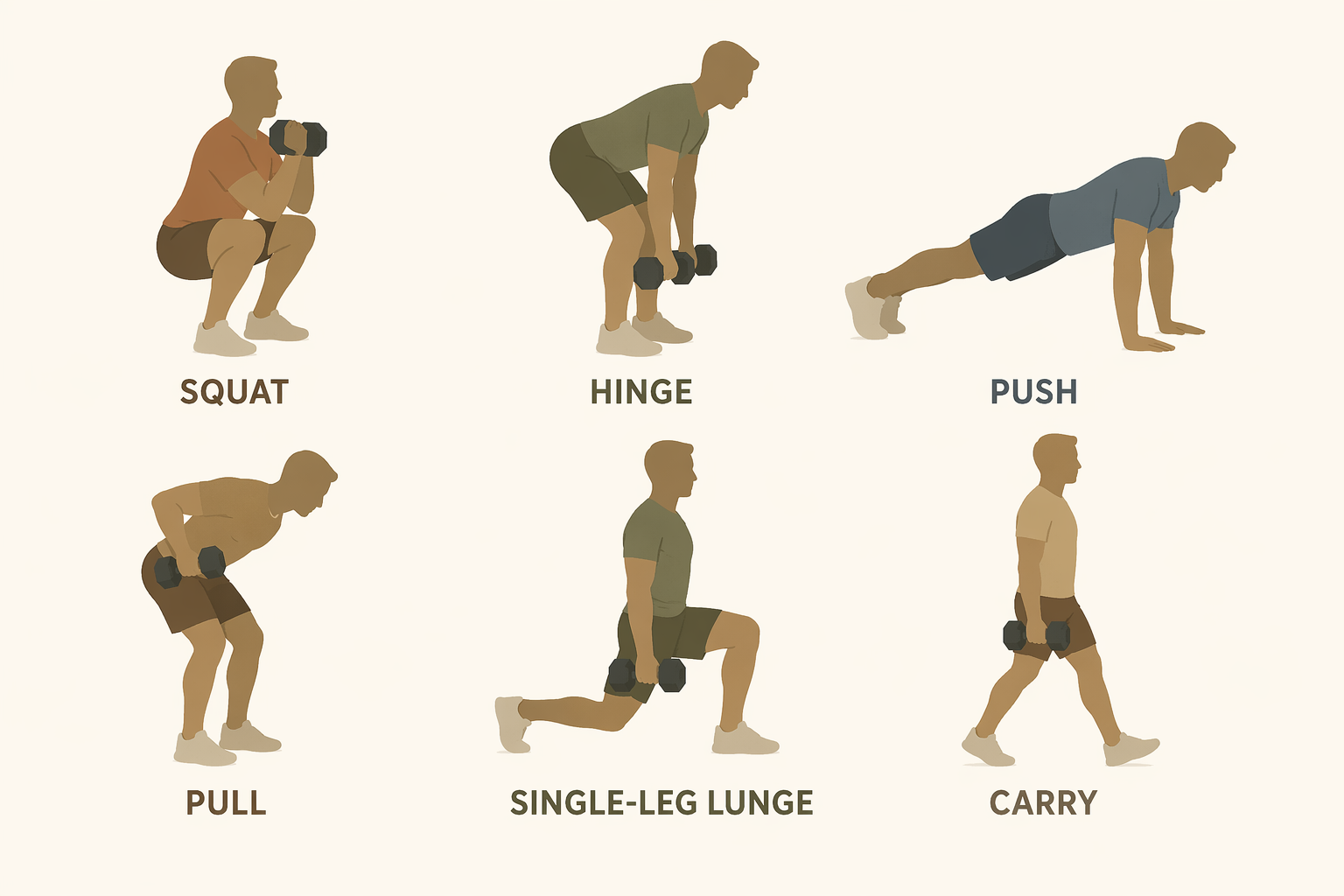
For a complete beginner, the goal is not to perform the hardest version of each pattern. The goal is to practice the pattern often enough that it stops feeling mysterious, while still asking the muscles to do real work.
| Pattern | Beginner exercise | If it feels too hard |
|---|---|---|
| Squat | Goblet squat | Sit-to-stand from a chair |
| Hinge | Glute bridge | Bodyweight glute bridge |
| Push | Push-up or dumbbell overhead press | Incline push-up with hands on a chair or wall |
| Pull | Bent-over dumbbell row | Band row |
| Single-leg | Forward lunge | Supported split squat or reverse step-back |
| Carry | Farmer carry | March in place holding one or two weights |
The 25–35 minute beginner routine
Do this routine two nonconsecutive days per week to start, such as Monday and Thursday or Tuesday and Friday. Leave at least one day between sessions so soreness does not become the reason you quit in week two.
Warm-up: 4–6 minutes
- March in place or walk around the room for 60 seconds.
- Do 8 slow bodyweight squats to a chair.
- Do 8 hip hinges with hands on hips, pushing your hips back as if closing a car door.
- Do 8 wall or counter push-ups.
- Do 10 glute bridges on the mat.
The warm-up should make the first working set feel less abrupt. It does not need to become a second workout.
Main circuit: 2–3 rounds
Do 10–12 reps of each exercise. Rest as needed between exercises, then rest 60–90 seconds after each full round. Start with 2 rounds for the first two weeks. Move to 3 rounds when you can finish 2 rounds without rushing, losing form, or needing several days to recover.
| Order | Exercise | Reps | What to watch |
|---|---|---|---|
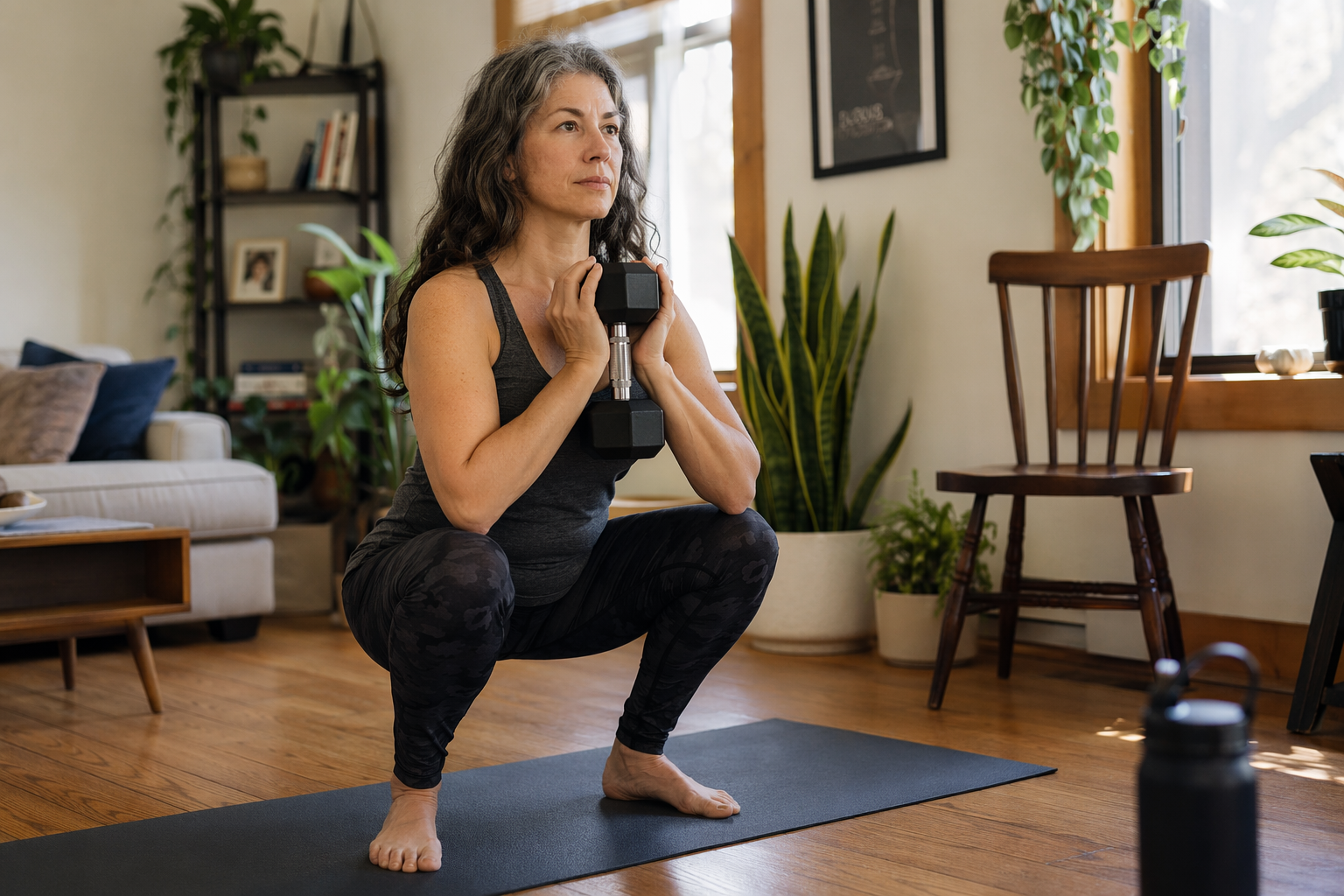
| 1 | Goblet squat | 10–12 | Hold one dumbbell at chest height; keep heels down and ribs stacked over hips. |
| 2 | Push-up or knee push-up | 10–12 | Use a wall, counter, or chair if the floor version makes your shoulders shrug or your lower back sag. |
| 3 | Bent-over row | 10–12 each side or both arms | Hinge at the hips; pull elbows toward ribs instead of yanking with the neck. |
| 4 | Forward lunge | 10–12 each side | Take a shorter range of motion or hold a chair if balance is the limiting factor. |
| 5 | Overhead press | 10–12 | Press without leaning back; use lighter weights than you use for rows. |
| 6 | Glute bridge | 10–12 | Pause briefly at the top; stop if you feel it mostly in the lower back. |
If six exercises feel like too much on day one, do the first four and add overhead press and glute bridges the next time. That is still strength training. The important part is that the session gets repeated.
Optional carry finisher: 2–4 minutes
If you have space, walk for 20–30 seconds holding a dumbbell in each hand, rest, and repeat 3–4 times. In a small room, march in place while holding one or two weights. Carries train grip, posture, trunk control, and the very practical skill of moving while loaded.
Keep the weights light enough that you can stand tall. If the carry turns into a hunched shuffle, the load is too heavy for today.
How often to train during perimenopause
Two sessions per week is the right starting point for most beginners because it is enough to build the habit and give the body repeated stimulus. Some sources push three weekly sessions as the stronger target, and that is reasonable once the routine no longer feels like an event. The useful progression is simple: two days per week first, then three when recovery, sleep, and schedule can support it.
A three-day week does not need a new routine. Repeat the same workout on Monday, Wednesday, and Friday, or keep two full sessions and add a shorter third day with squats, rows, presses, and carries. Beginners usually improve because they repeat the basics, not because they rotate through endless exercise variations.
Bone density is one reason to take the loading seriously over time. A review cited by Samson Physical Therapy reports that strength training twice per week at about 80% of one-repetition maximum can provide sufficient stimulus for maintaining bone mineral density in menopausal women.[4] That evidence is not a reason for a beginner to test a max lift in the living room. It is a reminder that, eventually, the weights need to become meaningfully challenging rather than permanently comfortable.
Progression: the part most beginner routines skip
The routine only works if it has a way to grow. Doing the same 8 lb goblet squat for the same 10 reps forever is movement, but it is not much of a strength plan after your body has adapted.
Use double progression:
- Choose a weight you can lift for 10 good reps.
- Keep that weight until you can do 12 good reps for all planned sets.
- Increase the weight next time and return to 10 reps.
- Repeat the process.
A simple example: if you goblet squat 10 lb for 10 reps in week one, work toward 10 lb for 12 reps. Once 12 reps are controlled for each round, try 12 or 15 lb and go back to 10 reps. The increase should feel noticeable, not chaotic.
If you do not have heavier dumbbells yet, progress in other ways. Slow the lowering phase to about three seconds on squats, lunges, presses, and rows. Add a brief pause at the bottom of a squat or the top of a glute bridge. With bands, use a band that gives more resistance while keeping the same rep range, or step farther from the anchor point if the setup is safe.
There are heavier low-rep protocols discussed in menopause fitness circles, including work around 3–4 reps at high intensity. Those belong later, after a woman has several months of lifting experience, reliable technique, and a clear sense of what hard but safe effort feels like. A first home routine should teach the body and the brain how to repeat the work.
What results are realistic
Strength progress often shows up before visible body changes. That can be frustrating if you were trained to judge workouts by the mirror, but it is useful because strength is easier to measure honestly.
| Time frame | What you may notice | What to track |
|---|---|---|
| 2–4 weeks | Better familiarity with the movements; some people also report improvements in energy or sleep | Whether you completed the sessions and how sore you felt afterward |
| 8–12 weeks | More visible changes in muscle tone or body composition may become easier to notice | Reps completed, weight used, and whether daily tasks feel easier |
| Longer term | The clearest progress is often load: heavier squats, rows, bridges, carries, and presses | Your written log, not memory |
Samson Physical Therapy describes a beginner who progressed from a 13 lb deadlift to a 90 lb deadlift over 10 months, even with once-weekly high-effort training.[4] That is a useful example because it shows the distance between “I barely know what I’m doing” and measurable strength. It is not a promise that every person will progress at that pace, and it does not make once weekly the ideal plan for everyone.
Expect some normal muscle soreness in the first couple of weeks, especially in the thighs, glutes, chest, and upper back. Sharp pain, joint pain that changes your movement, dizziness, or symptoms that feel unusual for you are not training badges. Stop and get appropriate medical guidance if something feels wrong.
Small adjustments that keep the routine beginner-friendly
- If knees complain during forward lunges, switch to supported reverse lunges or split squats with a smaller range of motion.
- If wrists dislike floor push-ups, use a wall, countertop, or sturdy chair so the angle is higher.
- If overhead pressing bothers your shoulders, use a lighter weight, reduce range slightly, or replace it with an incline push-up for now.
- If balance is the problem, hold the chair. Balance should not be the reason your legs never get stronger.
- If fatigue is high, keep two rounds and reduce the weight before cutting the session entirely.
Protein helps the work pay off, but it does not need to hijack the whole plan. One perimenopause home-workout guide cites 1.6 g of protein per kilogram of bodyweight as support for muscle synthesis during this stage.[5] If tracking grams feels like too much, start by making sure each meal contains a clear protein source, then refine later if needed.
Where to go after this routine starts feeling normal
If buying weights is the barrier, begin with an 8-week no-equipment strength plan for beginners and build the habit first. Bodyweight training is not a failure; it is a starting line.
If you already have dumbbells and want more structure, move into a 3-day dumbbell full-body plan. If lower-body moves are the confusing part, use a home leg workout progression guide to understand when to move from chair squats to goblet squats, split squats, and heavier hinge patterns.
For equipment, do not buy everything at once. A small-apartment home gym setup guide can help you decide which weights, bands, or storage pieces are worth buying first.
Two consistent weekly sessions are a legitimate start. Three is a strong next step. The better question is not whether the routine looks impressive, but whether the reps, load, and repeatability are moving in the right direction.
References
- Perimenopause & Strength Training: The Duo Your Mind & Body Need — Sweat
- Menopause Weight Training at Home: It Can Be Done! — Core Total Wellness
- Beginners' Perimenopause Workout — Nuffield Health
- Strength Training for Menopause: The Ultimate Guide on How to Get Started — Samson Physical Therapy
- Best Home Workouts for Perimenopause (2026) — Her Daily Fit
What a small equipment investment adds
We don't have a build tagged to this exact tier yet. Browse all builds.
How often should you repeat this?
How Whoop and Oura Ring track recovery for home workouts
For home exercisers deciding between WHOOP and Oura Ring, the better sleep and recovery tracker depends on training style: WHOOP's strength-aware tracking fits dumbbell and grip-heavy sessions, while Oura's sleep-first scoring suits yoga and indoor cycling. The verdict hinges on how each builds its daily recovery score, their home-workout tracking gaps, and who pays for hardware versus subscription.
Spot something off?
Tell us if a movement, tier assumption, or duration didn't match your experience.