
Build Muscle with This 3-Day Dumbbell-Only Full-Body Plan
A complete 3-day full-body dumbbell workout plan with exercise selection, weight guidance, and a double-progression system that helps home gym beginners and intermediates build muscle without needing heavier dumbbells every week.
- Duration
- 45 min
If you want a 3-day dumbbell-only workout plan, use a full-body schedule: train Monday, Wednesday, and Friday, or any three nonconsecutive days. Each workout hits legs, push, pull, shoulders or arms, and trunk work. That matters more than exercise variety, because a three-day push/pull/legs split would train most muscles only once per week, while this setup repeats the main patterns two to three times weekly.
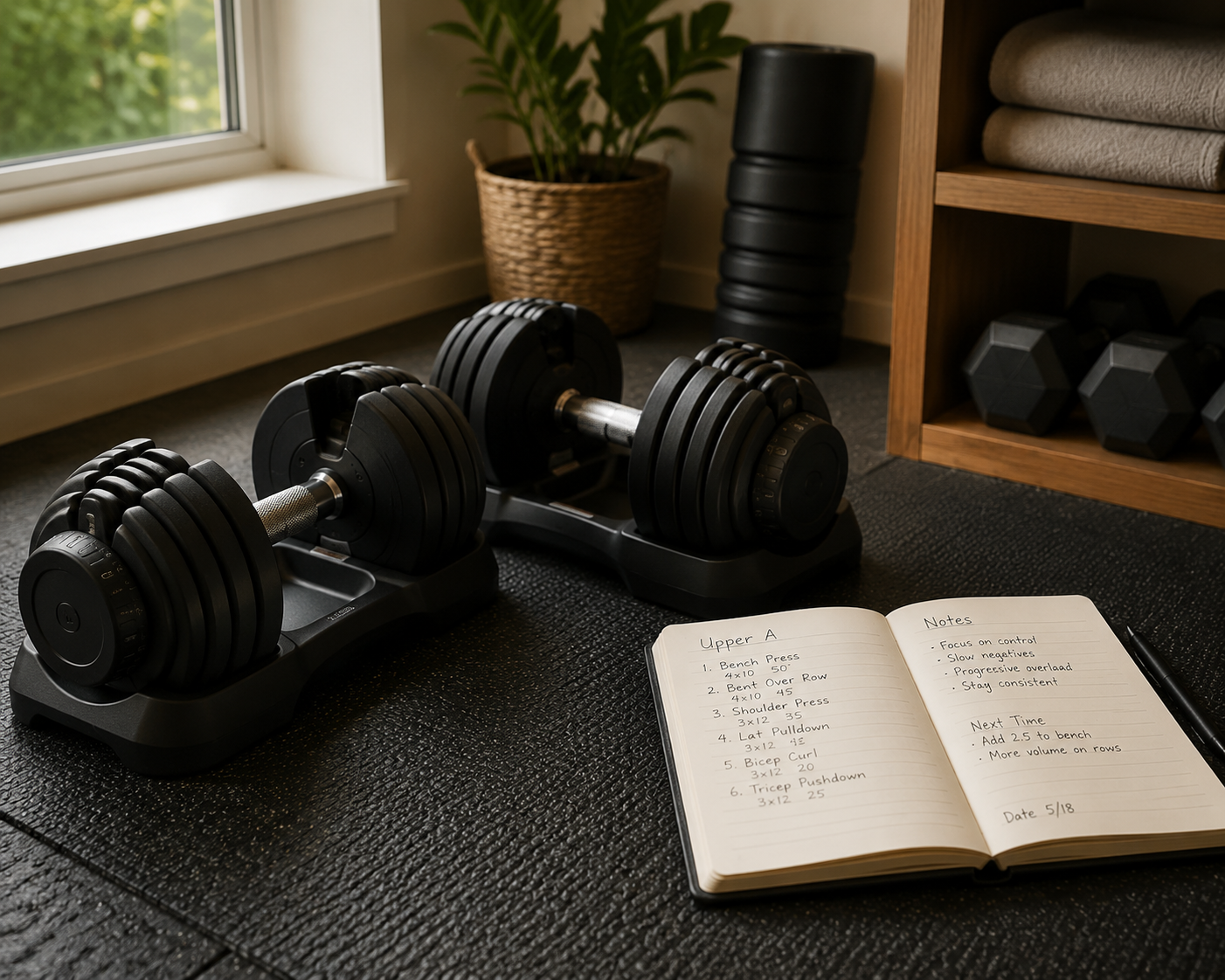
Equipment assumption: one pair of adjustable dumbbells, enough floor space to lie down, and preferably a bench. If you do not have a bench, use the substitutions listed in the plan. If your space is tight, the no-bench small-space dumbbell routine is the cleaner version to follow.
| Day | Focus | Workout |
|---|---|---|
| Day 1 | Squat, horizontal push, horizontal pull | Goblet squat, dumbbell bench press or floor press, one-arm row, Romanian deadlift, lateral raise, plank |
| Day 2 | Hinge, vertical push, single-leg work | Dumbbell Romanian deadlift, standing overhead press, Bulgarian split squat, chest-supported row or bent-over row, curl, dead bug |
| Day 3 | Squat/lunge, press, pull, arms | Front-foot elevated split squat or reverse lunge, incline dumbbell press or floor press, two-dumbbell row, hip thrust or glute bridge, overhead triceps extension, loaded carry |
The Complete 3-Day Dumbbell Plan
The plan uses the same basic logic found in current dumbbell-only programming guidance: compound lifts first, smaller isolation work later, and substitutions that do not quietly require a commercial gym setup.[1][2] Most main lifts sit in the 8–12 or 10–15 rep range, which is heavy enough to create mechanical tension and flexible enough for home dumbbells that may not jump in perfect increments.[2]
| Day 1 | Sets | Reps | Rest | No-bench option |
|---|---|---|---|---|
| Goblet squat | 3 | 10–15 | 90–150 sec | Same |
| Dumbbell bench press | 3 | 8–12 | 90–150 sec | Dumbbell floor press |
| One-arm dumbbell row | 3 each side | 8–12 | 75–120 sec | Hand supported on thigh, chair, or wall |
| Dumbbell Romanian deadlift | 2–3 | 10–15 | 90–150 sec | Same |
| Dumbbell lateral raise | 2 | 12–20 | 45–75 sec | Same |
| Plank | 2 | 30–60 sec | 45–75 sec | Same |
Start Day 1 with goblet squats because the exercise punishes sloppy bracing quickly and does not need much setup. Hold the dumbbell close to your chest, keep your ribs stacked over your pelvis, and stop the set when your squat depth or back position changes. If the dumbbell becomes too light, slow the lowering phase or use a brief pause at the bottom before you rush to add more reps.
For pressing, a bench press gives you a longer range of motion, but the floor press is not a second-rate exercise. It shortens the bottom position and can be friendlier on the shoulders. Do not bounce your upper arms off the floor; touch down under control, press, and keep the elbows roughly 30–60 degrees from your torso.
| Day 2 | Sets | Reps | Rest | Substitution |
|---|---|---|---|---|
| Dumbbell Romanian deadlift | 3 | 8–12 | 90–150 sec | Single-leg RDL if dumbbells are capped |
| Standing dumbbell overhead press | 3 | 8–12 | 90–150 sec | Seated press if you have a bench |
| Bulgarian split squat | 3 each side | 8–12 | 90–150 sec | Reverse lunge |
| Chest-supported dumbbell row | 3 | 8–12 | 75–120 sec | Bent-over two-dumbbell row |
| Alternating dumbbell curl | 2 | 10–15 | 45–75 sec | Hammer curl |
| Dead bug | 2 each side | 8–12 | 45–75 sec | Slow bodyweight only |
Day 2 is where many home trainees discover whether they are lifting or just moving weights around. On Romanian deadlifts, the dumbbells travel close to the legs, the hips move back, and the knees stay softly bent. You should feel hamstrings and glutes loading before the dumbbells reach the floor. If your lower back is the only place working, shorten the range and rebuild the hinge.
Bulgarian split squats are included because dumbbells often become too light for two-leg squatting before they become too light for single-leg work. Use a shorter stride if you want more quad emphasis and a slightly longer stride if your hips tolerate it better. The working leg should do the work; the back foot is a kickstand, not a launch pad.
| Day 3 | Sets | Reps | Rest | Substitution |
|---|---|---|---|---|
| Front-foot elevated split squat or reverse lunge | 3 each side | 10–15 | 90–150 sec | Goblet squat if balance is limiting |
| Incline dumbbell press | 3 | 8–12 | 90–150 sec | Dumbbell floor press |
| Two-dumbbell bent-over row | 3 | 8–12 | 75–120 sec | One-arm row |
| Dumbbell hip thrust or glute bridge | 3 | 10–15 | 75–120 sec | Floor glute bridge |
| Overhead dumbbell triceps extension | 2 | 10–15 | 45–75 sec | Close-grip floor press |
| Farmer carry | 2–3 | 30–60 sec | 60–90 sec | Suitcase carry, one side at a time |
The third day repeats the big patterns without copying Day 1. That is deliberate. You get another leg stimulus, another press, another row, and another trunk demand, but the angles change enough to reduce joint irritation and keep practice useful. Higher-rep carries and raises are fine here, but they are not the center of the hypertrophy plan. The center is still hard sets on repeatable lifts.
Why This Is Full-Body Instead of Push/Pull/Legs
A three-day PPL split looks organized on paper: push Monday, pull Wednesday, legs Friday. The problem is the calendar. Chest, back, and legs each get one main weekly exposure. Full-body training fixes that by spreading the work across all three sessions.
HevyApp’s guide to 3-day splits points readers toward full-body training when frequency is limited, and MuscleEvo’s comparison of push/pull/legs and full-body routines makes the same practical distinction: when you only train three times per week, full-body lets each muscle group be trained more often than a once-weekly split.[3][4] BonyToBeastly’s 3-day dumbbell structure also uses this frequency logic, pairing repeated weekly exposure with progression rules rather than a rotating list of novelty exercises.[2]
That does not mean PPL is bad. It means PPL is usually a poor fit for a three-day dumbbell-only muscle-building plan. If you train six days per week, the math changes. At three days, full-body is the cleaner choice. For a deeper breakdown of the split decision, see why full-body dumbbell workouts beat split routines.
Warm Up Without Turning It Into a Second Workout
Use five to eight minutes before each session. HyGYM’s 3-day dumbbell plan includes general warm-up and cool-down guidance, and BonyToBeastly’s approach keeps the warm-up tied to the first big lift rather than making it complicated.[2][5] The point is to arrive at the first work set ready, not tired.
- Do 2–3 minutes of easy movement: brisk walking, marching in place, light cycling, or step-ups.
- Do 5–8 controlled reps each of bodyweight squats, hip hinges, arm circles, and scapular push-ups.
- For the first main lift, do one lighter set before your work sets.
- If the first work set feels stiff or uncoordinated, repeat the lighter set instead of forcing the planned load.
After training, use two or three minutes of easy walking and relaxed breathing. Stretch if it helps you feel better, but do not pretend a cool-down fixes a workout that was too heavy, too rushed, or too close to failure on every set.
How to Choose Your Starting Dumbbell Weight
Pick a weight that lets you finish the low end of the rep range with about two reps in reserve. Reps in reserve, or RIR, means how many good reps you think you could still do when you stop the set. If you finish a set of 10 goblet squats and believe you could have done two more clean reps, that is 2 RIR.
| What the set felt like | Likely RIR | What to do next time |
|---|---|---|
| You stopped far before the set became difficult | 4+ RIR | Use a heavier dumbbell or add reps within the range |
| The final reps slowed, but form stayed clean | 1–3 RIR | Keep the weight and progress reps |
| The last rep barely moved or form changed | 0–1 RIR | Use the same weight or reduce load slightly |
| You missed the target reps | Too heavy | Lower the dumbbell weight next session |
Estimating RIR takes practice. Beginners usually undershoot at first, then overshoot once they learn how hard a set can feel. That is normal. For this plan, most work sets should land around 1–3 RIR. Isolation lifts such as lateral raises, curls, and triceps extensions can occasionally move closer to failure because the cost is lower. Heavy hinges, split squats, and presses do not need weekly heroics.
The Progression System: Add Reps Before You Add Weight
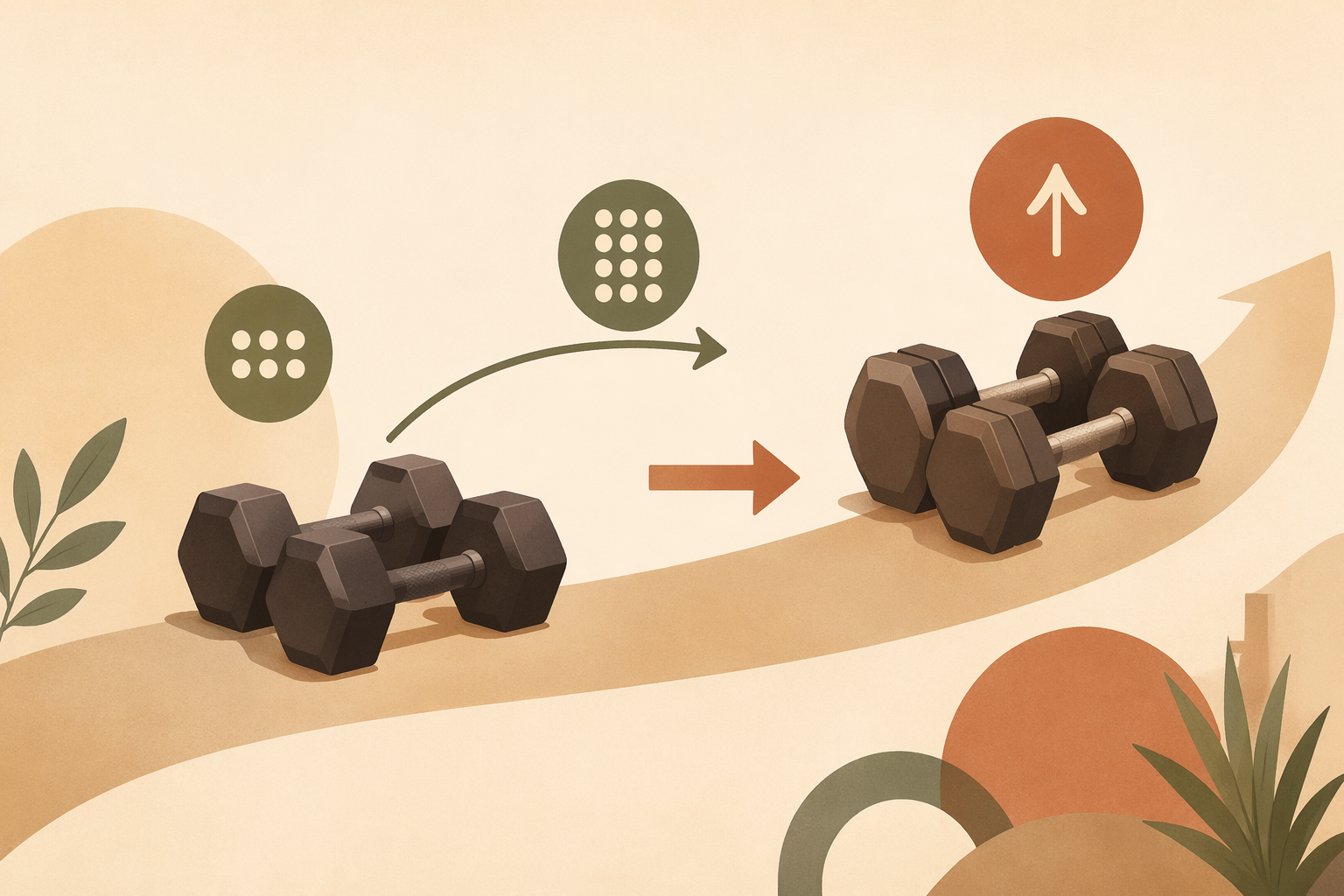
Use double progression. That means every exercise has a rep range. You first add reps inside that range. Only after you can hit the top of the range for all prescribed sets with the target RIR do you increase the dumbbell weight. BonyToBeastly uses this style of progression in its dumbbell plan, and LoadMuscle’s 2026 dumbbell-only guidance emphasizes similar progression logic for home lifters dealing with fixed equipment jumps.[1][2]
| Example: dumbbell bench press | Set 1 | Set 2 | Set 3 | Decision |
|---|---|---|---|---|
| Week 1 | 8 | 8 | 7 | Keep the same weight |
| Week 2 | 9 | 8 | 8 | Keep the same weight |
| Week 3 | 10 | 9 | 8 | Keep the same weight |
| Week 4 | 12 | 12 | 11 | Keep the same weight |
| Week 5 | 12 | 12 | 12 | Increase weight next time |
The first week is not a test of toughness. It is a setup week. Write down the weight, reps, and estimated RIR for every work set. Next week, your job is not to invent a new workout. Your job is to beat one or two numbers without letting form fall apart.
- If all sets are below the top of the range, keep the weight and try to add 1 rep somewhere next time.
- If you hit the top of the range on every set with 1–3 RIR, increase weight at the next session for that exercise.
- If the heavier dumbbells drop you below the bottom of the range, the jump was too large; return to the previous weight and use a harder variation.
- If reps fall for two straight weeks on several exercises, check sleep, food, stress, and whether every set has been pushed too close to failure.
If progression makes you anxious because every dumbbell jump feels too big, use the deeper full-body dumbbell progressive overload system. The important rule here is simple: reps are progress. Cleaner reps are progress. More controlled reps with the same capped dumbbells are progress.
When Your Dumbbells Are Too Light
Most home dumbbell plans eventually run into a ceiling. LoadMuscle specifically addresses capped dumbbell ranges and recommends extending progress with substitutions and harder variations before assuming the plan is finished.[1] That is the right instinct. A dumbbell that is too light for regular goblet squats may still be plenty for Bulgarian split squats, paused split squats, or slow eccentric reps.
| Problem | Use this before buying heavier dumbbells |
|---|---|
| Goblet squats are too easy | Bulgarian split squat, front-foot elevated split squat, slower 3-second lowering |
| Romanian deadlifts are too easy | Single-leg RDL, 2-second pause near the stretched position, higher rep range |
| Floor press is too easy | Slower lowering, paused reps, 1.5 reps, stricter lockout control |
| Rows are too easy | One-arm rows with a pause at the top, chest-supported rows, slower lowering |
| Lateral raises are too easy | Longer pauses, slower tempo, higher reps up to 20 |
Do not apply every difficulty tactic at once. Change one variable, track it, and keep the exercise recognizable. A paused split squat is still easy to compare from week to week. A paused, 1.5-rep, slow-tempo, mechanically altered version is harder to track than it needs to be.
Upgrade your dumbbells when several main lifts are above the rep range, your form is stable, and the harder variations no longer make the sets challenging within 1–3 RIR. Until then, a heavier set is useful, not magical.
Adjust the Plan Without Breaking It
The easiest way to ruin a good three-day plan is to keep adding exercises because one muscle feels neglected after one session. Give the plan at least several weeks of logged training before changing it. If you are an absolute beginner and even this amount of tracking feels like too much, start with the 8-week beginner full-body dumbbell plan instead.
- If workouts take too long, remove one isolation exercise before cutting squats, hinges, presses, or rows.
- If your knees dislike lunges, use goblet squats, box squats, or a shorter-range split squat.
- If your shoulders dislike overhead pressing, use incline pressing, floor pressing, or neutral-grip pressing.
- If recovery is poor, reduce each main lift by one set for two weeks before changing the entire split.
If your goal is more specific than general muscle gain, adjust rep ranges and exercise emphasis rather than abandoning the plan. The strength, hypertrophy, and fat-loss dumbbell guide explains those tradeoffs more directly. If you want a fixed calendar instead of an ongoing routine, use the 6-week full-body dumbbell training plan.
Food and Recovery, Kept in Proportion
Training creates the signal. Food and recovery decide how much of that signal you can use. For muscle gain, the practical baseline is enough protein, enough total calories to at least maintain body weight, and enough sleep that performance is not falling every week. A commonly used protein target for lifters is about 0.7 grams per pound of body weight, or 1.6 grams per kilogram.[2]
You do not need a perfect meal plan to start this workout, but you do need to stop expecting a low-calorie diet, poor sleep, and random training effort to build muscle at the same rate as a tracked program with adequate food. If body weight is dropping and your reps are dropping, the workout is probably not the main problem.
What to Track Each Workout
Write down four things: exercise, dumbbell weight, reps per set, and estimated RIR. That is enough. You do not need a complicated spreadsheet before you have three honest weeks of data.
| Exercise | Weight | Set 1 | Set 2 | Set 3 | RIR note |
|---|---|---|---|---|---|
| Goblet squat | Example: 40 lb | 12 | 11 | 10 | 2 RIR on final set |
| Floor press | Example: 30 lb each | 10 | 9 | 9 | 1–2 RIR |
| One-arm row | Example: 35 lb | 12/12 | 11/11 | 10/10 | Left side harder |
A strong dumbbell-only plan is not the one with the most exercises. It is the one you can repeat, measure, and progress. Run the full-body structure three days per week, keep most work sets close enough to failure, and use double progression before deciding the dumbbells are the limiting factor. The next decision is your first workout weight, then next week’s rep target.
References
- Dumbbell Only Workout, LoadMuscle, January 2026, https://loadmuscle.com/blog/dumbbell-only-workout
- 3-Day Full-Body Dumbbell Workout, BonyToBeastly, https://bonytobeastly.com/3-day-full-body-dumbbell-workout/
- 3 Day Split Workout Complete Guide, HevyApp, https://hevyapp.com/3-day-split-workout-complete-guide/
- Push Pull Legs vs Full Body, MuscleEvo, https://muscleevo.net/push-pull-legs-vs-full-body/
- 3 Day Dumbbell Workout, HyGYM, https://hygym.co.uk/blog/3-day-dumbbell-workout/
What a small equipment investment adds
We don't have a build tagged to this exact tier yet. Browse all builds.
How often should you repeat this?
How Whoop and Oura Ring track recovery for home workouts
For home exercisers deciding between WHOOP and Oura Ring, the better sleep and recovery tracker depends on training style: WHOOP's strength-aware tracking fits dumbbell and grip-heavy sessions, while Oura's sleep-first scoring suits yoga and indoor cycling. The verdict hinges on how each builds its daily recovery score, their home-workout tracking gaps, and who pays for hardware versus subscription.
Spot something off?
Tell us if a movement, tier assumption, or duration didn't match your experience.