
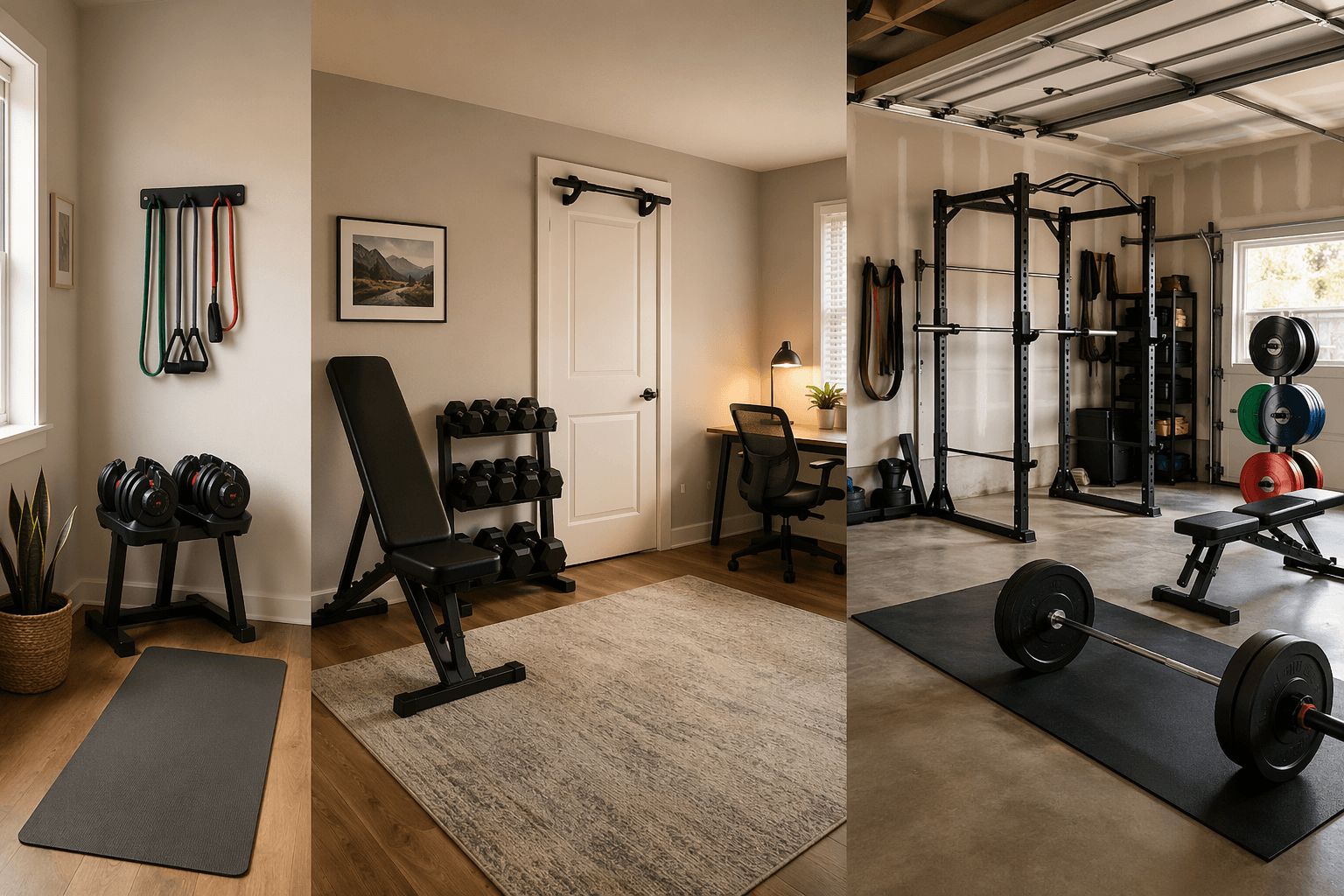
The best budget home gym equipment is not the cheapest equipment you can find. It is the cheapest setup you can leave usable in the space you actually have. That difference matters when the “gym” is also a bedroom corner, an office wall, a laundry route, or one half of a garage that still needs to hold tools and storage bins.
Before choosing a barbell, bench, rack, or adjustable dumbbells, measure the floor area you can dedicate without moving furniture every workout. Not the whole room. The usable rectangle. Then choose from the smallest setup that lets you train consistently.
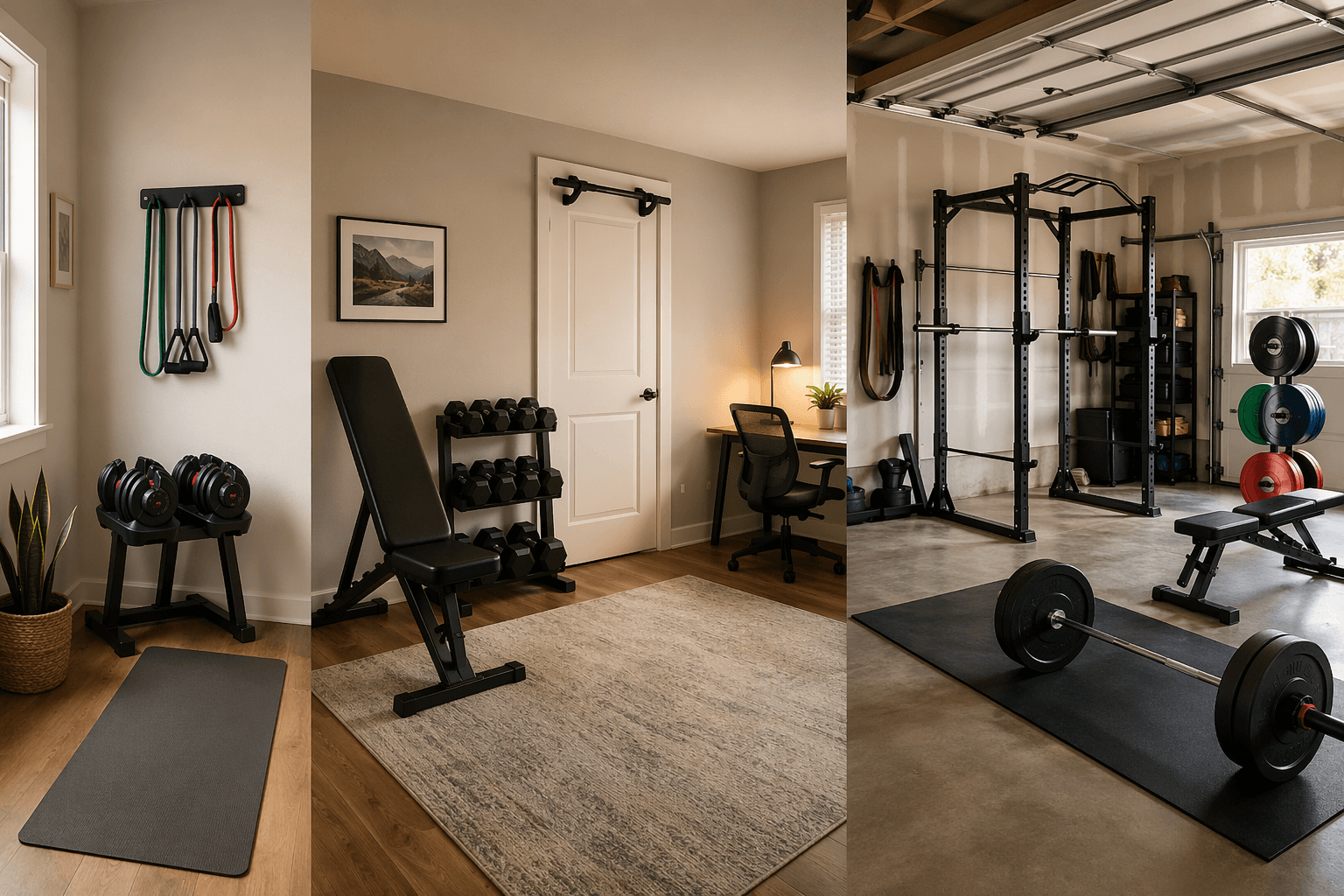
| Space tier | Expected cost | Equipment included | What becomes realistic | What this setup cannot do well |
|---|---|---|---|---|
| Apartment corner, under 30 sq ft | Roughly $400–$600 | Adjustable dumbbells, resistance bands, yoga mat, jump rope | Dumbbell strength training, band work, core work, conditioning that packs away | No barbell work, no deadlifts in the usual sense, limited long-term loading |
| Spare room, 30–80 sq ft | Roughly $600–$900 | Apartment setup plus folding or flat bench and pull-up option | Pressing, rows, split squats, pull-ups or assisted pull-ups, more stable compound patterns | Still awkward for heavy squats and barbell lifts unless the room can give up more permanent space |
| Garage or basement, 80+ sq ft | Roughly $900–$1,400 | Power rack, barbell, bumper plates, bench, matting as needed | Squats, deadlifts, bench press, overhead press, Olympic-lift practice if ceiling and flooring allow | No longer a minimal setup; cost, noise, plate storage, and permanent footprint become real constraints |
That table is the buying decision. Product choice comes after it. A $250 rack is not budget-friendly if the only place it fits blocks a car door. A $100 dumbbell set is not a bargain if it tops out before your lower body gets meaningful work. The point is to buy a complete setup, not a pile of good deals.
If you are still deciding what kind of room you actually have, it is worth stepping sideways into room-type planning for at-home gym equipment before comparing products. A spare bedroom, a rental living room, and a garage corner punish different mistakes.
Under 30 sq ft: the apartment corner setup
An apartment-corner gym has one job: stay easy enough to use that you do not need to “set up the gym” before every workout. This is where beginners get burned by impressive equipment that technically fits in the apartment but does not fit the routine. If a bench has to be dragged from a closet, a coffee table has to move, and plates have to be carried from another room, the friction becomes part of the program.
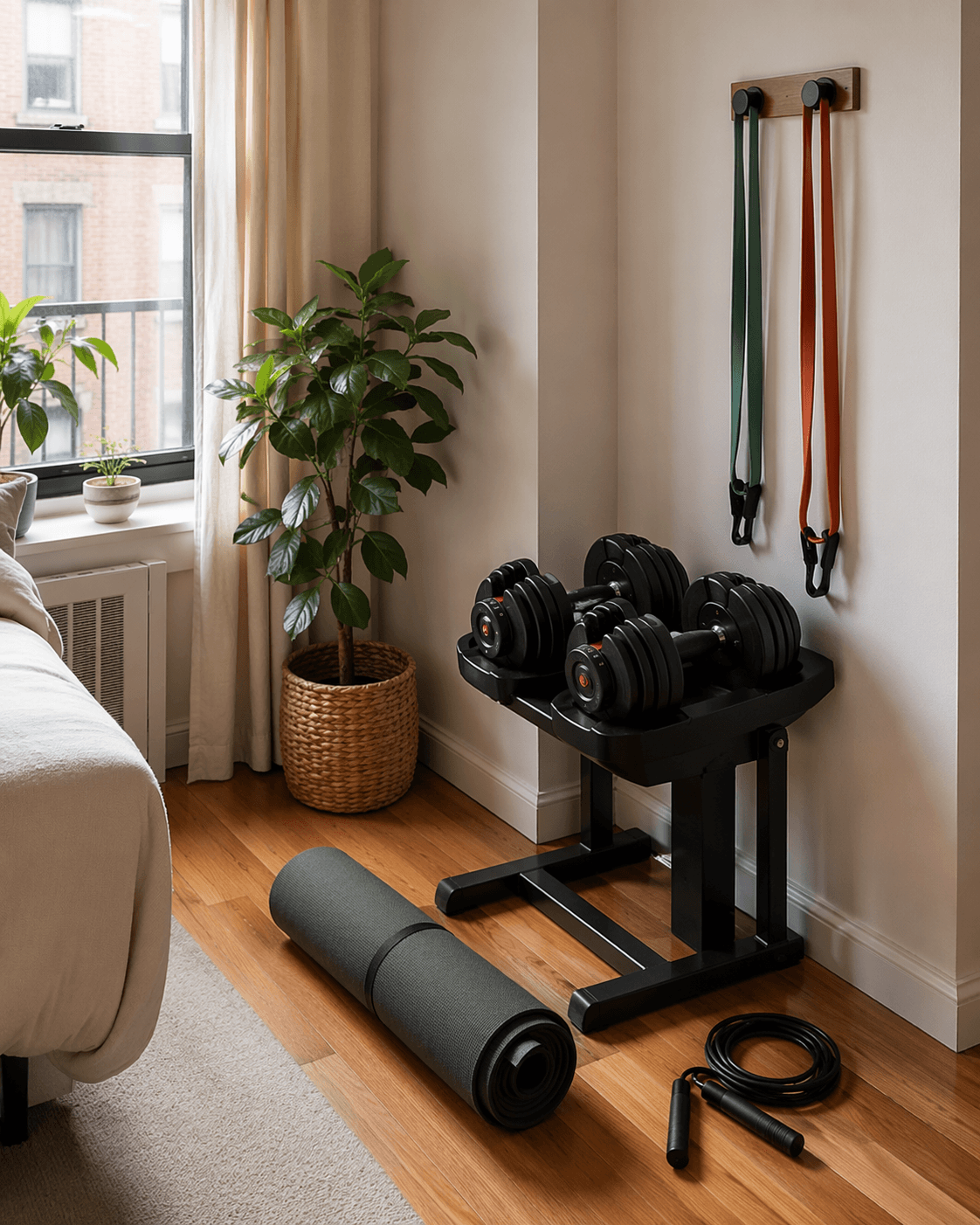
The cleanest version is adjustable dumbbells, bands, a mat, and a jump rope. REP QuickDraw adjustable dumbbells were listed at $335–$576 in the reviewed Garage Gym Reviews pricing, while a lower-cost BCBIG set appeared around $100 in the sourced budget materials; resistance bands ranged from $20–$192, yoga mats from $20–$144, and the WOD Nation Speed Rope was listed at $19.[1][2]
That price spread is why the apartment build lands around $400–$600 instead of one clean number. A beginner who buys the least expensive dumbbell option and a basic mat can come in much lower than someone who chooses a better-adjusting dumbbell system and a thicker mat. The practical question is not whether the premium version is nicer. It is whether the weights will be quick to change, comfortable to store, and heavy enough to keep the next few months of training from stalling.
This setup handles goblet squats, Romanian deadlift patterns with dumbbells, lunges, floor presses, overhead presses, rows, curls, triceps work, band pull-aparts, lateral raises, core work, and short conditioning sessions. The jump rope is optional if your floor, ceiling, or neighbors make impact a bad idea. In many apartments, it is better treated as an outdoor or hallway tool than a living-room promise.
Storage is the main reason this setup beats most “budget gym” bundles for renters. Dumbbells can sit on a small stand or against a wall. Bands can hang from a hook. A mat can roll vertically behind a door or beside a dresser. Nothing needs a permanent footprint except the small area where the weights live.
The ceiling is real, though. You are not buying deadlifts, back squats, bench press, or barbell progression. Dumbbells can train your whole body, but legs often outgrow small loads first. Bands help with volume and joint-friendly accessories; they do not replace heavy loading. If your goal is general fitness, muscle gain as a beginner, or a routine you can do three or four times a week without negotiating with your furniture, this tier makes sense. If your goal is powerlifting-style progress, it is a temporary base layer.
- Buy first: adjustable dumbbells and a mat.
- Add next: resistance bands for pulling volume, warmups, and assisted mobility work.
- Add only if your space allows it: jump rope.
- Skip for now: fixed dumbbell pairs that multiply storage, large benches that cannot fold or tuck away, and bargain racks that have nowhere safe to live.
If you want to compare compact options before committing, use a dedicated compact home gym comparison rather than a general equipment roundup. Small-space gear should be judged by storage and changeover time as much as by exercise variety.
30–80 sq ft: the spare-room setup
A spare room changes the calculation because you can introduce a bench and a vertical pulling option without letting equipment take over the room permanently. This is the bridge tier: more capable than a corner, still disciplined enough for a room that may also serve as an office, guest room, or storage space.
The bench is the upgrade that matters most. Garage Gym Reviews listed the REP FB-5000 Flat Bench at $245, with a 1,000-lb capacity and 11-gauge steel construction, and described it as matching premium benches at roughly half the price in its reviewed data.[1] For a budget setup, those specs are useful because the bench is not just for bench press. It turns dumbbell rows, seated presses, step-ups, split squats, hip thrusts, and chest-supported accessories into more stable movements.
A pull-up bar or power tower adds the missing vertical pull. The sourced range for pull-up options was $50–$260, depending on whether the buyer chooses a simple wall-mounted bar or a freestanding tower.[1][2] The cheaper wall-mounted route is cleaner if the wall and lease allow it. A tower avoids drilling but eats floor space and can look like it is permanently auditioning for a corner it does not quite deserve.
This tier is where compound training becomes more realistic, but not automatically barbell training. Dumbbell bench press, Bulgarian split squats, supported rows, step-ups, loaded carries if the room layout allows, pull-ups, push-ups, band work, and dumbbell hinges can cover a lot. The room still has to function after the workout. Foldable, wall-mounted, or easily parked equipment matters more here than another attachment.
| Choice | Better when | Watch for |
|---|---|---|
| Flat or folding bench | You want better pressing, rowing, split squat, and accessory options | Flat benches may be sturdier, but folding storage can matter more in dual-use rooms |
| Wall-mounted pull-up bar | You own the space or can safely mount into suitable structure | Lease restrictions, wall integrity, doorway clearance |
| Power tower | You cannot drill and have a stable corner to dedicate | Permanent footprint and wobble on cheaper models |
The expected $600–$900 total assumes you are building from the apartment setup upward: dumbbells, bands, mat, then bench and pull-up option. If you already own dumbbells, the room upgrade may be much less painful. If you start buying heavier dumbbells or a premium pull-up station, the tier creeps toward garage-gym money without giving you garage-gym lifts.
For buyers who know they will build slowly, a phased plan is safer than buying the spare-room version in one weekend. Start with the pieces that stay useful if you later move to a rack: dumbbells, bands, mat, and a solid bench. A three-phase compact home gym plan can help keep the order sensible.
80+ sq ft: the garage or basement setup
The garage build is where “budget” needs a stricter explanation. A rack, barbell, plates, and bench can cost roughly $900–$1,400 in the reviewed setup ranges.[1][2] That is not the minimum viable home gym. It is the upper ceiling of sensible beginner budget spending for someone who has the space and wants barbell training at home.
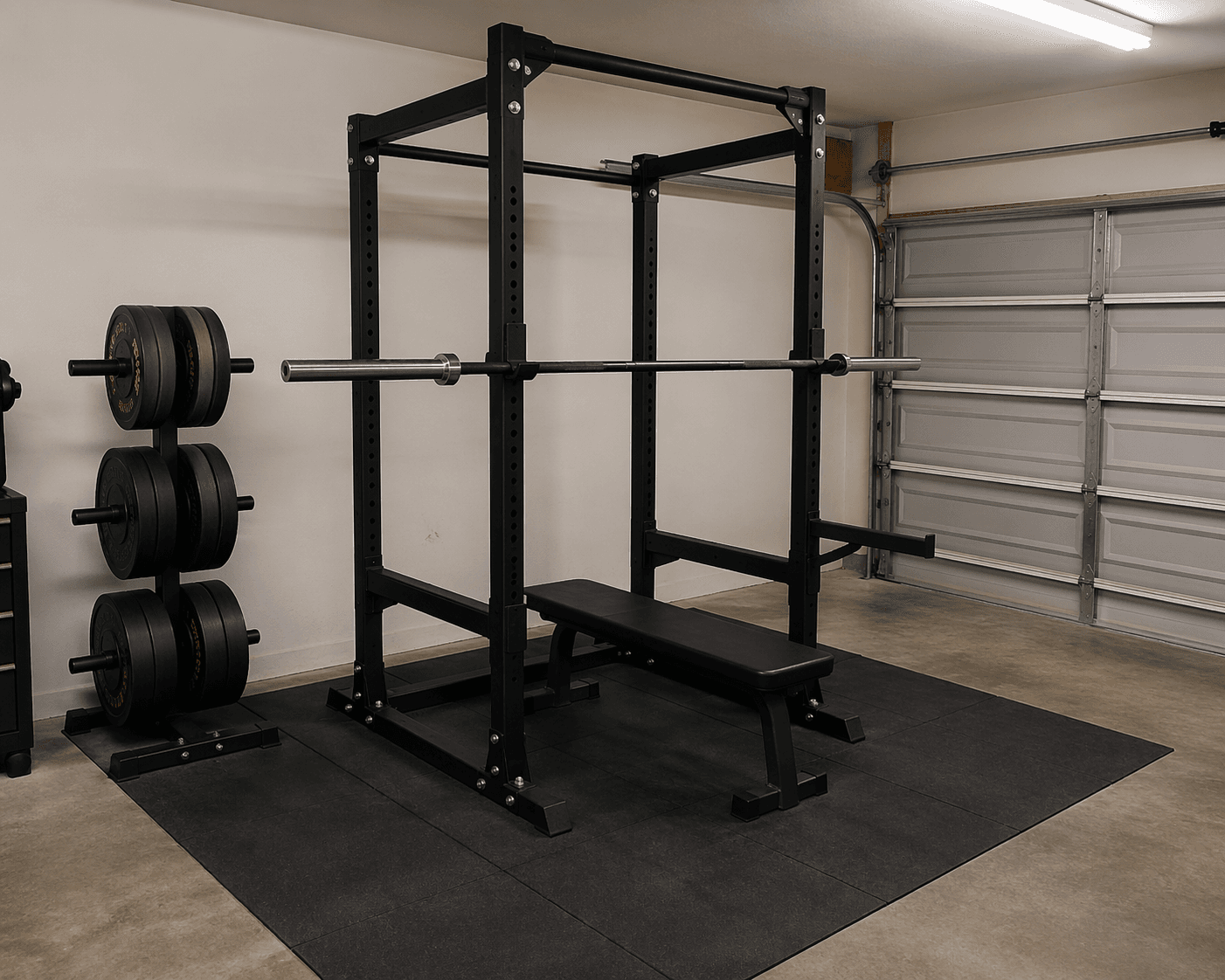
The rack choices in the research are budget-class even though the complete setup is not cheap. Garage Gym Reviews listed the Fitness Reality 810XLT at $250 with an 800-lb capacity, and the REP PR-1100 at $380 with a 700-lb capacity and 14-gauge steel construction.[1] Either one changes the training menu immediately: squats, bench press, rack pulls, overhead press from the rack if ceiling height allows, safer solo lifting with safeties, and a more stable base for progressive strength work.
The barbell is another place where budget does not have to mean flimsy. The Synergee Games Cerakote bar was listed at $180 with 190,000 PSI tensile strength and a lifetime warranty, while the comparison point in the reviewed material placed rival bars around a $375 average.[1] Those are the kinds of specs that make a lower-priced item interesting: not because it is cheap, but because it preserves the function that matters.
Plates are where the total starts drifting. Bumper plates were estimated around $250–$400 in the research brief, depending on chosen weight increments and current pricing.[1][2] A beginner does not need every plate size on day one, but the first purchase should match the lifts they intend to train. A rack without enough weight is an expensive pull-up station. Too many plates without storage becomes a garage obstacle course.
Noise and clearance deserve more respect than most budget lists give them. Deadlifts sound different in a garage attached to a house than they do in a detached basement. Olympic-lift practice needs ceiling clearance, plate durability, and flooring that can tolerate mistakes. Even basic benching needs enough side clearance to load plates without scraping storage shelves or squeezing between a car and the rack.
| Garage item | Role in the setup | Budget note |
|---|---|---|
| Power rack | Turns solo barbell training into a realistic option | Fitness Reality 810XLT and REP PR-1100 are budget-class rack examples in the sourced data |
| Barbell | Supports squats, pulls, presses, rows, and Olympic-lift practice | The Synergee Games Cerakote bar stands out on listed tensile strength, warranty, and price |
| Bumper plates | Provide load for deadlifts, squats, presses, and floor-based work | Total cost depends heavily on weight increments |
| Bench | Adds bench press, dumbbell work, and accessory options | A solid bench remains useful even if the rest of the setup changes |
A garage setup is worth considering if you already know you want barbell lifts, have 80+ sq ft that can stay dedicated, and can tolerate the storage footprint. It is a poor first move if you are still unsure whether you will train consistently at home. In that case, spend less, prove the habit, then let the equipment follow.
What to skip when the budget is tight
The easiest way to waste money is to buy the piece that looks most like a gym instead of the piece that removes the next training bottleneck. Beginners usually do not need specialty machines, multiple fixed-weight dumbbell pairs, large cardio machines, or cable attachments before they have solved space, storage, and repeatable loading.
- In an apartment, skip anything that requires a permanent footprint unless it replaces furniture you are truly willing to lose.
- In a spare room, skip freestanding equipment that prevents the room from working as an office, guest room, or shared space.
- In a garage, skip extra attachments until the rack, bar, plates, bench, flooring, and storage are actually working.
- At every tier, skip bargain items with unclear capacity, awkward adjustment, or dimensions you have not checked against your measured floor space.
If your budget number is still the part you are trying to understand, compare it against what different home fitness budgets actually buy. A $500 budget can be plenty in one room and frustratingly incomplete in another.
How to choose your tier
Choose the smallest setup that lets you train consistently now. That usually means resisting the setup you can technically afford if it makes the room harder to live in. Equipment that stays accessible gets used. Equipment that has to be negotiated with every laundry day, work call, or parking need becomes décor with knurling.
- Measure the usable training rectangle, including clearance for your body and the movement of the equipment.
- Pick the tier that fits that rectangle without requiring a room reset before every workout.
- Buy the pieces that keep working if you later upgrade: mat, bands, dumbbells, and a good bench are rarely wasted.
- Delay racks, towers, and large plate purchases until you know where they will live permanently.
For a broader first purchase sequence, use a first-time home gym buyer’s decision framework. The room-size choice should still come first, but some buyers also need help deciding between strength, conditioning, mobility, and general fitness goals.
Check prices and complaints before buying
The quoted prices and specs above should be treated as a planning snapshot, not a checkout guarantee. Garage Gym Reviews supplied much of the June 2026 equipment pricing and specification data used here, while some budget ranges came from Breaking Muscle materials published in 2025.[1][2] That older date matters. Product availability, package pricing, shipping costs, and model details may have shifted.
There is also a source-quality issue to keep in view: Garage Gym Reviews is a major home fitness publisher and competitor in this content space, so its recommendations should not be the only verification point. Before final purchase, check current retailer listings, recent user reviews, warranty language, return costs, and recurring complaints about wobble, adjustment speed, missing parts, finish wear, and shipping damage.
A budget home gym works when the equipment fits both the room and the routine. Start with the floor space you can truly give up, then buy only as much gym as that space can support.
References
- Garage Gym Reviews equipment pricing and specification data, Garage Gym Reviews, June 2026.
- Breaking Muscle budget home gym equipment pricing data, Breaking Muscle, 2025.
Comments
Join the discussion with an anonymous comment.