
Garmin Cirqa vs Whoop: Your Savings Without a Subscription
Compare the Garmin Cirqa and Whoop across 3 years of ownership: the Cirqa costs $199 one-time vs $597–$1,077 for Whoop. We break down what accuracy differences you get (or don't) for the savings.
| Category | wearable |
|---|---|
| Folded / stored footprint | none (wristband) |
| Price | $199 |
| Option | What you pay | 3-year total | Extra cost vs Cirqa | Ownership moment that matters |
|---|---|---|---|---|
| Garmin Cirqa | $199 one time | $199 | $0 | Paid off on day one; core tracking keeps working without a subscription [1] |
| Garmin Cirqa + optional Connect+ | $199 + about $69.99/year | About $409 | About $210 | Still optional; canceling Connect+ does not shut off core Cirqa data [1][2] |
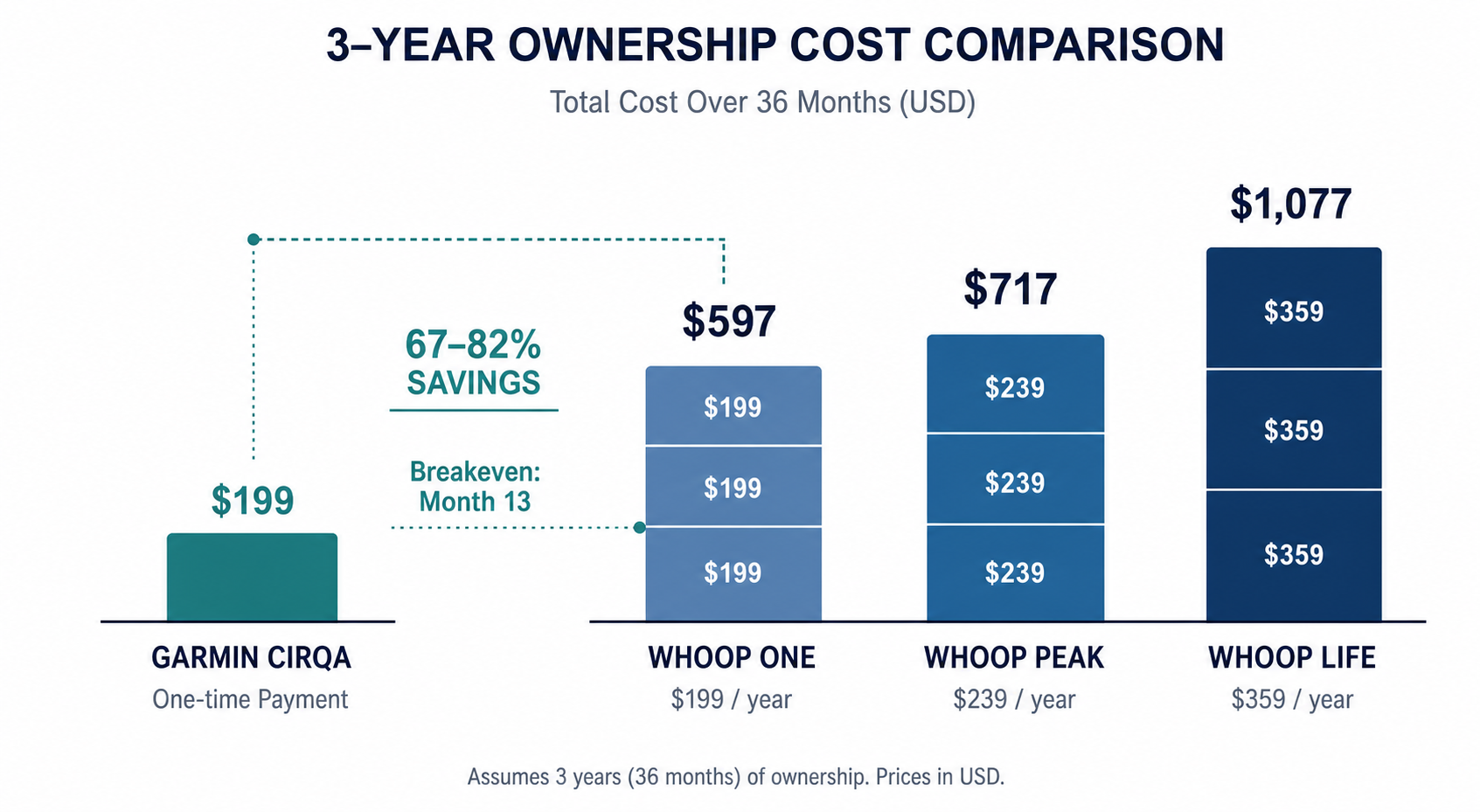
| Whoop One | $199/year | $597 | $398 | At month 13, the second annual payment makes Whoop One cost $199 again while Cirqa remains $199 [3] |
| Whoop Peak | $239/year | $717 | $518 | Costs more than three Cirqa bands over three years [3] |
| Whoop Life | $359/year | $1,077 | $878 | The 3-year bill is more than five times Cirqa’s one-time price [3] |
That is the Garmin Cirqa vs Whoop no-subscription comparison in its least flattering form for recurring fees: $199 once, or $597 to $1,077 over three years. Against Whoop One, Cirqa saves $398 over that period, or about 67%. Against Whoop Life, it saves $878, or about 82%. Even if you add Garmin Connect+ for three full years, the Cirqa path lands around $409, still well below every Whoop tier.
The break-even point is not some distant spreadsheet trick. It arrives at month 13. A Whoop One buyer pays another $199 for year two; a Cirqa buyer does not. From that month forward, every Whoop renewal has to justify itself against money that could have gone to shoes, adjustable dumbbells, a pull-up bar, groceries, or simply not being spent.
Regional pricing and promotions can move the Whoop number, so the table should not be treated as a quote for every country or sale window. But the structure is harder to move: Whoop is sold as an annual membership, while Cirqa launches as a $199 band with no mandatory subscription attached [1][3].
What The Subscription Actually Changes
Cirqa’s strongest argument is not that it avoids every paid feature. It is that the main fitness and recovery tools remain available after the purchase. Garmin lists Training Readiness, HRV Status, Body Battery, sleep scoring, VO2 max, connected GPS, heart-rate broadcast, and more than 80 activity profiles as Cirqa features, while DC Rainmaker’s hands-on confirms the band uses Garmin’s Elevate Gen4 optical sensor and connects into the regular Garmin ecosystem [1][2].
That matters because those are not decorative extras. Training Readiness is the feature many recovery-band shoppers are trying to buy in the first place. HRV Status and sleep scoring are the slow-burn trend tools. Body Battery gives the easy daily fatigue shorthand. VO2 max and activity profiles make Cirqa less narrowly recovery-only than Whoop. HR broadcast is especially practical for home-gym users because it can send heart rate to compatible gym equipment instead of making the band a closed dashboard.
Garmin Connect+ is where the line gets drawn. The optional subscription adds paid services such as structured workouts, nutrition logging, and AI insights, with DC Rainmaker reporting the pricing at $6.99 per month or $69.99 per year [2]. Those may be useful, but they are not required to keep Cirqa’s core recovery, sleep, heart-rate, and activity tracking alive.
Whoop is different by design. Its hardware is tied to the membership model; canceling the membership ends access to the data experience. That does not make Whoop a bad product. It does mean the annual fee is not an accessory cost. It is the product.
| Feature or ownership point | Garmin Cirqa without Connect+ | Whoop membership |
|---|---|---|
| Recovery readiness | Training Readiness included [1] | Recovery coaching included through membership |
| HRV trends | HRV Status included [1] | HRV and recovery metrics included through membership |
| Sleep scoring | Included [1] | Included through membership |
| Daily energy/fatigue shorthand | Body Battery included [1] | Strain/recovery model included through membership |
| Workout breadth | 80+ activity profiles, VO2 max, connected GPS [1] | More recovery-first than sport-watch-style |
| Heart-rate broadcast | Included for compatible equipment [1] | Not the same Garmin-style broadcast advantage |
| Paid add-ons | Connect+ gates structured workouts, nutrition logging, and AI insights [2] | The core experience requires an active membership [3] |
The Accuracy Trade-Off Is Real, But Smaller Than The Price Gap
If this comparison only asked which platform has the stronger recovery-first accuracy record, Whoop would have the cleaner argument. A 2025 peer-reviewed HRV comparison covering 536 nights reported Whoop 4.0 at CCC 0.94 and MAPE 8.17%, compared with Garmin Fenix 6 / Elevate Gen4 at CCC 0.87 and MAPE 10.52% [4]. Lower error and higher concordance favor Whoop in that dataset.
The caveat is important: that study was not Garmin Cirqa versus Whoop 5.0. It used a Garmin Fenix 6 with Garmin’s Gen4 sensor and Whoop 4.0 [4]. Cirqa uses the same Elevate Gen4 sensor family, so the Garmin side is relevant, but Cirqa-specific validation had not been published as of July 2026. Whoop 5.0 also claims improved sensors over Whoop 4.0, but independent validation specific to Whoop 5.0 was not available in the cited materials as of July 2026.
For resting heart rate and HRV trends, the gap looks less decisive in practical use. A 100-day Garmin-versus-Whoop comparison using a Forerunner 955 and Whoop 4.0 found Garmin averaging 52 bpm for resting heart rate and Whoop averaging 56 bpm, while the 7-day moving averages showed very strong trend correlation [5]. The exact numbers should not be transferred directly to Cirqa and Whoop 5.0, but the trend point is useful: both ecosystems can show whether your baseline is drifting up, down, or sideways.
Sleep is where Whoop keeps another edge. Wareable’s comparison work favors Whoop for catching more wake-up events, while Garmin tends to overestimate sleep duration [6]. If you regularly wake up, fall back asleep, and care about those interruptions being reflected accurately, that difference is not imaginary.
The buying question is whether that edge changes behavior enough to cover $398 to $878 over three years. For many home-fitness buyers, a modestly better HRV number does not automatically create a better training decision. If both devices show that your recovery is down after poor sleep and higher strain, the cheaper device has done the job most people needed it to do.
The Launch Caveats That Matter Before Buying
Cirqa is still a launch-period product. Garmin announced shipping for July 24, 2026, and DC Rainmaker’s hands-on was based on a pre-production loaner rather than a final retail unit [1][2]. That is not a reason to ignore the price math, but it is a reason to be cautious about early accuracy impressions.
The biggest early red flag was Training Readiness behavior. DC Rainmaker observed the score jumping 73 to 50 to 73 to 54 in one day on the pre-production unit, which made the feature look buggy at launch [2]. Firmware can improve that kind of behavior, but a budget buyer should still know the risk before treating Cirqa as a fully settled product on day one.
That caveat cuts both ways. Whoop has a longer recovery-band track record, but the strongest independent HRV number cited here applies to Whoop 4.0, not Whoop 5.0. If someone claims Whoop 5.0 is definitively more accurate than Cirqa across the board, the public validation needed for that exact claim was not in the available evidence as of July 2026.
Who Should Still Pick Whoop
Whoop is easiest to defend for the buyer who wants a recovery coach more than a fitness tracker. If you like being told how hard to train, how strain fits your recovery, and whether your sleep was good enough to push, Whoop’s membership model may feel less like a fee and more like the actual service you came for.
It also makes sense if you specifically want the better-supported option between these two for HRV accuracy and wake-up detection, accepting that the best cited data is still not a direct Cirqa-versus-Whoop-5.0 lab test. Some athletes will happily pay for a tighter recovery experience because the product’s value is the coaching loop, not the band.
That buyer should go in clear-eyed: after three years, the official annual tiers put Whoop at $597, $717, or $1,077 before any regional variation or promotional pricing changes the bill [3]. If canceling the membership would make the device useless to you, then the subscription is not a side note.
Who Should Pick Garmin Cirqa
Cirqa is the cleaner choice for the buyer who wants recovery data without turning a $199 decision into a recurring household expense. The one-time price keeps the core tools available: Training Readiness, HRV Status, Body Battery, sleep scoring, VO2 max, connected GPS, heart-rate broadcast, and the activity profiles most home exercisers are likely to use [1].
It is also the better fit if you already know you will ignore paid coaching prompts, skip nutrition logging, or use a different app for workouts. In that case, Connect+ is optional in the ordinary meaning of the word. You can decline it and still keep the main device experience.
For a budget-conscious buyer, the accuracy gap does not erase the cost gap. Whoop has the stronger cited HRV result and better sleep-wake detection support, but Cirqa’s savings are too large to treat as a minor perk. Over three years, you are not choosing between $199 and a little more. You are choosing between $199 and as much as $1,077.
The practical verdict: Garmin Cirqa is the better budget ownership choice unless you already know you will use Whoop’s recovery coaching enough to justify paying for it every year.
References
- Meet Cirqa smart band, Garmin, 2026.
- Garmin Cirqa: Everything You Need to Know, DC Rainmaker, July 2026.
- Membership Pricing, Whoop Support.
- WHOOP vs Oura vs Garmin, athletedata.health, 2026.
- Garmin vs Whoop HRV & heart rate variability, Gadgets & Wearables, April 16, 2023.
- Whoop vs Garmin, Wareable.
Verify further before you buy:
Price or spec changed since we checked? Report it below.
Comments
Join the discussion with an anonymous comment.