
Why the Garmin Cirqa Costs Less Than Whoop or Fitbit Air Over Time
Compare the total cost of the Garmin Cirqa, Fitbit Air, and Whoop 5.0 over one to two years to see which screenless fitness tracker offers the best value for home-gym owners on a budget.
| Category | wearable |
|---|---|
| Folded / stored footprint | Negligible (wrist-worn) |
| Price | $199.99 |
| Monthly subscription | $6.99 |
The Garmin Cirqa price and release date matter because this is not a $199.99 gadget competing only on launch-week novelty. Garmin announced the screen-free Cirqa on July 21, 2026, with shipping set for July 24, and its cleanest budget argument is the receipt: $199.99 once, no mandatory subscription for the main recovery and training metrics. Put that next to Whoop 5.0 at $239 per year on its cheapest annual tier, or Fitbit Air at $99 upfront plus $99 per year for Premium if you want the advanced metrics, and the decision stops being abstract very quickly.[1][2][3]
For a home gym, that difference is not pocket change. Month 13 is a resistance band set, a thicker mat, a used adjustable bench fund, or the recovery tool you delayed because every app in your life wanted another subscription. The question is not whether screenless trackers are interesting. It is whether the cheaper-upfront or subscription-based option still looks cheaper once you keep it long enough to matter.
The Receipt At 12 And 24 Months
| Tracker | Upfront cost | Subscription assumption | Total after 12 months | Total after 24 months | Budget read |
|---|---|---|---|---|---|
| Garmin Cirqa | $199.99 | No mandatory subscription for core health, recovery, and training metrics | $199.99 | $199.99 | Highest upfront hit, but no second-year bill |
| Whoop 5.0 | $0 device cost under membership model | $239 per year on cheapest annual tier | $239 | $478 | Costs more than Cirqa by year one, then pulls away fast |
| Fitbit Air with Premium | $99 | $99 per year for Premium if you want advanced metrics | $198 | $297 | Nearly tied with Cirqa at year one, more expensive by year two |
| Fitbit Air without Premium | $99 | No Premium renewal | $99 | $99 | Cheapest only if you accept a thinner advanced-metrics package |
This table is the whole fight. Cirqa is not the cheapest thing to buy on day one. Fitbit Air is. But if the reason you are shopping this category is recovery, readiness, HRV, sleep, and strain-style guidance, the Premium line cannot be waved away as optional without saying what you give up. With Premium included, Fitbit Air is almost the same cost as Cirqa after the first year and $97.01 more by month 24. Whoop is already $39.01 more than Cirqa after 12 months and $278.01 more after 24 months.[1][2][3]
That makes Cirqa the better value only if Garmin leaves the useful metrics outside the paywall. On paper at launch, it does.
What Cirqa Includes Without A Mandatory Subscription
Garmin’s strongest move is not the screenless band shape. It is letting Cirqa owners use Training Readiness, HRV Status, Body Battery, VO2 Max, sleep scoring, and stress tracking without requiring Garmin Connect+. Those are the exact categories that make a recovery tracker useful between lifting sessions: whether today is a good day to push volume, whether poor sleep is showing up in your nervous-system trend, and whether accumulated strain is starting to leak into normal daily energy.[1][2]
Training Readiness is the headline for lifters because it compresses recent sleep, recovery, and training load into a decision-friendly signal. It does not replace judgment. A bad score does not know that today is the only day your apartment gym is free, and a good score does not know your shoulder feels sketchy under a press. But it does give budget home-gym owners the thing Whoop has trained people to want: a daily readiness-style nudge without having to keep a membership active.
HRV Status is the slower, more useful number for people who tend to overreact to one rough night. The value is not a single morning reading; it is whether your baseline is drifting after heavier blocks, poor sleep, travel, alcohol, or life stress. If you are trying to decide whether to add a fourth hard session in a small home-gym setup, that trend is more useful than another motivational notification.
Body Battery is less sport-science-sounding, but it can be the metric that keeps a normal week honest. Apartment lifters often train around work, neighbors, shared space, and noise limits. A simple energy reserve estimate helps separate “I am being lazy” from “I have been under-recovered for three days and should stop turning every session into a test.” If you want a deeper explanation of how to use these signals without letting them run your life, FitAtHome’s guide to spotting overtraining with a recovery tracker is the practical next stop.
VO2 Max matters less for a dumbbell-only lifter than for a runner, but it still gives a useful cardio fitness anchor if your home training includes intervals, incline walking, cycling, or outdoor runs. Sleep scoring and stress tracking fill in the rest of the picture. None of these metrics magically improves recovery. They make the cost argument work because the same categories that create the subscription appeal elsewhere are available on Cirqa without a required recurring fee.[1][2]
Garmin Connect+ still exists. At launch, it is optional at $6.99 per month or $69.99 per year and adds features such as coaching, nutrition, and live heart-rate graph tools, rather than being required for the core Cirqa tracking package. That distinction matters. An optional upsell is annoying only if the free tier is hollow; based on the launch information and early hands-on coverage, Cirqa’s core tier is not hollow.[2][4]
The Home-Gym Costs That Do Not Fit In The Main Price Tag
Wrist wearables get awkward fast when straps press into the floor during push-ups, scrape against kettlebells, or sit under wrist wraps. That is why the biceps-band accessory is not a vanity add-on for this category. Garmin’s Cirqa biceps armband costs $59.99 at launch, and Whoop’s biceps band costs $49. The difference is that Garmin’s accessory is a one-time add-on, while Whoop’s band sits on top of the required $239 annual membership.[2][5]
| Setup | Tracker cost over 24 months | Biceps-band cost | 24-month total with biceps band |
|---|---|---|---|
| Garmin Cirqa + Garmin biceps armband | $199.99 | $59.99 | $259.98 |
| Whoop 5.0 + Whoop biceps band | $478 | $49 | $527 |
| Fitbit Air with Premium | $297 | No comparable armband cost included in the research brief | $297 before any alternate-wear accessory |
That accessory math is where Whoop gets hardest to justify for a budget setup. Over two years, Cirqa plus Garmin’s armband comes to $259.98. Whoop plus its biceps band comes to $527. The extra $267.02 is not paying for a barbell, plates, flooring, or a better fan for a hot apartment workout corner. It is paying to keep the dashboard alive.[2][5]
There are still use-case reasons someone might choose Whoop. If you specifically like the Whoop membership ecosystem, its recovery framing, and the habit loops around its app, then the price may be acceptable. FitAtHome’s Whoop Recovery Score guide is useful if you want to understand that system before paying into it. But from a home-gym budget view, Whoop needs to win on preference, coaching environment, or community feel. It does not win on two-year cost.
Battery Life And Outdoor Sessions
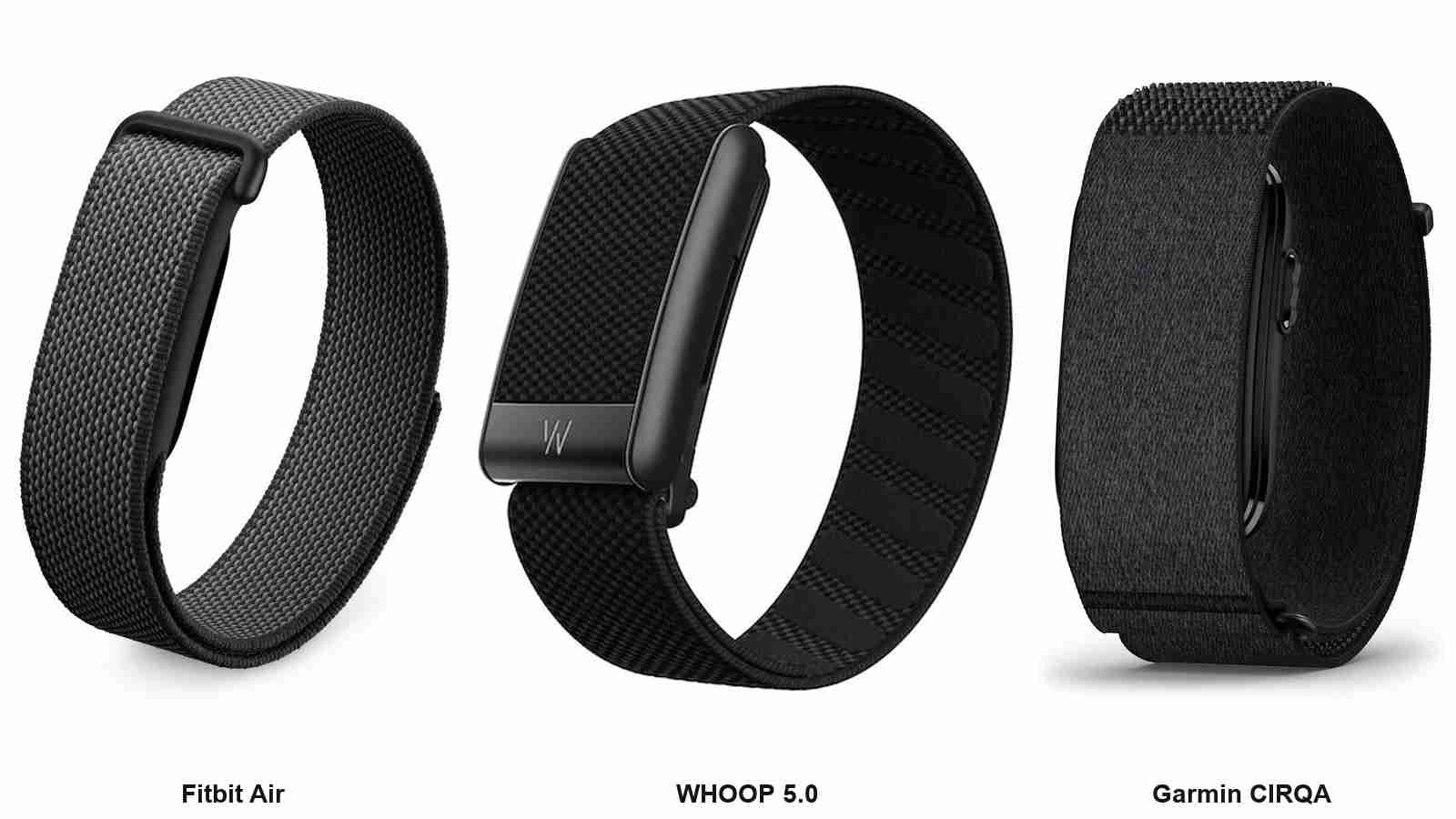
Cirqa is rated for up to 10 days of battery life. Fitbit Air is listed at 7 days, while Whoop 5.0 is listed at 14 days. That gives Whoop the battery edge, Garmin the middle position, and Fitbit the shortest interval in this comparison.[1][2][3]
For most home-gym owners, 10 days is enough to avoid charger fatigue. It covers several lifting sessions, overnight recovery tracking, and a weekend run without turning charging into another routine to manage. Whoop’s 14 days are better, but the extra four days do not erase the subscription gap unless battery life is your deciding feature.
Cirqa also supports connected GPS through phone tethering, so outdoor route tracking is still available even though the band has no screen and no standalone GPS. That is a reasonable compromise for someone whose main training happens indoors but who wants occasional run or walk data without buying a full GPS watch.[2][6]
Garmin Connect Is A Real Advantage, But Mostly For Garmin People
If you already use a Forerunner, Fenix, Edge, or another Garmin device, Cirqa has a clean ecosystem advantage: the data lands in Garmin Connect instead of forcing you to split recovery, cycling, running, and lifting context across another app. That is genuinely useful for a home-gym athlete who bikes outside, lifts inside, and wants one recovery baseline.
It is not a universal advantage. If you do not own Garmin gear and do not like Garmin Connect, the app is simply the place Cirqa lives. The value case still comes from the no-mandatory-subscription metrics, not from pretending every buyer is already in Garmin’s ecosystem.
Where Fitbit Air Still Makes Sense
Fitbit Air has the easiest day-one price: $99. If you mainly want a simple screenless tracker and can live without Premium-level depth, that is the cheapest path in this comparison. There is nothing wrong with that if your actual behavior is basic sleep, activity, and health tracking rather than daily readiness decisions.
The problem appears when Fitbit Air is treated as a full recovery-tracker alternative while Premium is left out of the bill. Add $99 per year for Premium, and the first-year total is $198, essentially tied with Cirqa. By the end of year two, it is $297. At that point, Cirqa has cost less while keeping the training-readiness and recovery-depth argument stronger for this specific home-gym buyer.[1][3]
So Fitbit Air is not the bad pick. It is the cheap-entry pick. It becomes the weaker budget pick when the buyer actually wants the advanced metrics that made them shop beyond a simple activity band in the first place.
Launch-Week Caveats Before Calling Cirqa A Safe Buy
Cirqa was announced on July 21, 2026 and ships July 24, so this is still a launch-window judgment, not a long-term durability verdict. The pricing, release timing, and feature list are confirmed, but battery aging, firmware cadence, and Garmin’s future choices around Connect+ cannot be proven on day one.[1][2]
There are also hardware limits. Cirqa uses Garmin’s Elevate Gen 4 sensor rather than the newer Gen 5 platform, and it does not include ECG. Early coverage describes the accuracy tradeoff as minor in most scenarios, but there is no independent lab-validated, Cirqa-specific heart-rate testing yet. For steady everyday tracking and recovery trends, that may be fine. For buyers who care most about verified high-intensity heart-rate accuracy during messy lifting sessions, it is a reason to wait for more testing.[2][6]
DC Rainmaker’s early unit also showed launch-firmware problems, including auto-detection and Training Readiness glitches, with activities not syncing and readiness scores oscillating. Those sound like patchable software issues, not a reason to dismiss the product outright, but they are exactly the kind of thing that can turn a smart budget buy into a support-ticket hobby if you buy in the first week.[2]
The armband has a smaller caveat: Garmin’s $59.99 biceps armband is black only at launch. That is not a performance issue, but it matters if you are expecting the same color choice as the wrist band or trying to keep a minimal kit looking consistent.[2][5]
The Budget Verdict
For a budget home-gym owner who wants recovery, sleep, HRV, stress, VO2 Max, and training-readiness guidance without another mandatory fee, Garmin Cirqa is the best-value pick over one to two years. The $199.99 upfront price looks heavier than Fitbit Air on day one, but the math changes once Premium enters the comparison. Against Whoop, the math is already in Garmin’s favor after 12 months and becomes hard to ignore after 24.
The clean recommendation is Cirqa with launch-window caution. Buy it if you want Garmin’s core recovery and training metrics without committing to a membership, especially if you already use Garmin Connect. Wait for more independent testing if heart-rate accuracy during lifting is your top concern or if firmware stability matters more than being early.
Whoop 5.0 is harder to justify on cost unless you specifically want the Whoop membership ecosystem. Fitbit Air is the cheaper entry if you can live without Premium-level depth. For the home-gym buyer trying to keep recurring fees from eating the next equipment upgrade, Cirqa is the one that makes the most sense at the current prices.
References
- Meet Cirqa Smart Band, the screen-free health and fitness tracker from Garmin — Garmin, July 21, 2026
- Garmin Cirqa: Everything You Need To Know — DC Rainmaker, July 2026
- Garmin Cirqa vs Fitbit Air — Gadgets & Wearables, July 21, 2026
- Garmin’s first screenless smart band: first impressions — Lifehacker
- Garmin Cirqa smart band announcement: price, features, release date — Wareable
- Garmin Cirqa Is Here: 10 Top Facts About Garmin’s Screen-Free Tracker — Forbes, July 21, 2026
Verify further before you buy:
Price or spec changed since we checked? Report it below.
Comments
Join the discussion with an anonymous comment.