
You wake up, open the Whoop app, and see the color before you have a full thought: green, yellow, or red. For a lot of people using a Whoop fitness tracker, that color becomes the morning question. Do you train hard, keep it moderate, take a recovery day, or ignore the whole thing because your legs still feel like yesterday’s squats happened in concrete?
Whoop’s recovery score is meant to answer part of that question, not all of it. The score is built from overnight heart rate variability, resting heart rate, respiratory rate, and sleep performance, with HRV carrying the most interpretive weight; Whoop does not publicly disclose the exact formula or weighting behind the composite score. The color bands are simple: green is 67–100%, yellow is 34–66%, and red is 0–33%.[1]
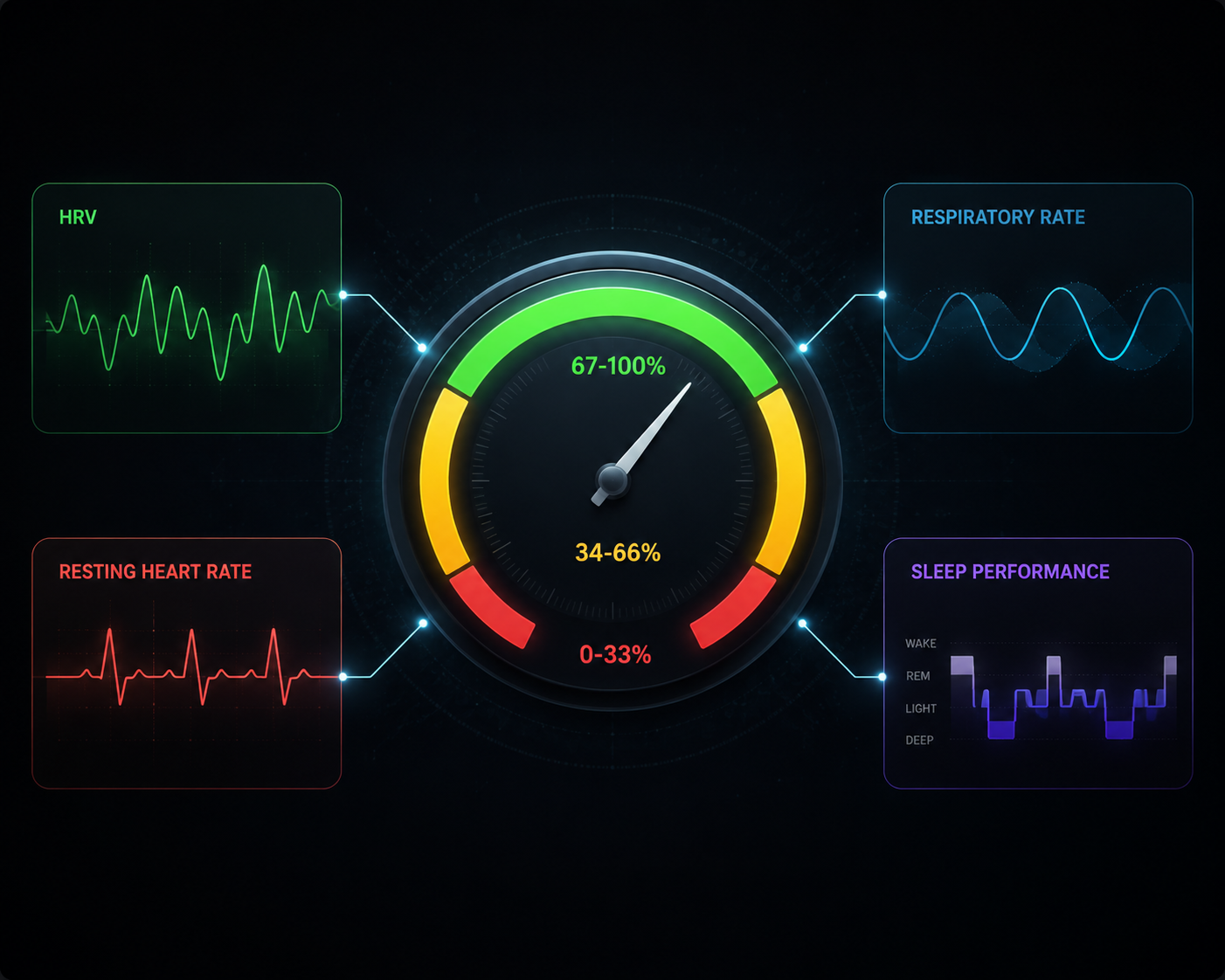
That makes the score useful, but easy to overuse. A green recovery score is not a lab clearance to max out deadlifts. A red score is not proof that you are broken. It is a morning estimate of cardiovascular and autonomic nervous system readiness, filtered through a proprietary model and a wrist-worn sensor.
If you are still deciding whether the device fits your setup, the purchase side is a separate question; this Whoop fitness tracker recovery guide for home gyms handles that value decision. Here, the better question is what the recovery score can actually tell you once it is already on your wrist.
What the Three Colors Are Really Asking You to Do
| Whoop recovery color | Score range | Practical training read |
|---|---|---|
| Green | 67–100% | Your overnight signals look favorable; consider harder training if your body and movement quality agree. |
| Yellow | 34–66% | Your signals are mixed; keep training moderate, reduce volume, or avoid the most demanding work. |
| Red | 0–33% | Your signals are strained; prioritize rest, easy movement, or active recovery. |
The table is the clean version. Real training is messier. A home trainee might get a green score after a solid night of sleep, then walk downstairs and realize their quads are still sore from split squats. Another person might get yellow after poor sleep but feel coordinated enough for a short upper-body session. The color should start the decision, not finish it.
The most useful habit is to treat the color as a cue: look under it. The underlying metrics usually explain more than the single number does.
The Four Inputs Behind the Recovery Score
HRV: the lead signal, not a soreness detector
Heart rate variability is the main signal most Whoop users learn to watch. In plain language, HRV reflects variation in time between heartbeats. Higher or lower is not automatically good or bad in isolation; what matters is how it compares with your own baseline and what else is happening around it.
A drop in HRV can show up after hard training, poor sleep, alcohol, emotional stress, travel, late caffeine, illness, or a combination of small stressors. That is why it can be a strong clue about systemic strain. It is also why it can mislead you if you ask it to do a job it was never built for. HRV does not look inside your hamstrings and tell you whether eccentric lunges left them damaged.
For strength training, this distinction matters. Local muscle fatigue can be high while autonomic signals look fine. That is the classic green-score-but-sore-legs morning. The sensible move is not to throw out the score; it is to combine it with what you can feel and see. If squats feel awkward in warmups, your recovery score does not get a vote over your knees, hips, or bar speed.
Resting heart rate: the quiet strain signal
Resting heart rate is easier to understand than HRV: if your overnight resting heart rate is elevated above your norm, your body may be carrying extra load. That load could come from training, dehydration, poor sleep, alcohol, illness, heat, stress, or simply a rough day stacked on top of another rough day.
This is one reason the recovery score is better read as a pattern than a verdict. A single elevated morning can happen. A week where resting heart rate keeps creeping up while HRV keeps dropping is more interesting, especially if training volume, work stress, or sleep disruption also changed.
Respiratory rate: usually boring, until it is not
Respiratory rate tends to be less dramatic day to day, which is part of why sudden changes can stand out. It is not the metric most people use to decide between intervals and mobility work, but it adds context when the rest of the score looks off.
If respiratory rate shifts at the same time your resting heart rate rises and HRV falls, that cluster deserves more attention than one odd number by itself. For a home workout, that might mean swapping a high-intensity conditioning session for walking, mobility, or easy zone work.
Sleep performance: useful, with one important caveat
Sleep performance is where Whoop can be genuinely helpful because it makes sleep debt harder to hand-wave away. The app compares how much sleep you got with what it estimates you needed, then feeds that into the recovery picture.
There is peer-reviewed support for Whoop sleep estimation, but the detail matters. A 2020 Journal of Sports Sciences study compared Whoop with polysomnography and found valid sleep estimation when bedtimes were manually entered.[2] That condition is not a footnote for real users. If your bedtime data is sloppy, your sleep readout can be less useful.
For training decisions, sleep is often the easiest recovery input to act on. You may not be able to force HRV up tomorrow, but you can protect bedtime, stop treating late caffeine as harmless, and notice whether alcohol keeps dragging your recovery into yellow or red.
A Better Morning Check Than Obeying the Color
The best way to use Whoop is not to stare at the recovery score until it tells you who you are today. Use it like a short morning review.
- Check the color and score range.
- Open the underlying metrics: HRV, resting heart rate, respiratory rate, and sleep performance.
- Compare the data with how you feel: soreness, pain, mood, motivation, coordination, and warmup quality.
- Look back at the previous 24 to 72 hours: training load, alcohol, late meals, stress, hydration, travel, and sleep timing.
- Log the likely causes in the journal instead of trying to remember them later.
- Make the training decision from the pattern, not from one number.
That routine keeps the score in its lane. If the app is green and your warmup moves well, it may be a good day to push. If the app is green but your back feels sharp on hinges, the plan changes. If the app is red but you feel fine, you still do not need to panic; you might choose an easy session and watch whether the next few mornings confirm the signal.
For home workouts, this is where the score becomes practical. A green day might support heavier lifts, intervals, or a longer conditioning block. Yellow might mean reducing sets, slowing tempo, or keeping the session technical. Red might mean mobility, walking, easy cycling, or recovery work. If you want that training-prescription angle in more detail, this home workout guide to Whoop recovery goes deeper.
The Journal Is Where the Score Starts Getting Useful
The recovery score gets too much attention; the journal probably does not get enough. Whoop lets users log behaviors such as alcohol, caffeine, late meals, sleep environment, hydration, stress, and menstrual cycle phase, then connects those entries with recovery trends over time.[3]
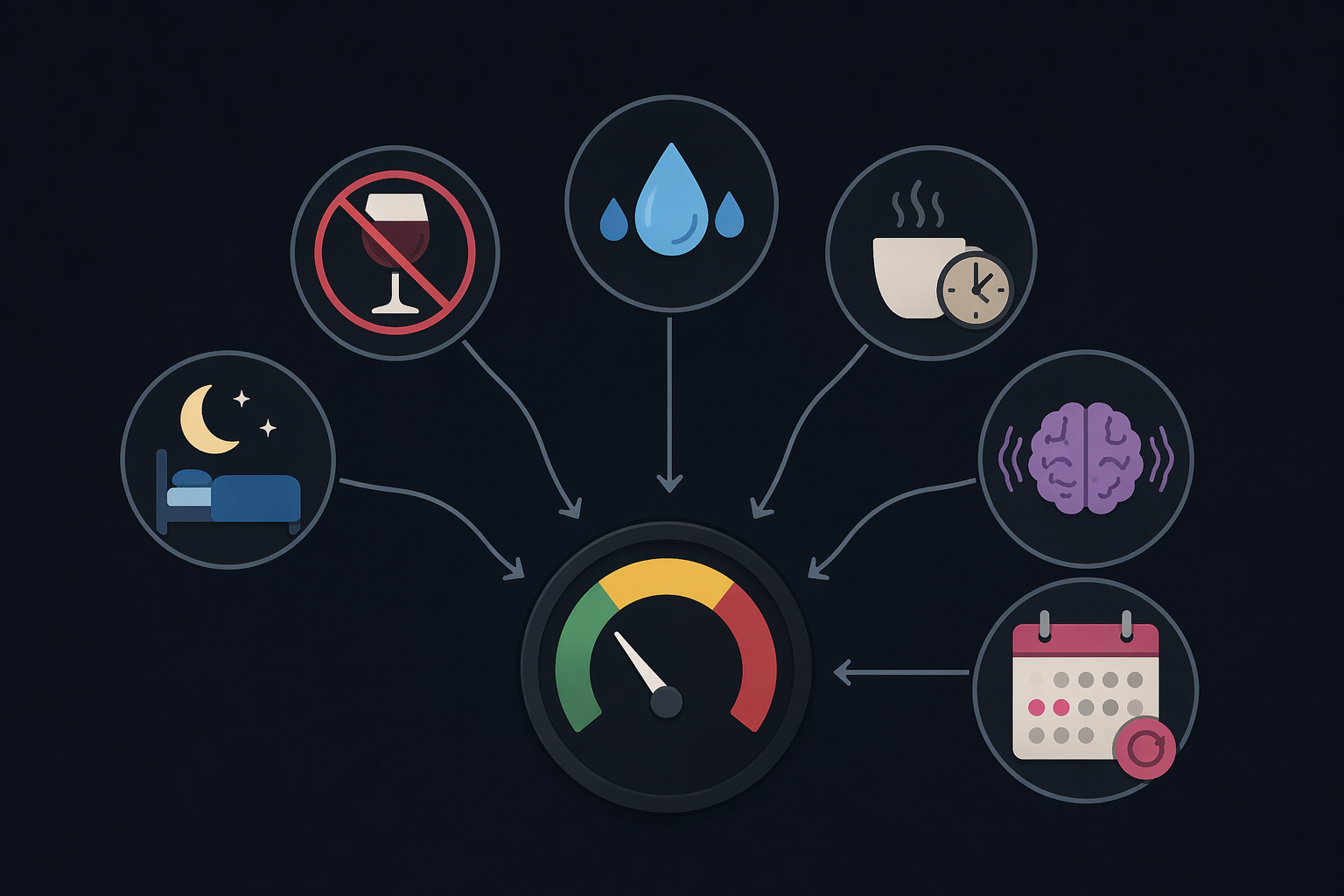
This matters because most people are bad at remembering cause and effect. You may remember the one night you had a drink and still woke up green. You may forget the six other nights when alcohol, a late meal, and short sleep all landed together. The journal is not magic, but it is a better memory than vibes.
The point is not to turn your life into a compliance spreadsheet. Pick the variables you are actually willing to change. For most home trainees, the useful starting set is sleep timing, alcohol, caffeine timing, hydration, unusually hard training, stressful days, late meals, and menstrual cycle phase if relevant.
After a few weeks, the question becomes less dramatic and more useful: what keeps showing up before low recovery? Maybe red mornings cluster after late alcohol. Maybe HRV drops when conditioning and poor sleep stack together. Maybe the late coffee you insisted was fine keeps appearing before worse sleep performance. Those are the findings that change tomorrow’s choices.
Whoop’s journal features may also depend on the plan or product setup you use, so membership details are worth checking before you buy. This 2026 Whoop membership guide is the better place to sort out tiers and access.
How to Improve Your Whoop Recovery Score Without Chasing It
You can influence recovery scores, but trying to hack one morning usually misses the point. The behaviors that tend to matter are boring in the way most useful training habits are boring: repeatable, trackable, and easier to see over weeks than over one day.
- Keep sleep and wake times more consistent, especially before hard training days.
- Watch alcohol closely; log it honestly and look for recovery patterns instead of relying on one exception.
- Move caffeine earlier if sleep performance or sleep timing keeps suffering.
- Treat hydration and late meals as variables worth testing, not moral victories or failures.
- Account for high-stress days, not just hard workouts, because both can show up in overnight signals.
- Track menstrual cycle phase if it affects sleep, temperature, perceived effort, or recovery patterns.
The practical move is to change one or two variables at a time. If you cut alcohol, move caffeine earlier, add hydration, change bedtime, and reduce training volume all in the same week, you may feel better, but you will not know which change mattered most.
A clean experiment is simple. For example, you might keep training roughly the same for two weeks while moving caffeine before midafternoon and logging sleep performance. That is a hypothetical test, not a guarantee. The value is that it gives your journal data a chance to show a pattern instead of becoming a pile of unrelated entries.
If your main goal is raising recovery through behavior changes, use a more focused plan after you understand the mechanics. This guide to science-backed ways to improve your Whoop recovery score is the natural next step.
What the Score Misses
The biggest miss is local muscular fatigue. Whoop can pick up signals related to systemic strain, but it does not directly measure whether your calves are still cooked from jump rope, whether your grip is fried from carries, or whether your shoulders are irritated from too many pressing sessions.
That is not a small limitation for home training. Many people using garage and apartment setups lift with limited equipment, repeat movement patterns often, and manage recovery without a coach watching every set. In that context, soreness, pain, range of motion, and movement quality are not soft data. They are part of the decision.
If the score says green but your warmup squats feel slow and uneven, lower the load or change the movement. If your shoulder feels sharp during push-ups, switch the session. If you are generally tired but not sore, a low-intensity recovery session may still help. For that side of the equation, this guide to foam rolling and active recovery for home gym training is more relevant than another minute staring at HRV.
How Reliable Is the Whoop Recovery Score?
The honest answer is split. Some underlying measurements, especially sleep under specific conditions, have evidence behind them. The composite recovery score is a different claim. A June 2026 comparison from Kygo Health reported that only 2 of 12 major recovery or readiness scores across the wearable market had published peer-reviewed validation; Whoop’s composite formula is proprietary and was not listed as independently validated.[4]
That Kygo Health comparison is useful, but it also comes from a commercial health-aggregation app, so it should be read as market analysis rather than a neutral academic review. Still, the caution is fair: a readiness number can be useful without being the same thing as a validated clinical or lab measure.
Sensor behavior also depends on placement and context. Wareable’s Whoop 5.0 testing found heart rate readings during exercise could differ from a chest strap by about 5–15 beats per minute, with differences related to wrist versus bicep placement and testing conditions.[5] That does not make the device useless. It does mean exercise heart rate accuracy and overnight recovery scoring should not be treated as identical questions.
Two practical conclusions follow. First, do not argue with the app every morning as if one of you must be completely right. Second, do not outsource judgment to a proprietary score just because it looks precise. If you want the longer evidence discussion, read what the research says about whether wearing a Whoop makes you healthier.
The Right Way to Let Whoop Change Your Training
The recovery score is at its best when it changes the size of the workout, not when it decides your identity for the day. It can help you choose between heavy and moderate, intervals and easy cardio, full session and shorter session, training and active recovery.
A simple rule works well: let Whoop influence intensity, volume, and recovery planning; let pain, soreness, skill quality, and common sense keep veto power.
For wearable shoppers, the question is whether this style of feedback matches how you train. If you want a screen-free band that pushes recovery habits and journal tracking, Whoop has a clear lane. If you want a watch face, workout display, or broader training metrics, compare it against other options before committing. This 2026 recovery tracker comparison is the better next read.
If you already own the device, the next useful step is less glamorous: log honestly, watch weekly trends, and stop treating one green score as permission to ignore the obvious. The app can help you see patterns. Your body still gets the final word.
References
- Whoop 5.0 Review, CNET
- Validation of a wearable device for estimating sleep, Journal of Sports Sciences, 2020
- Whoop Recovery Scores, Steph Gaudreau
- Recovery Scores Compared: Whoop, Oura, Garmin, Kygo Health, June 2026
- Whoop 5.0 Review, Wareable



Comments
Join the discussion with an anonymous comment.