
The useful answer is neither “yes, the Whoop fitness tracker makes you healthier” nor “no, wearables are just expensive mood rings.” The best peer-reviewed evidence says consistent Whoop wear is associated with lower resting heart rate, longer sleep, and more activity. It also suggests a feedback loop: wearing the device more often appears to predict later improvements, rather than merely reflecting that healthier people are more likely to wear it.
That last sentence needs a firm hand on the brake. The main study supporting it was observational, lasted 12 weeks, and was authored by Whoop employees. It is peer-reviewed and indexed on PubMed Central, but it is not independent research. So the fairest buyer-facing conclusion is this: consistent use may help some people improve measurable health markers, probably by nudging sleep and recovery behavior, but the evidence is suggestive rather than definitive.
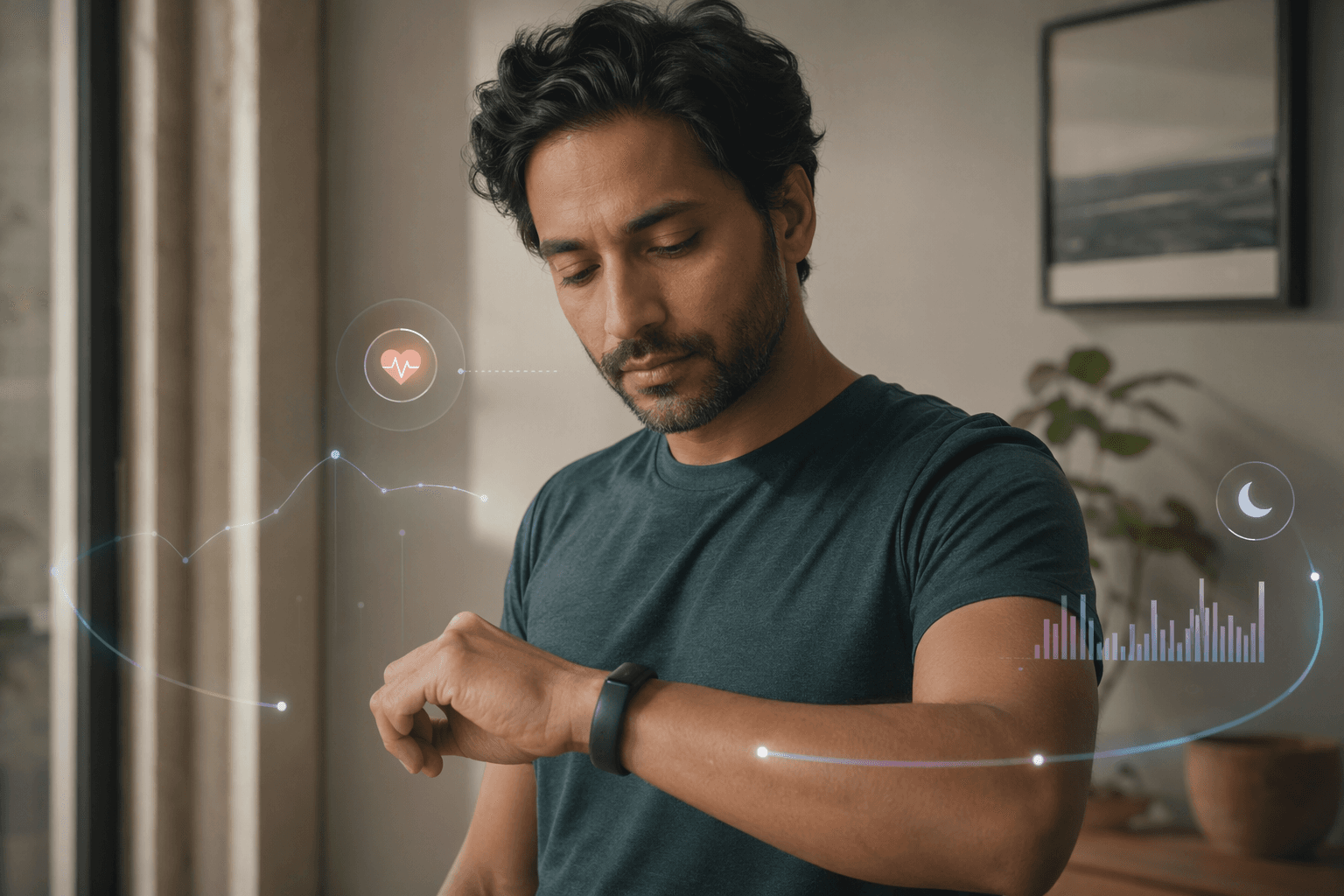
The strongest study is large, specific, and conflicted
The most relevant evidence comes from a 2025 study by Grosicki and colleagues published in Sensors. It analyzed 11,914 Whoop subscribers over 907,249 observation days during a 12-week window, comparing people who wore the device daily with people who wore it fewer than five days per week.[1]
The headline differences were not tiny dashboard decorations. Daily wearers had about 3.8 beats per minute lower resting heart rate, slept about 0.33 hours more per night, and logged about 91 additional activity minutes per week compared with lower-frequency wearers.[1] For a home-training subscriber trying to decide whether another monthly fee is worth it, resting heart rate and sleep duration are the two numbers that deserve the most attention. They are simple enough to understand without pretending the device is a lab.
| What the 2025 study compared | Observed difference for daily wearers |
|---|---|
| Resting heart rate | About 3.8 bpm lower |
| Sleep duration | About 0.33 hours more per night |
| Activity minutes | About 91 more minutes per week |
| Observation window | 12 weeks |
| Dataset | 11,914 subscribers and 907,249 observation days |
The conflict of interest is not a footnote-level issue. The study authors were Whoop employees.[1] That does not make the findings false, and it does not erase peer review. It does mean the results should not be read the way we would read a fully independent randomized trial conducted by researchers with no commercial stake in the outcome.
Still, the size and structure of the dataset make the paper more useful than a marketing claim or a handful of anecdotes. Nearly twelve thousand users and more than nine hundred thousand observation days are enough to ask a better question than “Do Whoop users look healthy?” The better question is whether changes in wear behavior come before changes in physiology.
The causal question: healthy-user bias or feedback loop?
Wearable studies run into a familiar problem: the people who keep wearing a tracker may already be the people who sleep more, train more consistently, drink less, or care more about recovery. If that is all that is happening, the device is not changing behavior. It is just identifying people who were already behaving differently.
The Grosicki study tried to address that suspicion with Granger causality analysis. In plain English, the analysis tested whether past wear frequency helped predict future resting heart rate beyond the reverse explanation that prior resting heart rate predicted later wear frequency. The study reported that past wear frequency predicted future lower resting heart rate, supporting the idea of a causal feedback loop.[1]
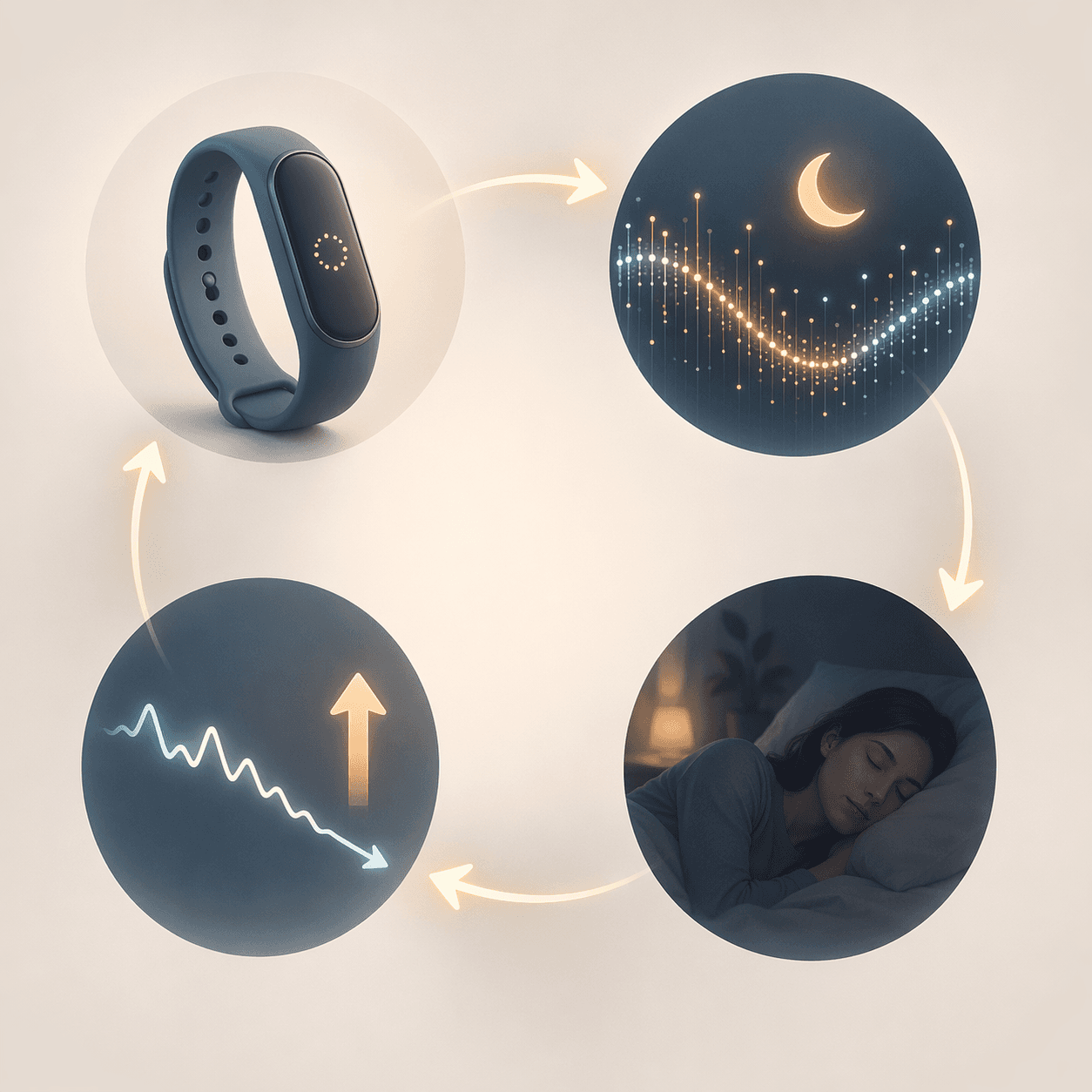
That is stronger than a simple cross-sectional comparison, but it is not courtroom proof. Granger causality can show temporal prediction; it cannot fully eliminate unmeasured explanations. A subscriber who starts wearing Whoop every day may also have started a new training block, cut back on alcohol, changed jobs, or become more deliberate about bedtime. Some of those changes might be prompted by the tracker. Some might not.
The most interesting part is the mediation finding. Sleep duration partially mediated the relationship between wear frequency and resting heart rate, while activity minutes did not.[1] That matters because it points away from the easiest wearable story—“the tracker made people exercise more”—and toward the more plausible recovery story: daily feedback may have helped users protect sleep, and better sleep was linked with lower resting heart rate.
That squares with how a recovery tracker can actually change a person’s week. A home trainee without a coach may not need another reminder to suffer through intervals. They may need permission to stop stacking hard days, notice that late nights are dragging down recovery, or see that a lower resting heart rate tends to follow a few boring nights of adequate sleep. For more on what Whoop’s recovery inputs are trying to summarize, the site’s Whoop recovery score explainer is the better place to go deeper.
What the numbers do and do not mean for a subscriber
A roughly 3.8 bpm lower resting heart rate is meaningful enough to notice, but it should not be inflated into a medical promise. Resting heart rate moves with fitness, stress, illness, heat, alcohol, medication, sleep, and measurement conditions. In a population-level study, a difference like this is worth taking seriously. For one individual looking at one month of data, it is still a trend to interpret cautiously.
The sleep difference may be the more practical signal. An extra 0.33 hours per night is roughly 20 minutes.[1] That does not sound dramatic, which is exactly why it feels believable. Many people do not overhaul their health because a wearable produces an elegant score; they change because the same small consequence appears every morning. Go to bed late, recovery looks worse. Stack several better nights, the trend improves. The device becomes less of a coach and more of an annoying mirror.
The 91 additional weekly activity minutes are useful, but the study’s mediation result makes them less central to the health-marker story.[1] More activity was associated with consistent wear, yet activity minutes did not explain the resting-heart-rate relationship in the way sleep duration partially did. That distinction keeps the claim narrower and more useful: Whoop may be most valuable when it changes recovery behavior, not when it simply adds more movement to people who are already active.
Are Whoop’s measurements good enough for this kind of claim?
Measurement quality matters, but it should not take over the question. The issue here is not whether every Whoop data point is laboratory-grade in every condition. It is whether the resting heart rate, HRV, sleep, and trend data are plausible enough to support a behavior-change study.
On that narrower point, the supporting evidence is reasonably encouraging. A CQUniversity and Australian Institute of Sport study of Whoop 3.0 reported 99.7% heart rate accuracy and 99% HRV accuracy against gold-standard ECG under resting conditions.[2] A 2024 medRxiv systematic review concluded that Whoop had acceptable accuracy for sleep and cardiac variables to establish baselines in clinical studies.[3]
Those findings are helpful, but the caveats are not cosmetic. The CQUniversity/AIS work tested older Whoop 3.0 hardware and focused on resting conditions, not hard intervals, lifting sets, or sweaty wrist movement.[2] Wareable’s reviewer testing found 5–15 bpm inconsistencies during exercise, which is a useful reminder that exercise heart rate is a different problem from overnight or resting trend measurement.[4]
For readers who want the longer sensor-by-sensor version, our Whoop accuracy research guide covers that ground in more detail. For this question, the important distinction is simple: Whoop looks more defensible as a resting-trend and sleep-feedback tool than as a flawless real-time exercise heart-rate instrument.
The limits that stop this from being a clean verdict
The first limit is study design. The 2025 paper was observational, not randomized.[1] Users were not randomly assigned to wear Whoop daily or wear it fewer than five days per week. That leaves room for baseline differences, motivation differences, lifestyle changes, and other unmeasured factors.
The second limit is the time window. Twelve weeks is long enough to detect short-term changes in wear habits, sleep, activity, and resting heart rate, but it is not enough to know whether the effect persists after the novelty fades.[1] Many people have lived through the first bright phase of a wearable: check everything, obey everything, then slowly stop caring. The study does not fully answer what happens after that phase.
The third limit is authorship. Company-authored research can be useful, especially when the dataset is only available to the company, but it should be read with more friction than independent work. Peer review reduces some problems. It does not remove the commercial incentive to frame findings favorably.
The fourth limit is individual translation. A group average does not tell you whether your own subscription will change your sleep, training choices, or resting heart rate. If you already protect sleep, train intelligently, and ignore recovery scores when they conflict with common sense, the marginal benefit may be small. If you routinely train hard on poor sleep and need external feedback to back off, the same device may be more useful.
So, does wearing Whoop make you healthier?
Consistent Whoop wear is linked with healthier measurable trends in the strongest available study: lower resting heart rate, longer sleep, and more weekly activity.[1] The Granger causality result makes the evidence more persuasive than a simple “healthy people wear trackers” explanation, and the mediation finding gives the mechanism some shape: sleep appears to be part of the pathway, while activity minutes do not explain the resting-heart-rate change in the same way.[1]
That is enough to treat Whoop as a potentially useful behavior-feedback tool, especially for people training at home who lack a coach and need help noticing recovery patterns. It is not enough to treat it as a guaranteed health intervention. The key evidence is observational, short-term, and company-authored.
If the subscription question is really “Will this device justify its monthly cost for me?”, that depends less on the elegance of the dashboard and more on whether you will change behavior when the trend is obvious. The device can show that sleep debt is accumulating. It cannot make you go to bed. For the cost side of that decision, see our Whoop recovery score subscription guide.
The safest practical framing is this: use Whoop as a trend monitor and recovery-feedback system, not as a medical device or a promise of better health. If you have symptoms, cardiovascular concerns, sleep-disorder concerns, or medication questions, wearable metrics should sit behind professional medical advice, not replace it.
References
- Grosicki et al. 2025 Whoop subscriber study, Sensors, 2025, https://pmc.ncbi.nlm.nih.gov/articles/PMC12030945/
- CQUniversity/Australian Institute of Sport Whoop 3.0 accuracy study, Sensors, https://www.mdpi.com/journal/sensors
- 2024 medRxiv systematic review on Whoop sleep and cardiac accuracy, medRxiv, 2024, https://www.medrxiv.org/
- Wareable Whoop exercise heart rate testing, Wareable, https://www.wareable.com/


Comments
Join the discussion with an anonymous comment.