
A few years ago I would have told you the screenless band with the subscription was a hard pass for anyone who wasn't an elite athlete or a quantified-self obsessive. The math didn't work: $30 a month for a device that just showed you numbers you could get from a smartwatch. Then the Fitbit Air landed at $99 with no required subscription, and suddenly the question isn't "is Whoop accurate" but "is Whoop worth $717 over three years when the Air costs $99?"
The answer depends on a single thing: whether you will actually change your behavior based on what the band tells you. Not whether you like looking at the numbers. Not whether the dashboard looks clean. Whether you will adjust your training, your sleep, your caffeine timing because a score told you to. Most people overestimate how much they will do that.
What the score actually measures
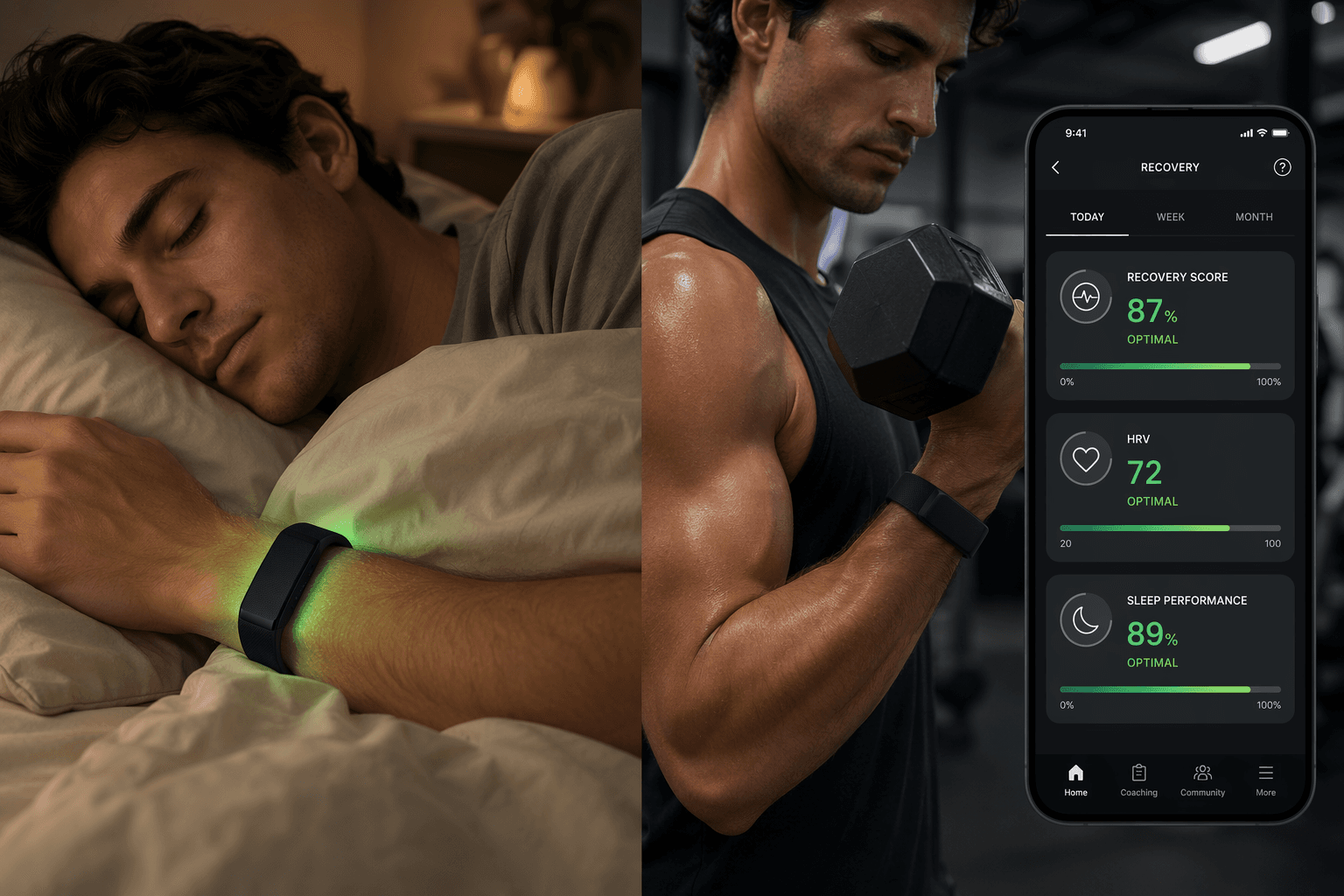
Whoop's recovery score is not a muscle soreness index. I've seen people confuse it with that. It measures your autonomic nervous system readiness, calculated from heart rate variability (HRV) sampled during the last phase of deep sleep, resting heart rate, respiratory rate, and sleep performance. The algorithm ignores the previous day's strain entirely. That distinction matters: the score tells you whether your body is ready to handle stress, not whether you are still sore from yesterday's squats.
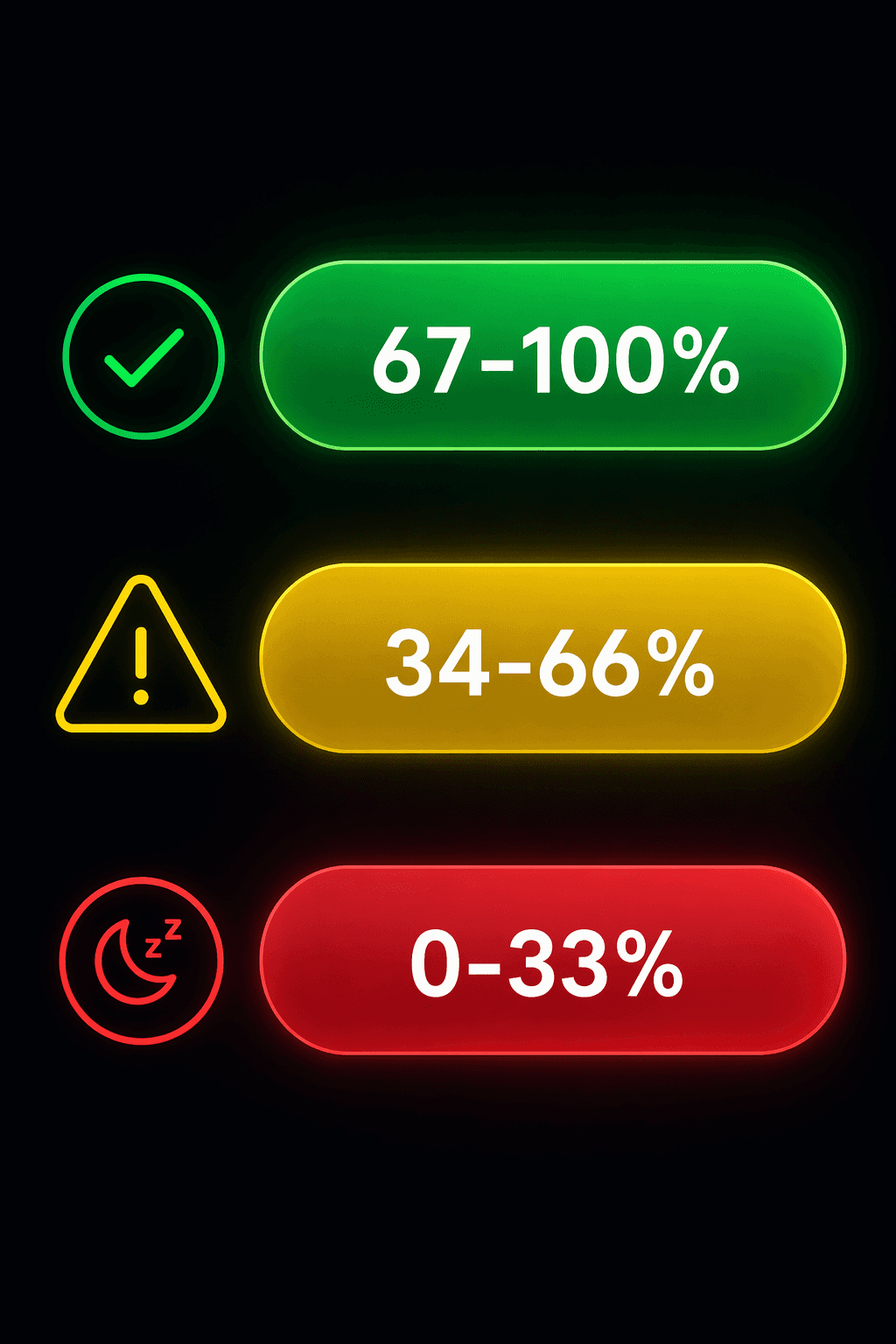
The output is a single number between 0 and 100, divided into three color zones. Green (67–100%) means you are ready for a hard session. Yellow (34–66%) suggests you can train but should be cautious. Red (0–33%) means light activity or rest is advised. Whoop claims the average member sits around 58%, but that figure comes from the company's own marketing and has not been independently verified. I treat it as a directional baseline, not a precision target.
The reason Whoop can measure HRV accurately enough for recovery scoring is that it captures the data during low-motion deep sleep — conditions that are ideal for optical sensors. This is a critical point. The wrist-based accuracy complaints you see (5–15 BPM errors during exercise, reported by Wareable) apply to workouts. Recovery scoring sidesteps that problem because it takes its measurements when you are still. That does not make it perfect, but it means the recovery score is on firmer ground than the real-time heart rate during a burpee set.
The journal: the feature you'll either use or waste
If Whoop only showed you a number every morning, it would be a fancy indicator light. What separates it from a readiness score on a $99 band is the journal. Every day you log behaviors — alcohol, caffeine, late meals, stress, supplements — and after a few weeks the app surfaces correlations between those habits and your recovery. CNET's review notes that users see "clear correlations" between specific habits and recovery scores after consistent journaling.
This is the make-or-break question for the subscription: will you actually fill in the journal every day for the first month? Not for the first week when the gadget is new. For the first month. Most people stop. The data from Vora Blog puts it bluntly: the real test is whether the data changes your behavior. If you only like seeing scores, a cheaper tracker may be enough.
How accurate is it?
The accuracy conversation has two sides. On one hand, a 2024 systematic review in medRxiv found that WHOOP has acceptable accuracy for sleep and cardiac variables to be used in clinical studies. An AIS-funded study cited 99.7% accuracy for heart rate and 99% for HRV compared to ECG. Those are strong numbers. On the other hand, the same review noted room for improvement in four-stage sleep identification, and Wareable's testing showed 5–15 BPM inconsistencies during exercise. These claims are not contradictory — the recovery score uses HRV data captured during ideal conditions (deep sleep), while exercise HR tracking struggles with motion artifacts. The recovery score is the more reliable of the two measurements.
For context on the broader accuracy picture, see our WHOOP Recovery Score Accuracy article, which dives deeper into the independent science. For the purposes of deciding whether to subscribe, the key point is this: the data is trustworthy enough to act on. You will not be misled by the recovery score.
The real cost: $717 over three years
Here is where the math gets uncomfortable. Whoop's recommended Peak tier costs $239 per year. Over three years that is $717. The Oura Ring 4 costs $349 upfront plus $69.99 per year — a three-year total of $559. The Fitbit Air costs $99 with no required subscription.
| Device | Upfront cost | Yearly subscription | 3-year total |
|---|---|---|---|
| Whoop Peak (recommended) | $0 (band included) | $239/yr | $717 |
| Oura Ring 4 | $349 | $69.99/yr | $559 |
| Fitbit Air | $99 | $0 (optional $99/yr Premium) | $99 (or $396 with Premium) |
The Fitbit Air is a May 2026 product, so long-term reliability data does not exist yet. But the price difference is dramatic enough that even if you replace the Air after two years, you still come out ahead of Whoop. The Oura Ring 4 is a more direct competitor feature-wise but carries its own subscription. Neither matches the depth of Whoop's journal and correlation engine, but both provide Daily Readiness scores that serve the same purpose for most home athletes.
What $99 gets you this year
The Fitbit Air tracks over 45 activity types automatically, offers Daily Readiness and Cardio Load (a training load metric), and includes FDA-certified background Afib detection. Its heart rate accuracy is mixed — in some workouts it matches Whoop, in others it overreports by 20–40 BPM, according to DC Rainmaker's review. That is a real limitation for anyone doing high-intensity intervals where precise heart rate matters. For steady-state cardio and daily readiness guidance, it is likely sufficient. An optional Premium subscription ($9.99/month or $99/year) adds deeper insights, but the core readiness features work without it.
The Oura Ring 4's readiness score is more similar to Whoop's recovery score in that it considers HRV, sleep, and activity. But Oura's subscription ($69.99/year) is still a fraction of Whoop's, and the ring form factor appeals to people who do not want a band on their wrist. Neither alternative provides the journal-based correlation feature that makes Whoop uniquely actionable — but for the home athlete training four days a week, the question is whether that extra actionability is worth the extra $600 over three years.
When the subscription makes sense
I'll be straightforward: if you train less than four days a week, you don't need Whoop. Even if you train more, if you won't log the journal every day for the first month and let the correlations surface, you're overpaying. The Vora Blog's assessment is the most honest I have seen: the real test is whether the data changes your behavior. If you will log the journal daily, let the correlations surface, and then adjust your sleep schedule, caffeine intake, and training intensity based on your recovery zone — then the $239 annual cost is a reasonable investment in performance. The correlation engine can show you within two to three weeks that, say, alcohol after 8 PM drops your recovery by 10 points, or that magnesium before bed raises it. That is actionable insight that no other wearable delivers without a lot of manual analysis.
Bottom line: you have to use it
The recovery score alone is not worth $239 a year. The journal that makes it actionable is. If you will use it, Whoop is the best recovery wearable on the market. If you will not, the Fitbit Air at $99 gives you a readiness score, training load, and sleep tracking that covers 80% of what most home athletes need. The three-year cost difference is $618. That is real money. Spend it on something that actually changes how you train.
For more on how the algorithm works, see our guide on How Whoop Recovery Scores Actually Work.
Comments
Join the discussion with an anonymous comment.