
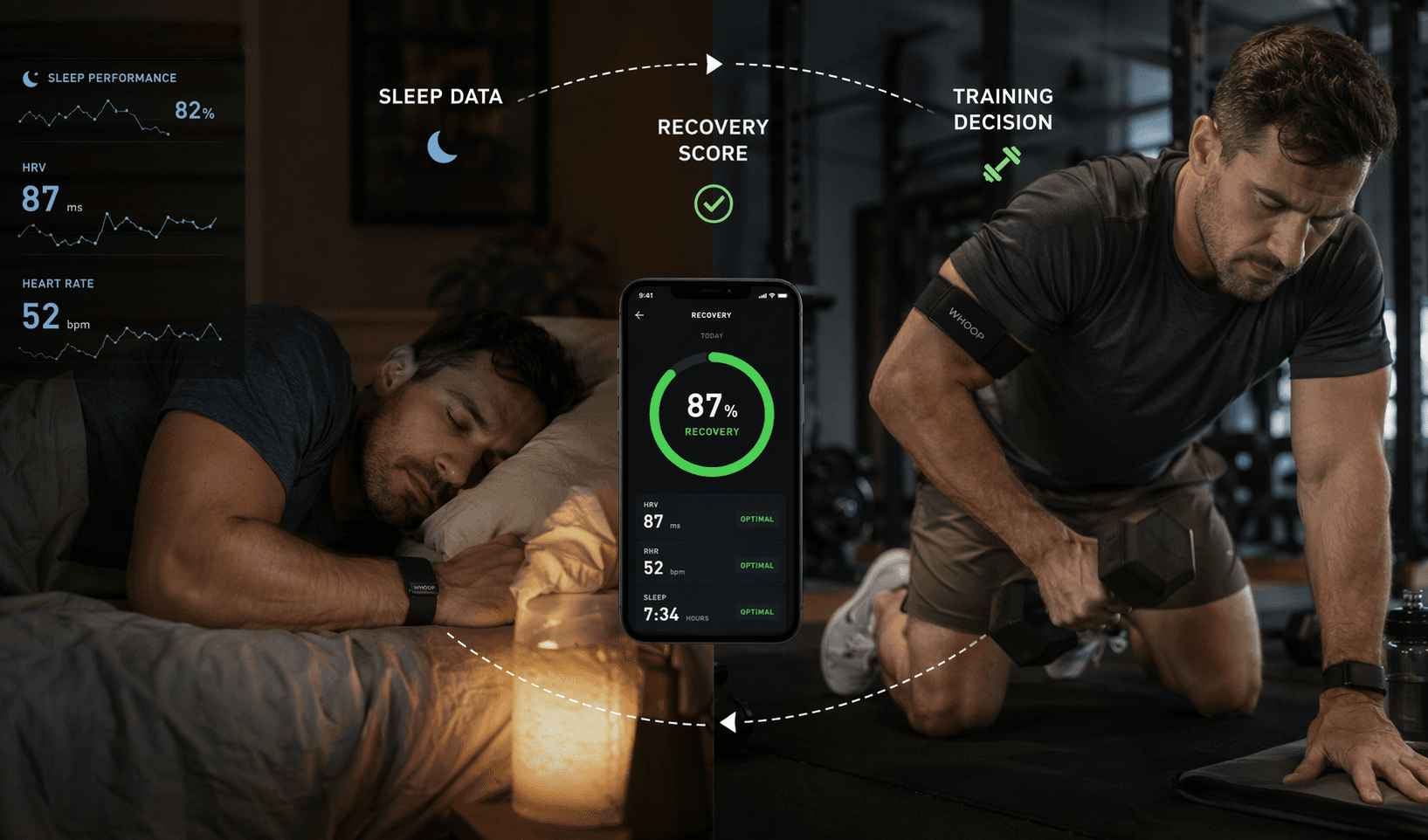
You wake up, check your WHOOP and see a red recovery score of 28%. Your legs feel heavy from yesterday’s leg day, but that number seems to say something more: skip today. Or maybe you're just tired from a bad night’s sleep, and the recovery score is picking up on that — not on how recovered your muscles actually are. The question that home fitness athletes need answered is not whether WHOOP’s sensors are accurate, but whether the recovery score they produce means what WHOOP says it means. The independent science gives a more layered answer than the marketing.
The Recovery Score: What It Measures vs. What It Claims
The recovery score blends heart rate variability (HRV), resting heart rate (RHR), sleep performance, and respiratory rate into a 0–100 percentage, color-coded red (0–33%), yellow (34–66%), or green (67–100%). That sounds straightforward, but the score is relative to your personal baseline — not an absolute good-or-bad. WHOOP’s own member averages are a useful reality check: the average daily recovery across all members is 58%, which means the typical user is in yellow most days. Average HRV is 65 ms for men and 62 ms for women, average RHR is 55.2 bpm (men) and 58.8 bpm (women). If your recovery hovers around 50–60%, that’s not failure — it’s normal.
| Metric | WHOOP Member Average |
|---|---|
| Daily Recovery | 58% |
| HRV (men) | 65 ms |
| HRV (women) | 62 ms |
| RHR (men) | 55.2 bpm |
| RHR (women) | 58.8 bpm |
| Sleep Performance | 82% |
| Nightly Sleep Debt | 43 minutes |
| Daily Strain (0–21) | 11.0 |
A green score does not mean you are fully recovered. A red score does not mean your muscles are in danger. The score reflects how your autonomic nervous system responded overnight, not whether your quads are ready for another set of squats.
The Sensors Are Good — When You Wear Them Right
Before we pick apart the recovery score, let’s be fair: WHOOP’s raw HR and HRV sensors are genuinely impressive — when worn correctly. Independent testing from the5krunner found a 0.98 correlation between biceps-worn WHOOP heart rate and a chest strap reference across 19 multisport workouts. That’s as good as it gets for optical HR. Similarly, the medRxiv systematic review concluded that WHOOP has “acceptable accuracy for heart rate metrics” – a qualified endorsement that covers the sensor layer, not the score itself.
Why Overnight Physiology Is Not the Same as Readiness
The recovery score leans heavily on overnight HRV, but does HRV measured at rest actually reflect exercise readiness? The most damning piece of independent evidence comes from the5krunner’s morning HRV comparison: day-to-day HRV correlation between WHOOP and a Polar H10 chest strap reference was only r = 0.30 (n=31). The baseline correlation was even weaker at -0.28. That means WHOOP’s daily HRV number is noisy enough that a single red score could be driven by measurement variability, not a real drop in recovery.
Across-device comparisons paint a different picture: Oura Ring vs. WHOOP showed a strong HRV RMSSD correlation of r≈0.841 (the5krunner, n=30). So the devices agree with each other, but neither tracks the chest strap well day-to-day. This strongly suggests that the limitation is inherent to overnight HRV measurement – resting physiology is variable, and a single morning snapshot is not a stable indicator of readiness. The medRxiv review confirms a natural day-to-day HRV variability of 3–13%, meaning even a perfectly accurate sensor would show swings that are not related to actual recovery.
Sleep performance is another key input, but sleep staging is not a solved problem – even for the gold standard. The Miller et al. 2020 validation study (n=12 healthy adults, 86 sleeps) found WHOOP’s two-stage sleep/wake agreement at 89% (Cohen’s kappa 0.49) against polysomnography (PSG). That sounds respectable until you know that a kappa under 0.5 represents moderate agreement – the wearable and PSG disagree on sleep vs. wake classification a meaningful fraction of the time. For four-stage categorization (light, deep, REM, wake), agreement dropped to 64% (kappa 0.47). Miller et al. 2022 (n=53 adults) reported similar: two-stage agreement 86% (kappa 0.44), multi-stage 60% (kappa 0.44).
I should add that even PSG has inter-scorer disagreement. For N1 (light sleep), two trained technicians classify the same epoch differently about 40% of the time (κ≈0.40–0.41). That means the reference standard itself is blurry for the sleep stage most often misidentified by wearables. The medRxiv review found that WHOOP has “room for improvement for four-stage sleep” – not a WHOOP-specific failure, but a limitation shared by all optical wearables.
Another input that can inflate the recovery score is deep sleep. the5krunner found WHOOP’s deep sleep detection averaged 131.8 minutes per night, well above the expected 60–120 minute range. Since deep sleep is a positive contributor to the recovery calculation, users who consistently see high deep sleep numbers may be getting a recovery score that overestimates their true readiness. To WHOOP’s credit, the Schyvens et al. (2025) study reported best-in-class deep sleep sensitivity of 69.6% for WHOOP 4.0, but that sensitivity comes with a trade-off of overestimation. If your WHOOP always shows you getting 2+ hours of deep sleep, treat the recovery score with extra caution.
When Wrist Placement Fails You
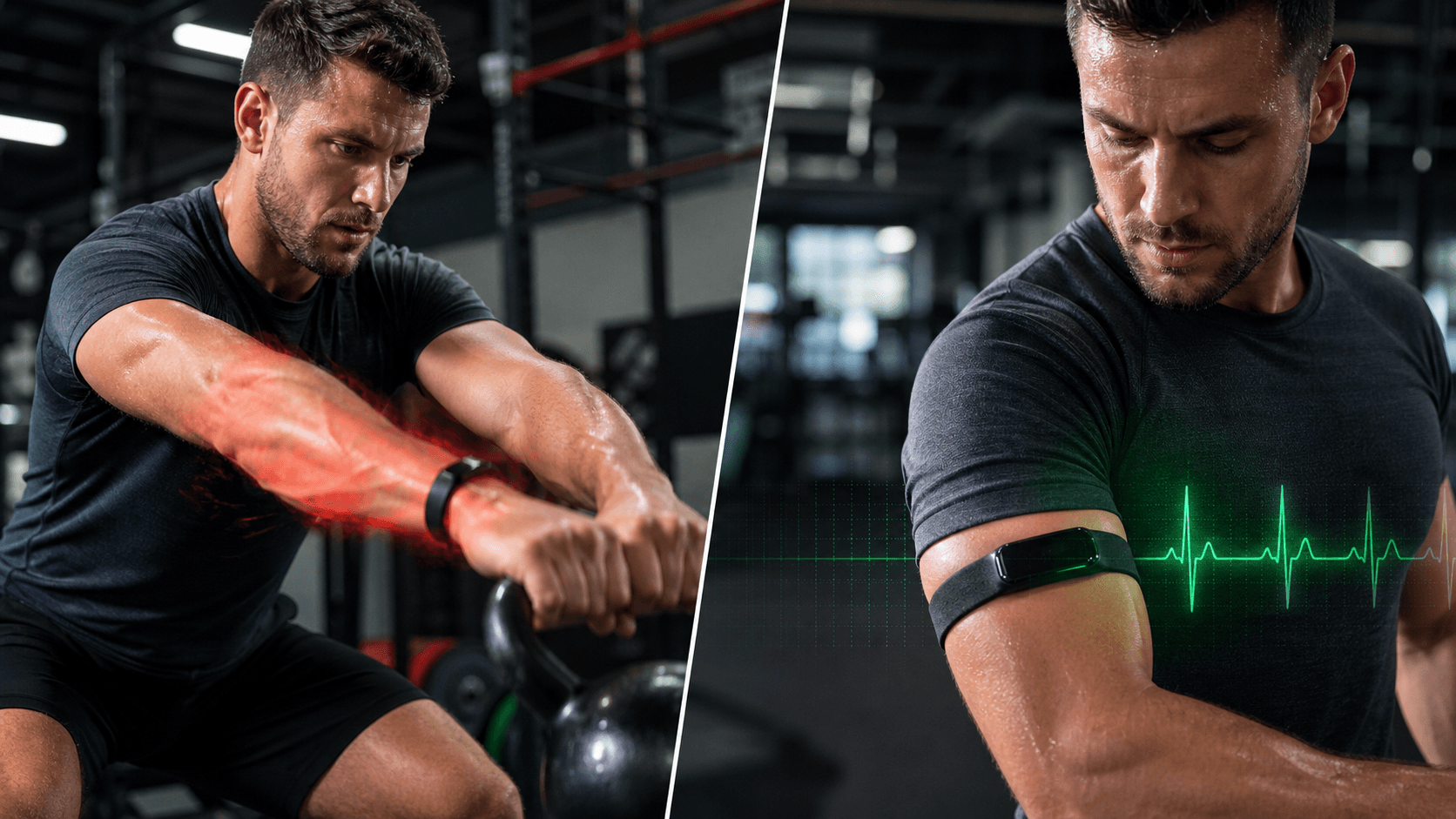
The 0.98 biceps correlation is impressive, but most people wear WHOOP on the wrist. During high-intensity functional training — CrossFit, HIIT, HYROX — wrist-worn accuracy degrades significantly. the5krunner’s HYROX simulations showed cadence lock (heart rate reading artificially tied to movement frequency) and Zone 5 misreads. If you perform wrist-intensive exercises like burpees, kettlebell swings, or rowing, your WHOOP may report a heart rate that is more motion artifact than true signal. The consequence for the recovery score: if your training strain is miscalculated, the daily recovery adjustment will be wrong.
How to Use WHOOP Without Being Misled
None of this makes WHOOP useless. It makes the recovery score useful as a long-term trend tool, not a daily command.
- Trust trends over weeks, not single-day scores. Look at your 7- or 30-day HRV and recovery trend lines, not the number you see at 7 a.m.
- Ignore a single red score if you feel good and slept reasonably. It is likely noise.
- Wear your WHOOP on the biceps during training. The difference in HR accuracy is large enough to affect strain and recovery calculations.
- Treat the recovery score as a directional input, not a workout dictator. Combine it with how your body actually feels.
- Use the sleep staging data as a rough estimate. If WHOOP consistently reports deep sleep above 2 hours, adjust your expectations.

WHOOP’s recovery score is built on remarkable sensor technology. But the gap between sensor accuracy and metric meaning is real. The home fitness athlete who understands that gap will get far more value from the device than one who follows every red number as an order to rest.
Comments
Join the discussion with an anonymous comment.