
Whoop vs. Oura vs. Garmin vs. Fitbit: Which Recovery Tracking Ecosystem Actually Works for Home Fitness?
Comparing the recovery tracking ecosystems of Whoop, Oura, Garmin, and Fitbit for intermediate-to-advanced home fitness enthusiasts who train 4–6 days per week. We break down total cost of ownership over 3 years, HRV accuracy, sleep tracking depth, and which ecosystem delivers the most actionable insights for optimizing recovery.
How much your fitness tracker actually costs over three years
The device on your wrist is not just measuring your body — it is measuring your wallet too. Four ecosystems dominate the recovery tracking space: Whoop, Oura, Garmin, and Fitbit. They cost radically different amounts over three years, and they treat your data in fundamentally different ways. The question is not which one has the best HRV accuracy. It is which one's cost model and tracking philosophy align with how you actually train and recover.
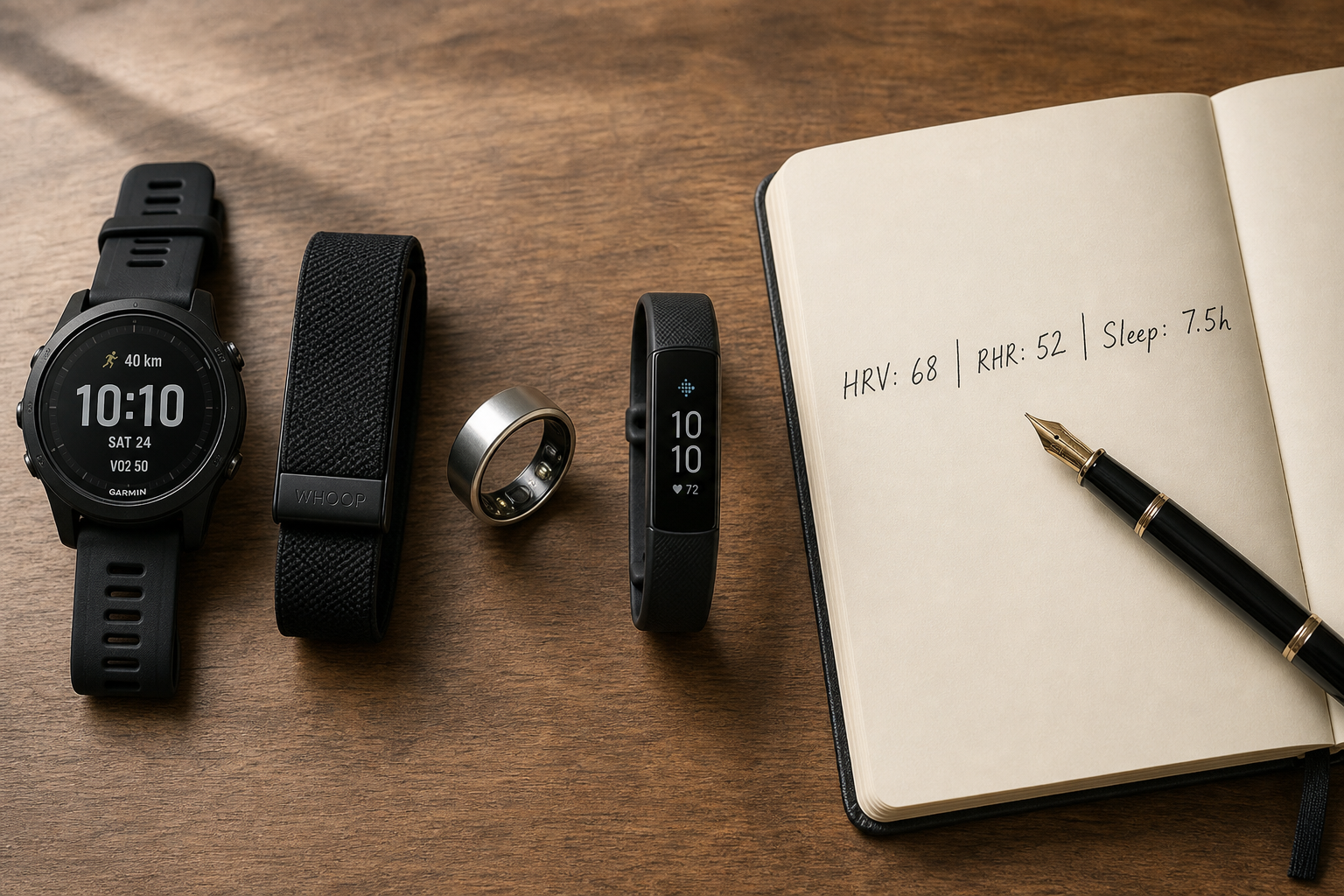
The 3-year cost table that should be your first filter
Most buyers compare upfront price and forget the subscription cost. The gap between the lowest and highest three-year total is more than $700. Here is what you actually pay:
| Ecosystem | Device Cost | Subscription per Year | 3-Year Total |
|---|---|---|---|
| Garmin Vivoactive 6 | $299 one-time | $0 | $299 |
| Fitbit Charge 6 (base) | $120–$160 one-time | $0 | $120–$160 |
| Fitbit Charge 6 + Premium | $120–$160 one-time | $80/yr | $360–$400 |
| Oura Ring 4 + membership | $349 one-time | $71.88/yr ($5.99/mo) | $564.64 |
| Whoop One | $0 (device included) | $199/yr | $597 |
| Whoop Peak | $0 (device included) | $239/yr | $717 |
| Whoop Life | $0 (device included) | $359/yr | $1,077 |
Garmin users keep their devices an average of eight years (per Strava data cited by The Verge). That stretches the Garmin advantage even further. Whoop's highest tier, Life, costs more in three years than a high-end Garmin Fenix 8 plus a decade of free analytics. The subscription model is not a convenience fee — it is the main cost. The eight-year figure is self-reported, but it matches my own experience: I still use a Garmin from 2020.
HRV accuracy: does it change your workout decisions?
The best available independent data on nocturnal HRV accuracy comes from Dial et al. (2025), a peer-reviewed study with 13 participants across 536 nights. The concordance correlation coefficients (CCC) against a Polar H10 chest strap:
| Device | HRV CCC | HRV MAPE | Agreement Rating |
|---|---|---|---|
| Oura Ring 4 | 0.99 | 5.96% | Excellent |
| Whoop 4.0 | 0.94 | 8.17% | Moderate |
| Garmin Fenix 6 | 0.87 | 10.52% | Poor |
More importantly, a Lifehacker test wearing five devices simultaneously (Apple Watch, Fitbit Charge 6, Garmin Forerunner 265S, Oura Ring 4, Whoop 4.0) found that HRV and resting heart rate trend lines tracked together across all devices, even though absolute numbers differed. For a home fitness enthusiast training 4–6 days per week, the absolute HRV number matters less than whether your device consistently shows you trending up or down. All four ecosystems do that adequately.
If you want the most precise nocturnal HRV possible — perhaps you are a data-hungry athlete or you rely on readiness scores for competition — Oura is the clear winner. But for most people, the difference between 0.99 and 0.94 will not change a Tuesday morning workout decision.
What the data does for you (or doesn't)
This is where the four philosophies diverge into concrete daily behavior. Cost is one thing; whether the device actually changes how you train is another.
Whoop: the coach that talks back
Whoop's Recovery score is uniquely sensitive to lifestyle inputs: alcohol, late meals, stress. After a night out, Whoop shows your recovery tanked the next morning. The feedback loop is immediate and behavior-changing. You see a direct consequence of your choices, and the strain recommendation adjusts accordingly. This is not just a metric — it is a behavior-change engine.
But the subscription cost adds up fast. And if you are considering the Whoop Life tier, be aware that the FDA sent a warning letter in July 2025 about Whoop's blood pressure marketing claims. That feature, promoted in the Life tier, is not FDA-cleared and carries regulatory risk.
For a deeper look at how Whoop calculates that recovery score and whether you should trust it, read our full breakdown.
Garmin: the free real-time dashboard
Garmin's Body Battery updates in real time throughout the day. Take a nap at 2 p.m., and within minutes your Body Battery shows you are recharged. Whoop only shows the recovery benefit the next morning. For anyone who wants to make same-day decisions about whether to push or hold back, Garmin's immediacy is a genuine advantage — and it costs nothing extra.
Garmin's sleep tracking has its flaws (it tends to overestimate sleep duration and miss wake-ups compared to Whoop), but the complete package — GPS, training metrics, zero subscription — makes it the best long-term value for most home fitness enthusiasts. I've used Garmin for years, and the real-time Body Battery is what keeps me from overtraining on a bad sleep night.
Oura: the passive overnight observer
Oura gives you a morning Readiness score based on excellent HRV and sleep tracking, but it is a passive system. There is no real-time feedback during the day. You do not see how a nap or a stressful phone call affects your recovery until the next morning. For someone who simply wants the most accurate overnight data and does not need daytime coaching, Oura is the best choice. But that accuracy comes at a subscription cost, and the ring form factor is not for everyone — some find it uncomfortable for weightlifting or typing.
See our deep-dive on Oura's Readiness Score and HRV accuracy for the full science.
Fitbit: the basic band with Google upsells
Fitbit Charge 6 offers reasonable sleep and heart rate tracking for a low upfront cost. But the ecosystem is progressively folding into Google's, and Fitbit Premium ($80/year) gates many of the deeper recovery insights. Without Premium, you get a basic sleep score and limited HRV trends. With Premium, the cost approaches Oura's total without matching Oura's accuracy. Fitbit works best if you are already in the Google ecosystem and want a simple, affordable tracker. Just note that the subscription is increasingly pushed.
The hidden lock-in: form factor and data ownership
Whoop is a screenless strap designed for 24/7 wear; Oura is a ring that some find comfortable but others remove during lifting; Garmin is a watch that can be bulky for sleep; Fitbit is a small band that most people tolerate well. If you cannot wear it at night, you lose the recovery data entirely. Try a device for a week if possible before committing.
Data portability matters too. Garmin Connect allows full data export for free. Oura and Whoop gate detailed data behind their subscriptions — if you stop paying, you lose access to your historical trends. Fitbit integrates with Google Health, but the long-term landscape is uncertain. A great ecosystem is worthless if you feel locked in. For more on the screenless form factor, read our Screenless Fitness Tracker Buyer's Guide 2026.
Which one fits your habits?
- Choose Garmin if you want a watch with GPS, no subscription, and the most long-term value. You sacrifice peak HRV accuracy and a real-time recovery coach for a zero-annual-fee ecosystem that also tracks your runs and rides.
- Choose Whoop if you want a sleep-focused coach that changes your behavior — and you do not mind paying annually for it. You get the best lifestyle-feedback loop in the business, but you pay for it every year.
- Choose Oura if you want the most accurate nocturnal HRV data available and can wear a ring 24/7. You get excellent sleep and readiness scores, but the system is passive and requires a subscription.
- Choose Fitbit if your budget is tight and you already use Google services. You get basic tracking at a low entry price, but the subscription upsells and ecosystem uncertainty are real downsides.
The best ecosystem is the one whose cost model and tracking philosophy align with your training habits — not the one with the highest HRV accuracy or the lowest sticker price. If you still want a broader selection, see our comprehensive Best Fitness Tracker Decision-Matrix Guide.
This is general fitness education, not medical advice. For diagnosis or treatment of pain or injury, consult a qualified clinician.
Pick your next session
Browse all routines to find an appropriately-spaced next session.
Spot something off?
This content sits adjacent to health guidance — tell us if a citation or figure needs a correction.