
You have seen the number: 99.7% heart rate accuracy. Whoop puts it on its marketing page, in press releases, in comparison tables. The figure comes from a 2022 study funded by the Australian Institute of Sport and conducted by CQUniversity, published in Sensors. And the number is real — for the conditions it measured.
What is also real, and what the marketing does not put front and center: that study was done on Whoop 3.0, not the 5.0 or the MG band you wear now. And it was done under resting conditions – participants sat still. No running. No heavy breathing. No wrist flexion from a barbell. I would not use that 99.7% figure to claim workout accuracy.
What the AIS Study Actually Tested — and What It Didn't
The study compared six consumer wearables against a gold-standard ECG. Whoop 3.0 had a heart rate accuracy with a standard deviation of just 1 BPM from ECG. That is excellent. Other wearables ranged from 2.1 to 12.8 BPM. For heart rate variability, Whoop's error was 3.9 ms; the next-best was 28.1 ms, the worst 46.9 ms. Those are resting numbers.
But the study did not measure any device during exercise. The protocol: participants at rest, wearing multiple devices, compared to ECG. The claim that this validates Whoop's accuracy during workouts is simply not supported by the data. The inference does not hold.
| Device | HR accuracy (SD vs ECG) | HRV error (SD vs ECG) |
|---|---|---|
| WHOOP 3.0 | 1.0 BPM | 3.9 ms |
| Other wearables (range) | 2.1 – 12.8 BPM | 28.1 – 46.9 ms |
A 2024 systematic review on medRxiv concluded that Whoop has "acceptable accuracy for two-stage sleep and heart rate metrics" but noted "room for improvement in four-stage sleep and HRV identification." The review itself is a pre-print, not yet peer-reviewed. It aggregates peer-reviewed primary studies, but the final conclusions about overall accuracy have not been independently validated at the review level. The evidence base is solid but narrower than the marketing suggests.
What Happens When You Actually Move? The Independent Data
This is where the marketing promise and independent reality diverge. Wareable's testing of Whoop 5.0/MG compared it against a Garmin HRM-Pro Plus chest strap and an Apple Watch during varied exercise. The results are not what you would expect from a device marketed as "most accurate."
During a 7-mile steady run, Whoop reported an average heart rate of 159 BPM, while the chest strap and Apple Watch both read 153 BPM. Six beats per minute higher is not a rounding error. During a 90-minute tennis session, Whoop reported 130 BPM, while the Apple Watch read 141 and the chest strap 144 — 11 to 14 BPM low. The error direction is inconsistent — sometimes over, sometimes under. You cannot mentally calibrate for it.
Independent tester Michael Kummer ran a more controlled experiment: he wore a Polar H10 chest strap simultaneously with Whoop during brisk walking and a CrossFit workout. During the CrossFit workout, only 58% of Whoop's readings were within 5 BPM of the chest strap. That means 42% of the time, the error was larger than 5 BPM. For a workout with burpees, kettlebell swings, and box jumps — exactly the kind of dynamic, arms-moving activities that home fitness enthusiasts do — the accuracy falls apart.
| Activity | Readings within 5 BPM of chest strap | Average deviation |
|---|---|---|
| Brisk outdoor walk | 74% | 3.8 BPM |
| CrossFit workout | 58% | Not reported, but implied larger |
The mechanism is simple physics. Optical heart rate sensors use photoplethysmography: they shine light into the skin and measure changes in blood volume. When the wrist moves, the sensor shifts, ambient light leaks in, and the signal-to-noise ratio drops. During weightlifting, wrist flexion tightens or loosens the band. Tattoos and skin pigmentation can absorb the light. This is not unique to Whoop — every wrist-based optical sensor struggles. But Whoop's marketing often implies its proprietary algorithms overcome these limits. The independent data says they do not.
The Overlooked Insight: Your Recovery Score Has Nothing to Do with Exercise HR
Here is the most important thing that nearly every accuracy debate misses: the recovery score is calculated from HRV measured during the last phase of deep sleep, not from workout heart rate data. Michael Kummer explicitly verified this from Whoop's own documentation, and it is consistent with Whoop's published methodology.
This means that even if exercise heart rate readings are off by 15 BPM — and they are — the recovery score remains unaffected. The algorithm that tells you whether your body is ready to train does not use the data that the sensor collects during your workout. It uses data collected while you are lying still, breathing slowly, with no motion artifacts. That is why the recovery score is scientifically robust even when exercise HR is unreliable.
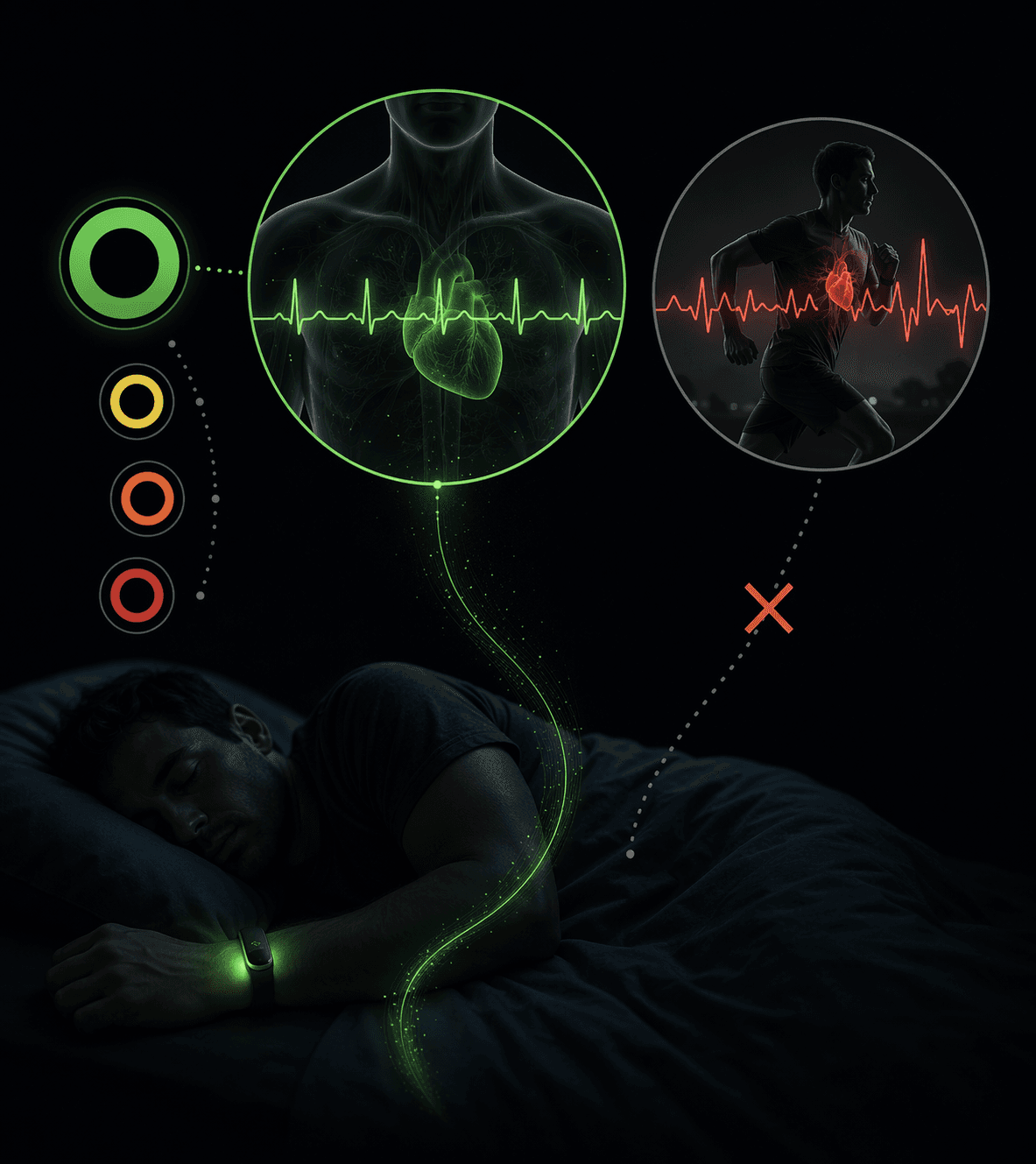
This also explains Whoop's design choice to be screenless. It is not trying to be a real-time coaching device. It is a data-collection and analysis tool that gives you a daily readiness score. If you want live heart rate feedback during a workout, you need a chest strap or a watch with a screen. Whoop is not that product.
When to Trust Whoop — and When to Use a Chest Strap
The evidence supports a clear split. Use Whoop for the things it does well; do not trust it for the things it does not.
| Trust Whoop | Do not rely on Whoop |
|---|---|
| Trends in resting heart rate over weeks | Real-time heart rate zones during exercise |
| HRV trends and nightly variation | Calorie burn estimates during workouts |
| Sleep duration trends (2-stage sleep) | Absolute sleep stage breakdown (4-stage) |
| Recovery score (readiness to train) | Heart rate during dynamic, arms-moving activities |
| Long-term strain trends | Anything requiring ±5 BPM precision |
If your primary goal is managing recovery, sleep, and long-term readiness, Whoop is the best-validated consumer wearable on the market. The resting and sleep data is backed by peer-reviewed research. The marketing just needs to let the workout claims go.
Comments
Join the discussion with an anonymous comment.