
You open the morning dashboard. Oura says you are at 78 — good but cautious. Whoop gives you a green recovery of 72%. Fitbit’s Daily Readiness Score says 85, ready to go. Which one do you believe?
Recovery tracking is the reason many home fitness users buy a wearable. But the three main contenders — Oura Ring, Whoop, and Fitbit — do not agree on the same metric. The question is not which produces prettier graphs. It is which produces data you can actually act on when you have no coach to interpret it.
Why recovery is a separate buying criterion
Heart rate variability (HRV), resting heart rate, sleep staging, and body temperature are the signals that tell you whether to push or rest. These metrics demand better sensor quality and algorithm design than step counting or calorie burn. A device that tracks steps well can still produce misleading HRV data. If you are buying a tracker specifically to decide whether to take a rest day, the accuracy of its recovery-specific sensors matters more than any other feature.
For a full primer on what these metrics mean, read our guide on Health Fitness Tracker Recovery Metrics. Here we focus on which device actually measures them best.
The finger advantage: why Oura’s HRV accuracy is real but bounded
Oura’s finger-worn form factor is not a marketing gimmick. A photoplethysmography (PPG) sensor on the finger captures blood volume pulse signals through thinner tissue with less motion artifact than a wrist strap. The result, in Oura’s own published data, is 99% heart rate accuracy and 98% HRV accuracy (r² vs. ECG).
I should pause on those numbers. They come from Oura’s science page, not from an independent head-to-head trial. The 98% HRV figure is impressive, but it is a manufacturer claim. Independent data from Forbes (Pines, March 2026) tells a more measured story: Oura’s sleep staging sensitivity ranges from 76-80%, with precision of 77-80%. That is good — comparable to clinical polysomnography in some respects — but it is not the overall “99% accurate” picture the marketing suggests.
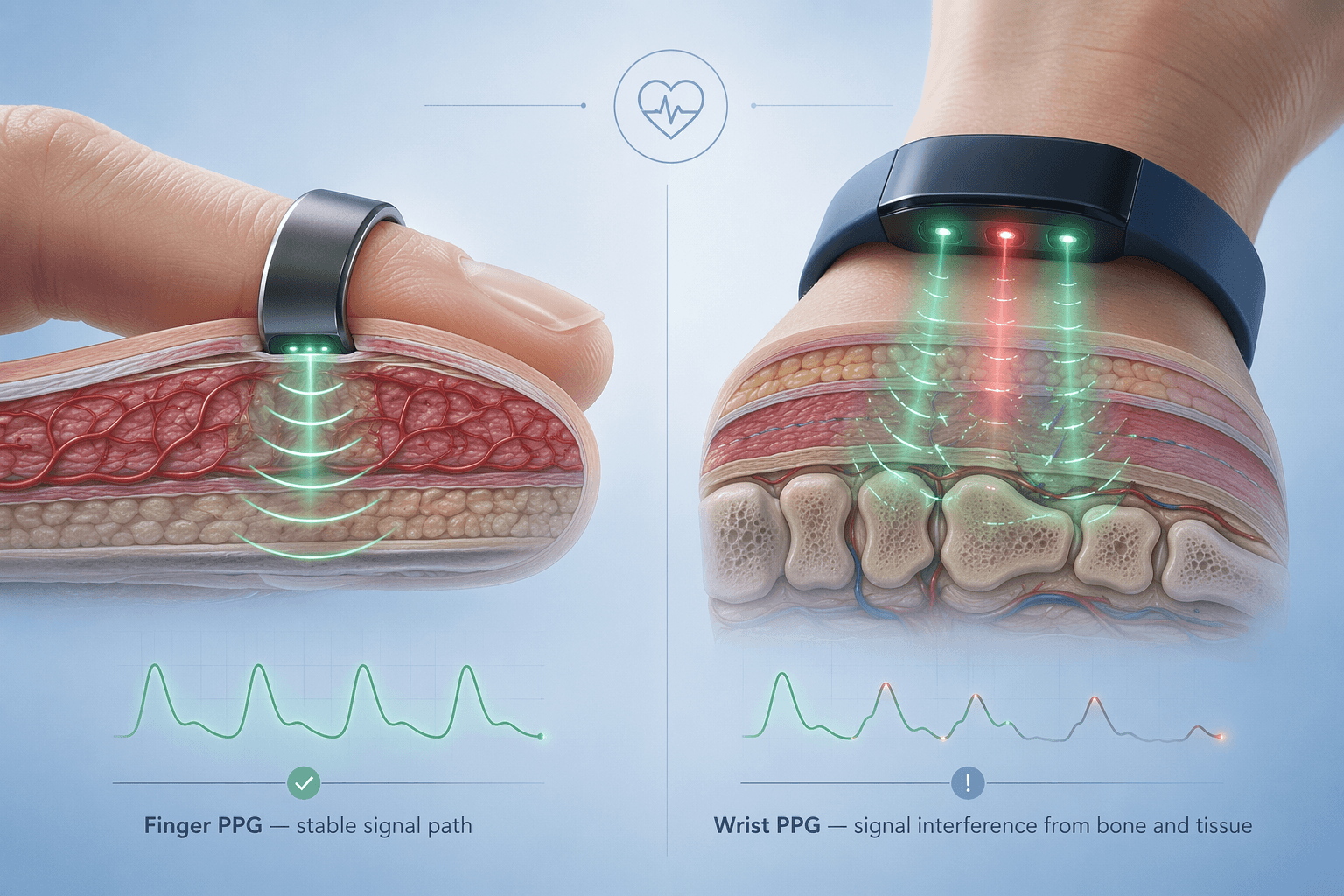
Whoop and Fitbit use wrist-worn PPG. Their HRV data can be more variable, especially during sleep motion. But the real gap is not just in raw accuracy — it is in consistency overnight. Oura’s finger placement stays stable; a wrist band can shift. That steady overnight reading is what makes the ring’s resting HR and HRV trends more reliable for day-to-day recovery decisions.
Sleep staging: Whoop’s 95% sensitivity hides a 51% wake specificity problem
Whoop markets its sleep tracking heavily, and on one axis it delivers: the device achieves 95% sensitivity for detecting sleep versus wake. That sounds like a slam dunk. But sensitivity is only half the equation.
The same 2020 study cited in Forbes shows Whoop’s specificity for wake detection is just 51%. That means it often mistakes wakefulness for sleep. In practice, if you lie in bed for 30 minutes before falling asleep, Whoop may credit that time as sleep. Your recovery score rises, but your actual rest did not.
| Device | Sleep Sensitivity | Wake Specificity | Source |
|---|---|---|---|
| Whoop | 95% | 51% | Forbes/Pines 2026, 2020 study |
| Fitbit | 95-96% | 58-69% | Forbes/Pines 2026 |
| Oura Ring | 76-80% | 77-80% precision | Forbes/Pines 2026 |
Fitbit is similar: 95-96% sensitivity, 58-69% specificity. Oura’s numbers are lower on sensitivity (76-80%) but much better on wake detection (77-80% precision). That lower sensitivity means Oura might miss a few minutes of light sleep, but it will not inflate your total sleep time by counting wakefulness as sleep.
How each device turns data into a decision
Sensor accuracy matters, but what you ultimately see is a score — Oura’s Readiness Score, Whoop’s Recovery Score, Fitbit’s Daily Readiness Score. The methodology behind each score determines how actionable the number is.
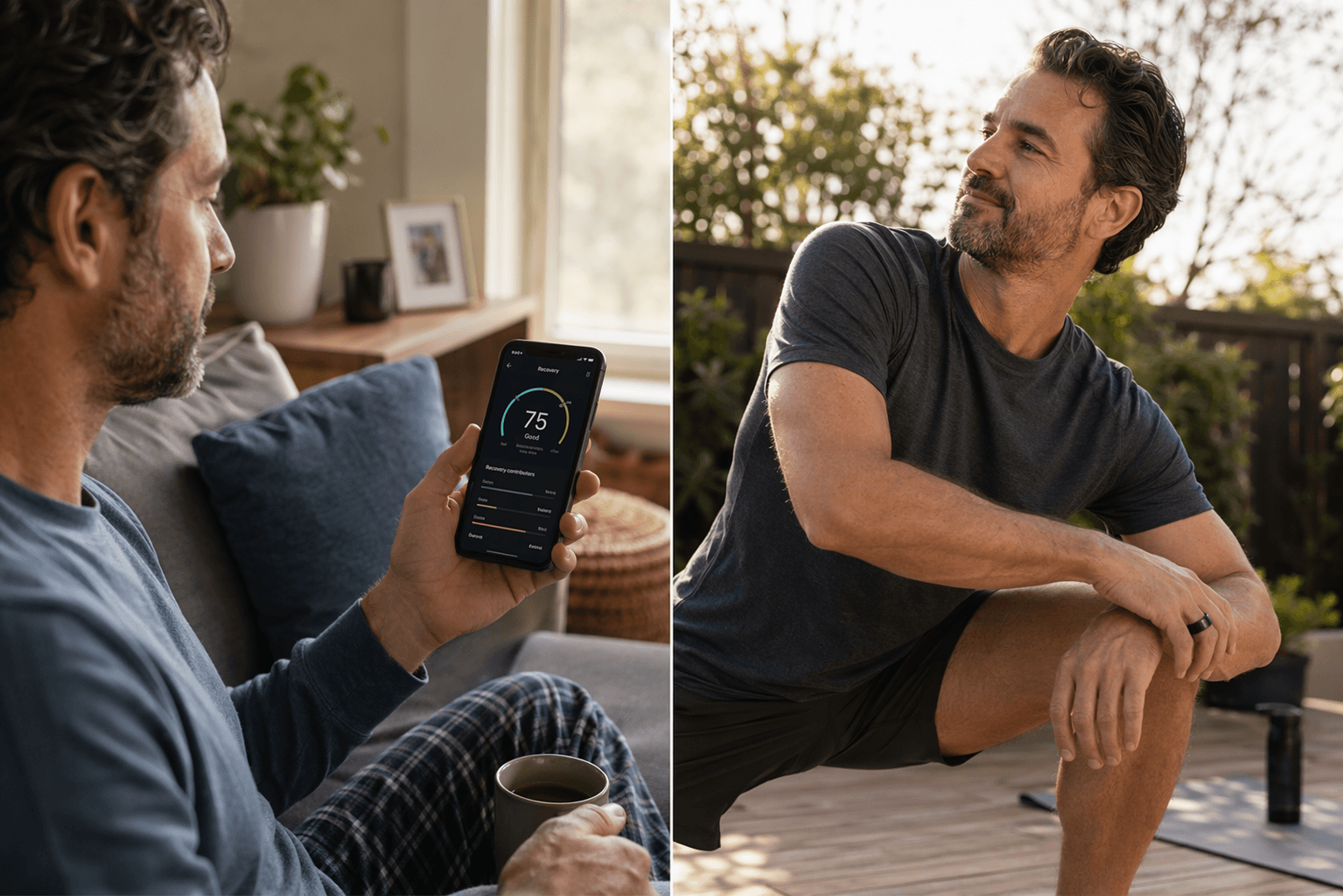
Oura’s Readiness Score (0-100, with 85+ optimal) is built from seven contributors grouped into sleep, activity, and body stress pillars. Two of those — Sleep Balance and Activity Balance — use 14-day weighted averages. That means a single bad night (or a single hard workout) does not crash the score. The ring compares your recent 14-day average to your long-term baseline. For a home fitness user training without a coach, that trend-based smoothing is the difference between a useful signal and reaction to noise.
Whoop’s Recovery Score focuses on the strain-recovery loop: it measures recovery, suggests a target strain for the day, and then tracks whether you hit that strain. This works well for athletes who periodize load, but it is less intuitive for someone just wanting to know “should I take it easy today?” Whoop also factors autonomic nervous system balance (HRV, resting HR, respiratory rate) but without the 14-day smoothing that Oura uses.
Fitbit’s Daily Readiness Score (rolled out with Charge 5 and Sense 2) uses HRV, recent sleep, and activity patterns. It is simpler and leans heavily on Fitbit’s sleep algorithm. For casual users, it works, but the wake specificity problem means it may overstate readiness.
For a deeper dive into how Whoop builds its score, see How Whoop Calculates Your Recovery Score — and Whether You Should Trust It. For a broader ranking of trackers by recovery accuracy, check Best Fitness Trackers for Recovery in 2026.
Body temperature: a feature, not just a sensor spec
All three devices track skin temperature trends. Oura claims to detect deviations as low as 0.13°C with 92% accuracy — again, manufacturer data. The real differentiator is what Oura does with the data: if the Body Temperature contributor detects an elevated trend, the app automatically alerts you and offers Rest Mode, which lowers your Activity Target for the day. Whoop and Fitbit show the trend but do not automatically adjust your recovery guidance the same way.
Temperature is a secondary signal, but Oura’s proactive response makes it more practically useful than a raw chart.
The cost that flips the value proposition
Subscription cost is the most overlooked factor in tracker comparisons. Here is the real-world cost over three years for each device:
| Device | Hardware (one-time) | Subscription (monthly) | 3-Year Total |
|---|---|---|---|
| Oura Ring 4 | $349–$499 | $5.99 | $565–$715 |
| Whoop 4.0 | $0 (device included) | $16.63–$30 | $599–$1,080 |
| Fitbit Charge 6 | $159 | $9.99 (Premium, optional) | $519 (with Premium) |
Oura’s total tops out around $715 (Gold ring + 3 years subscription). Whoop’s minimum is $599 (annual plan at ~$16.63/month), and it reaches $1,080 if you pay month-to-month. Fitbit is the clear budget winner, especially if you skip Premium and use the free tier.
Oura’s subscription is higher than Fitbit’s free tier, but significantly lower than Whoop’s. If cost is a primary concern, the decision is simple: Fitbit for basics, Oura for deep recovery data, Whoop only if you need its strain-recovery loop and can stomach the ongoing fee.
Which tracker for your home fitness profile
Take the evidence and apply it to your situation.
- Recovery-focused home gym user: You want a daily readiness score you can trust, and you train 3-5 days per week. Oura Ring is the clear choice. Its HRV accuracy, trend-based Readiness Score, and automatic rest mode give you the most actionable guidance. The higher upfront cost is worth it if you plan to use the data to make real training decisions.
- High-volume endurance athlete: You train daily, periodize load, and need to balance strain and recovery. Whoop’s strain-recovery loop is purpose-built for this. Just be aware that its sleep scoring may inflate your recovery on restless nights.
- Casual exerciser or budget-conscious buyer: You want to track sleep, steps, and a simple readiness signal. Fitbit’s ecosystem is reliable, affordable, and easy. Use the free app or pay $10/month for deeper insights.
For a full metric-by-metric buying guide, see Best Fitness Tracker for Recovery: A Metric-by-Metric Buying Guide. And if you are leaning toward a ring form factor, our Fitness Tracker Ring Buyer's Guide 2026 covers the trade-offs every first-time buyer should know.
The honest answer: no device gives you perfect recovery data. Oura comes closest for most home fitness users, but only if you accept its accuracy boundaries and the subscription cost. Whoop is a strong alternative if you understand its sleep scoring quirk. Fitbit is the pragmatic choice if you just need a ballpark signal. The real winner is the one whose data you actually trust enough to rest when it says rest.
Comments
Join the discussion with an anonymous comment.