
Three Devices, Three Recovery Philosophies — Which One Fits Your Training Personality?
Whoop costs $478 over two years. Oura costs $493. Garmin costs $350, one-time, no subscription. If you're hunting for the best fitness tracker for recovery, start with those numbers. None of these devices will improve your training if you don't wear it consistently — and a subscription you resent will end up in a drawer.
The real difference isn't just price. Each device has a distinct philosophy about what recovery data is for. Whoop's strain/recovery loop treats you as an athlete who wants daily coaching. Oura's passive, finger-based approach aims to give you a morning snapshot without wrist bulk. Garmin's integrated Training Readiness puts recovery into context with your running and strength metrics — and never asks for a dime after purchase. The question isn't which tracker has the most features. It's which approach matches your training personality.
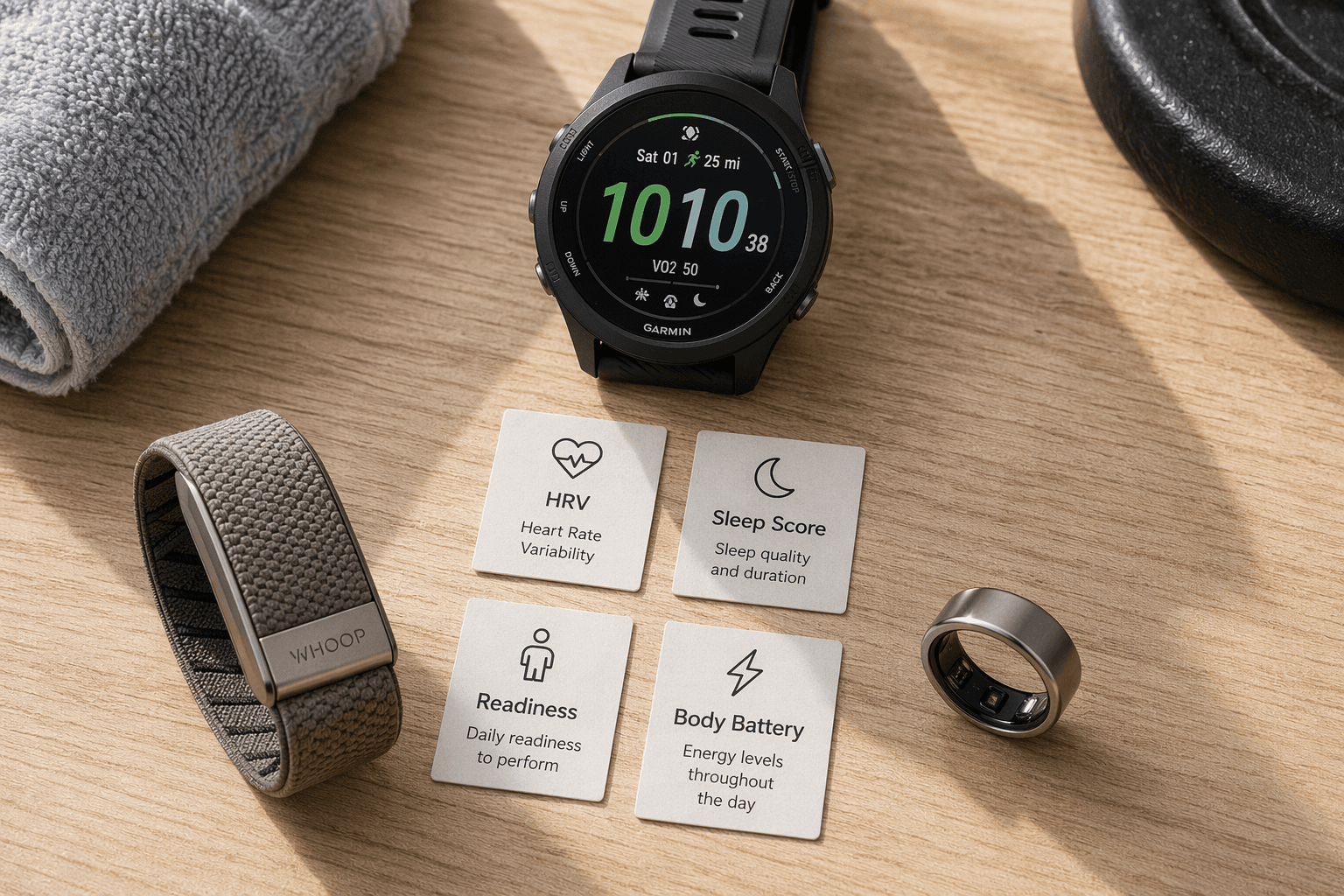
Whoop 5.0: Daily Coaching, but That Subscription Bites
I spent a month on a Whoop trial. The app is beautiful. The daily strain/recovery feedback loop is genuinely useful for athletes who want to know exactly when to push and when to back off. But the more I used it, the more the subscription cost nagged at me — and the more I noticed its limitations during weightlifting.
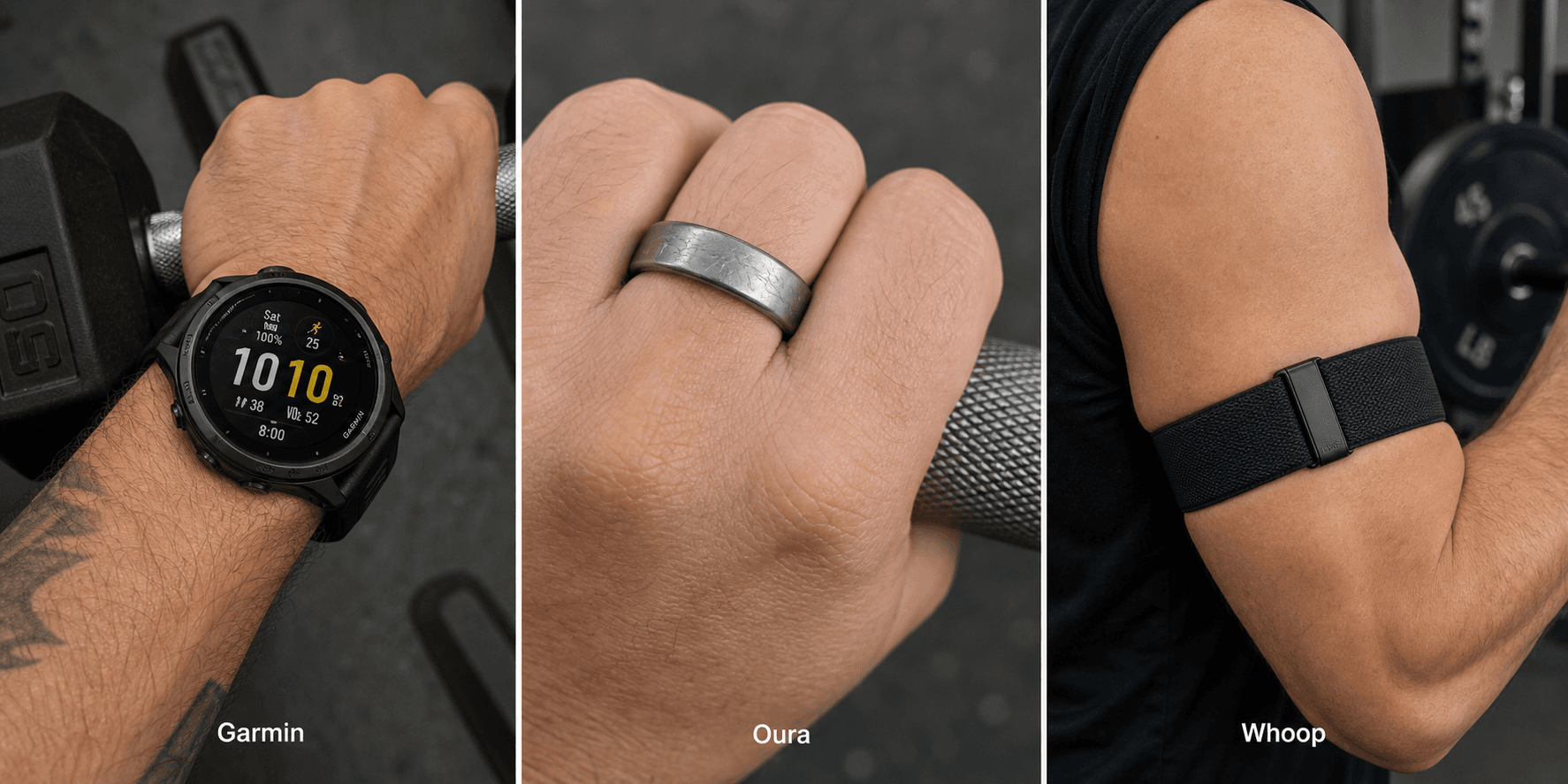
Whoop's subscription runs $199 to $359 per year depending on the tier (Peak at $239 is the mid-range). Battery lasted about 12 days in my testing — close to the marketed 14, though Garage Gym Reviews reported 12 days. The screenless form factor means no distractions during workouts, and it straps comfortably on the bicep or wrist. But here's the thing that made me doubt it: heart rate readings jumped from 140 to 160 bpm just by wiggling the band. That's a problem when you're doing barbell rows or overhead press — the band shifts, and your recovery score may be built on bad data.
Whoop also doesn't track steps — a deliberate choice, but one that can feel incomplete if you want a single device for everything. If you're considering a screenless tracker, read our Screenless Fitness Tracker Buyer's Guide 2026 for a broader view. For now, Whoop works best for athletes who want constant coaching and are willing to pay $478+ over two years.
Oura Ring 4: Sleep Tracking Gold Standard — But Can It Handle a Barbell?
I borrowed an Oura Ring 4 from a friend and wore it for three weeks. The sleep tracking is remarkable — a 2024 study in Sleep Medicine with 96 participants found good accuracy for sleep stages compared to polysomnography, though the study had Oura involvement. Reading the readiness score each morning (85+ means go train, 70-84 take it easy, under 70 recover) is simple and actionable. But as a strength athlete, I ran into real problems.
The titanium ring scratches when you grip a barbell. After a few deadlift sessions, the surface looked like it had been through a rock tumbler. More importantly, Oura offers no real-time feedback during workouts — you can't glance at your heart rate or see a live HRV reading. It's a morning briefing tool, not a training companion. Battery lasts up to 8 days (I got 7), which means you need to charge it roughly weekly. Forget a charge trip and you lose a full night's data — a continuity risk that matters for trends.
For a deeper look at Oura's readiness methodology — including the readiness score thresholds and HRV accuracy — see our dedicated article. The bottom line: Oura is the best fitness tracker for sleep-focused athletes who don't need real-time activity feedback and can tolerate the form factor trade-offs. The 2-year cost ($349 + $6/month = $493) is comparable to Whoop.
Garmin: No Subscription, and Recovery That Works with Training
I've owned a Garmin Forerunner for years, so I'm biased. But the bias comes from experience: Garmin's Training Readiness is the most comprehensive recovery metric I've used, and it's completely free after the one-time watch purchase.
Garmin Training Readiness is calculated from six factors: Sleep Score (0-100), Recovery Time, Acute Training Load, HRV Status (7-day rolling average), Sleep History, and Stress History. That's more factors than Whoop's Recovery score or Oura's Readiness. Importantly, it updates throughout the day — after a hard workout, your readiness drops, then recovers as you rest. It tells you not just whether to rest, but when it's safe to go hard again. Garmin's training readiness methodology is detailed on their technology page.
- Forerunner 265: ~$350 on sale (The Verge) — best value for runners and hybrid athletes
- Forerunner 965: $600 — longer battery (23 days) and mapping
- Venu 3: ~$450 — Body Battery, Sleep Coach with nap detection (Lifehacker)
- Vivoactive 6: ~$300 — 11-day battery, more casual
The key advantage: no subscription. Garmin users keep their devices an average of eight years. A Forerunner 265 at $350 over two years is $350 — period. Over three years, it's still $350. Compare that to Whoop's $717 ($239/yr × 3) or Oura's $565 ($349 + $6/mo × 36). You'd have to replace the Garmin twice to match those costs.
Head-to-Head: Recovery Metrics, Costs, and Form Factors That Actually Matter
| Dimension | Whoop 5.0 | Oura Ring 4 | Garmin (Forerunner 265) |
|---|---|---|---|
| 2-year total cost | $478 (Peak tier) | $493 ($349+$144) | $350 (one-time) |
| Recovery score components | Strain, sleep, HRV, respiratory rate | Sleep, HRV, activity | Sleep Score, Recovery Time, Acute Load, HRV Status, Sleep History, Stress History |
| Real-time HR during lifting | Unreliable — band shift causes 20 bpm jumps | Not available | Accurate for steady-state; watch can bump but stable |
| Battery life (claimed) | 14 days | 8 days | 7–23 days depending on model |
| Form factor issues | Band shifts under wrist; interferes with wraps | Scratches from barbell; no activity screen | Watch face can bump; no ring to scratch |
| Subscription | $199–$359/yr | $6/mo | None |
| GPS | No (tethered) | No | Built-in |
The battery numbers matter more than you think. A device that needs charging every 8 days (Oura) means a single forgotten charge breaks your trend data. Whoop's longer battery helps, but its HR reliability during weightlifting makes me question the strain score when it counts. Garmin's battery range (7–23 days) gives you flexibility — if you use GPS heavily, you'll charge more often, but in smartwatch mode it lasts long enough to never worry.
Can You Have Both? The Oura + Garmin Dual-Wielding Case
The Verge's wearables reporter Victoria Song has recommended dual-wielding an Oura Ring for sleep and a Garmin for training — a setup that, over 3–5 years, costs less than a Whoop alone. Let's do the math: Oura ($493/2yr) + Garmin ($350 one-time) = $843 over two years. Whoop Life tier ($359/yr) = $718, but over three years Oura+Garmin ($843 + $144 extra year = $987) beats Whoop ($1,077). Over five years, the gap widens.
I'm not saying you should buy two devices. But if you're serious about sleep accuracy and want real-time training feedback, this combo gives you the best of both worlds without a recurring subscription that scales with time. You charge two devices, manage two apps — that's the trade-off. For hybrid athletes who train 5–6 days a week with varied sessions, it's a legitimate option worth considering.
The Verdict: Match the Tracker to Your Training Week, Not a Spec Sheet
After all the testing and number crunching, here's my honest take:
- Choose Whoop if you want daily coaching, are willing to pay $200–$359 each year, and don't mind a screenless band that may shift during lifts. It's great for runners and endurance athletes who can keep the band stable.
- Choose Oura if sleep insight is your top priority, you can tolerate a ring that scratches under a barbell, and you don't need real-time data during workouts. It's perfect for morning-readiness-focused athletes who log training separately.
- Choose Garmin if you train multiple disciplines, want recovery context without a subscription, and prefer one device that tracks everything from GPS to HRV. It's the most cost-effective and comprehensive option for home gym athletes who train 3–6 days a week.
I lean toward Garmin for most home gym athletes because it combines reliable recovery metrics with training load and GPS — all without an annual renewal charge. But I respect the dual-wielding path for those who need best-in-class sleep tracking from Oura plus Garmin's training insights. The best fitness tracker for recovery is the one whose cost structure and form factor match your actual training week, not the one with the most features on a spec sheet.
Comments
Join the discussion with an anonymous comment.