
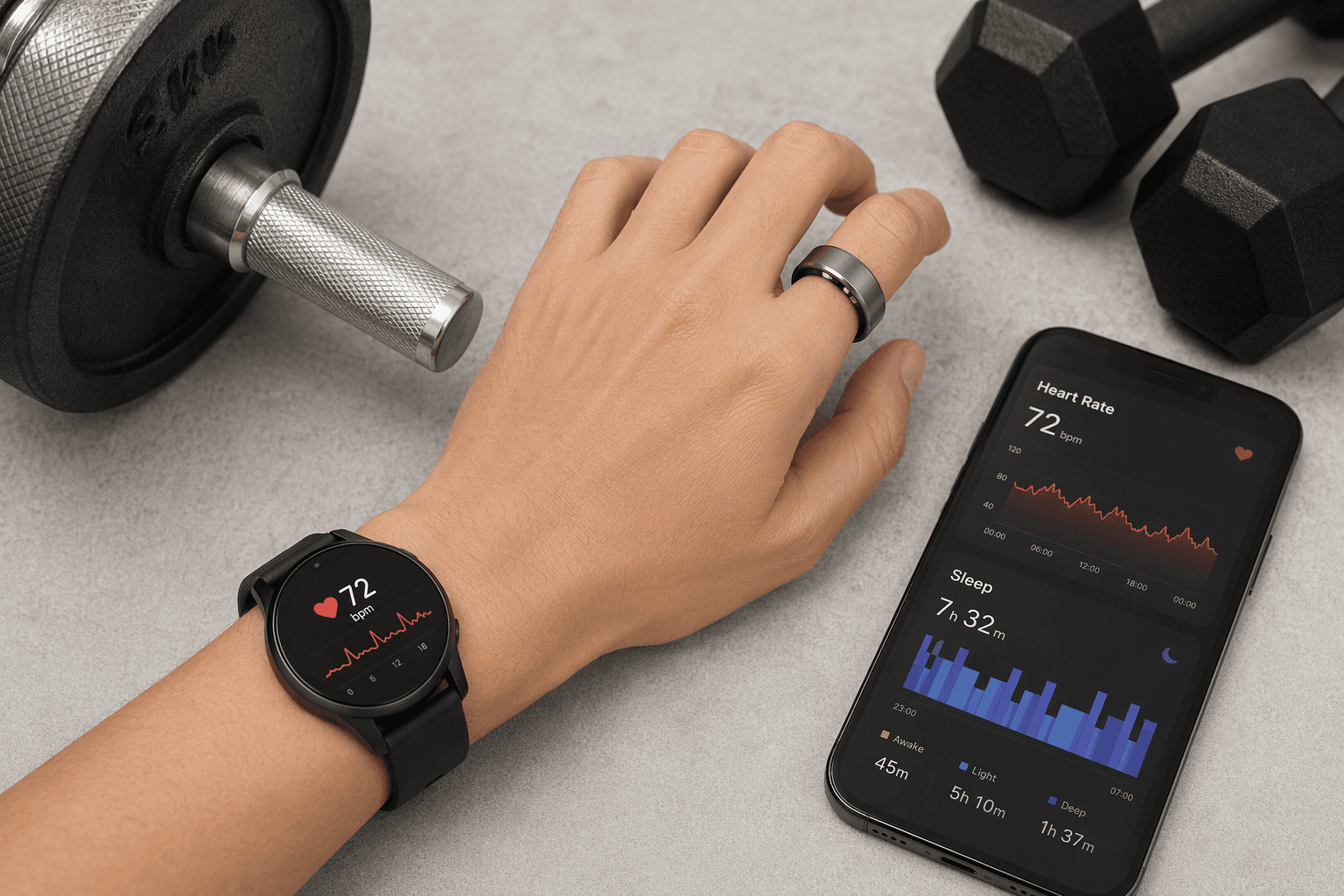
The price tag is the first thing you see — and the least reliable number
You look at the Oura Ring 4: $349. That feels like the cost. Then you add it to your cart and the fine print mentions a monthly fee. Five ninety nine, they say. That does not sound like much.
Over three years, $5.99 a month becomes $215.64. Add the $349 up front and the ring costs $559 total. That is $160 more than a Samsung Galaxy Ring ($399, no subscription), which you might have dismissed as more expensive at first glance.
I have seen this mistake in every roundup that treats subscription cost as a footnote. The up-front price is not the price. Here is how the major rings stack up over 1, 2, and 3 years.
| Ring | Up‑front price | Subscription | 1‑year total | 2‑year total | 3‑year total |
|---|---|---|---|---|---|
| Oura Ring 4 | $349 | $5.99/mo or $69.99/yr | $419 | $489 | $559 |
| Samsung Galaxy Ring | $399 | None | $399 | $399 | $399 |
| RingConn Gen 2 | $299 | None | $299 | $299 | $299 |
| Amazfit Helio Ring | $150 | None | $150 | $150 | $150 |
| Circular Ring 2 | $349 | None | $349 | $349 | $349 |
| Ultrahuman Ring PRO | $349 | None | $349 | $349 | $349 |
Oura calls its subscription a membership. Call it what it is: a monthly fee for data you already generated. The math is straightforward. If you keep the ring for two years, you have already paid more than the Galaxy Ring — and you still do not own the full software.
Without Oura's subscription, your daily dashboard shows three scores: readiness, sleep, and activity. That is it. No detailed sleep stages. No HRV trends. No workout heart rate graphs. No stress score. No resilience baselines. The competitors give you all of that for the purchase price:
- RingConn Gen 2 — full data, no subscription.
- Amazfit Helio — full data, no subscription.
- Ultrahuman Ring PRO — full data, no subscription.
- Circular Ring 2 — full data, no subscription.
- Samsung Galaxy Ring — full data, no subscription (with the caveats we will get to about phone lock-in).
Battery life: claimed vs. real — and why every night matters
Manufacturers advertise maximum battery life with most features turned off. Real-world use — sleep tracking, SpO2, workout logging — cuts those numbers substantially. The result is that a ring with a rated seven days might need charging every third or fourth day.
That matters because a smart ring's primary value is overnight data. If you have to charge it during the night or take it off every other night because the battery is low, you lose sleep consistency. Here is what current rings actually deliver:
| Ring | Claimed (max) | Real‑world (typical) | Charging case |
|---|---|---|---|
| RingConn Gen 2 | 10–12 days | 10–12 days | Yes (150 days total) |
| Amazfit Helio | 4 days | ~4 days | No |
| Oura Ring 4 | 7 days | 5–6 days | No |
| Samsung Galaxy Ring | 7 days | 5–6 days | Yes (charges ~1.5 times) |
| Ultrahuman Ring PRO | 15 days (manufacturer claim) | Unverified | No |
| Circular Ring 2 | 5 days | ~5 days (with ECG off) | No |
RingConn Gen 2 is the outlier. Its charging case doubles as a power bank — you can go weeks without thinking about it. Every other ring below 7 days real-world will force you to develop a charging habit that conflicts with sleep tracking.
Workout accuracy: why your ring won't replace a chest strap
Smart rings are excellent at what they were originally designed for: sleep staging and resting physiology. A 2025 systematic review of 107 studies found 93–96% agreement with clinical polysomnography for sleep staging. The same review found almost no studies examining step or workout accuracy.
The reviews that do exist are single‑reviewer tests — Android Central ran a 5‑workout HR test, Lifehacker did a practical lifting assessment. Both show rings consistently miss heart rate spikes above 140 bpm compared to a chest strap. These are directional, not generalizable, but they are the best data we have. The pattern is consistent enough to treat as a real limitation.
Oura Ring 5 launched in late May 2026. Oura claims improved workout HR tracking, but no independent multi‑subject testing exists yet. I would treat that claim as unverified until someone runs it against a Polar H10.
Ecosystem lock‑in: what actually breaks on the wrong phone
Compatibility is not binary. It is a spectrum, and you need to check your own phone model before buying.
| Ring | iOS support | Android support | Feature loss without matching phone |
|---|---|---|---|
| Samsung Galaxy Ring | No | Yes (Samsung-only AI) | Non‑Samsung Android: no Energy Score, Booster Cards, snore tracking; iOS: not supported at all |
| Oura Ring 4 | Yes | Yes | None (but subscription required for full data) |
| RingConn Gen 2 | Yes | Yes | None |
| Amazfit Helio | Yes | Yes | None |
| Circular Ring 2 | Yes | Yes | None |
| Ultrahuman Ring PRO | Yes | Yes | None |
The Galaxy Ring is the worst offender. If you have a Pixel or a OnePlus, you get basic tracking — step count, sleep duration, heart rate — but not the AI insights that make the ring interesting. If you have an iPhone, it simply does not work. Samsung has said nothing about iOS support.
Oura works on both platforms, but the subscription is effectively a lock‑in of its own: the ring becomes a $349 paperweight without it. The others — RingConn, Amazfit, Circular, Ultrahuman — work fully with both iOS and Android, no strings attached.
Practical constraints that kill long‑term wear
Reviewers often skip the physical reality of wearing a ring 24/7. Here is what you will actually encounter:
- Sizing: Amazfit Helio only comes in sizes 8, 10, and 12. If you are a size 7 or 11, you cannot use it. Oura, RingConn, and Samsung offer full sizing kits. Circular Ring 2 also offers a full range.
- Finger swelling: If you are between sizes, size up. During a workout or in warm weather, fingers expand. A tight ring becomes uncomfortable and can affect sensor readings.
- Grip interference: When you lift barbells, kettlebells, or dumbbells, the ring presses into the metal. Some people take it off. That means you lose workout data during sets.
- Scratch risk: The titanium and ceramic coatings are durable but not indestructible. Against knurled bars or weight plates, every ring will show wear. Consider a protective case or accept the patina.
- Calibration period: Circular Ring 2 requires a 2‑week calibration before its ECG and sleep scores stabilize. You cannot judge it on day one.
So who should buy what?
Your priorities should determine your choice, not the marketing claims. Here is a breakdown by profile.
| Profile | Top priority | Best pick | Runner‑up |
|---|---|---|---|
| Sleep‑first buyer | Accurate sleep staging, long battery, no subscription | RingConn Gen 2 | Oura Ring 4 (if OK with subscription) |
| Fitness‑first buyer | Workout HR, ECG, advanced sensors | Circular Ring 2 (ECG, AFib detection) | Ultrahuman Ring PRO (if battery claims hold) |
| Budget buyer | Lowest total cost | Amazfit Helio (if size fits) or RingConn Gen 2 | — |
| Ecosystem buyer | Tight integration with existing phone | Samsung Galaxy Ring (only if on Samsung phone) | Oura (works with both, but subscription required) |
My overall recommendation for most buyers: a subscription‑free ring with at least seven days of real‑world battery life. That points to RingConn Gen 2 or, if you are in a Galaxy ecosystem and do not mind the lock‑in, the Samsung Galaxy Ring. Workout accuracy should be a secondary consideration unless you are a runner or lifter who needs real‑time data — in which case you should keep a chest strap and treat the ring as your 24/7 passive monitor.
The four trade‑offs in this guide are not separate boxes to check. They interact. A ring with poor battery life will miss sleep data, which defeats the main reason to wear a ring. A ring with a subscription will cost more than you think. A ring locked to one phone brand limits your future options. Understand them all together, and you will end up with a device you actually keep wearing.
Comments
Join the discussion with an anonymous comment.