
The useful question with a Whoop fitness tracker usually shows up before the coffee has finished brewing: the app says green, yellow, or red, and your workout plan says dumbbells, intervals, or a ride. If the score is green, should you push harder than planned? If it is red, should you cancel the workout even though you feel fine?
The best answer is less dramatic than the dashboard makes it feel. Whoop’s recovery score can be a good daily signal for home training intensity, but it works best when it shapes decisions over weeks. It is much weaker when treated as a one-morning verdict on what your body is allowed to do.
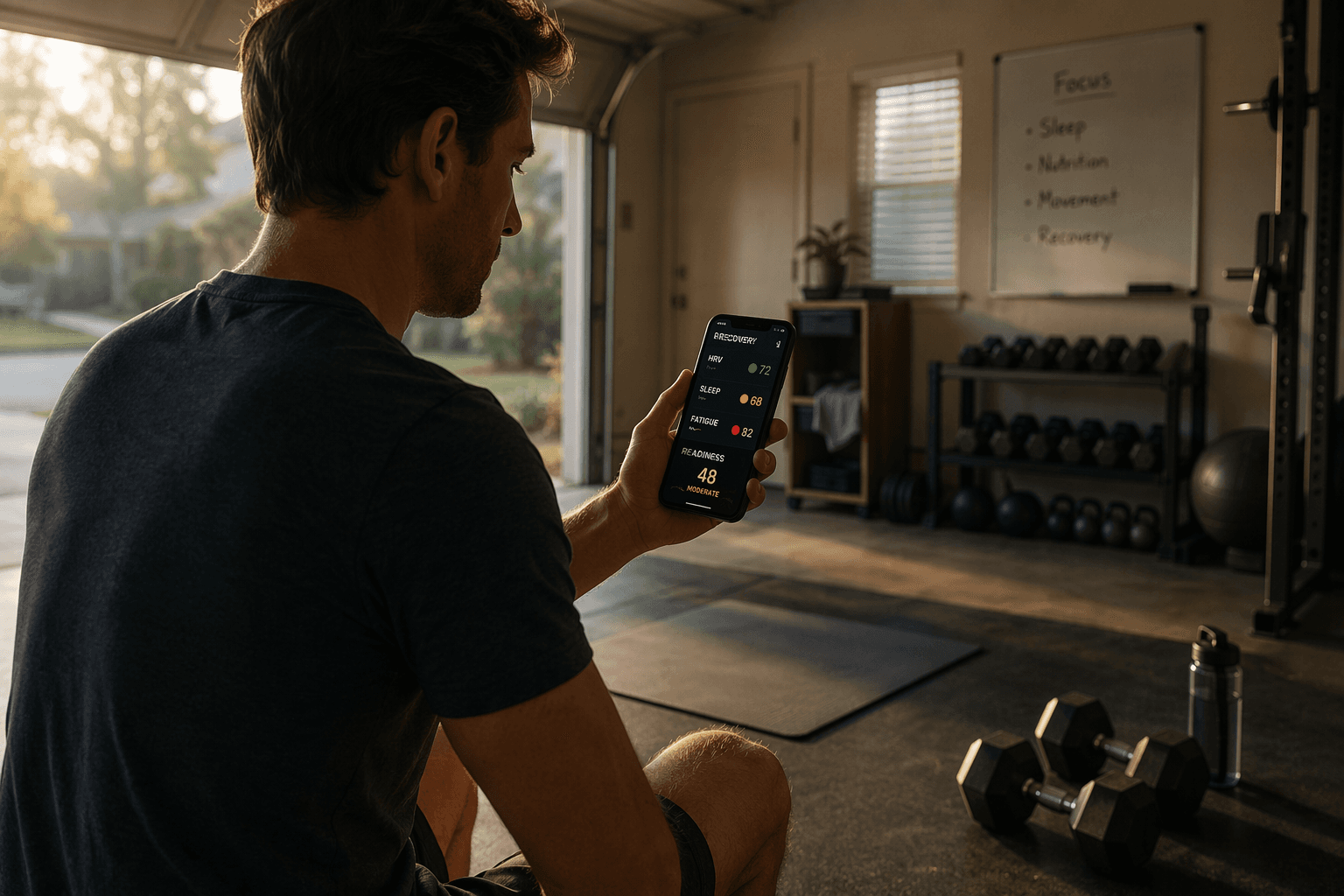
What the recovery score is actually measuring
Whoop’s recovery score is not just an HRV number with a color slapped on top. Whoop says the score is built from four inputs: heart rate variability, resting heart rate, sleep performance, and respiratory rate.[1][2]
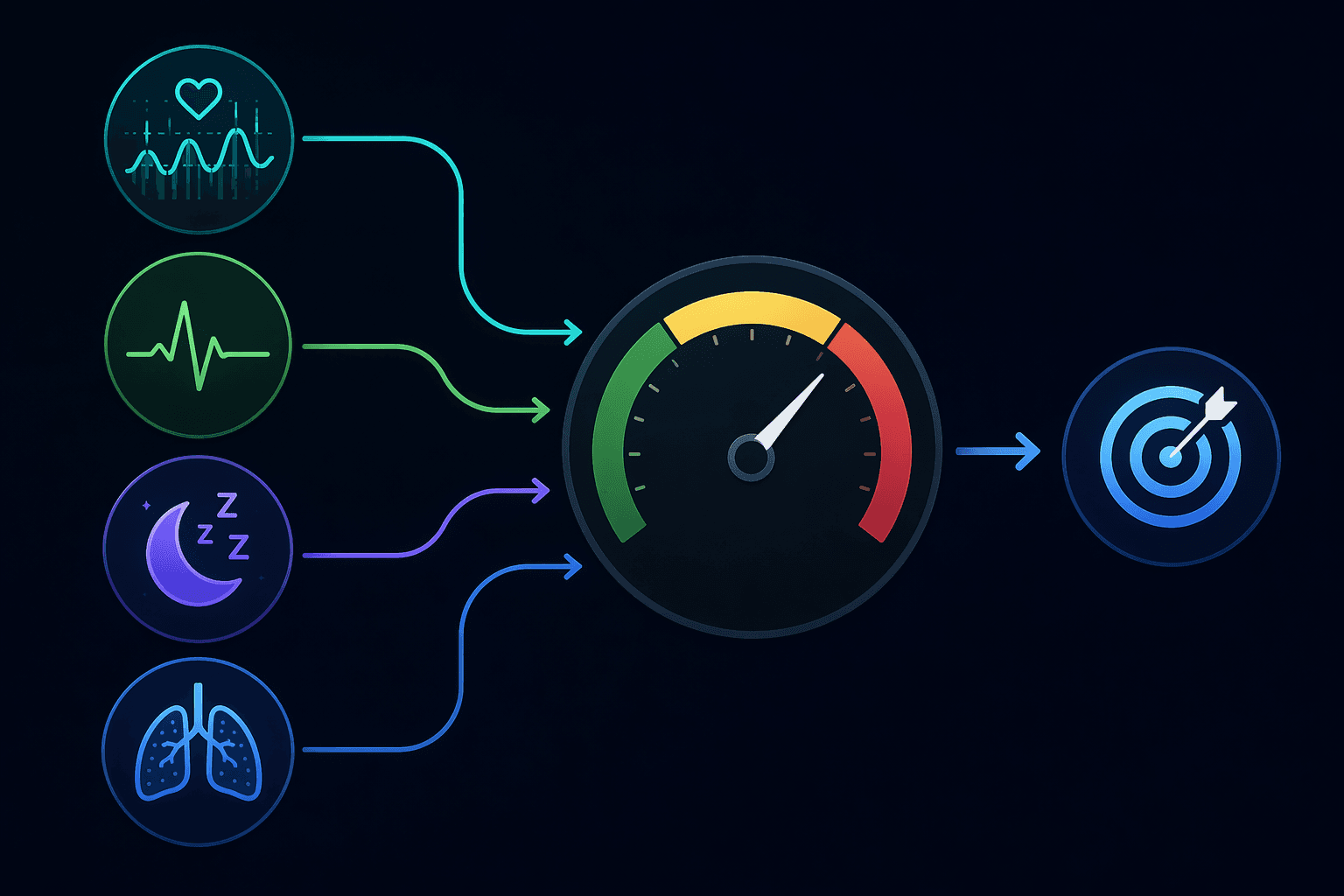
Those inputs matter because they answer different questions. HRV is meant to reflect how your nervous system is responding. Resting heart rate gives another view of physiological strain. Sleep performance compares how much sleep you actually got with how much Whoop estimates you needed. Respiratory rate can help flag changes from your personal baseline. Put together, they create the green-yellow-red recovery score and feed into Whoop’s strain coach, which recommends a daily strain target based on recovery.[1][2]
| Input | How Whoop describes it | What it can mean for a home workout |
|---|---|---|
| HRV | Captured during the last slow-wave sleep cycle | A higher or lower reading than your own baseline can influence whether today looks like a push day or a lower-intensity day |
| Resting heart rate | The lowest 60-second average during sleep | A higher-than-usual overnight resting heart rate may be a reason to avoid turning a normal session into a max-effort one |
| Sleep performance | Actual sleep compared with sleep need | Short sleep may not ban training, but it can make volume and intensity harder to absorb |
| Respiratory rate | Tracked against your baseline | A change can add context when the recovery score looks unusually low or high |
The HRV detail is easy to miss. Whoop does not simply grab a random daytime HRV reading while you are answering email or warming up. Its recovery system uses HRV captured during the last slow-wave sleep cycle, which is meant to reduce noise from movement, stress, food, caffeine, and the thousand small things that happen once the day begins.[1][2]
That does not make the number sacred. It makes it more structured. For a home trainee, the value is that the score is based on overnight physiology rather than how motivated you feel while staring at a kettlebell.
How to read green, yellow, and red without becoming weird about it
Whoop divides recovery into three zones: green at 67% and above, yellow from 34% to 66%, and red from 0% to 33%. Whoop describes green as a better state for high-strain training, yellow as a normal or moderate range, and red as a cue to prioritize recovery, lower strain, or rest.[2]
At home, that can translate cleanly if you use the color as a starting point rather than an order.
- Green: keep the planned hard session, or consider adding intensity if your body also feels ready. This is the day for heavier dumbbell work, harder intervals, or a higher-strain ride if it already fits the week.
- Yellow: treat it as ordinary. Most training days live here. Do the planned session, but avoid turning every moderate day into a test of character.
- Red: lower the ceiling. That might mean mobility, zone 2 cardio, easy cycling, technique work, a walk, or a true rest day.
The mistake is thinking every green day deserves punishment and every red day requires surrender. A green score on the fourth hard day in a row does not magically erase accumulated joint soreness. A red score before a short, easy strength technique session does not automatically mean you should lie motionless until tomorrow.
For someone training in a garage or spare room before work, the useful move is often a small adjustment: reduce the number of hard sets, swap jumps for low-impact conditioning, cap the ride at conversational pace, or stop the session before it turns into a second workout hiding inside the first one.
The strain target is helpful, but your training plan still matters
Whoop’s strain coach uses recovery to suggest a daily strain target.[2] That is one of the cleaner parts of the system because it gives the recovery score somewhere to go. Instead of leaving you with a color and a mood, it connects readiness to a training-load suggestion.
Still, a strain target should sit inside a plan, not replace one. If your week already has two strength days, two cardio days, and one easier recovery day, Whoop can help you decide where to push and where to soften. It should not turn a coherent week into seven disconnected reactions to a morning score.
A practical home setup might look like this: keep the weekly structure stable, then let recovery guide the intensity inside each slot. On a green strength day, work up to the heavier end of your planned range. On a yellow day, stay in the middle. On a red day, use lighter loads, fewer sets, mobility, or an easy cardio replacement. If you are still building the structure itself, a separate guide to building a home cardio week is more useful than letting a recovery score invent the week from scratch.
Sleep debt and the Journal are where Whoop becomes more than a morning color
The recovery score gets the attention, but the more durable value may come from the features that explain why the score keeps moving. Whoop’s sleep debt tracker follows cumulative sleep deficit and recommends bedtimes based on that debt.[1]
That matters because many home exercisers do not need another reminder that they are tired. They need a way to see the cost of repeated almost-enough nights. One six-hour night before a moderate workout may be manageable. Several nights of missed sleep can quietly turn normal training into a recovery problem.
The Journal feature adds a second layer. Whoop lets users tag habits such as caffeine, alcohol, late meals, and supplements, then view correlations with recovery over time.[1] That is more useful than guessing. If late alcohol keeps showing up before red mornings, or late caffeine keeps pairing with weaker sleep performance, the recovery score becomes less of a mysterious judgment and more of a behavior loop.
This is also where consistency matters. If you wear the band, log habits, and adjust sleep or training based on patterns, the system has something to work with. If you check the app occasionally, ignore the Journal, and never change the workout, the recovery score is mostly decoration.
Where the accuracy gets complicated
The strongest independent boundary in the available evidence is a January 2024 medRxiv systematic review, which should be read as preliminary because it is a preprint and had not been peer reviewed. The review found that WHOOP had “acceptable accuracy for sleep and cardiac variables for baseline clinical use,” while also concluding that four-stage sleep identification across N1, N2, N3, and REM “has room for improvement.”[3]
That distinction is important. It is reasonable to use Whoop for baseline sleep and cardiac trend tracking. It is much less reasonable to treat every sleep-stage breakdown as a lab-grade explanation for why your workout felt bad. Total sleep, resting heart rate, HRV trends, and respiratory-rate changes are the sturdier ground. Detailed sleep-stage interpretation is thinner ground.
HRV also moves around naturally. Whoop’s own framing notes day-to-day HRV shifts of 3% to 13% due to factors such as measurement timing and body position.[2] That does not make HRV useless. It means a single dip should not be treated like a diagnosis or a command.
This is the same reason broader fitness tracker accuracy advice usually separates trend-worthy metrics from numbers that look more precise than they are. If you want that wider context, see this metric-by-metric guide to what fitness bands can and cannot measure reliably, or this breakdown of which smartwatch fitness metrics deserve attention.
When the score and your body disagree
The annoying part is that disagreement is not rare enough to ignore. Garage Gym Reviews noted a real-world mismatch in which its founder reported days when he “went all out” despite receiving a low score, and other days when the score looked better than how he felt.[4]
That anecdote does not prove Whoop is unreliable. It proves something more ordinary: wearable recovery scores and perceived readiness are measuring overlapping but not identical things. The band can see overnight patterns. It cannot feel your knee, know that yesterday’s yard work was harder than expected, or understand that poor motivation is coming from work stress rather than training fatigue.
A good operating rule is to require agreement for big decisions. Green plus good body feel can justify pushing intensity. Red plus heavy legs, poor sleep, or elevated soreness is a strong case for pulling back. Mixed signals deserve moderation: warm up, reassess, and choose the version of the workout that leaves room for tomorrow.
A simple way to use Whoop across a home training week
The most useful pattern is not “obey the color.” It is “keep the plan, adjust the dose.”
| Morning signal | If the workout is strength | If the workout is cardio or HIIT |
|---|---|---|
| Green and you feel good | Use the top end of the planned load or set range | Keep intervals or higher-strain work if it belongs in the week |
| Green but you feel beat up | Keep technique crisp and avoid chasing a personal best | Use steady cardio or reduce impact |
| Yellow | Train as planned, usually at moderate effort | Stay within the planned session rather than adding extra intensity |
| Red but symptoms are mild | Reduce sets, load, or range of motion; consider mobility | Choose low-strain cardio, walking, or an easy ride |
| Red and you feel clearly off | Rest or do gentle movement only | Rest, walk, or postpone the hard session |
The table looks almost too simple, but that is the point. Recovery data should reduce the number of reckless decisions, not add another layer of anxiety before a 35-minute workout.
Over several weeks, look for repeat patterns. If red scores cluster after late meals, alcohol, travel, or hard evening sessions, the Journal can help you decide what to change. If yellow days are normal but workouts are progressing, there may be no problem to solve. If green scores keep tempting you to add extra work until soreness piles up, the issue is not the device. It is using permission as pressure.
How Whoop fits among recovery wearables
Whoop’s appeal is partly its restraint: no watch face, no constant screen, and a system built around recovery, strain, sleep, and habits. That makes it different from a general smartwatch and different again from a smart ring. For a broader comparison of how Whoop’s recovery scoring stacks up against other wearables, see our head-to-head on Oura Ring vs. fitness trackers for recovery.
The important thing in 2026 is not to rely on outdated assumptions about old single-tier pricing or older hardware positioning. Whoop’s tier structure changed in late 2025 with the launch of 5.0 and MG hardware, so the recovery score should be evaluated as a training system rather than reduced to an old price-versus-gadget argument.
The durable rule
Whoop’s recovery score is most useful when it becomes a daily signal inside a larger routine. Green can open the door to higher strain. Yellow can keep normal training normal. Red can lower the ceiling and push you toward recovery, mobility, low-impact work, or sleep repair.
The score becomes less useful when one morning number cancels a well-designed plan, overrides obvious body feedback, or turns HRV noise into a personality test. Use the color, sleep debt, Journal correlations, and strain target to watch patterns and adjust intensity. Do not let the dashboard push you into a workout your body is clearly resisting, and do not let one red morning convince you that your training is broken.
References
- How It Works, Whoop.
- WHOOP Recovery Explained, Whoop.
- Accuracy of the WHOOP Strap wearable device for the measurement of sleep and cardiac variables: a systematic review, medRxiv, January 2024.
- Whoop vs Apple Watch, Garage Gym Reviews.



Comments
Join the discussion with an anonymous comment.