
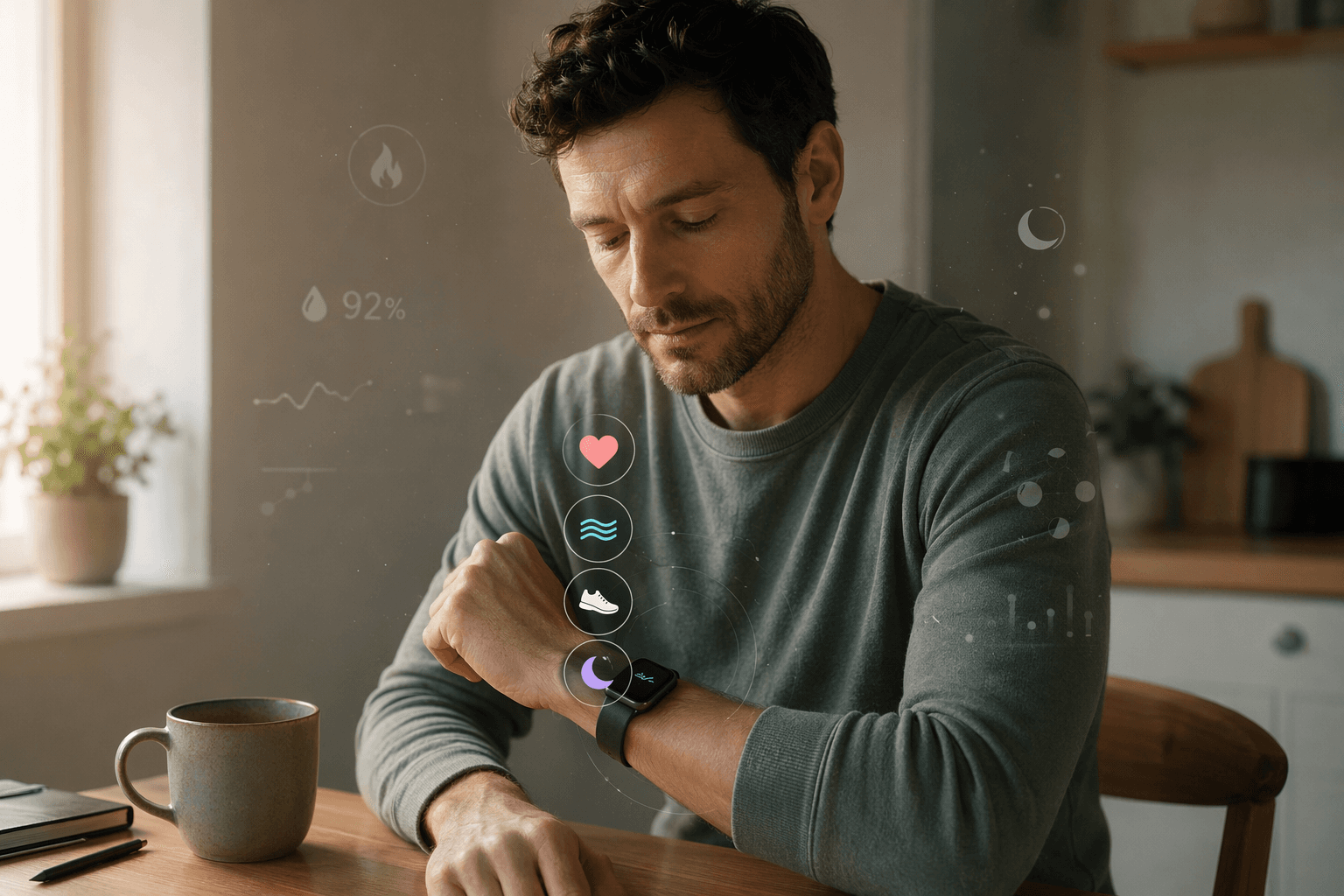
A smartwatch is at its best when it helps you notice a pattern you would have missed: your resting heart rate has been creeping up, your usual step floor disappeared during a stressful week, or your sleep schedule has become chaotic. It is much less useful when it turns one ordinary morning into a referendum on your discipline, recovery, metabolism, or worthiness to train.
For fitness decisions from a smartwatch, the simplest split is this: track metrics that are reasonably repeatable, meaningful against your own baseline, and tied to a safe action. Be suspicious of numbers that look precise but cannot tell you what to do differently.
| Metric | Best Use | Do Not Use It For |
|---|---|---|
| Resting heart rate | Trend over weeks; recovery warning when unusually elevated for several days | Judging one workout from one odd reading |
| HRV | Personal recovery trend compared with your own normal range | Competing with other people’s scores |
| Steps | Daily activity floor and consistency check | Moral score or proof that a workout was good enough |
| Sleep consistency | Schedule, duration patterns, and obvious disruption | Micromanaging nightly sleep-stage percentages |
| Calories burned | Rough activity context | Deciding exactly how much to eat back |
| SpO2 | Possible health-context discussion with a clinician | Self-diagnosing from routine wellness readings |
| VO2 max | Long-term direction of change | Treating the absolute number as a fitness identity |
The Metrics That Earn a Place on Your Morning Screen
Resting heart rate deserves attention because it can move in a direction that actually means something. Over weeks, a lower resting heart rate can reflect improving cardiovascular fitness. A sustained, unexplained increase of 5 or more beats per minute can also be a sign to look at recovery, illness, stress, or sleep before pushing hard again.[1]
The word “sustained” is doing real work there. A single higher reading after a late dinner, poor sleep, alcohol, dehydration, or a stressful evening is not a training plan. The useful question is whether today is part of a pattern: several mornings above your normal range, especially when it lines up with fatigue, soreness, or a scratchy throat.
HRV, or heart rate variability, belongs in the same category, with even more caution. Higher HRV is generally associated with better recovery and stress resilience, but normal HRV is highly individual. Comparing your number with someone else’s is mostly a good way to make yourself anxious. The better use is to learn your own usual range and notice when HRV stays unusually low, particularly when other recovery signals are also off.[1]
Steps are less glamorous, which is probably why they are useful. They do not need to explain your nervous system, sleep architecture, or cellular oxygen use. They tell you whether your day had movement in it. Research cited in Yahoo Health’s expert guide reported that smartwatch users averaged 1,800 more steps and 40 extra minutes of daily movement while wearing a tracker.[2] That is exactly the kind of behavior change most home exercisers can use: not drama, just a higher floor.
Sleep also belongs on the dashboard, but not every sleep number does. Bedtime consistency, wake time consistency, total sleep duration, and obvious disruptions are more useful than debating whether your watch correctly labeled a block as deep sleep. Trackers tend to do better at detecting sleep versus wake than at timing specific stages, so stage percentages deserve less authority than schedule and duration.
The Calorie Number Is the One to Treat Most Carefully
Calorie burn looks practical because it seems to answer a practical question: how much energy did that workout use? The problem is that many people turn it into a second question the watch is not precise enough to answer: how much more can I eat today?
A SAS Life analysis reported that devices over- or underestimate energy expenditure by more than 30% on average across 22 brands and 36 devices. The same discussion noted that individual device error can vary widely, from 3% in controlled lab conditions to more than 90% in real-world conditions.[3] That does not make the number meaningless. It does make it too shaky to use as permission to eat back a precise amount.
This is where a small error becomes a downstream habit. If your watch regularly overestimates energy expenditure and you regularly match meals to that estimate, your nutrition may drift without you noticing. If it underestimates and you use that number to restrict food after harder training, you may stack fatigue on top of fatigue. The watch did not force either choice, but it made the choice feel mathematically justified.
A better use is rough context. A long hike probably took more out of you than a short walk. A hard interval session probably deserves more recovery attention than a gentle mobility session. The exact calorie number should not be the bridge between workout and dinner.
Build a Two-Week Baseline Before You Make Rules
The annoying part of useful smartwatch data is that it gets better when you stop demanding instant meaning from it. Wear the watch consistently for at least two weeks before treating trends as decision support. That does not turn the device into a lab instrument, but it gives you a personal reference point.
- Wear it overnight if you want resting heart rate, HRV, and sleep trends to mean anything.
- Check resting heart rate under similar conditions, ideally in the morning before caffeine or training.
- Look for your normal step range on workdays, weekends, and training days instead of chasing one universal goal.
- Notice your usual sleep window before judging any single short night.
- Write down how you actually feel for a few days; the watch cannot know whether your legs feel heavy walking down the stairs.
A baseline also protects you from the most common mistake: treating the device’s population-based interpretation as more important than your own normal. A low HRV day for one person may be ordinary for another. A 7,000-step day may be active for someone recovering from illness and unusually low for someone who normally walks everywhere.
A Morning Check-In That Leads to an Actual Training Decision
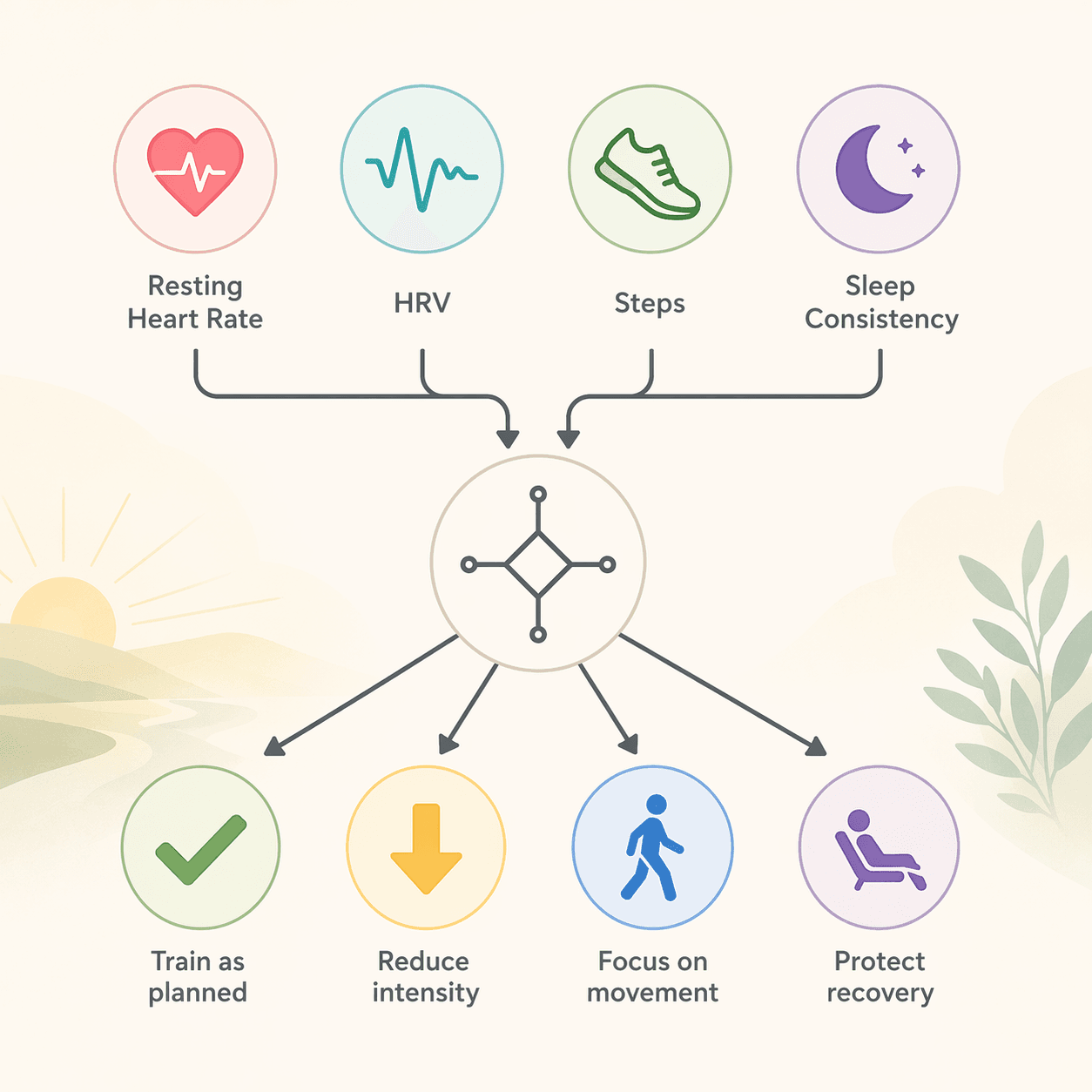
The morning check-in should take less than a minute. If it becomes a 20-minute investigation, the watch has won and your workout has already become more complicated than it needs to be.
| Morning Signal | What to Look For | Training Action |
|---|---|---|
| Resting heart rate | Normal for you | Keep the plan unless your body says otherwise |
| Resting heart rate | Several mornings 5+ bpm above baseline without an obvious reason | Reduce intensity or protect recovery |
| HRV | Within your usual range | Train normally if sleep and energy also look normal |
| HRV | Unusually low for you, especially with poor sleep or high fatigue | Shift hard work to easier movement |
| Steps | You have been far below your usual activity floor | Add walking or light movement before adding more intensity |
| Sleep consistency | Short or irregular for several nights | Choose a shorter, easier session or rest |
The rule is not “obey the lowest score.” It is “change the plan when multiple signals point in the same direction or one signal is strongly and repeatedly abnormal.” That distinction matters. A single low HRV reading with normal resting heart rate, decent sleep, and good energy may not deserve much attention. A low HRV reading plus elevated resting heart rate, poor sleep, and unusual soreness is a different morning.
If the Signals Are Normal, Train as Planned
Normal does not mean perfect. It means your key numbers are close enough to your baseline that the watch has not found a strong reason to interfere. Do the strength session, ride, run, Pilates class, or home circuit you planned. If the warm-up feels unusually bad, you can still adjust. Your body gets a vote too.
If Recovery Looks Slightly Off, Reduce Intensity
This is the option most people underuse. You do not have to turn every yellow flag into a rest day. Keep the appointment with yourself, but remove the part that would be expensive to recover from: max intervals, heavy top sets, high-impact finishers, or a personal-record attempt.
A home workout can become lower stakes quickly. Use lighter weights, stop two or three reps earlier, turn intervals into steady cardio, or make the session shorter. The win is not that you “listened to your watch.” The win is that you trained in a way tomorrow can absorb.
If Movement Has Disappeared, Raise the Floor
A watch can be genuinely helpful here. If your training plan says three workouts a week but your step trend shows long sedentary stretches between them, the missing piece may not be another hard session. It may be daily movement: a walk after lunch, a few short breaks, errands on foot, or an easy spin while watching TV.
This is also where movement reminders earn their keep. They are not sophisticated, but they interrupt the kind of day where you realize at 8 p.m. that your body has mostly moved between chair, kitchen, and couch. Expert guidance cited by Texas Health Resources and Yahoo Health supports starting with simple metrics such as steps, heart rate, and movement reminders before adding more complex interpretation.[1][2]
If Several Signals Are Bad, Protect Recovery
The watch is most useful when it helps you stop negotiating with obvious evidence. If resting heart rate is elevated for several mornings, HRV is unusually low, sleep has been short, and you feel flattened, the brave choice may be boring: walk, stretch, eat normally, hydrate, and go to bed earlier.
That does not mean a device can diagnose illness or decide your medical care. It means a cluster of recovery signals can justify not forcing a hard workout before your body is ready. If unusual symptoms, concerning heart-rate changes, breathing issues, faintness, or persistent fatigue show up, that belongs with a healthcare provider rather than a readiness score.
Sleep Stages, VO2 Max, and SpO2 Need Smaller Jobs
Sleep-stage charts are tempting because they look scientific and specific. The safer habit is to use sleep tracking for patterns you can verify in real life: bedtime drift, short sleep, frequent wake periods, and whether a rough night matches how you feel. Nightly percentages for deep, light, and REM sleep should not decide whether you lift heavy at 7 a.m.
VO2 max is similar. It can be interesting as a long-term fitness trend, especially if the estimate moves in the same direction as your workouts and perceived capacity. It is not a daily readiness metric. Device estimates are also model-specific and affected by the kind of activities the watch can measure well, so the direction over months matters more than the exact number on Tuesday.
Independent testing also shows why device and context matter. A Nature Scientific Reports study that evaluated Garmin Vivoactive 4 and Fitbit Sense devices in 16 healthy young adults provides useful accuracy context, but the sample and devices limit how broadly those findings should be applied.[4] A watch can be good enough for trends without being accurate enough for every claim people attach to it.
SpO2 is another number that should stay in its lane for general wellness users. If you have a medical condition, altitude exposure, sleep-breathing concern, or clinician-directed reason to monitor oxygen saturation, follow medical guidance. If you are generally healthy and checking it because the tile is available, it is rarely the best metric for deciding whether today’s home workout should be harder or easier.
How to Keep the Watch From Running the Workout
The cleanest setup is a small dashboard. Put resting heart rate, HRV trend, steps, and sleep duration or consistency where you can see them. Move calorie burn, sleep stages, SpO2, badges, and novelty scores out of the first screen if they pull you into unhelpful interpretation.
- Use one-day changes as prompts, not commands.
- Look for repeated deviations from your own baseline before changing a plan.
- Require more than one signal before canceling a workout you otherwise feel ready to do.
- Never use calorie burn as an exact nutrition target.
- Give every metric a job; if it cannot lead to a safe, specific action, demote it.
If your current device does not show the metrics you actually want clearly, that is a device-selection problem, not a reason to stare harder at bad data. Recovery-focused wearables, screenless trackers, and traditional smartwatches all make different trade-offs. The right choice depends on whether you care most about workout tracking, sleep and recovery trends, battery life, comfort, or fewer distractions.
The Next Morning
Tomorrow morning, do not open every tile. Check whether resting heart rate is normal for you. Check whether HRV is inside your usual range. Notice whether your step trend has been active or sedentary. Look at sleep duration and schedule before sleep-stage percentages. Then choose one of four actions: train as planned, reduce intensity, focus on movement, or protect recovery.
That is enough. Smartwatch fitness data becomes useful when it reduces decision noise. The watch does not need to grade your morning. It needs to help you make the next reasonable training choice and then get out of the way.
References
- Your Smartwatch, Simplified: The Metrics You Should Track for Better Health, Texas Health Resources
- How to use your smartwatch to reach your fitness goals, Yahoo Health
- Can you trust your smartwatch? A deep dive into calorie burn estimates, SAS Life
- Accuracy of smartwatches for the remote assessment of exercise capacity, Nature Scientific Reports
Comments
Join the discussion with an anonymous comment.