
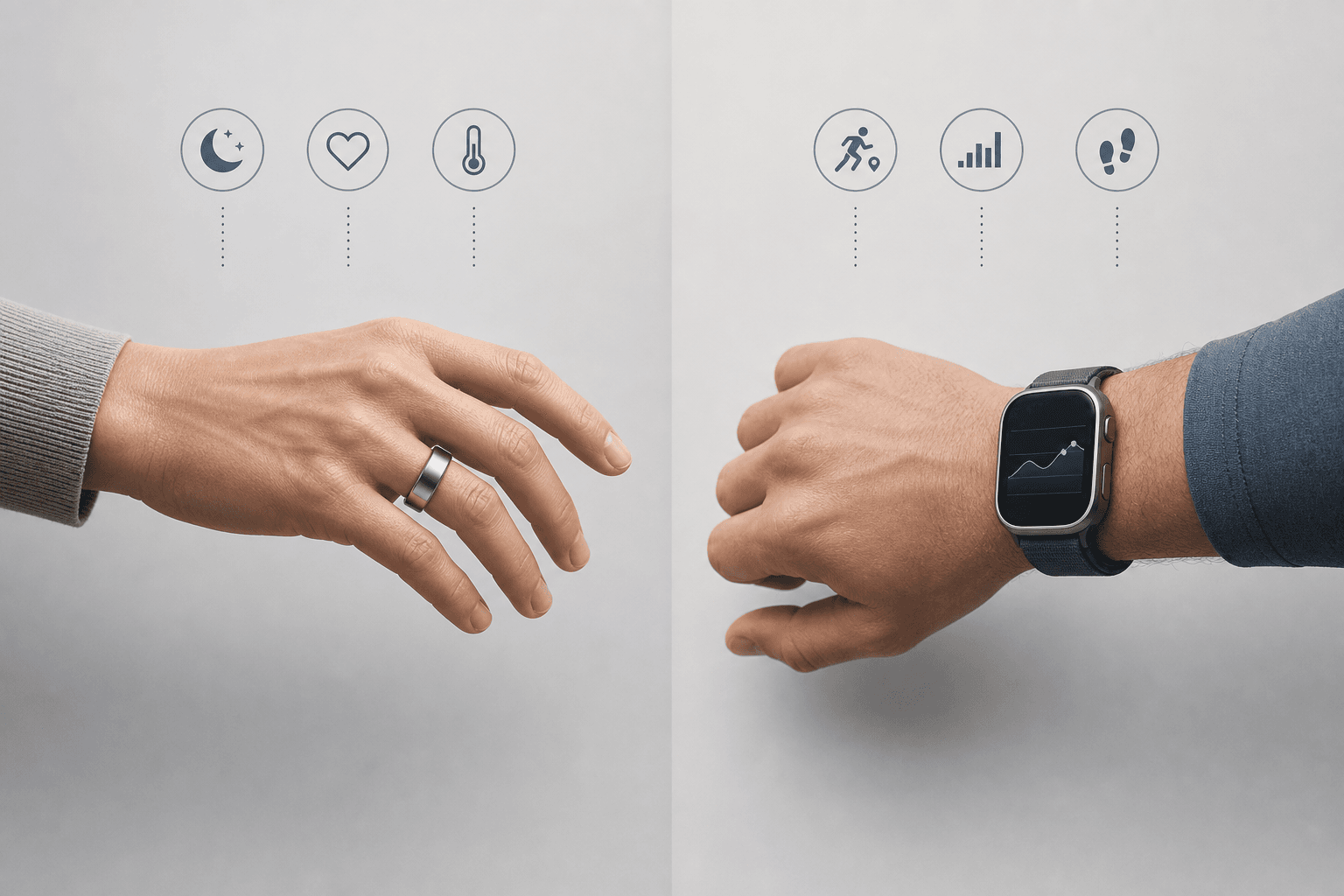
The Smart Ring Promise vs. The Workout Reality
Picture this: you are a regular runner or gym-goer, and you have been wearing a smartwatch for years. You see the sleek, jewelry-like smart ring ads promising 24/7 health tracking without the bulk. The idea is tempting — one small device on your finger that monitors your sleep, heart rate, and recovery, all while looking like a wedding band. Could you finally ditch the wrist computer?
The short answer, based on the test data available as of mid-2026, is no — not if your primary goal is accurate workout tracking. Smart rings are excellent at what they were designed for: passive, round-the-clock health monitoring. But when you ask them to do what a fitness watch does — track heart rate during a sprint interval, map a 10K run with GPS, or count your bench press reps — they fall short in ways that matter to anyone who trains with intent.
This article is not another "best smart ring" roundup. It is an evidence-based evaluation of a specific question: can a fitness tracker ring replace your smartwatch for workouts? We will walk through what rings do well, where they fail, the concrete test data that shows the gap, and — most importantly — the hybrid approach that serious athletes are increasingly adopting.
What Smart Rings Track Well: Recovery and Sleep
Before we get into the workout limitations, it is only fair to acknowledge where smart rings genuinely excel. Their form factor — a small, lightweight ring worn continuously — gives them advantages that wrist-worn devices cannot match for passive monitoring.
- Resting heart rate and heart rate variability (HRV): The finger's dense blood vessel network can produce more stable readings than the wrist at rest, according to a 2022 review in Frontiers in Physiology. Preliminary evidence from a 2023 study in Mayo Clinic Proceedings: Digital Health also suggests rings may produce more accurate PPG readings in darker skin tones compared to wrist-based sensors.
- Sleep stages and duration: A 2024 meta-analysis in Applied Sciences covering 19 studies found that smart rings vary in total sleep time estimates and often underestimate REM duration, but they are generally reliable for tracking sleep trends over time. The Oura Ring, for instance, combines motion, heart rate, body temperature, and respiratory rate for its sleep estimation.
- Body temperature trends: Continuous skin temperature monitoring is a standard feature on most smart rings and provides useful context for detecting illness onset or tracking menstrual cycle phases.
- Readiness and recovery scores: Devices like the Oura Ring 4 and Samsung Galaxy Ring synthesize HRV, sleep, and activity data into a daily readiness score. This is the same kind of metric that made Whoop popular, now available in a ring form factor.
For these passive metrics, rings have a clear practical advantage: they are comfortable enough to wear 24/7, including during sleep, and their battery life (typically 5–8 days for the Oura Ring 4, up to 10–12 days for the RingConn Gen 2) means you are not taking them off to charge every night like you would with most smartwatches.
Where Smart Rings Fail During Workouts
The moment you start moving with intent — running, lifting, cycling, or doing HIIT — the smart ring's limitations become apparent. These are not minor accuracy quibbles; they are fundamental hardware and design constraints that make rings unsuitable as a primary workout tracker.
- Active HR accuracy degrades sharply at elevated intensity. Dr. Bhaskar Semitha, a cardiologist at Fortis Hospital, notes that rings work best at rest and accuracy drops during exercise: "If it shifts even slightly or if the wearer's hands are cold, the readings can be off." A 2021 study in the Journal of Electrical Bioimpedance confirms that motion artifacts can affect accuracy even during mild exercise. The concrete test data below shows just how wide the gap can get.
- No built-in GPS. As of June 2026, no smart ring on the market has its own GPS receiver. This means distance, pace, and route mapping for outdoor runs, rides, or walks depend entirely on your phone being nearby with GPS enabled. If you run without your phone, you get no distance data.
- No gyroscope means no rep counting or stroke detection. Smart rings lack the gyroscopes found in most fitness watches and bands. This makes it impossible for the ring to detect specific movements like weightlifting reps, swimming strokes, or even distinguish between walking and running with the same reliability as a wrist-based accelerometer.
- Real-time data is phone-dependent. A smart ring has no screen. You cannot glance at your wrist to check your pace, heart rate zone, or elapsed time during a workout. You must pull out your phone and open the companion app, which is impractical during most training sessions.
- Durability concerns with weightlifting. Multiple testers across WIRED, Wareable, and CNET report needing to remove their smart rings when lifting weights. The rings scratch against barbells, dumbbells, and kettlebells. WIRED notes that "ring protectors can help," and Wareable states they "always suggest taking it off when doing activities like lifting weights, because it will get scratched."
HR Accuracy Test Data: Rings vs. Smartwatches
The most concrete evidence of the ring-vs-watch gap comes from a 5-workout test conducted by Android Central, comparing the Amazfit Helio Ring, Oura Ring 4, RingConn Gen 2, Garmin Venu 3, and Pixel Watch 3 across one run and four gym workouts. The results are striking.
| Device | Avg HR (High-Intensity Workout) | Max HR | Key Limitation |
|---|---|---|---|
| Garmin Venu 3 (watch) | 151 bpm | 186 bpm | Baseline reference |
| Oura Ring 4 | 95 bpm | 109 bpm | 60-70 bpm gap vs. Garmin at high intensity |
| RingConn Gen 2 | 88 bpm | Not reported | Severely underestimated HR |
| Samsung Galaxy Ring (Spartan Race) | Under 150 bpm | Not reported | Pixel Watch 2 avg ~170 bpm; OnePlus Watch 2 avg ~169 bpm |
| Ultrahuman Ring Air (track workout) | 182 bpm | Not reported | Overestimated HR; Garmin read 168 bpm avg |
| Amazfit Helio Ring | Within 4 bpm of Garmin | Not reported | Closest to watch accuracy, but limited to 3 sizes and 4-day battery |
Comments
Join the discussion with an anonymous comment.