
The Green Number That Lied to Me
Your Oura Ring says 82. Green light. Go hard, right? You slept eight hours, your resting heart rate is low, and the Readiness Score is smiling at you. So you load up the barbell, push through your planned session, and by the third set you feel flat. The weights feel heavier than last week. Your breathing is off. You finish because the number told you to, but your body was signaling something else.
I have been there. Training alone, without a coach, you learn to trust the dashboard because there is no one else to tell you when to pull back. The problem is that the single 0–100 Readiness Score is the most seductive and the most misleading number Oura gives you. It synthesizes seven different signals into one neat figure, and our brains love neat figures. But the aggregate can lie.
The hardware earns trust. A fully independent study from 2025 — published in Physiological Reports, funded by the Air Force Research Laboratory, no competing interests — tested Oura Ring Gen3 and Gen4 against ECG reference monitors across over 500 nights. For heart rate variability (HRV), the concordance correlation coefficient hit 0.99. For resting heart rate, 0.98. That is lab-grade accuracy in a ring you wear to bed. So the raw data is solid. The problem is what the algorithm does with it.
That 82 may look cheerful, but if your HRV balance is trending below your long-term average and your body temperature is elevated, the score is smoothing over a conflict. You need to see the conflict to make the right call. As one coach wrote, most people overreact to a bad score and underreact to a good one. I would add: most people trust a single number because it feels objective. But the objective raw data can produce a misleading average when the components disagree.
What That 82 Is Really Made Of
Oura groups the seven contributors into three pillars: sleep, activity, and body stress. Here is what each measures and why it matters for your training decision.
| Pillar | Contributor | What It Measures | Key Detail |
|---|---|---|---|
| Sleep | Sleep | Total sleep time, efficiency, timing, and consistency against your personal target | Single-night snapshot |
| Sleep | Sleep Balance | How your recent sleep quality compares to your 14-day average | 14-day weighted average – lags behind a single bad night |
| Activity | Previous Day Activity | Calories burned, steps, and movement volume from yesterday | Direct effect – high activity yesterday lowers today’s score |
| Activity | Activity Balance | How your recent activity load compares to your 14-day baseline | 14-day weighted average – slow to reflect a recent cutback in training |
| Body Stress | Resting Heart Rate | Night-time low heart rate; a rising trend signals incomplete recovery or illness | Tracks well with HRV trends |
| Body Stress | HRV Balance | Recent HRV compared to long-term average; a drop after high intensity is normal, a persistent decline signals poor recovery | CCC 0.99 validated – the most reliable signal for training readiness |
| Body Stress | Body Temperature | Night-time skin temperature deviation from your norm | Early illness signal – can spike before symptoms appear |
| Body Stress | Recovery Index | A proprietary composite of RHR, HRV, and temperature trends | Not individually adjustable – treat as a secondary check |
The Sleep Balance and Activity Balance are based on 14-day weighted averages, not single-night snapshots. That means if you just returned from a trip or cut training volume this week, those contributors may still be dragging the score down from last week's tiredness. Conversely, they can make the score look good when you have actually been overreaching for three days but the baseline has shifted upward. The 14-day lag is the single most common reason the aggregate score misleads.
Body Temperature deserves special attention. Oura says a significant deviation from your normal range will lower the score, often as an early illness signal. Runner's World reported that Oura's Symptom Radar predicted illness before symptoms appeared on two separate occasions during their test. If your temperature contributor is off and the rest of the score is green, do not ignore it.
Why 72 Is Not Just 72
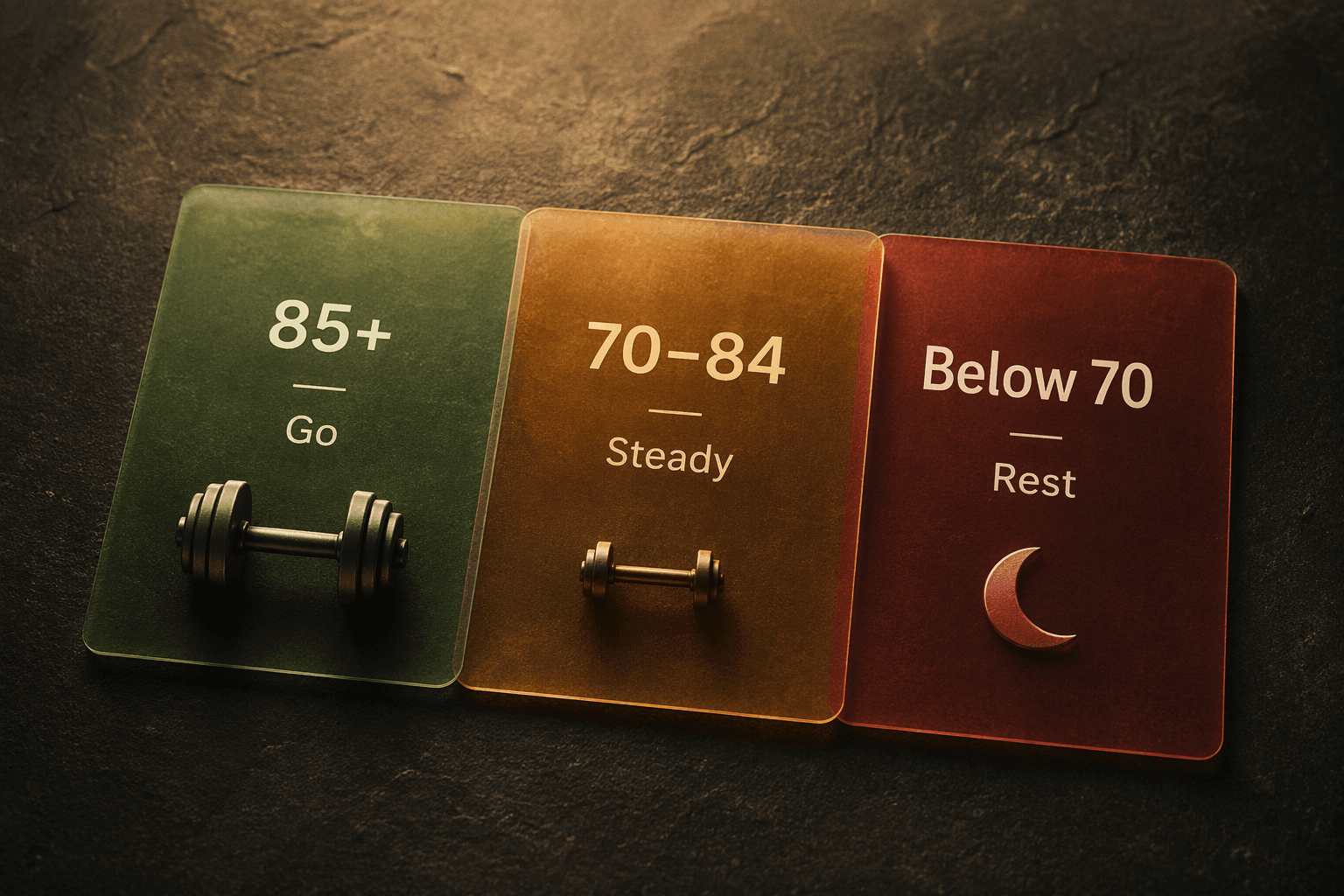
Oura's official thresholds are simple: 85+ is optimal, 70–84 is good, below 70 means pay attention. That is a reasonable starting framework, but the home gym athlete needs more nuance. A score of 72 with low HRV balance and a high body temperature is not the same as a 72 with strong sleep balance and a flat activity trend. The first says rest; the second says maintain. The aggregate number cannot tell you which is which.
Third-party sources like Livity propose a four-zone breakdown that adds a "compromised" band: 85–100 optimal, 70–84 good, 60–69 compromised, below 60 poor. That extra band matters because it gives you a middle ground between "train as planned" and "mandatory rest." I find this framework more useful for daily decisions — it leaves room for a lower-intensity swap day without the psychological weight of a "bad" score.
| Zone | Oura Threshold | Refined Threshold (Livity) | What It Means for Your Home Workout |
|---|---|---|---|
| Optimal | 85+ | 85–100 | Push high-intensity work. Heavy squat day, sprints, or a tough HIIT session. Your body is ready. |
| Good | 70–84 | 70–84 | Maintain current load. Execute your planned session as written. Do not add extra volume. |
| Compromised | N/A | 60–69 | Swap for lower intensity. Aerobic zone work, lighter dumbbells, or a mobility day. Not a rest day, but no max effort. |
| Poor | < 70 | < 60 | Take a full recovery day. Stretching, walking, or nothing. The score says your body is still processing stress. |
When the Score Says Go but Your Body Says No
This is where the article earns its keep. The aggregate score is a summary. The contributors are the actual data. When they disagree, the contributors win. Here are the three most common conflict patterns I see, and the rule for each.
- High readiness (85+) + low HRV balance. The 14-day weighted average for Sleep Balance and Activity Balance can keep the score elevated while your nervous system is still strained. HRV is the most sensitive marker of acute recovery state. If HRV balance is trending below your baseline, treat the score as overstated. Maintain or swap for lower intensity, even if the green light says push.
- High readiness + elevated body temperature. Body temperature deviation is often the first sign of infection. The score may not yet reflect it if other components are strong. Trust the temperature signal. Take a rest day or reduce to light activity. This is the one pattern where I ignore the aggregate completely.
- Low readiness + good sleep balance + low HRV. If you slept well but your HRV is tanked, look for external factors: a late heavy meal, alcohol, travel, or menstrual cycle shifts. These suppress the score without indicating true training stress. Do not automatically take a rest day — consider whether the cause is manageable and the score will rebound tomorrow. Livity notes that travel across time zones can disrupt Oura's algorithms for two to three days.
The rule I use: lean toward the contributor that deviates most from its own baseline. If HRV balance is 10 points below your personal average but the overall score is 80, the HRV signal is more informative than the average. The 14-day lag also means that if Activity Balance is low but you know you have been training light recently, the number is misleading. You can safely ignore that contributor until your baseline re-anchors.
What to Do When a Contributor Is Off
Once you know which contributor is dragging your score down, you can act on it. These are not exhaustive — just high-impact actions that work for a home gym athlete with limited time.
- Sleep Balance: prioritize consistency over total hours. Going to bed within the same 30-minute window stabilizes the 14-day average faster than one long sleep on the weekend.
- HRV Balance: the best lever is a consistent sleep schedule and stress management. Avoid food two hours before bed — late heavy meals elevate nighttime heart rate and suppress HRV. Alcohol destroys HRV overnight; a single drink can lower next-day HRV by 10–20 points.
- Body Temperature: hydrate well and keep your sleeping environment cool (65–68°F). If the contributor rises despite good sleep, suspect illness and rest.
- Activity Balance: if you have been training harder than usual, the 14-day average will catch up. Do not cut volume drastically — just reduce intensity for a couple of days until the balance indicator normalizes.
The Livity article lists common failure modes that keep your score artificially low. Avoid late heavy meals, alcohol, and erratic sleep around travel. If you track your menstrual cycle, expect HRV to drop and RHR to rise during the luteal phase — that is normal, and the score does not need to be overridden.
Five Times I Ignore the Number
There are days when the Readiness Score is noise. Not because the algorithm is bad, but because the assumptions behind it do not apply. Here are the situations where I stop looking at the number entirely.
- Travel across time zones. Oura's algorithms expect your circadian rhythm to be stable. Crossing two or more time zones scrambles HRV, RHR, and sleep data for two to three days. The score during that period is not actionable. Train by feel and do not stress about a red score.
- Alcohol. Even one drink can drop HRV by 10–20 points and raise RHR. If you had a glass of wine with dinner, the next morning's score will reflect that — but it does not mean your training stress is higher. Ignore the score, train as planned, and let the data reset the next day.
- Late heavy meals. Eating within two hours of bed elevates heart rate and disrupts temperature. The score will dip, but it is a transient artifact, not a recovery signal.
- Menstrual cycle. During the luteal phase, HRV naturally drops and RHR rises. Oura accounts for this in the long-term baseline, but individual scores on certain days may be lower than expected. Do not let the score push you into a rest day if you feel fine.
- Early illness. Body temperature deviates before symptoms appear. If that contributor is elevated and the overall score is still green, trust the temperature. The one case where you should override a high score with a caution.
A final caveat: Oura Ring 5 was released in June 2026. It has redesigned 12-pathway sensors, but no independent peer-reviewed validation exists yet. The accuracy data cited here — the CCC 0.99 for HRV — comes from studies using Gen3 and Gen4. The new hardware may perform differently. If you are comparing Oura with other screenless trackers before buying, see our Screenless Fitness Tracker Buyer's Guide 2026 for a comparison by budget and use case. For a deeper dive into the science behind the Readiness Score, read How Oura Ring Tracks Recovery: Readiness Score, HRV Accuracy, and What the Science Says.
The Readiness Score is a tool, not a verdict. When the components agree, it gives you confidence. When they clash, the components tell the real story. The home gym athlete without a coach needs that skill more than the number. Learn to read the room inside the ring, and you will make better decisions than any dashboard can hand you.
Comments
Join the discussion with an anonymous comment.